The ESAT gender gap, module by module: what the data actually shows
Men outscore women in every ESAT module, by between 0.25 and 0.57 of a band. That much matches most quantitative admissions tests.
The surprise is where the gap is biggest. It is not in Physics, the most male-dominated module. It is in Chemistry and Biology, the two modules where women are best represented. That pattern is worth understanding properly, because it points away from the explanations most people reach for first.
All figures are from the UAT-UK ESAT Technical Report 2025/26.
How big is the gender gap in each module?
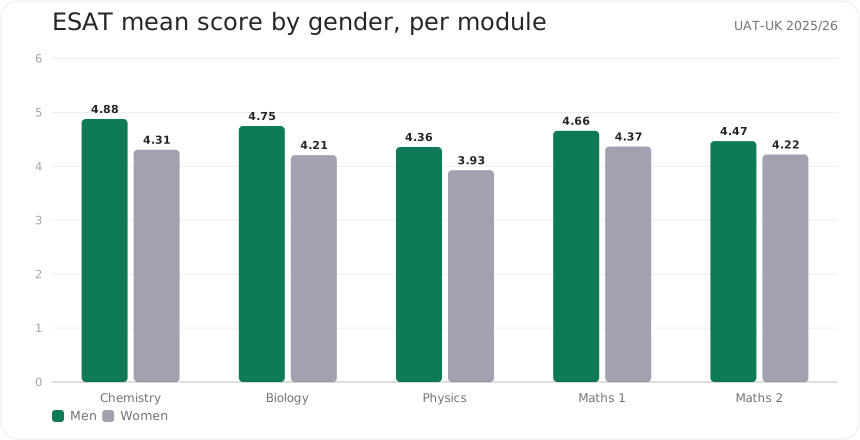
| Module | Men | Women | Men average | Women average | Gap |
|---|---|---|---|---|---|
| Chemistry | 1,595 (51%) | 1,507 (48%) | 4.88 | 4.31 | 0.57 |
| Biology | 585 (38%) | 929 (60%) | 4.75 | 4.21 | 0.54 |
| Physics | 8,450 (75%) | 2,705 (24%) | 4.36 | 3.93 | 0.43 |
| Maths 1 | 9,820 (69%) | 4,195 (30%) | 4.66 | 4.37 | 0.29 |
| Maths 2 | 8,874 (73%) | 3,100 (26%) | 4.47 | 4.22 | 0.25 |
Read the composition column and the gap column together, because the pattern inverts what you would expect.
Physics is 75 percent male with a gap of 0.43. Maths 2 is 73 percent male with a gap of 0.25. Biology is 60 percent female with a gap of 0.54. The more male-dominated the module, the smaller the gap tends to be.
Why is the gap biggest in the modules women dominate?
Biology is the clearest puzzle. At A-level, biology is one of the sciences where female participation and attainment are strongest, and women are the majority of ESAT Biology candidates at 60 percent. Yet the score gap there is the second largest in the test.
UAT-UK present the data without proposing a cause, and it would be wrong to invent one. But a few explanations can be ruled out with confidence.
It is not the questions. UAT-UK check every question for bias between candidates of equal ability, and the 2025/26 checks came back essentially clean: no significant gender bias at all in Maths 1, one flagged item in Biology, and two flagged items in Chemistry across all the comparisons they run. One question out of a full paper cannot produce a gap of half a band.
It is not the scale. Biology is anchored the same way as every module, with the typical (median) October candidate at 4.5 and the 90th percentile at 7.0, using its own candidates.
It is not small numbers. If a gap were a quirk of a small sample, you would expect it where one gender is scarcest, which is Physics. That is the opposite of where the biggest gaps are.
What is left is who chooses to sit each module, and here we are giving you our reading rather than UAT-UK's. In a heavily male-dominated module like Physics, the women who enter are a strongly self-selected group: they have chosen a subject where they are a small minority, which usually means they are confident and well prepared, and that compresses the gap. In a female-majority module like Biology, there is much less of that filter. The women sitting ESAT Biology are closer to a representative slice of Biology applicants generally, so the group includes more candidates who are less specifically prepared for this test.
If that is right, the gap is a statement about who enters each module, not about ability. It also predicts exactly what the table shows: the gap shrinking as the module gets more male-dominated.
Are ESAT questions biased against women?
Since this is the question people reasonably ask, here is what the checking actually involves.
UAT-UK run what is called differential item functioning analysis on every question. In plain terms: they compare men and women of equal measured ability and check whether either group finds a particular question harder than that ability predicts. It is built to catch a question that is really testing something other than the science.
In 2025/26, Maths 1 showed no significant gender bias on any question. In Biology, one item was flagged, item 731190, favouring men. Flagged items are reviewed to establish whether the stated answer is wrong or the question is flawed, and the findings feed back into how questions are written.
That is a clean result. Whatever is producing the score gaps, it is not the paper.
What does a group average mean for you?
Almost nothing, and this is not a consolation line. It is what the numbers say.
These are group averages over thousands of candidates, with individual scores spread widely around them. The distributions for men and women overlap almost entirely: there are women at 8.0 and men at 2.0 in every module. A difference of 0.54 between two group averages tells you nothing about where any individual will land.
What the selection reading does suggest is practical. If ESAT Biology and Chemistry candidates arrive, on average, less specifically prepared for this test than Physics candidates do, then the gap is a preparation gap, and preparation gaps close. Biology is also the module where scores bounce around most from paper to paper, as the full score distributions show, so a single practice result there means less than anywhere else.
The answer to both is the same: consistent timed practice, 27 questions in 40 minutes, tracked over several papers rather than judged on one. Every ESAT past paper is here with worked solutions, free to start.
Where these numbers come from
The gender breakdowns and the question-level bias results are published in the UAT-UK ESAT Technical Report 2025/26 at uat.ac.uk, which also sets out the checking method in full. The selection explanation offered above is our interpretation, not UAT-UK's.
Frequently asked questions
Is there a gender gap in ESAT scores?
Yes, in every module. It ranges from 0.25 of a band in Maths 2 to 0.57 in Chemistry, with men scoring higher in all five.
Which ESAT module has the biggest gender gap?
Chemistry, at 0.57 of a band, closely followed by Biology at 0.54. Both are modules where women make up a large share of the candidates.
Are ESAT questions biased against women?
UAT-UK check every question for bias between candidates of equal ability. In 2025/26, Maths 1 showed no significant gender bias at all and one Biology item was flagged. A single question cannot produce a gap of half a band.
What proportion of ESAT candidates are women?
About 30 percent in Maths 1. It varies widely by module, from 24 percent in Physics to 60 percent in Biology.