Engineering Admissions Assessment 2016 is one of the closest available past papers for the Engineering and Science Admissions Test. Below, all 54 questions are mapped to the ESAT topics they test, each with its answer and a worked solution that shows every step. Sit it cold under exam timing, then work back through anything you missed using the solutions.
What this paper covers on the ESAT
Every question mapped to the Engineering and Science Admissions Test specification, so you know exactly which areas it tests.
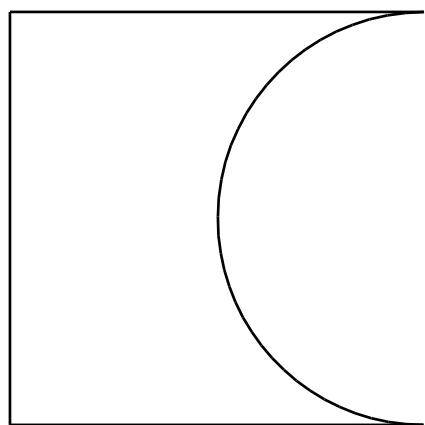
A square piece of metal has a semicircular piece cut out of it as shown. The area of the remaining metal is 100 cm².
[diagram not to scale] Which one of the following is a correct expression for the length of the side of the square in centimetres?
A.208−π2
B.104−π2
C.208+π2
D.108−π1
E.204−π1
Answer: A
Worked solution
Let the side length of the square be s. The radius of the semicircle is r=s/2. The area of the remaining metal is the area of the square minus the area of the semicircle. Area=s2−21πr2100=s2−21π(2s)2100=s2−8πs2100=s2(1−8π)100=s2(88−π)s2=8−π800s=8−π800s=8−π400×2s=208−π2
Question 2
1 mark
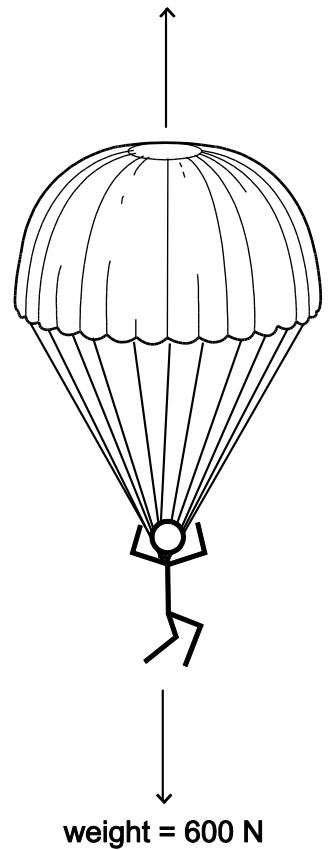
Shortly after opening her parachute, a free-fall parachutist of mass 60 kg (including equipment) experiences the forces shown in the diagram. drag (air resistance) = 900 N weight = 600 N
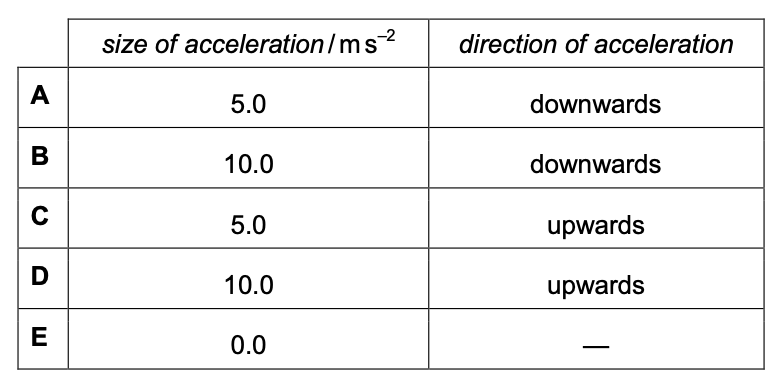
[diagram not to scale] Which line in the table gives the size and direction of the acceleration of the parachutist at this instant?
A.size of acceleration/ms⁻²: 5.0, direction of acceleration: downwards
B.size of acceleration/ms⁻²: 10.0, direction of acceleration: downwards
C.size of acceleration/ms⁻²: 5.0, direction of acceleration: upwards
D.size of acceleration/ms⁻²: 10.0, direction of acceleration: upwards
E.size of acceleration/ms⁻²: 0.0, direction of acceleration: —
Answer: C
Worked solution
The resultant force (Fnet) is the difference between the upward drag and the downward weight. Fnet=900N−600N=300N The result is positive, so the net force is directed upwards. According to Newton's second law, F=ma. The mass (m) is 60kg. 300=60×aa=60300a=5ms−2 The acceleration is in the same direction as the resultant force. Therefore, the acceleration is 5.0ms−2 upwards.
Question 3
1 mark
In a right-angled triangle PQR the hypotenuse is the side PR. The length of side PQ is 20 cm and the ratio RQ:PQ is 1:2 What is the length of the perpendicular from the hypotenuse to the point Q?
A.85 cm
B.102 cm
C.25 cm
D.52 cm
E.45 cm
Answer: E
Worked solution
Given a right-angled triangle PQR with hypotenuse PR, we have: - PQ=20 cm - RQ:PQ=1:2⟹RQ=21×20=10 cm First, we find the length of the hypotenuse PR using Pythagoras' theorem: PR2=PQ2+RQ2 PR2=202+102=400+100=500 PR=500=105 cm Let h be the perpendicular distance from point Q to the hypotenuse. The area of the triangle can be calculated in two ways. We equate them to find h: Area=21×base×height 21×RQ×PQ=21×PR×h 21×10×20=21×105×h 100=55⋅h h=55100=520 h=5205=45 cm
Question 4
1 mark
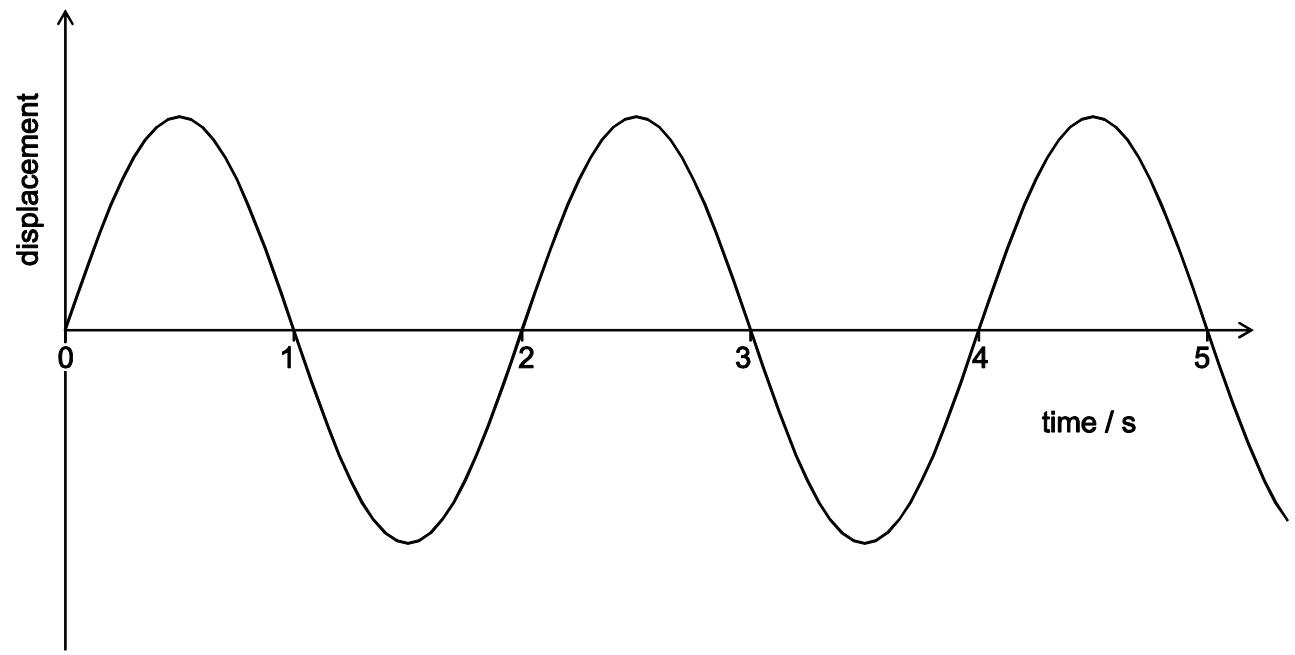
The displacement/time graph shown represents a wave of wavelength 1.5 cm.
What is the speed of the wave?
A.0.33 cm s−1
B.0.67 cm s−1
C.0.75 cm s−1
D.1.33 cm s−1
E.1.5 cm s−1
F.3.0 cm s−1
Answer: C
Worked solution
The relationship between wave speed (c), frequency (f), and wavelength (λ) is given by the formula: c=fλ From the displacement-time graph, the period (T), the time for one full wave cycle, is 2 seconds. The frequency is the reciprocal of the period: f=T1=21Hz The wavelength is given as λ=1.5cm. Substituting these values into the wave speed equation: c=21×1.5=0.75cm s−1
Question 5
1 mark
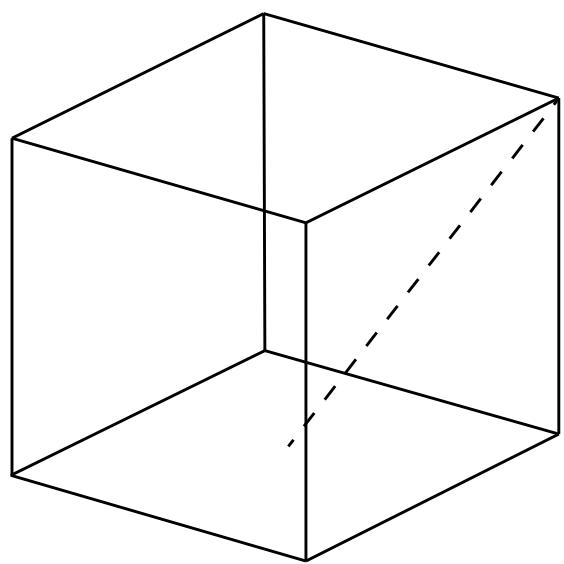
A cube has sides of unit length. What is the length of a line joining a vertex to the midpoint of one of the opposite faces (the dashed line in the diagram below)?
[diagram not to scale]
A.23
B.2
C.25
D.3
E.5
Answer: A
Worked solution
The cube has sides of unit length. We can solve this by forming a right-angled triangle in 3D. - One leg is a vertical edge of the cube, with length 1. - The other leg is the line from a vertex on the base to the center of the base. First, find the length of the diagonal of the square base: Diagonalbase=12+12=2 The distance from a vertex to the center of the base is half of the diagonal’s length: Leg2=22=21 Let the required length be x. Using Pythagoras’ Theorem on our 3D triangle: x2=12+(21)2=1+21=23 x=23
Question 6
1 mark
A point mass travelling at a constant speed has a momentum of 30 N s and a kinetic energy of 150 J. What is the mass of the object?
A.2 kg
B.3 kg
C.5 kg
D.6 kg
E.10 kg
F.15 kg
Answer: B
Worked solution
The momentum (p) and kinetic energy (Ek) are given by the equations: p=mv=30 Ek=21mv2=150 From the kinetic energy equation, we can write: mv2=2×150=300 Now, we can find the velocity (v) by dividing: mvmv2=30300 v=10 m/s Substitute the value of v back into the momentum equation to find the mass (m): m×10=30 m=1030 m=3 kg
Question 7
1 mark
If you look at a clock and the time is 9.45, what is the angle between the hour and the minute hands?
A.0∘
B.7.5∘
C.15∘
D.22.5∘
E.30∘
Answer: D
Worked solution
At the time 9:45, the minute hand points exactly at the '9' on the clock face. The hour hand moves continuously. In 12 hours, it moves 360∘. A time of 45 minutes is equivalent to 6045=43 of an hour. Therefore, at 9:45, the hour hand has moved 43 of the way from the '9' towards the '10'. The angle between any two consecutive hour marks is 12360∘=30∘. The angle between the minute hand (at '9') and the hour hand is the angle the hour hand has moved past the '9'. Angle=43×30∘=490∘=22.5∘
Question 8
1 mark
Which of the following is a correct unit of potential difference (voltage)?
A.amp per ohm
B.coulomb per joule
C.joule per second
D.newton per coulomb
E.watt per amp
Answer: E
Worked solution
We check the units derived from fundamental electrical equations for each option to find the correct unit for potential difference (voltage, V). A) From Ohm’s Law, V=IR. Units: Volts = Amps × Ohms. Option ’amp per ohm’ (A/Ω) is incorrect. B) From Work/Energy, W=QV, so V=QW. Units: Volts = Joules per Coulomb (J/C). Option ’coulomb per joule’ (C/J) is incorrect. C) From Power, P=tE. Units: Watts = Joules per second (J/s). This defines the Watt, not the Volt. D) From Electric Field Strength, E=qF. Units: N/C. This is the unit for electric field strength, not potential difference. Incorrect. E) From Electrical Power, P=IV, so V=IP. Units: Volts = Watts per Ampere (W/A). This is correct.
Question 9
1 mark
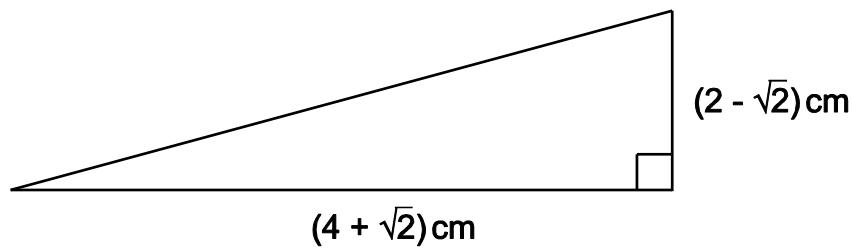
The right-angled triangle shown has horizontal and vertical sides measuring (4+2) cm and (2−2) cm respectively.
[diagram not to scale] Calculate the area of the triangle.
A.(5+32)cm2
B.(3−2)cm2
C.(3+32)cm2
D.(5−2)cm2
Answer: B
Worked solution
The area of a right-angled triangle is found using the formula: Area=21×base×height Substitute the given lengths of the base and height: Area=21(4+2)(2−2) Expand the brackets (using FOIL): Area=21(4×2−42+22−22)Area=21(8−42+22−2) Combine the constant terms and the square root terms: Area=21(6−22) Distribute the 21 to get the final answer: Area=3−2
Question 10
1 mark
Two radioactive sources X and Y have half-lives of 4.8 hours and 8.0 hours respectively. Both decay directly to form only stable isotopes. The activity of a sample of the source X is 320 Bq, and the activity of a sample of the source Y is 480 Bq. The two samples are now combined. What is the activity of the combination of X and Y 24 hours later? (An activity of 1 Bq is 1 decay per second.)
A.25 Bq
B.50 Bq
C.55 Bq
D.70 Bq
E.100 Bq
F.140 Bq
Answer: D
Worked solution
Calculate the number of half-lives that occur for each source in 24 hours. Source X: - Number of half-lives: nX=4.8 hours24 hours=5 - Final activity: AX=2nXA0,X=25320=32320=10 Bq Source Y: - Number of half-lives: nY=8.0 hours24 hours=3 - Final activity: AY=2nYA0,Y=23480=8480=60 Bq Total Activity: The total activity is the sum of the individual final activities. Atotal=AX+AY=10 Bq+60 Bq=70 Bq
Question 11
1 mark
A solid sphere of radius r fits inside a hollow cylinder. The cylinder has the same internal diameter and length as the diameter of the sphere. The volume of a sphere is 34πr3, where r is the radius of the sphere. What fraction of the space inside the cylinder is taken up by the sphere?
A.41
B.31
C.21
D.32
E.43
Answer: D
Worked solution
The volume of the sphere is given as: Vsphere=34πr3 A cylinder that fits the sphere has an internal radius equal to the sphere's radius, r, and a height, h, equal to the sphere's diameter, 2r. The volume of the cylinder is calculated as: Vcylinder=π×(radius)2×(height)=πr2h=πr2(2r)=2πr3 The fraction of the cylinder's volume taken up by the sphere is the ratio of their volumes: Fraction=VcylinderVsphere=2πr334πr3=234=32
Question 12
1 mark
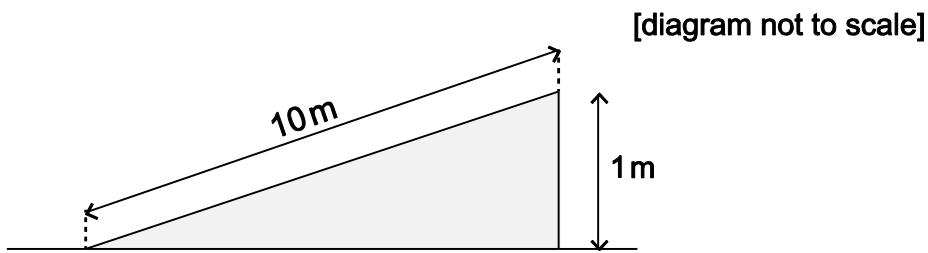
A cyclist and a bike have a combined mass of 100 kg. The cyclist free-wheels (rolls without pedalling) at a constant speed of 0.80ms−1 down a slope where the cyclist descends 1.0 m for each 10 m travelled along the road, as shown in the diagram.
[diagram not to scale] Calculate the loss in gravitational potential energy as the cyclist loses 100 m in vertical height and hence calculate the total resistive force on the cyclist and bike. (gravitational field strength = 10Nkg−1)
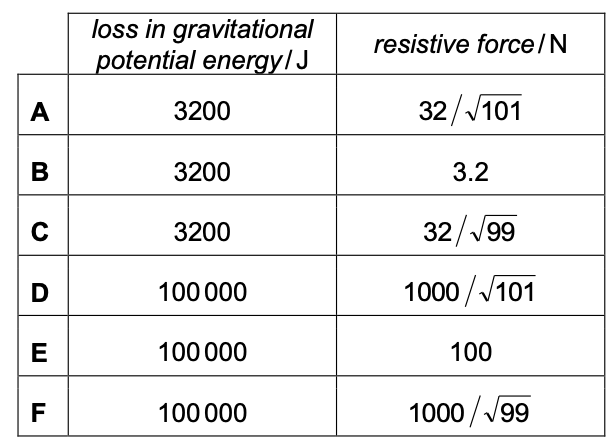
A.loss in gravitational potential energy/J: 3200, resistive force/N: 32/101
B.loss in gravitational potential energy/J: 3200, resistive force/N: 3.2
C.loss in gravitational potential energy/J: 3200, resistive force/N: 32/99
D.loss in gravitational potential energy/J: 100 000, resistive force/N: 1000/101
E.loss in gravitational potential energy/J: 100 000, resistive force/N: 100
F.loss in gravitational potential energy/J: 100 000, resistive force/N: 1000/99
Answer: E
Worked solution
First, we calculate the loss in gravitational potential energy (GPE) for a vertical height drop of h=100m. GPEloss=mgh=(100kg)×(10Nkg−1)×(100m)=100,000J The cyclist travels at a constant speed, so there is no change in kinetic energy. This means the GPE lost equals the work done against resistive forces. Work Done by resistive force=GPEloss=100,000J From the problem, for every 1m of vertical descent, the cyclist travels 10m along the road. For a 100m descent, the distance travelled, d, is: d=100×10m=1000m The resistive force, F, can now be found: Work Done=F×d100,000J=F×1000mF=1000100,000N=100N
Question 13
1 mark
Which of the expressions below has the largest value for 0<x<1?
A.x1
B.x2
C.(1+x)1
D.x1
E.x
Answer: A
Worked solution
To find which expression is largest for 0<x<1, we can substitute a test value from this interval. Let’s choose x=21. We evaluate each expression: A: x1=1/21=2 B: x2=(21)2=41 C: 1+x1=1+211=231=32 D: x1=1/21=2 E: x=21=21 Comparing the results: 2 is the largest value. This corresponds to expression A.
Question 14
1 mark
A ball is thrown vertically upwards and leaves the thrower's hand with a speed of 12ms−1. You may assume that all of the initial kinetic energy of the ball has been converted into gravitational potential energy when the ball reaches its highest point. What is the height above the thrower's hand to which it rises? (gravitational field strength = 10Nkg−1)
A.7.2 m
B.14.4 m
C.24 m
D.60 m
E.120 m
Answer: A
Worked solution
By the principle of conservation of energy, the initial kinetic energy (KE) of the ball is converted into gravitational potential energy (GPE) at its highest point. KEinitial=GPEfinal21mv2=mgh The mass m cancels out, so we can solve for the height h: h=2gv2 We are given the initial speed v=12ms−1 and the gravitational field strength g=10Nkg−1. h=2×10122h=20144h=7.2m
Question 15
1 mark
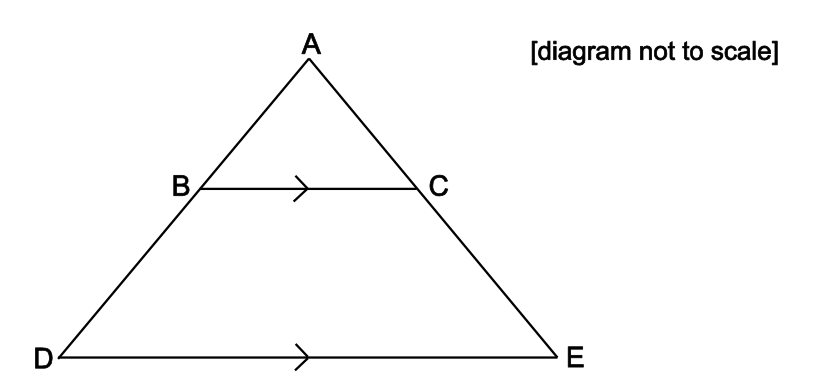
A shape is formed by drawing a triangle ABC inside the triangle ADE. BC is parallel to DE. AB = 4 cm, BC = x cm, DE = x + 3 cm, DB = x - 4 cm
[diagram not to scale] Calculate the length of DE.
A.5 cm
B.7 cm
C.9 cm
D.4+27 cm
E.7+27 cm
Answer: C
Worked solution
Triangles ABC and ADE are similar because BC is parallel to DE. The ratio of their corresponding sides is equal. BCDE=ABAD The length of side AD is the sum of AB and DB: AD=AB+DB=4+(x−4)=x Substitute the given values into the ratio equation: xx+3=4x Now, we solve the resulting quadratic equation for x: 4(x+3)=x24x+12=x2x2−4x−12=0(x−6)(x+2)=0 Since length must be a positive value, x=6. We calculate the length of DE: DE=x+3=6+3=9cm
Question 16
1 mark
A lorry of mass m, and travelling initially at speed v along a horizontal road, is brought to rest by an average horizontal braking force F in time t. Ignoring any other resistive forces, what distance is travelled by the lorry during this time? (gravitational field strength = 10Nkg−1)
A.mgF
B.Fmgv
C.2Fmv2
D.2gv2
E.vt
F.2vt
Answer: C
Worked solution
According to the work-energy principle, the work done by the braking force is equal to the change in the lorry's kinetic energy. Since the lorry comes to rest, its final kinetic energy is zero. The work done by the force, W, is equal to the initial kinetic energy, KEi. W=KEiForce×Distance=21mv2 Substituting the variables F for Force and d for Distance: F×d=21mv2 To find the distance travelled, we rearrange the equation to solve for d: d=2Fmv2
Question 17
1 mark
Two variables are connected by the relation: P∝Q21. Q is increased by 40%. To the nearest percent, describe the change in P in percentage terms.
A.29% decrease
B.44% decrease
C.49% decrease
D.51% decrease
E.80% decrease
F.96% decrease
Answer: C
Worked solution
The relationship is given by P∝Q21, so we can write P=Q2k. Let the initial values be P1 and Q1. An increase in Q by 40% means the new value, Q2, is 1.4×Q1. The new value for P, denoted P2, is: P2=Q22k=(1.4Q1)2k=1.96Q12k Since P1=Q12k, we can substitute to find P2 in terms of P1: P2=1.961P1 The fractional change in P is: P1P2−P1=P11.961P1−P1=1.961−1=1.961−1.96=−1.960.96 To find the percentage decrease: 1.960.96×100%=19696×100%=4924×100% Approximating the value: 4924≈5024=0.48⟹48% Since the denominator is slightly smaller, the result is slightly larger than 48\%. 4924≈0.4897...≈49%
Question 18
1 mark
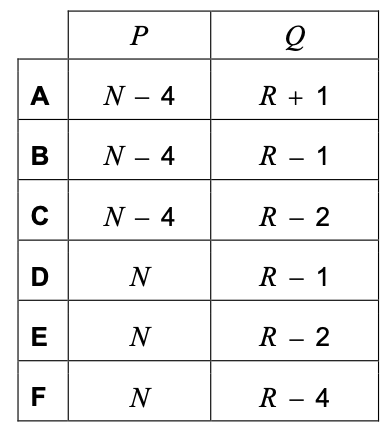
Nuclide RNX is an unstable isotope which decays in two stages into nuclide Z as shown: $_R^N X → _{R-1}^P Y → _Q^F Z What are the values of P and Q? (Consider only alpha and beta decays.)
A.P: N-4, Q: R+1
B.P: N-4, Q: R-1
C.P: N-4, Q: R-2
D.P: N, Q: R-1
E.P: N, Q: R-2
F.P: N, Q: R-4
Answer: B
Worked solution
The decay process is: RNX→R−2PY→QPZ \subsection*{Step 1: X→Y} The atomic number (subscript) decreases by 2 (from R to R−2). This indicates an alpha decay, which involves the emission of a 24He particle. In an alpha decay, the mass number (superscript) decreases by 4. P=N−4 \subsection*{Step 2: Y→Z} The mass number P remains constant. This indicates a beta decay, where a neutron becomes a proton, and an electron (−10e) is emitted. In a beta decay, the atomic number increases by 1. The atomic number of nuclide Y is R−2. Q=(R−2)+1=R−1
Question 19
1 mark
Three variables x, y and z are known to be related to each other in the following ways: x is directly proportional to the square of z. y is inversely proportional to the cube of z. Which of the following correctly describes the relationship between x and y?
A.The square of x is directly proportional to the cube of y.
B.The square of x is inversely proportional to the cube of y.
C.The cube of x is directly proportional to the square of y.
D.The cube of x is inversely proportional to the square of y.
E.x is directly proportional to y6.
Answer: D
Worked solution
The given proportionalities are: x∝z2y∝z31 We can express a term proportional to z from each relation. From the first relation: x∝z From the second relation: z3∝y1⟹z∝3y1 Now, we can equate the two expressions that are proportional to z: x∝3y1 To express this relationship with integer powers, we raise both sides to the power of 6, which is the lowest common multiple of the root indices (2 and 3). (x)6∝(3y1)6x(1/2)×6∝y(1/3)×61x3∝y21 This means the cube of x is inversely proportional to the square of y.
Question 20
1 mark
A pulse of frequency 100 kHz is emitted from an ultrasound scanner, and is reflected from a foetus 10 cm below the transmitter placed on the mother's abdomen. The speed of sound within the mother's body is 500ms−1. How long after its emission from the scanner does it take for the pulse to reach the receiver which is adjacent to the transmitter?
A.0.20 ms
B.0.40 ms
C.0.50 ms
D.0.80 ms
E.1.0 ms
Answer: B
Worked solution
The ultrasound pulse travels to the foetus and is reflected back. The total distance is therefore twice the distance to the foetus. Total distance (d)=2×10cm=20cm=0.2m The speed of the pulse is given. Speed (v)=500ms−1 The time taken for the round trip is calculated as: Time (t)=speeddistance=500ms−10.2m=50002s=0.0004s Converting to milliseconds (ms): 0.0004s×1000=0.4ms
Question 21
1 mark
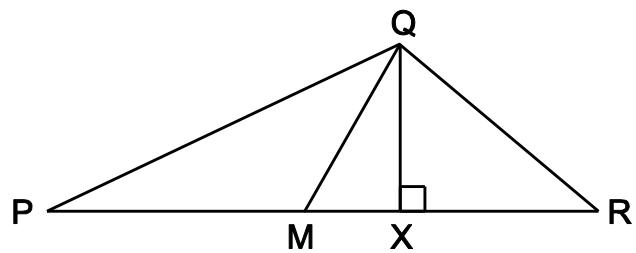
In the triangle PQR shown below:
[diagram not to scale] X lies on PR ∠QXR is 90∘ PXQX=61 XRQX=32 M is the midpoint of PR. What is MXQX?
A.91
B.125
C.94
D.21
E.65
Answer: C
Worked solution
To find the ratio, we can set a reference length. Let QX=1. From the given ratios, we can determine the lengths of PX and XR: PXQX=61⟹PX=6×1=6XRQX=32⟹XR=23×1=23 The total length of the base PR is: PR=PX+XR=6+23=215M is the midpoint of PR. The distance from P to M is: PM=2PR=215/2=415 The distance MX is the difference between PX and PM: MX=PX−PM=6−415=424−15=49 The required ratio is: MXQX=9/41=94
Question 22
1 mark
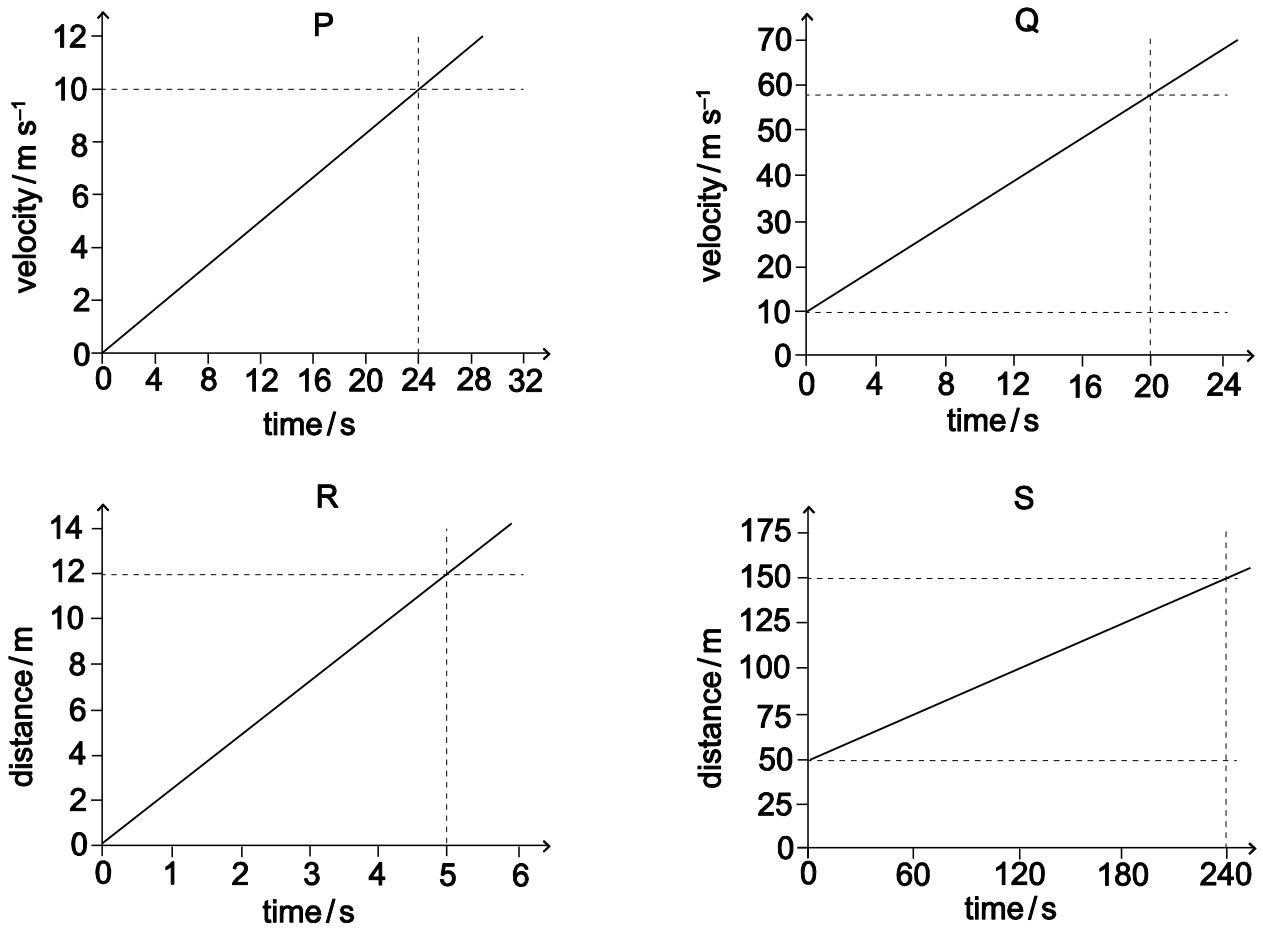
The diagrams below show either velocity-time or distance-time graphs for four different objects, P, Q, R and S.
Which graph(s) show an object accelerating at 2.4ms−2?
A.P only
B.Q only
C.R only
D.S only
E.P and Q only
F.Q and R only
G.P and S only
Answer: B
Worked solution
Acceleration is the gradient of a velocity-time graph. A straight line on a distance-time graph indicates constant velocity, hence zero acceleration. Graphs R and S (Distance-Time): - These graphs show constant velocity (straight line), meaning acceleration is 0. Graph P (Velocity-Time): - The gradient represents acceleration. a=ΔtΔv=24 s10 m/s=2.4 ms−2 Graph Q (Velocity-Time): - The gradient represents acceleration. a=ΔtΔv=20 s48 m/s=2.4 ms−2 Only graph Q shows an object accelerating at 2.4 ms−2.
Question 23
1 mark
Solve the inequality x2≥8−2x
A.x≥4
B.x≤2 and x≥−4
C.x≥−2 and x≤4
D.x≥2 or x≤−4
Answer: D
Worked solution
To solve the inequality, first rearrange it into the standard quadratic form with zero on one side. x2≥8−2xx2+2x−8≥0 Next, factorise the quadratic expression. (x+4)(x−2)≥0 For the product to be non-negative, either both terms are non-negative, or both are non-positive. Case 1: Both terms are non-negative. (x+4)≥0 and (x−2)≥0⟹x≥2 Case 2: Both terms are non-positive. (x+4)≤0 and (x−2)≤0⟹x≤−4 Combining these two cases, the solution is x≥2 or x≤−4.
Question 24
1 mark
Which one of the following statements about nuclear physics is true?
A.The process of emission of a gamma ray from a nucleus is called nuclear fission.
B.The half-life of a radioactive substance is half the time taken for its nuclei to decay.
C.The number of neutrons in a nucleus is its atomic number (proton number) minus its mass number.
D.When a nucleus emits a beta particle, there is no change in the number of particles it contains.
E.When a nucleus emits an alpha particle, one of its neutrons becomes a proton plus an electron.
Answer: D
Worked solution
We can determine the correct statement by a process of elimination, analysing the definitions of key concepts in nuclear physics. A: This is incorrect. The emission of a gamma ray is a de-excitation process where a nucleus loses energy. Nuclear fission is the splitting of a heavy nucleus into two or more lighter nuclei. B: This is incorrect. The half-life is the time it takes for half of the radioactive nuclei in a sample to undergo decay. C: This is incorrect. The number of neutrons is the mass number (A) minus the atomic number (Z). The statement reverses this relationship. E: This is incorrect. This statement describes beta decay (n→p+e−+νˉe). Alpha decay is the emission of an alpha particle (a helium nucleus). D: This is correct. In beta decay, a neutron converts into a proton or vice-versa. This changes the neutron and proton numbers individually, but the total number of nucleons (the mass number) remains constant.
Question 25
1 mark
The total surface area of a cylinder, measured in square centimetres, is numerically the same as its volume, measured in cubic centimetres. The radius of the cylinder is r cm, the height is h cm. Express h in terms of r.
A.h=r−22r
B.h=r+22r
C.h=r+2
D.h=r−2
E.h=2r(r−2)
Answer: A
Worked solution
The total surface area of a cylinder is the sum of the area of the two circular ends and the curved side. A=2πr2+2πrh The volume of a cylinder is given by: V=πr2h The question states that the surface area and volume are numerically equal. 2πr2+2πrh=πr2h Divide the equation by the common factor π. 2r2+2rh=r2h Rearrange the equation to isolate terms involving h. 2r2=r2h−2rh Factor out h from the right-hand side. 2r2=h(r2−2r) Solve for h and simplify the expression. h=r2−2r2r2=r(r−2)2r2=r−22r
Question 26
1 mark
Two resistors with resistance R1 ohms and R2 ohms are connected in series with a battery that has a voltage V across its terminals. Which formula gives the power dissipated by the resistor with resistance R1 ohms?
A.R1+R2VR1
B.R1+R2V2R1
C.(R1+R2)2VR12
D.(R1+R2)2V2R1
E.(R1+R2)2V2R12
F.(R1+R2)2V2R22
Answer: D
Worked solution
For resistors in series, the total resistance is the sum of individual resistances. Rtotal=R1+R2 The total current I flowing through the circuit is given by Ohm's law: I=RtotalV=R1+R2V This current flows through both resistors. The voltage V1 across resistor R1 is: V1=I×R1=R1+R2VR1 The power P1 dissipated by resistor R1 is given by the formula P=RV2. P1=R1V12 Substituting the expression for V1: P1=R1(R1+R2VR1)2=(R1+R2)2V2R12×R11P1=(R1+R2)2V2R1
Question 27
1 mark
The square PQRS is positioned so that its vertices are at the points with coordinates: (1, 1), (-1, 1), (-1, -1) and (1, -1). The square is rotated clockwise through 90∘ about the origin and then reflected in the line y=x. Which transformation will return the square to its original orientation?
A.A reflection in the x-axis.
B.A reflection in the y-axis.
C.A reflection in the line y=−x.
D.A rotation of 90∘ clockwise about the origin.
E.A rotation of 90∘ anticlockwise about the origin.
Answer: B
Worked solution
Let’s track the transformation of a general point (x,y) on the square. Step 1: Rotation A clockwise rotation of 90° about the origin maps a point (x,y) to (y,−x). Step 2: Reflection A reflection in the line y=x maps a point (x′,y′) to (y′,x′). Applying this to our transformed point from Step 1, (y,−x), we get (−x,y). Combined Transformation The overall transformation is (x,y)→(−x,y). This is the definition of a reflection in the y-axis. To return the square to its original state, we must apply the inverse of this transformation. A reflection is its own inverse, so the required transformation is another reflection in the y-axis.
Question 28
1 mark
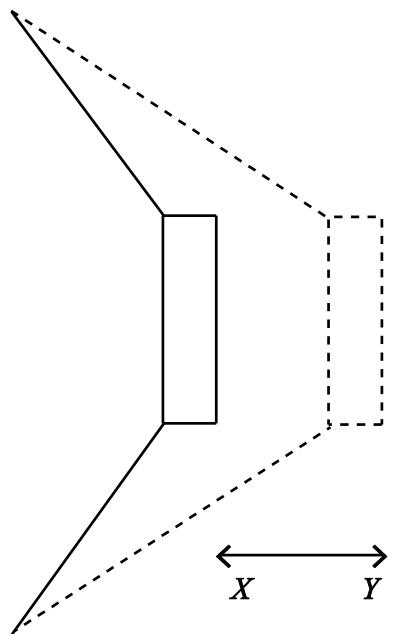
A sound wave is produced by a loudspeaker cone, which creates pulses of pressure by moving back and forth between two points X and Y as shown in the diagram.
[diagram not to scale] The distance between points X and Y is 5.0 mm and the loudspeaker produces pulses of high pressure every 0.20 milliseconds. The following statements about the sound wave produced are made: P It has a speed of 25ms−1. Q It has an amplitude of 5.0 mm. R It has a wavelength of 5.5 mm. S It has a frequency of 5.0 kHz. Which of these statements can be correctly deduced from the information given?
A.P only
B.S only
C.P and Q only
D.P and R only
E.Q and S only
F.R and S only
G.P, R and S only
Answer: B
Worked solution
We evaluate each statement based on the information given. boldsymbolP(Speed): The speed of the sound wave cannot be determined from the information provided, as it depends on the medium. boldsymbolQ(Amplitude): The cone moves a total distance of 5.0 mm. The amplitude is the maximum displacement from the central equilibrium position, which is half of the total distance. Amplitude=25.0mm=2.5mm Thus, statement Q is incorrect. boldsymbolR(Wavelength): The wavelength λ is given by the formula c=fλ. Since the wave speed c is unknown, the wavelength cannot be calculated. boldsymbolS(Frequency): The time period T is given as 0.20 milliseconds. T=0.20ms=0.20×10⁻³s Frequency f is the reciprocal of the time period. f=T1=0.20×10⁻³s1=5000Hz=5.0kHz Statement S can be correctly deduced. Only statement S can be deduced.
Question 29
1 mark
Which one of the following is a simplification of x2−2xx2−4 where x=2 and x=0?
A.x−2x−4
B.xx−2
C.x2
D.xx+2
E.x+1x+2
Answer: D
Worked solution
To simplify the algebraic fraction, we factorise the numerator and the denominator. x2−2xx2−4=x(x−2)(x+2)(x−2) The numerator is factorised as a difference of two squares, and the denominator by taking out the common factor of x. Since the problem states x=2, the term (x−2) is non-zero and can be cancelled from the top and bottom. =xx+2
Question 30
1 mark
Not in the current ESAT specification — included for completeness, but you won't be tested on it.
A car and driver, of total mass 1000 kg, travel with uniform acceleration from rest along a horizontal road. The car's engine produces a force of 3.0 kN. After a time of 5.0 s the car reaches a speed of 10ms−1. Consider the resistive forces acting on the car to be constant. What is the acceleration of the car ams−2 and what is the total of the resistive forces f kN acting on the car?
A.a = 2.0; f = 1.0
B.a = 2.0; f = 2.0
C.a = 2.0; f = 3.0
D.a = 3.0; f = 1.0
E.a = 3.0; f = 2.0
Answer: A
Worked solution
First, we find the acceleration, a, of the car. a=tΔv=5.0 s10 m s−1=2.0 m s−2 Next, we use Newton's second law, Fnet=ma, to find the resistive force, f. The net force is the difference between the engine's driving force and the resistive force. The driving force is 3.0 kN=3000 N. The car's mass is 1000 kg. Fdriving−f=ma3000−f=1000×2.03000−f=2000 Solving for f: f=3000−2000=1000 N Converting the resistive force to kilonewtons: f=1.0 kN The acceleration is a=2.0 m s−2 and the resistive force is f=1.0 kN.
Question 31
1 mark
Given that axb2xc3x=2, where a, b, and c are positive real numbers, then x=
A.log10(a+2b+3c2)
B.log10(a+2b+3c)log102
C.log10(a+2b+3c)2
D.a+2b+3c2
E.log10(ab2c32)
F.log10(ab2c3)log102
G.log10(ab2c3)2
H.ab2c32
Answer: F
Worked solution
Given the equation axb2xc3x=2. Take the logarithm base 10 of both sides: log10(axb2xc3x)=log102 Apply the logarithm properties log(MNP)=logM+logN+logP and log(Mk)=klogM: xlog10a+2xlog10b+3xlog10c=log102 Factor out x: x(log10a+2log10b+3log10c)=log102 Combine the terms in the parenthesis using logarithm rules: xlog10(ab2c3)=log102 Solve for x: x=log10(ab2c3)log102
Question 32
1 mark
Not in the current ESAT specification — included for completeness, but you won't be tested on it.
Particle P has a fixed mass of 2 kg and particle Q has a fixed mass of 5 kg. The two particles are moving in opposite directions along a straight line on a smooth plane. Particle P has a speed of 3ms−1 and particle Q has a speed of rms−1. The particles collide directly. After the collision the direction of each particle is reversed. The speed of P is now 1ms−1 and the speed of Q is halved. What is the value of r?
A.158
B.1514
C.1516
D.38
E.516
Answer: C
Worked solution
Let the initial direction of particle P be positive. According to the principle of conservation of linear momentum, the total momentum before the collision equals the total momentum after. Momentum Before Collision Total Momentum =mPuP+mQuQ =(2)(+3)+(5)(−r) =6−5r Momentum After Collision (Directions are reversed) Total Momentum =mPvP+mQvQ =(2)(−1)+(5)(+2r) =−2+25r Equating Momenta 6−5r=−2+25r 8=5r+25r 8=210r+5r 8=215r 16=15r r=1516
Question 33
1 mark
Which one of the following numbers is largest in value? (All angles are given in radians.)
A.tan(43π)
B.log10100
C.sin10(2π)
D.log210
E.(2−1)10
Answer: D
Worked solution
We evaluate each option to determine the largest value: \begin{itemize} \item[A:] tan(43π)=−1 \item[B:] log10(100)=log10(102)=2 \item[C:] sin10(2π)=(1)10=1 \item[D:] For log2(10), we know 23=8 and 24=16. Since 8<10<16, the value must be between 3 and 4. \item[E:] For (2−1)10, the base 2−1 is a positive number less than 1. Raising it to the power of 10 results in a very small positive number. \end{itemize} Comparing the results, the value from option D is the largest.
Question 34
1 mark
Not in the current ESAT specification — included for completeness, but you won't be tested on it.
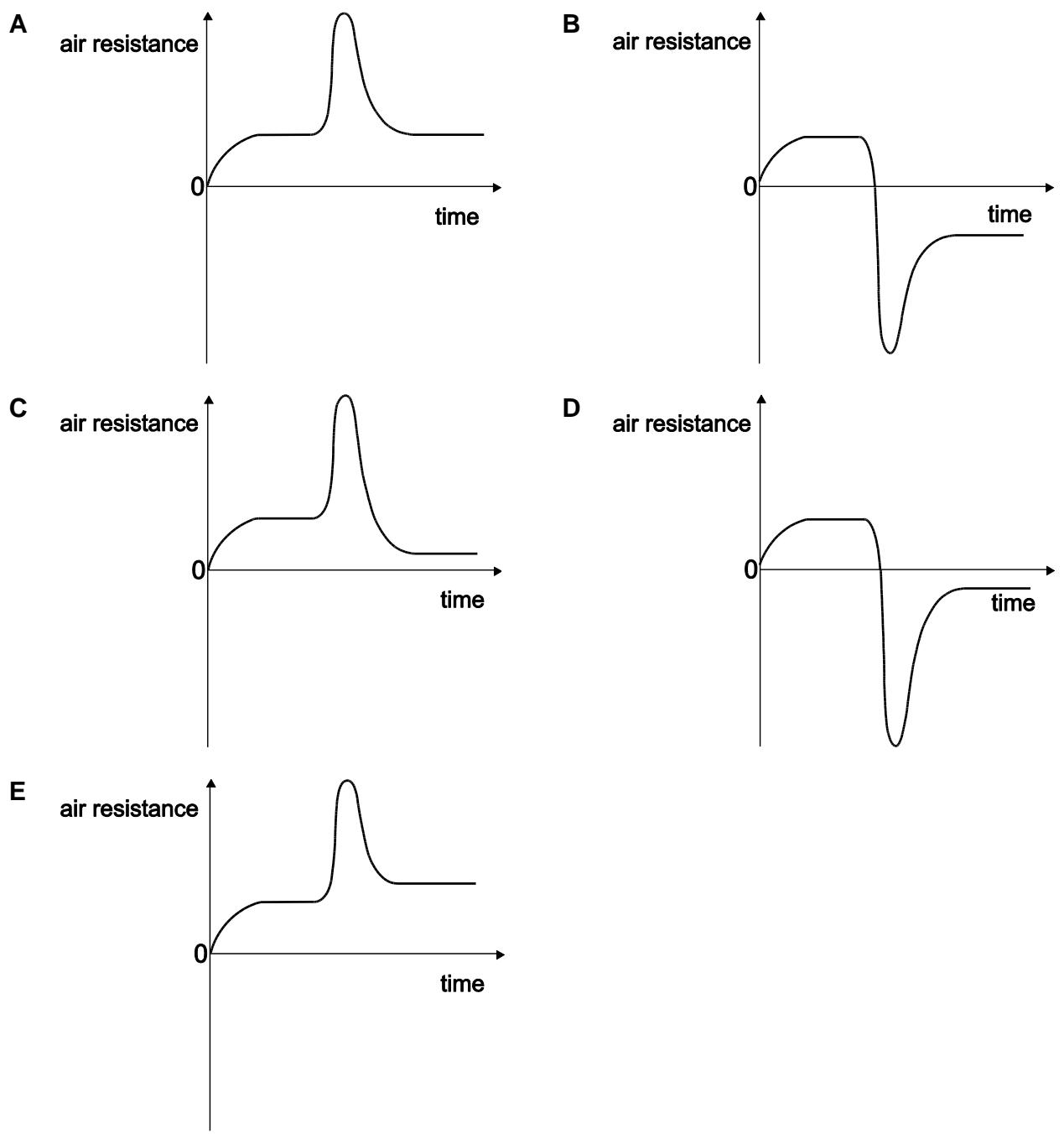
A parachutist falls from an aircraft and reaches a terminal velocity. After a while he opens his parachute and reaches a new (lower) terminal velocity. Which graph shows how the total air resistance (drag) force acting on him and the parachute varies with time during the fall?
A.Graph A
B.Graph B
C.Graph C
D.Graph D
E.Graph E
Answer: A
Worked solution
The air resistance (drag) is a resistive force, so its magnitude cannot be negative. This fact eliminates options B and D. When an object travels at a constant terminal velocity, the net force on it is zero. This implies that the drag force is equal in magnitude to the object's weight (Fdrag=W). This is true for the first terminal velocity (before the parachute opens) and the second, lower terminal velocity (after it opens). Therefore, the drag force during both periods of terminal velocity must be the same, meaning the horizontal plateaus on the graph must be at the same height. Graph A is the only option that satisfies these conditions. It shows the drag force increasing to a plateau, spiking when the parachute opens, and then decreasing back to the same plateau level.
Question 35
1 mark
The sum of the roots of the equation 22x−8×2x+15=0 is
A.3
B.8
C.2log102
D.log10(415)
E.log102log1015
Answer: E
Worked solution
The equation is 22x−8⋅2x+15=0. Let y=2x. The equation becomes a quadratic in y: y2−8y+15=0 Factorising the quadratic expression: (y−3)(y−5)=0 This gives two solutions for y: y=3ory=5 Substitute back y=2x to find the roots for x: 2x=3or2x=5 Solving for the two roots (x1,x2) by taking logarithms: x1=log23andx2=log25 The sum of the roots is x1+x2: Sum=log23+log25 Using the logarithm property logbm+logbn=logb(mn): Sum=log2(3×5)=log215 Using the change of base formula, logba=logcblogca, to convert to base 10: Sum=log102log1015
Question 36
1 mark
Not in the current ESAT specification — included for completeness, but you won't be tested on it.
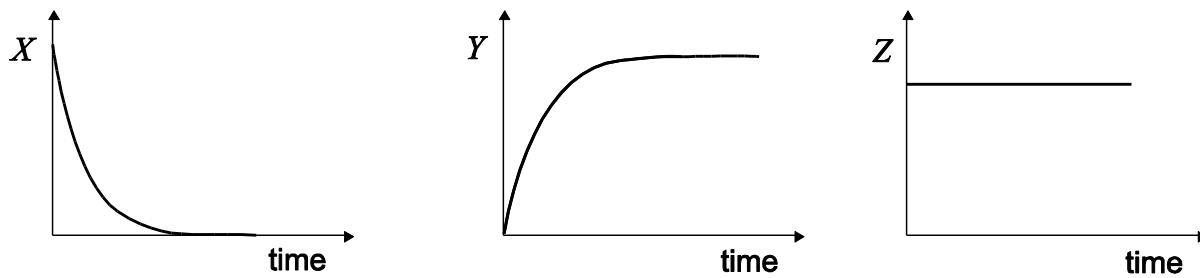
A car is accelerated from rest along a horizontal road by a constant thrust force produced by the engine. The car eventually reaches a terminal velocity. The graphs below show the variation with time of three quantities (X, Y and Z) for the car:
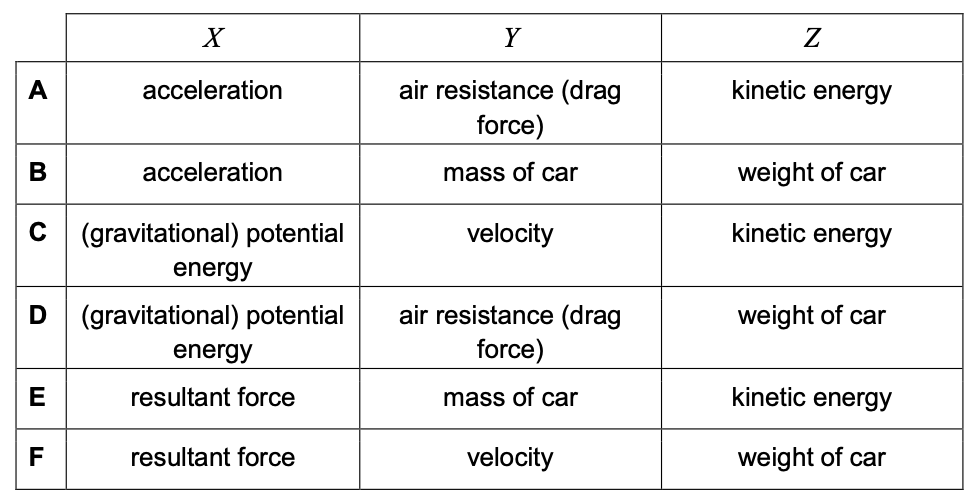
Which line in the table could correctly identify the quantities X, Y and Z?
A.X: acceleration, Y: air resistance (drag force), Z: kinetic energy
B.X: acceleration, Y: mass of car, Z: weight of car
C.X: (gravitational) potential energy, Y: velocity, Z: kinetic energy
D.X: (gravitational) potential energy, Y: air resistance (drag force), Z: weight of car
E.X: resultant force, Y: mass of car, Z: kinetic energy
F.X: resultant force, Y: velocity, Z: weight of car
Answer: F
Worked solution
The car moves on a horizontal road, so its mass, weight, and gravitational potential energy are all constant. - Graph Z shows a constant quantity. This can be the weight of the car. This eliminates options A, C, and E, which suggest Z is kinetic energy. Kinetic energy increases from zero as the car accelerates, so it is not constant. - Graph Y shows a non-constant quantity. This eliminates option B, where Y is the mass of the car. - Graph X shows a non-constant quantity. This eliminates option D, where X is gravitational potential energy. By elimination, option F is the only choice that is consistent with the physics of the situation.
Question 37
1 mark
For any real numbers a, b, and c where a≥b, consider these three statements: 1. −b≥−a 2. a2+b2≥2ab 3. ac≥bc Which of the above statements must be true?
A.none of them
B.1 only
C.2 only
D.3 only
E.1 and 2 only
F.1 and 3 only
G.2 and 3 only
H.1, 2 and 3
Answer: E
Worked solution
We are given that a,b,c are real numbers and a≥b. We must evaluate the three statements. \textbf{Statement 1: −b≥−a} We start with the given inequality: a≥b When we multiply an inequality by a negative number, such as −1, the inequality sign is reversed. (−1)×a≤(−1)×b−a≤−b This is equivalent to −b≥−a. Thus, statement 1 is true. \textbf{Statement 2: a2+b2≥2ab} The square of any real number is non-negative. Therefore: (a−b)2≥0 Expanding the left side gives: a2−2ab+b2≥0 Rearranging the terms: a2+b2≥2ab This is true for all real numbers a and b, regardless of whether a≥b. Thus, statement 2 is true. \textbf{Statement 3: ac≥bc} Starting with a≥b, the outcome of multiplying by c depends on its sign. \begin{itemize} \item If c>0, then ac≥bc (inequality holds). \item If c<0, then ac≤bc (inequality reverses). \end{itemize} Since c can be any real number, this statement is not always true. Therefore, only statements 1 and 2 must be true.
Question 38
1 mark
Not in the current ESAT specification — included for completeness, but you won't be tested on it.
A heavy block of stone rests on a rough, horizontal surface. The block is subject to a horizontal force that increases from zero at a constant rate. Assume that the coefficient of friction is greater than zero and that its value is independent of whether or not the block is moving. What happens to the block of stone? (Assume air resistance is negligible.)
A.It moves forwards immediately and accelerates forwards with a constant acceleration.
B.It remains stationary at first and then accelerates forwards with a constant acceleration.
C.It remains stationary at first and then accelerates forwards with an increasing acceleration.
D.It moves forwards immediately with a constant velocity.
E.It remains stationary at first and then moves forwards with a constant velocity.
Answer: C
Worked solution
Initially, the block is stationary. The static frictional force balances the applied force. The block will only start to move when the applied force exceeds the maximum static friction, which is a fixed value. Let the applied force be Fapp and the constant kinetic frictional force be Ff. The applied force increases linearly with time. Once the block is moving, the net force is: Fnet=Fapp−Ff By Newton's second law, Fnet=ma: a=mFnet=mFapp−Ff Since the applied force Fapp is continuously increasing and Ff is constant, the net force Fnet also increases. Thus, the acceleration a must also increase. The block remains stationary at first, then moves with an increasing acceleration.
Question 39
1 mark
The sequence an is given by the rule: a1=2 an+1=an+(−1)n for n≥1 What is ∑n=1100an?
A.150
B.250
C.-4750
D.5150
E.4(1−(21)100)
F.4((23)100−1)
Answer: A
Worked solution
The sequence is defined by the recurrence relation: a1=2an+1=an+(−1)nfor n≥1 We calculate the first few terms to find a pattern: a1=2a2=a1+(−1)1=2−1=1a3=a2+(−1)2=1+1=2a4=a3+(−1)3=2−1=1a5=a4+(−1)4=1+1=2 The sequence is {2,1,2,1,…}. For odd terms an=2, and for even terms an=1. The sum required is ∑n=1100an. This is the sum of 100 terms. The sum can be grouped into 50 pairs: ∑n=1100an=(a1+a2)+(a3+a4)+⋯+(a99+a100) Each pair consists of an odd term (value 2) and an even term (value 1). Sum of each pair=2+1=3 There are 50 such pairs. Total Sum=50×3=150
Question 40
1 mark
Not in the current ESAT specification — included for completeness, but you won't be tested on it.
A white billiard ball of mass 0.20 kg is travelling horizontally at 3.0ms−1 and hits a red billiard ball of the same mass which is at rest. After the collision the white ball continues in the same direction with a speed of 1.0ms−1. What is the speed of the red ball immediately after the collision?
A.1.0ms−1
B.1.5ms−1
C.2.0ms−1
D.2.5ms−1
E.3.0ms−1
Answer: C
Worked solution
This problem is solved using the principle of conservation of linear momentum, where the total momentum before the collision equals the total momentum after. ewline Let the mass of each ball be m=0.20kg and the final velocity of the red ball be v. ewline The initial momentum is calculated from the white ball, as the red ball is at rest. Momentum before=(0.20kg×3.0ms−1)+(0.20kg×0ms−1)=0.6Ns The final momentum is the sum of the momenta of both balls. Momentum after=(0.20kg×1.0ms−1)+(0.20kg×v)=0.2+0.2v Equating the momentum before and after the collision: 0.6=0.2+0.2v0.4=0.2vv=0.20.4v=2.0ms−1
Question 41
1 mark
How many real roots does the equation x4−4x3+4x2−1=0 have?
A.0
B.1
C.2
D.3
E.4
Answer: C
Worked solution
To find the number of real roots for y=x4−4x3+4x2−10, we locate its turning points. First, we find the derivative: dxdy=4x3−12x2+8x Set the derivative to zero to find the stationary points: 4x3−12x2+8x=04x(x2−3x+2)=04x(x−1)(x−2)=0 The stationary points occur at x=0, x=1, and x=2. Next, evaluate the function at these x-values: \begin{itemize} \item At x=0, y=−10. \item At x=1, y=14−4(1)3+4(1)2−10=−9. \item At x=2, y=24−4(2)3+4(2)2−10=16−32+16−10=−10. \end{itemize} The turning points are (0,−10), (1,−9), and (2,−10). Since the function is a positive quartic and all turning points are below the x-axis, the graph must cross the x-axis exactly twice.
Question 42
1 mark
Not in the current ESAT specification — included for completeness, but you won't be tested on it.
A certain planet has no atmosphere. The planet has a gravitational field strength at its surface of gpNkg−1; this value is considered constant for this question. A rock is projected vertically upwards from the surface of the planet at an initial speed of 20ms−1. The rock reaches a maximum height h metres. Which option shows a possible correct pair of values for gp and h? (Consider only gravitational forces.)
A.gp=5.0;h=4.0
B.gp=5.0;h=40
C.gp=10;h=2.0
D.gp=20;h=1.0
E.gp=20;h=20
Answer: B
Worked solution
By the principle of conservation of energy, the initial kinetic energy is converted into gravitational potential energy at the maximum height h. 21mv2=mgph The mass m cancels out. We can rearrange for the product gph: gph=2v2 Given the initial speed v=20ms−1: gph=2202=2400=200 We check the options to find which pair of values for gp and h gives a product of 200. For option B: gp=5.0 and h=40. gph=5.0×40=200 This is the only option that satisfies the condition.
Question 43
1 mark
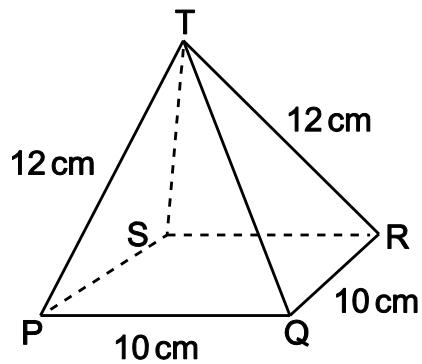
A box is a hollow pyramid. The base of the box is a square with sides 10 cm and all the slant edges of the box are 12 cm long.
[diagram not to scale] What is the angle made by the slant edge TP with the base PQRS?
A.sin−11225
B.sin−1125
C.sin−11252
D.cos−11225
E.cos−1125
F.cos−11252
Answer: F
Worked solution
Let the center of the square base be M. The required angle, x, is the angle between the slant edge TP and the line PM, where PM is the projection of TP onto the base. This forms a right-angled triangle TMP, with the right angle at M. The hypotenuse is the slant edge, TP=12cm. The side PM is half the length of the diagonal of the square base. First, find the length of the diagonal of the base (e.g., PR) using Pythagoras' Theorem: PR2=102+102=200PR=200=102cm The distance from a corner to the center is half the diagonal: PM=21×PR=2102=52cm In the right-angled triangle TMP, we can find the angle x using cosine: cos(x)=HypotenuseAdjacent=TPPMcos(x)=1252x=cos−1(1252)
Question 44
1 mark
Not in the current ESAT specification — included for completeness, but you won't be tested on it.
A ball is dropped from a height of 16 m on to a horizontal surface, and on each bounce loses 50% of its kinetic energy. After which bounce will the maximum height of the rebound fall to less than 160 cm for the first time? (Assume air resistance is negligible, and the only external force acting on the ball while not in contact with the surface is gravity.)
A.4th
B.5th
C.6th
D.7th
E.8th
Answer: A
Worked solution
The gravitational potential energy (GPE) is directly proportional to height (Ep=mgh). A 50% loss of kinetic energy during a bounce means the rebound GPE, and thus the rebound height, is 50% of the pre-bounce height. hafter=0.5×hbefore The initial height is 16 m. The target height is less than 160 cm = 1.6 m. We track the maximum height after each bounce: - After bounce 1: h1=0.5×16 m=8 m - After bounce 2: h2=0.5×8 m=4 m - After bounce 3: h3=0.5×4 m=2 m - After bounce 4: h4=0.5×2 m=1 m The height after the 4th bounce (1 m) is the first to be less than 1.6 m.
Question 45
1 mark
The variables x and y and the constants a and b are real and positive. The variables x and y are related. A graph of logy against logx is drawn. For which one of the following relationships will this graph be a straight line?
A.yb=ax
B.y=abx
C.y2=a+xb
D.y=axb
E.yx=ab
Answer: D
Worked solution
A graph of logy against logx is a straight line if the equation can be expressed in the linear form Y=mX+c, where Y=logy and X=logx. The target form is logy=mlogx+c. Let's take logarithms of each option: \begin{itemize} \item[A:] y6=ax⟹6logy=xloga. Linear in x, not logx. \item[B:] y=abx⟹logy=loga+xlogb. Linear in x, not logx. \item[C:] y2=a+xb⟹2logy=log(a+xb). Not a linear form. \item[D:] y=axb⟹logy=loga+blogx. This is in the form logy=(b)logx+(loga), which is linear. \item[E:] yx=ab⟹xlogy=bloga. Not a linear form. \end{itemize} Only option D gives a straight line relationship between logy and logx.
Question 46
1 mark
Not in the current ESAT specification — included for completeness, but you won't be tested on it.
A man of weight 600 N stands on a set of accurate weighing scales in a moving elevator (lift). The reading on the scales is 480 N. Which statement correctly describes the motion of the elevator?
A.The elevator is moving downwards with constant speed.
B.The elevator is moving downwards with decreasing speed.
C.The elevator is moving upwards with increasing speed.
D.The elevator is moving upwards with constant speed.
E.The elevator is moving upwards with decreasing speed.
Answer: E
Worked solution
Let W be the true weight of the man and R be the reading on the scales, which is the normal reaction force. W=600 N(Force acting downwards) R=480 N(Force acting upwards) The net force, Fnet, on the man is the resultant of these two forces. Using Newton’s Second Law (Fnet=ma), and taking the upward direction as positive: Fnet=R−W ma=480 N−600 N ma=−120 N The negative sign indicates that the net force and hence the acceleration, a, are in the downward direction. An object has a downward acceleration if it is either moving downwards with increasing speed, or moving upwards with decreasing speed. Let’s check the options: - A, D: Constant speed means a=0. Incorrect. - B: Decreasing downward speed means acceleration is upwards. Incorrect. - C: Increasing upward speed means acceleration is upwards. Incorrect. - E: Decreasing upward speed means acceleration is downwards. Correct.
Question 47
1 mark
For what values of the non-zero real number a does the quadratic equation ax2+(a−2)x=2 have distinct real roots?
A.all values of a
B.a = -2
C.a > -2
D.a ≠ -2
E.no values of a
Answer: D
Worked solution
For a quadratic equation to have distinct real roots, its discriminant (b2−4ac) must be greater than zero. First, rearrange the equation ax2+(a−2)x=2 into the standard form ax2+bx+c=0: ax2+(a−2)x−2=0 Here, the coefficients are a=a, b=(a−2), and c=−2. Now, set the discriminant to be greater than zero: (a−2)2−4(a)(−2)>0(a2−4a+4)+8a>0a2+4a+4>0(a+2)2>0 The square of a real number, (a+2)2, is always positive, except when it is zero. This occurs when a+2=0, which means a=−2. Therefore, the inequality is true for all real values of a except for a=−2.
Question 48
1 mark
Not in the current ESAT specification — included for completeness, but you won't be tested on it.
The track for a tram is straight and horizontal. A tram is travelling along the track at a velocity of 12.0ms−1 when the brakes are applied. Because of this, the tram decelerates to rest at a constant rate of 1.50ms−2. What is the distance travelled by the tram over the total time for which it is decelerating?
A.18.0 m
B.48.0 m
C.96.0 m
D.108 m
E.216 m
Answer: B
Worked solution
This is a problem of kinematics with constant acceleration. We use the equation of motion: v2=u2+2as Given values are: - Initial velocity, u=12.0ms−1 - Final velocity, v=0ms−1 (since the tram comes to rest) - Acceleration, a=−1.50ms−2 (a deceleration) We need to find the distance, s. Substitute the values into the equation: 02=(12.0)2+2(−1.50)s 0=144−3.0s 3s=144 s=3144 s=48m
Question 49
1 mark
A triangle is to be drawn with sides that are integer lengths in centimetres, and a total perimeter of 12 cm. How many different (non-congruent) triangles can be drawn?
A.1
B.2
C.3
D.10
E.12
Answer: C
Worked solution
Let the integer side lengths of the triangle be a,b, and c. The perimeter is 12, so a+b+c=12. The Triangle Inequality Theorem requires that the sum of the lengths of any two sides must be greater than the length of the third side. This implies that no single side can be greater than or equal to half the perimeter. Thus, each side must be less than 6 cm. We list the possible combinations of integers {a,b,c} that sum to 12 and satisfy this condition: - {4,4,4}: An equilateral triangle. Check: 4+4>4. This is valid. - {5,4,3}: A scalene triangle. Check: 3+4>5. This is valid. - {5,5,2}: An isosceles triangle. Check: 2+5>5. This is valid. Any other set of integers summing to 12, such as {6,5,1}, will violate the triangle inequality (1+5>6). Thus, there are 3 possible non-congruent triangles.
Question 50
1 mark
Not in the current ESAT specification — included for completeness, but you won't be tested on it.
A particle of weight 5 N is held in position by two light ropes. One of the ropes makes an angle of 60∘ with the upward vertical, the other is horizontal. What is the tension in the horizontal rope?
A.1.253 N
B.5 N
C.53 N
D.10 N
E.103 N
Answer: C
Worked solution
The particle is held in position, which means it is in equilibrium. The net force is zero, so the horizontal and vertical components of the forces must balance. Let H be the tension in the horizontal rope and F be the tension in the angled rope. For vertical equilibrium, the upward component of F must balance the downward weight: Fcos(60∘)=5F×21=5⟹F=10N For horizontal equilibrium, the tension H must balance the horizontal component of F: H=Fsin(60∘) Substituting the value of F: H=10×23H=53N
Question 51
1 mark
The triangle PQR has a right angle at R. The length of PQ is 4 cm, correct to the nearest centimetre. The length of PR is 2 cm, correct to the nearest centimetre. Find the minimum possible length, in centimetres, of QR.
A.6−21
B.23−21
C.25−21
D.25
E.23
F.6
Answer: F
Worked solution
The triangle PQR is right-angled at R. By Pythagoras' theorem: PQ2=PR2+QR2⟹QR=PQ2−PR2 The lengths are given correct to the nearest centimetre. This gives us the bounds for PQ and PR: PQ=4 cm⟹3.5≤PQ<4.5PR=2 cm⟹1.5≤PR<2.5 To find the minimum possible length of QR, we must use the minimum value of PQ (PQmin) and the maximum value of PR (PRmax). QRmin=PQmin2−PRmax2 Substitute the boundary values: QRmin=3.52−2.52 Using the difference of two squares, a2−b2=(a−b)(a+b): QRmin=(3.5−2.5)(3.5+2.5)QRmin=(1)(6)=6
Question 52
1 mark
Not in the current ESAT specification — included for completeness, but you won't be tested on it.
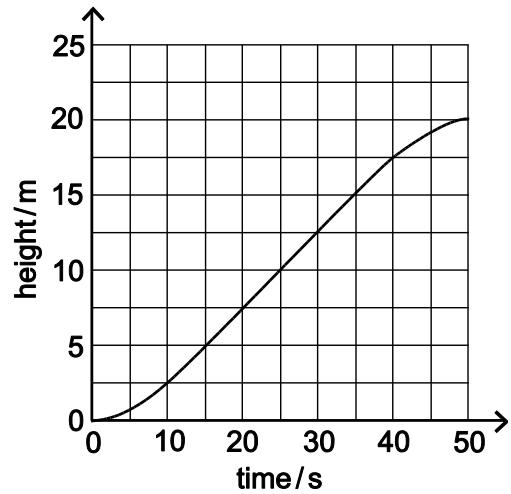
The graph shows the variation with time of the height through which a crane lifts a mass of 20 kg.
What is the power output of the crane when the mass is at a height of 10 m? (gravitational field strength = 10Nkg−1, the effects of air resistance and friction are negligible)
A.0.1 W
B.10 W
C.40 W
D.100 W
E.400 W
F.4000 W
Answer: D
Worked solution
The power output of the crane is the rate at which it does work. Since the effects of air resistance and friction are negligible, the work done is equal to the gain in gravitational potential energy. Power=TimeWork Done=ΔtΔEp The change in potential energy is ΔEp=mgΔh. Thus, Power=ΔtmgΔh=mg(ΔtΔh)=mgv The velocity, v, is the gradient of the height-time graph. At the point where the height is 10 m, the graph is linear. We can calculate the gradient for this section: v=gradient=30 s−10 s15 m−5 m=20 s10 m=0.5 m/s Now, we calculate the power with m=20 kg and g=10 Nkg−1. P=(20 kg)×(10 Nkg−1)×(0.5 m/s)=100 W
Question 53
1 mark
The angle x is measured in radians and is such that 0≤x≤π. The total length of any intervals for which −1≤tanx≤1 and sin2x≥0.5 is
A.12π
B.6π
C.4π
D.3π
E.125π
F.2π
G.65π
Answer: B
Worked solution
We must find the total length of the interval(s) where both inequalities are met for x∈[0,π]. First inequality: −1≤tanx≤1. This is satisfied in the intervals: 0≤x≤4πand43π≤x≤π Second inequality: sin(2x)≥0.5. This is satisfied when: 6π≤2x≤65π Dividing by 2 gives the interval for x: 12π≤x≤125π Intersection: We find the overlap between the solution sets. The only common region is: 12π≤x≤4π Total length: The length of this interval is calculated as: Length=4π−12π=123π−π=122π=6π
Question 54
1 mark
Not in the current ESAT specification — included for completeness, but you won't be tested on it.
A train consists of a powered engine travelling horizontally pulling two unpowered carriages.
[Diagram showing: carriage 2 --T-- carriage 1 -- powered engine -> 15 000 N] The engine has a mass of 20 000 kg, and each carriage has a mass of 5000 kg. When the engine accelerates from rest it develops a thrust (driving force) of 15 000 N as shown. Ignoring resistive forces, what is the tension (pulling force) T in the light and inextensible coupling between carriage 1 and carriage 2?
A.2500 N
B.3750 N
C.5000 N
D.7500 N
E.15 000 N
Answer: A
Worked solution
First, we find the acceleration of the entire system. ewline The total mass of the train is: mtotal=20000kg+5000kg+5000kg=30000kg Using Newton's second law, F=ma, with the given thrust: a=mtotalF=30000kg15000N=0.5m/s2 The tension T in the coupling between carriage 1 and carriage 2 is the net force acting on carriage 2. Applying Newton's second law to carriage 2: T=mcarriage 2×a=5000kg×0.5m/s2=2500N
ENGAA 2016 Specimen Paper Section 1 for the ESAT: Questions, Worked Solutions & Spec Mapping | esat.fyi