ENGAA 2017 D564/11
54 questions54 marks80Updated August 2025
The ENGAA 2017 D564/11 paper in full: all 54 questions, each with its answer. ENGAA is the Engineering Admissions Assessment. Sit it cold under exam timing, mark it, then work back through anything you missed using the solutions below.
Download the original PDF →Questions and answers are free. Full step-by-step worked solutions unlock with a free account. Start practising.
Question 1
1 markEvaluate
- A.1
- B.3
- C.
- D.
- E.
- F.9
Answer: F
Question 2
1 markA car is travelling along a horizontal road in a straight line.
The graph is a velocity-time graph for part of the car's journey.
(Image of a velocity-time graph is shown. Key points: (0,20), (30,20), (50,30), (110,30), (120,20), (150,20))
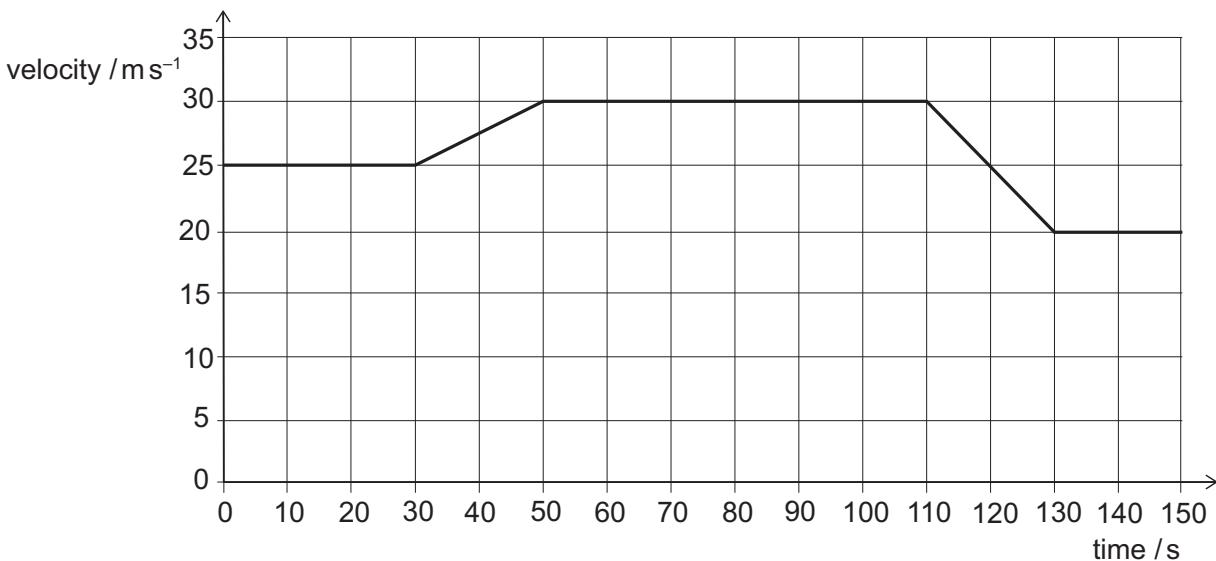
During this part of the journey, what is the total distance that the car travels while it is decelerating?
The graph is a velocity-time graph for part of the car's journey.
(Image of a velocity-time graph is shown. Key points: (0,20), (30,20), (50,30), (110,30), (120,20), (150,20))
During this part of the journey, what is the total distance that the car travels while it is decelerating?
- A.400 m
- B.500 m
- C.550 m
- D.600 m
- E.750 m
- F.1400 m
- G.1800 m
- H.1900 m
Answer: B
Question 3
1 markSolve fully the inequality
- A.
- B.
- C.
- D.
- E.
- F.
Answer: E
Question 4
1 markWhen a saucepan of water is heated from below, convection currents form and transfer heat through the liquid.
Here are three statements about the water as it is heated:
1 The mass of a fixed volume of the water increases.
2 The density of a fixed mass of the water decreases.
3 The volume of a fixed mass of the water increases.
Which of these statements help(s) to explain how convection currents are formed?
Here are three statements about the water as it is heated:
1 The mass of a fixed volume of the water increases.
2 The density of a fixed mass of the water decreases.
3 The volume of a fixed mass of the water increases.
Which of these statements help(s) to explain how convection currents are formed?
- A.none of them
- B.1 only
- C.2 only
- D.3 only
- E.1 and 2 only
- F.1 and 3 only
- G.2 and 3 only
- H.1, 2 and 3
Answer: G
Question 5
1 markThe equation gives in terms of :
Which one of the following is a rearrangement for in terms of ?
Which one of the following is a rearrangement for in terms of ?
- A.
- B.
- C.
- D.
- E.
- F.
- G.
Answer: B
Question 6
1 markAn electric motor is used to pull a broken-down car slowly from the road up a ramp on to the back of a breakdown truck.
The car has a mass of 1200 kg and is lifted through a vertical height of 1.0 m.
The total input energy to the motor is 28 kJ and it is 75% efficient.
In the process of lifting the car, energy is lost to the surroundings from the motor and from other causes.
What is the total energy lost to the surroundings?
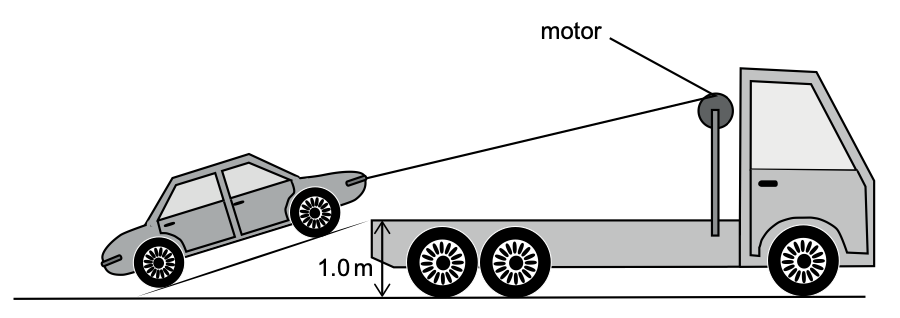
(gravitational field strength = )
The car has a mass of 1200 kg and is lifted through a vertical height of 1.0 m.
The total input energy to the motor is 28 kJ and it is 75% efficient.
In the process of lifting the car, energy is lost to the surroundings from the motor and from other causes.
What is the total energy lost to the surroundings?
(gravitational field strength = )
- A.7.0 kJ
- B.9.0 kJ
- C.12 kJ
- D.16 kJ
- E.21 kJ
- F.33 kJ
Answer: D
Question 7
1 markA fruit stall sells apples costing £x each, and pears costing £y each.
Sam bought 2 apples and 5 pears, and the total cost of these was £P.
Lesley bought 3 apples and 2 pears, and the total cost of these was £Q.
Which of the following is an expression for the cost, in pounds (£), of a pear?
Sam bought 2 apples and 5 pears, and the total cost of these was £P.
Lesley bought 3 apples and 2 pears, and the total cost of these was £Q.
Which of the following is an expression for the cost, in pounds (£), of a pear?
- A.
- B.
- C.
- D.
- E.
- F.
- G.
Answer: G
Question 8
1 markIn one type of medical scanner a source is placed inside a patient's body. This source causes pairs of gamma-rays to be emitted simultaneously in opposite directions.
Detectors on each side of the patient are used to detect the gamma-rays. The distance between the two detectors is 3.0 m. When the source is at Q, half-way between the detectors, the two gamma-rays arrive at the same time.
In a particular scan the gamma-rays arrive at the two detectors with a time difference of s.
Assume that, inside the patient, the gamma-rays travel at a speed of .
How far from Q, half-way between the detectors, is the gamma-ray source?
Detectors on each side of the patient are used to detect the gamma-rays. The distance between the two detectors is 3.0 m. When the source is at Q, half-way between the detectors, the two gamma-rays arrive at the same time.
In a particular scan the gamma-rays arrive at the two detectors with a time difference of s.
Assume that, inside the patient, the gamma-rays travel at a speed of .
How far from Q, half-way between the detectors, is the gamma-ray source?
- A.6.0 mm
- B.12 mm
- C.24 mm
- D.6.0 cm
- E.12 cm
- F.24 cm
Answer: D
Question 9
1 mark is directly proportional to squared.
When is 2, is 4.
is inversely proportional to .
When is 2, is 5.
What is in terms of ?
When is 2, is 4.
is inversely proportional to .
When is 2, is 5.
What is in terms of ?
- A.
- B.
- C.
- D.
- E.
- F.
- G.
- H.
Answer: E
Question 10
1 markWhen a plutonium-239 nucleus absorbs a neutron it undergoes nuclear fission. One particular fission reaction results in the creation of xenon and zirconium as daughter nuclei. The nuclear equation for this reaction is shown but with some non-zero integers replaced by the letters and .
Which equation is correct?
Which equation is correct?
- A.
- B.
- C.
- D.
- E.
- F.
Answer: B
Question 11
1 markWhich one of the following is a simplification of
- A.
- B.
- C.
- D.
- E.
- F.
Answer: D
Question 12
1 markAn electric motor is connected to a constant 12V d.c. supply. The motor is used to lift a mass of 20 kg by means of a rope and pulley. The mass is lifted vertically through a height of 6.0 m in a time of 5.0 s. The complete lifting system (motor, rope and pulley) is 80% efficient.
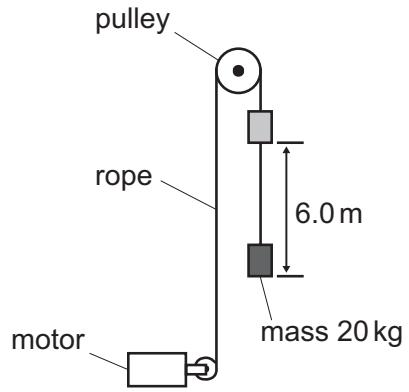
What is the current in the electric motor?
(gravitational field strength = )
What is the current in the electric motor?
(gravitational field strength = )
- A.1.6 A
- B.2.0 A
- C.2.5 A
- D.16 A
- E.20 A
- F.25 A
Answer: F
Question 13
1 markWhat is the value of that makes the following expression correct?
- A.-2.25
- B.-1.75
- C.-1.5
- D.-0.5
- E.-0.25
Answer: D
Question 14
1 markThe nuclide decays to the stable nuclide Y. During this process four particles are emitted: an -particle and three particles.
Which of the following is not a nuclide that could be formed at any stage during this process?
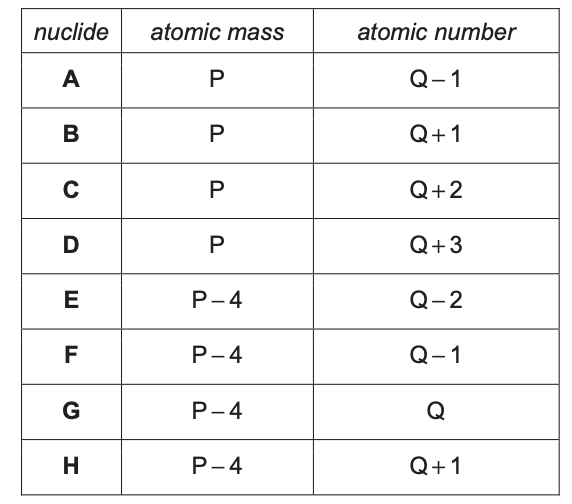
Which of the following is not a nuclide that could be formed at any stage during this process?
- A.nuclide with atomic mass P, atomic number Q-1
- B.nuclide with atomic mass P, atomic number Q+1
- C.nuclide with atomic mass P, atomic number Q+2
- D.nuclide with atomic mass P, atomic number Q+3
- E.nuclide with atomic mass P-4, atomic number Q-2
- F.nuclide with atomic mass P-4, atomic number Q-1
- G.nuclide with atomic mass P-4, atomic number Q
- H.nuclide with atomic mass P-4, atomic number Q+1
Answer: A
Question 15
1 markThere are 100 students in Year 10.
Each student studies exactly one of French, German, and Spanish.
girls study French and there are girls in total.
boys study German.
There are 35 students studying Spanish of which are boys.
Which of the following is an expression for the total number of students studying German?
Each student studies exactly one of French, German, and Spanish.
girls study French and there are girls in total.
boys study German.
There are 35 students studying Spanish of which are boys.
Which of the following is an expression for the total number of students studying German?
- A.X+2Y
- B.X+Y+35
- C.X+3Y-35
- D.2X+2Y
- E.2X + Y - 35
- F.2X+3Y-35
- G.2X + Y + 35
Answer: F
Question 16
1 markThe radius of an iron-56 atom is times greater than the radius of an iron-56 nucleus.
What is the value of ?
What is the value of ?
- A.
- B.
- C.
- D.
- E.
- F.
Answer: A
Question 17
1 markAn exterior angle of a regular polygon with sides is larger than an exterior angle of a regular polygon with sides.
What is the value of ?
What is the value of ?
- A.10
- B.12
- C.15
- D.18
- E.21
- F.24
- G.27
Answer: C
Question 18
1 markGraph 1 shows how the displacement of one of the particles of a medium varies with time in seconds as a wave travels through the medium.
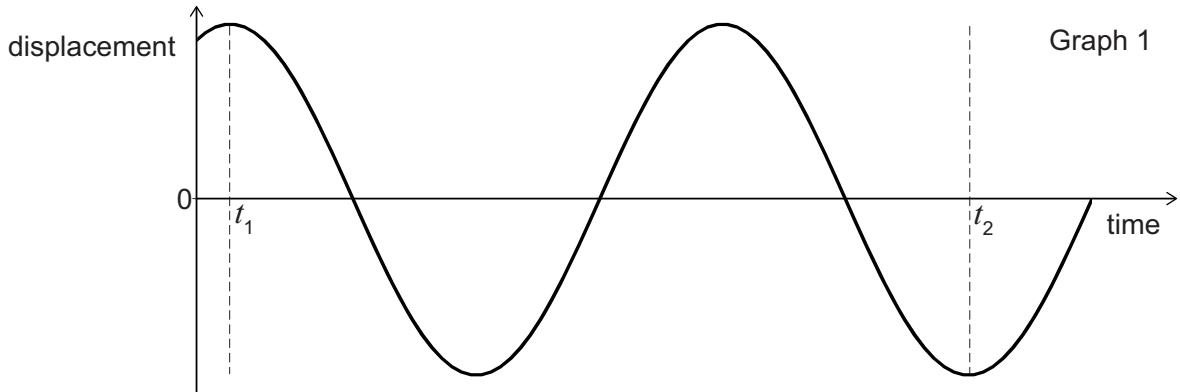
Graph 2 shows how the displacement varies with distance in metres at one time for the same wave.
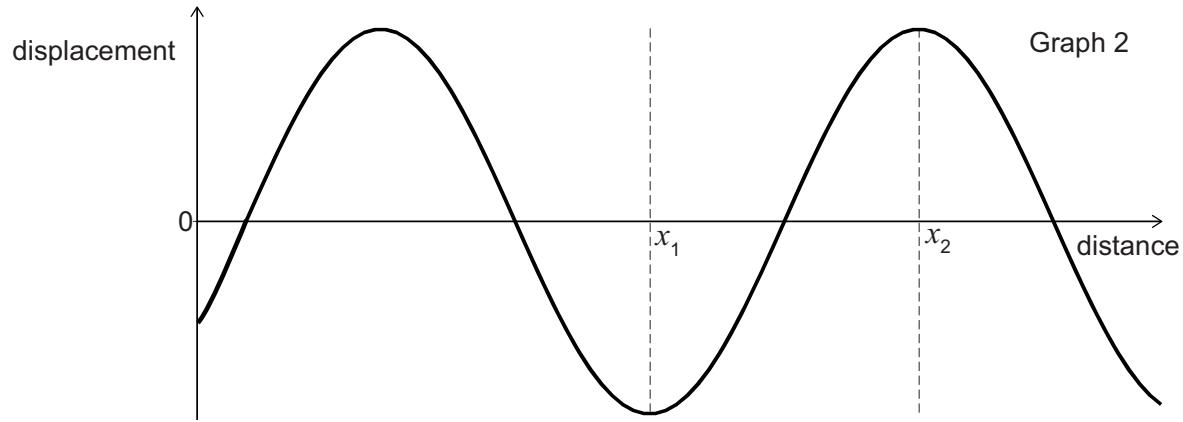
Which expression gives the speed in of the wave?
Graph 2 shows how the displacement varies with distance in metres at one time for the same wave.
Which expression gives the speed in of the wave?
- A.
- B.
- C.
- D.
- E.
- F.
Answer: E
Question 19
1 markThe bearing of a ship R from a lighthouse L is .
A canoe C is due North of R.
C is the same distance from the ship and the lighthouse.
What is the bearing of L from C?
A canoe C is due North of R.
C is the same distance from the ship and the lighthouse.
What is the bearing of L from C?
- A.
- B.
- C.
- D.
- E.
Answer: B
Question 20
1 markA kettle is designed to work from a car's power socket. The kettle has a power rating of 150 W when a constant voltage of 12.0V d.c. is applied across its element.
How much charge passes through the element of this kettle when the voltage of 12.0 V is applied across it for 20 minutes?
How much charge passes through the element of this kettle when the voltage of 12.0 V is applied across it for 20 minutes?
- A.96 C
- B.250 C
- C.15000 C
- D.36000 C
- E.900000 C
- F.2160000 C
Answer: C
Question 21
1 markThe hands of a 12-hour analogue clock move continuously. When the time on the clock is 4:00, the angle between the minute hand and the hour hand is .
What is the angle between the two hands at 4:40?
What is the angle between the two hands at 4:40?
- A.
- B.
- C.
- D.
- E.
Answer: B
Question 22
1 markA freight train travelling on a straight horizontal track at collides with a passenger train travelling at in the opposite direction. Both trains immediately come to a complete stop on the track.
The freight train has three locomotives of 130 tonnes each and seven container wagons of 30 tonnes each. The passenger train has two locomotives of 70 tonnes each and a number of passenger carriages of 10 tonnes each.
How many passenger carriages does the passenger train have?
The freight train has three locomotives of 130 tonnes each and seven container wagons of 30 tonnes each. The passenger train has two locomotives of 70 tonnes each and a number of passenger carriages of 10 tonnes each.
How many passenger carriages does the passenger train have?
- A.7
- B.9
- C.10
- D.24
- E.46
Answer: C
Question 23
1 markA pet shop has 4 female rabbits and male rabbits for sale.
A customer buys 2 of the rabbits, chosen at random, and each rabbit is equally likely to be chosen.
The probability that both the chosen rabbits are male is .
What is the value of ?
A customer buys 2 of the rabbits, chosen at random, and each rabbit is equally likely to be chosen.
The probability that both the chosen rabbits are male is .
What is the value of ?
- A.2
- B.4
- C.6
- D.8
- E.9
- F.11
- G.12
Answer: C
Question 24
1 markConsider the following three statements about a parachutist of mass 72 kg falling vertically at a constant velocity of after the parachute has opened:
1 The parachutist has a constant kinetic energy of 1800 J.
2 The parachutist is losing gravitational potential energy at a rate of .
3 Air resistance and the force of gravity acting on the parachutist are a Newton's third law pair of forces.
Which of the statements is/are correct?
(gravitational field strength = )
1 The parachutist has a constant kinetic energy of 1800 J.
2 The parachutist is losing gravitational potential energy at a rate of .
3 Air resistance and the force of gravity acting on the parachutist are a Newton's third law pair of forces.
Which of the statements is/are correct?
(gravitational field strength = )
- A.none of them
- B.1 only
- C.2 only
- D.3 only
- E.1 and 2 only
- F.1 and 3 only
- G.2 and 3 only
- H.1, 2 and 3
Answer: C
Question 25
1 markThe diagram shows a square with side of length cm. A circle is drawn with centre O which lies at the mid-point of one of the sides of the square. This side forms part of a diameter of the circle. The circle passes through two corners of the square as shown.
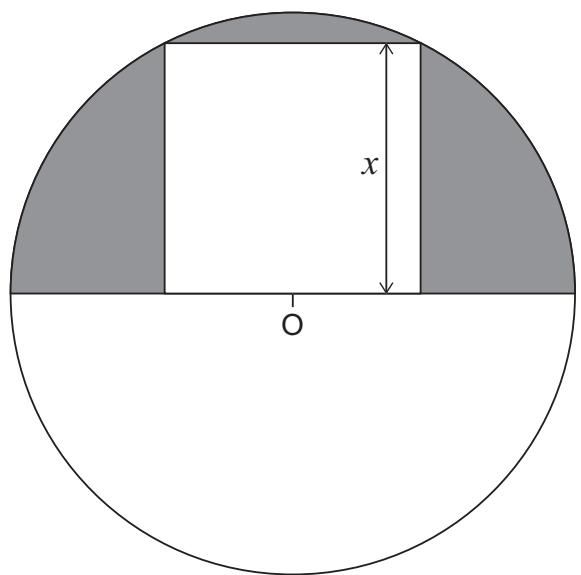
What is the area, in cm, of the shaded part of the semi-circle?
What is the area, in cm, of the shaded part of the semi-circle?
- A.
- B.
- C.
- D.
- E.
- F.
Answer: F
Question 26
1 markTwo radioactive sources X and Y have half-lives of 3.0 hours and 2.0 hours respectively. The product of the decay of both of the sources is a stable isotope of the element Z.
Six hours ago a mixture contained the same number of atoms of both X and Y, and no other atoms.
What fraction of the mixture is now made up of atoms of Z?
Six hours ago a mixture contained the same number of atoms of both X and Y, and no other atoms.
What fraction of the mixture is now made up of atoms of Z?
- A.
- B.
- C.
- D.
- E.
- F.
Answer: D
Question 27
1 markA cylindrical hollow metal pipe is 16 cm long.
It has an external diameter of 10 cm and an internal diameter of 8 cm.
The density of the metal from which the pipe is made is 8 grams per cm.
[diagram not to scale]
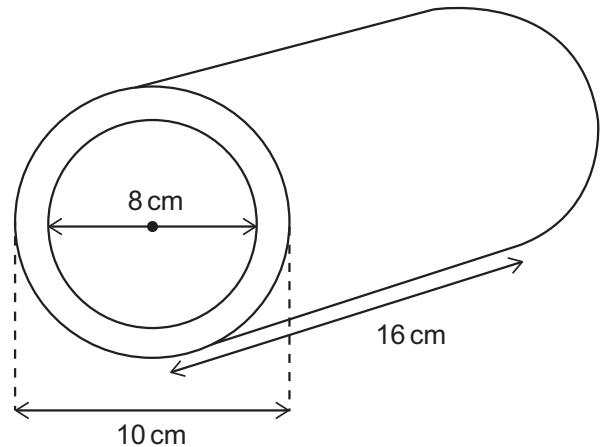
What is the mass of the pipe in grams?
It has an external diameter of 10 cm and an internal diameter of 8 cm.
The density of the metal from which the pipe is made is 8 grams per cm.
[diagram not to scale]
What is the mass of the pipe in grams?
- A.
- B.
- C.
- D.
- E.
- F.
- G.
- H.
Answer: G
Question 28
1 markCar X passes car Y on a motorway.
Car X is travelling at 1.5 times the speed of car Y.
The mass of car X is of the mass of car Y.
How do the kinetic energies of the two cars compare?
Car X is travelling at 1.5 times the speed of car Y.
The mass of car X is of the mass of car Y.
How do the kinetic energies of the two cars compare?
- A.kinetic energy of car X = kinetic energy of car Y
- B.kinetic energy of car X = kinetic energy of car Y
- C.kinetic energy of car X = kinetic energy of car Y
- D.kinetic energy of car X = kinetic energy of car Y
- E.kinetic energy of car X = kinetic energy of car Y
Answer: E
Question 29
1 markWhich one of the following is a simplification of
- A.
- B.
- C.
- D.
- E.
- F.
- G.
- H.
Answer: E
Question 30
1 markThe diagram shows a crane being used on a building site. The crane is perfectly balanced about P.
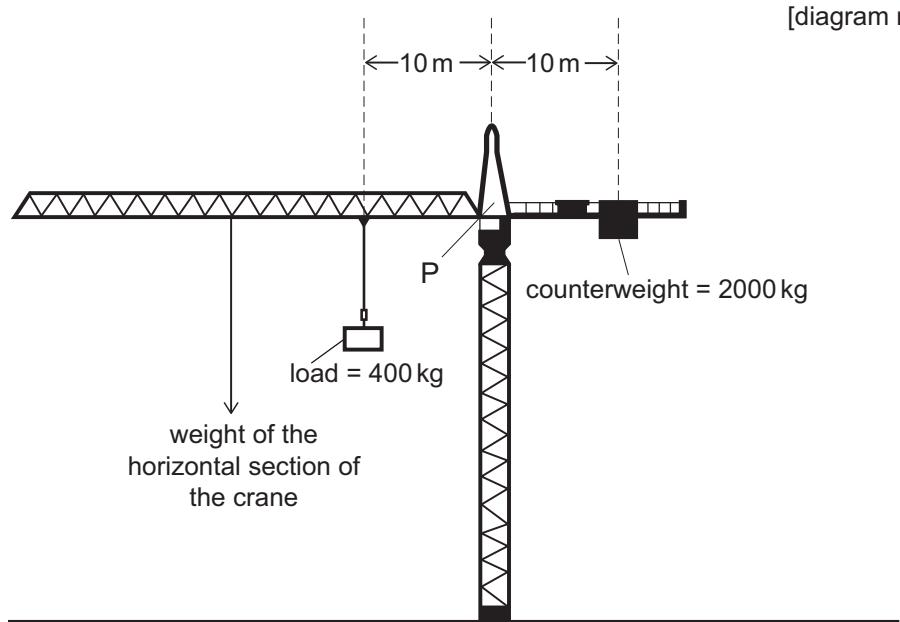
[diagram not to scale, shows a load of 400kg at 10m left of P and a counterweight of 2000kg at 10m right of P. The weight of the horizontal section of the crane is also a factor.]
The load is now moved to the left by 5.0 m.
To keep the crane perfectly balanced about P, how far does the counterweight have to move, and in which direction?
(gravitational field strength = )
[diagram not to scale, shows a load of 400kg at 10m left of P and a counterweight of 2000kg at 10m right of P. The weight of the horizontal section of the crane is also a factor.]
The load is now moved to the left by 5.0 m.
To keep the crane perfectly balanced about P, how far does the counterweight have to move, and in which direction?
(gravitational field strength = )
- A.1.0 m to the left
- B.1.0 m to the right
- C.3.0 m to the left
- D.3.0 m to the right
- E.4.0 m to the left
- F.4.0 m to the right
Answer: B
Question 31
1 mark is the smallest positive value of which is a solution to both the equations and .
How many values of in the range are solutions to at least one of these equations?
How many values of in the range are solutions to at least one of these equations?
- A.0
- B.2
- C.3
- D.4
- E.8
Answer: C
Question 32
1 markA ball is thrown vertically upwards in still air and is then caught at the same height when it comes back down.
Which velocity-time graph shows this complete motion?
(Take upwards as positive, and ignore air resistance.)
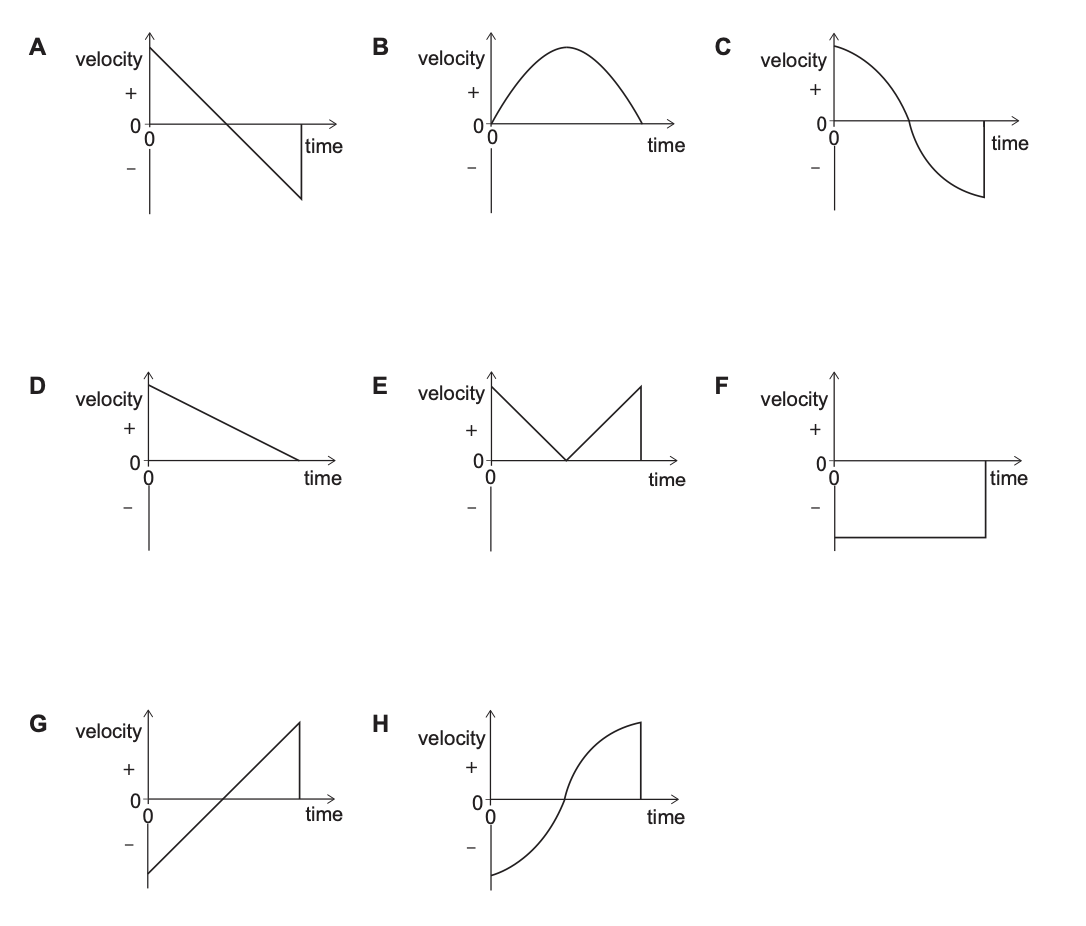
Which velocity-time graph shows this complete motion?
(Take upwards as positive, and ignore air resistance.)
- A.Graph of velocity vs time: straight line with negative slope, starting with positive velocity, crossing time axis, ending with negative velocity.
- B.Graph of velocity vs time: downward-opening parabola starting with positive velocity.
- C.Graph of velocity vs time: sine wave starting at a positive peak.
- D.Graph of velocity vs time: straight line with negative slope, starting with positive velocity, ending at zero velocity.
- E.Graph of velocity vs time: 'V' shape, negative slope to zero velocity, then positive slope.
- F.Graph of velocity vs time: step function, positive constant velocity then negative constant velocity.
- G.Graph of velocity vs time: 'V' shape, positive slope from negative velocity to zero, then positive slope to positive velocity.
- H.Graph of velocity vs time: sine wave starting from origin.
Answer: A
Question 33
1 markWhich of the following is a solution to the equation ?
- A.
- B.
- C.2
- D.
- E.
Answer: B
Question 34
1 markAn aircraft is climbing at constant speed in a straight line at an angle of to the horizontal.
Which statement about the resultant force on the aircraft is correct?
Which statement about the resultant force on the aircraft is correct?
- A.It is parallel to its motion.
- B.It is perpendicular to its motion.
- C.It is zero.
- D.It is equal to its weight.
- E.It is equal to the drag acting on the aircraft.
Answer: C
Question 35
1 markThe diagram shows the outline of a keyhole consisting of three straight sides and an arc from a circle.
The sides PQ and RS are both 18 mm in length and when extended meet at the centre of the circle O forming an angle of radians.
The longer arc from Q to R has length mm.
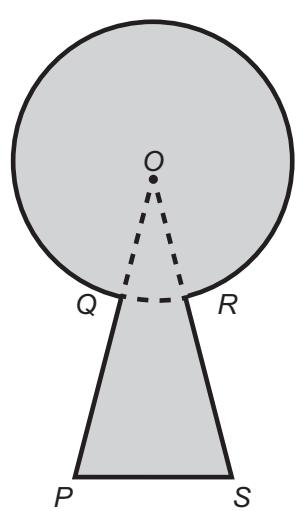
[diagram not to scale]
What is the area, in mm, of the keyhole as shaded in the diagram?
The sides PQ and RS are both 18 mm in length and when extended meet at the centre of the circle O forming an angle of radians.
The longer arc from Q to R has length mm.
[diagram not to scale]
What is the area, in mm, of the keyhole as shaded in the diagram?
- A.
- B.
- C.
- D.
- E.
- F.
Answer: C
Question 36
1 markA horizontal, uniform bar of mass 60 kg is 4.0 m long and is pivoted at one end. The bar is held in equilibrium by a force at the other end of the bar, acting at an angle of to the horizontal.
[diagram not to scale]

Which expression gives the magnitude of in newtons?
(gravitational field strength = )
[diagram not to scale]
Which expression gives the magnitude of in newtons?
(gravitational field strength = )
- A.
- B.
- C.
- D.
- E.
- F.
- G.
- H.
Answer: E
Question 37
1 markIt is given that and where and are real numbers.
Which of the following expressions is a simplification of ?
Which of the following expressions is a simplification of ?
- A.
- B.
- C.
- D.
- E.
- F.
- G.
- H.
Answer: F
Question 38
1 markA ball starts at a speed of . The ball is subject to a constant deceleration of as it travels a distance of 20.0 m in a straight line.
What is the final speed of the ball?
What is the final speed of the ball?
- A.
- B.
- C.
- D.
- E.
- F.
Answer: D
Question 39
1 markThe graph of the function , where and are real constants, has a local maximum when and a local minimum when .
What are the values of and ?
What are the values of and ?
- A. and
- B. and
- C. and
- D. and
- E. and
- F. and
Answer: D
Question 40
1 markA block of mass 1.0 kg is at rest on a rough horizontal surface. The block is attached by a light inextensible string to a force meter. The other end of the force meter is attached by another light inextensible string via a frictionless pulley to a load of mass 1.0 kg. The block remains stationary.
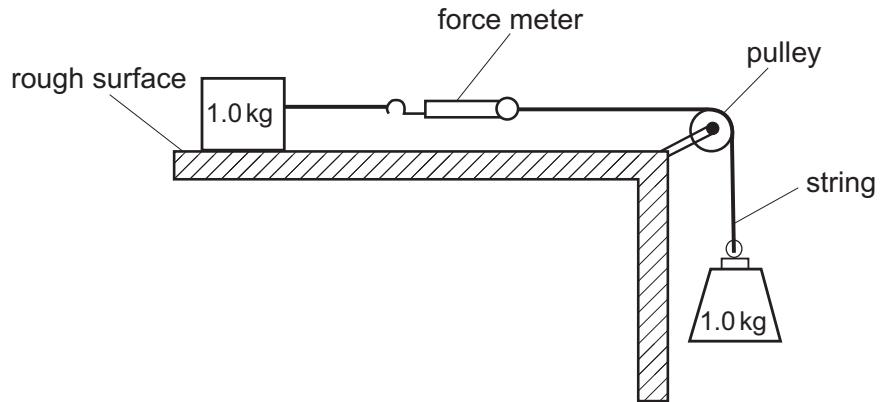
What is the reading on the force meter?
(gravitational field strength = )
What is the reading on the force meter?
(gravitational field strength = )
- A.0.0 N
- B.0.5 N
- C.1.0 N
- D.2.0 N
- E.5.0 N
- F.10 N
- G.20 N
Answer: F
Question 41
1 markIn triangle PQR
cm
cm
What is the maximum value of the area, in cm, of triangle PQR?
cm
cm
What is the maximum value of the area, in cm, of triangle PQR?
- A.
- B.
- C.
- D.
- E.
- F.
Answer: D
Question 42
1 markAn apple of mass 100 g, growing on a tree, falls vertically from a height of 4.0 m above the ground. It hits the ground with a speed of .
How much work does the apple do against resistive forces during its descent, before it hits the ground?
(gravitational field strength = )
How much work does the apple do against resistive forces during its descent, before it hits the ground?
(gravitational field strength = )
- A.0.80 J
- B.3.6 J
- C.4.0 J
- D.7.2 J
- E.8.0 J
Answer: A
Question 43
1 markGiven that , what is the coefficient of in ?
- A.240
- B.4320
- C.4860
- D.12960
- E.19440
Answer: E
Question 44
1 markA stone is fired vertically upwards at a speed of on a still day from the top of a 6.0 m high cliff. It then falls down and lands at the bottom of the cliff.
[diagram not to scale]
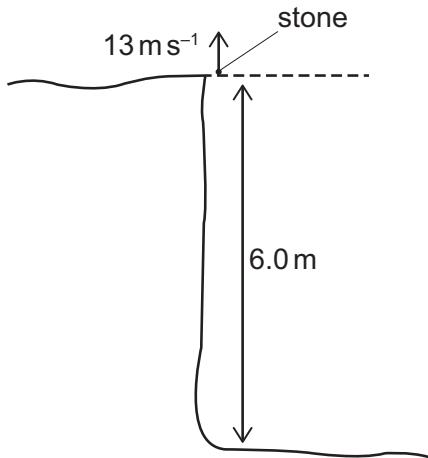
From when the stone passes the top of the cliff on the way down, how long does it take to reach the ground at the bottom of the cliff?
(air resistance can be ignored; gravitational field strength = )
[diagram not to scale]
From when the stone passes the top of the cliff on the way down, how long does it take to reach the ground at the bottom of the cliff?
(air resistance can be ignored; gravitational field strength = )
- A.0.40 s
- B. s
- C.0.60 s
- D. s
- E.1.3 s
- F.2.0 s
- G.2.5 s
- H.3.0 s
Answer: A
Question 45
1 markA geometric progression has first term equal to 1 and common ratio .
The sum to infinity of the series is .
Find the possible values of in the range .
The sum to infinity of the series is .
Find the possible values of in the range .
- A.
- B.
- C.
- D.
- E.there are no values of x in this range
Answer: A
Question 46
1 markAn archer fires an arrow of mass 0.024 kg vertically upwards from a bow.
The graph shows how the force of the bowstring on the arrow varies with distance as the arrow moves upwards.
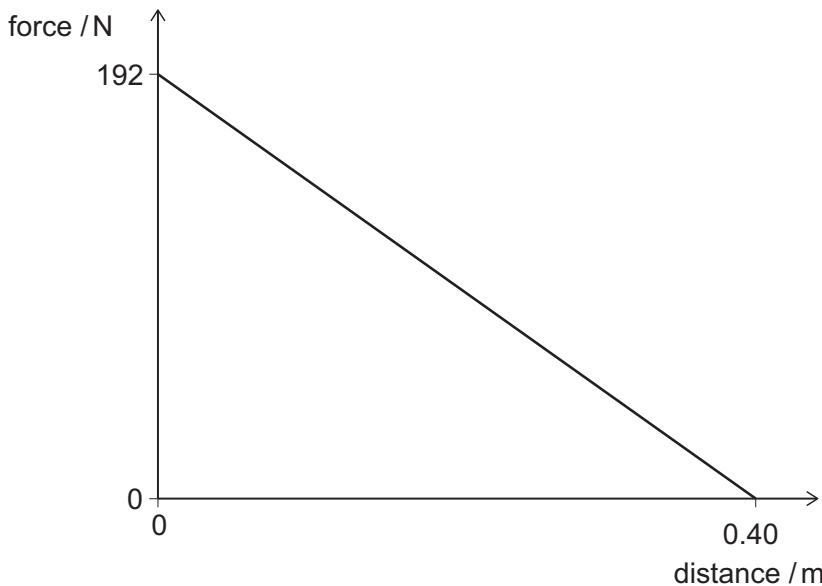
(Graph is linear, from (0, 192) to (0.40, 0))
The work done by the force of the bowstring is given by the area under the force-distance graph.
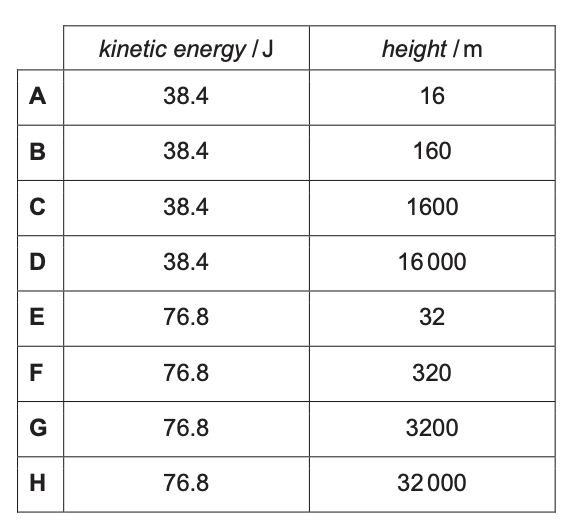
When the arrow leaves the bow, what is the kinetic energy of the arrow, and what is the maximum height that it gains from this point?
(Air resistance can be ignored. The effect of gravity as the arrow is fired is negligible compared to the force of the bowstring. The gravitational field strength = .)
The graph shows how the force of the bowstring on the arrow varies with distance as the arrow moves upwards.
(Graph is linear, from (0, 192) to (0.40, 0))
The work done by the force of the bowstring is given by the area under the force-distance graph.
When the arrow leaves the bow, what is the kinetic energy of the arrow, and what is the maximum height that it gains from this point?
(Air resistance can be ignored. The effect of gravity as the arrow is fired is negligible compared to the force of the bowstring. The gravitational field strength = .)
- A.kinetic energy / J: 38.4, height / m: 16
- B.kinetic energy / J: 38.4, height / m: 160
- C.kinetic energy / J: 38.4, height / m: 1600
- D.kinetic energy / J: 38.4, height / m: 16000
- E.kinetic energy / J: 76.8, height / m: 32
- F.kinetic energy / J: 76.8, height / m: 320
- G.kinetic energy / J: 76.8, height / m: 3200
- H.kinetic energy / J: 76.8, height / m: 32000
Answer: B
Question 47
1 markThe sequence of numbers is given by
where is an integer.
The fourth term, , is equal to -7.
What is the value of ?
where is an integer.
The fourth term, , is equal to -7.
What is the value of ?
- A.-10
- B.-2
- C.-1
- D.8
- E.26
Answer: C
Question 48
1 markA book of mass rests on a rough horizontal surface. The surface is now tilted as shown:
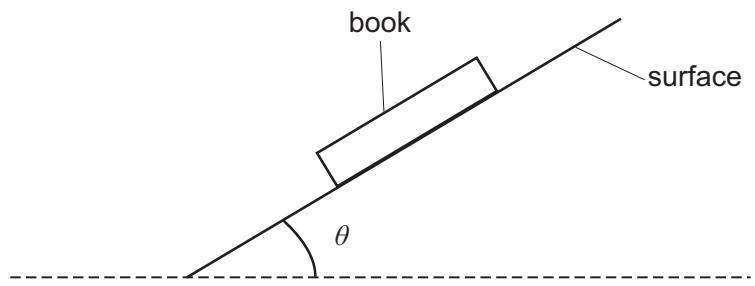
When the angle of tilt is , the book slides down the slope at a constant speed.
What is the acceleration of the book down the slope when the angle of tilt is ?
(gravitational field strength = )
When the angle of tilt is , the book slides down the slope at a constant speed.
What is the acceleration of the book down the slope when the angle of tilt is ?
(gravitational field strength = )
- A.
- B.
- C.
- D.
- E.
- F.
- G.
- H.
Answer: H
Question 49
1 markFind the complete set of values of for which
- A.
- B.
- C.
- D.
- E.
- F.
Answer: A
Question 50
1 markA suitcase of mass is on a conveyor belt which moves upwards at a constant speed at an angle of to the horizontal. The coefficient of friction between the suitcase and the slope is . The suitcase does not slip, even if angle is made slightly larger.
Which expression gives the friction force between the suitcase and the belt?
(gravitational field strength = )
Which expression gives the friction force between the suitcase and the belt?
(gravitational field strength = )
- A.
- B.
- C.
- D.
- E.
Answer: B
Question 51
1 markThe curve is stretched by a scale factor of parallel to the x-axis and then translated by in the negative x-direction.
What is the equation of the new curve?
What is the equation of the new curve?
- A.
- B.
- C.
- D.
- E.
- F.
- G.
- H.
Answer: H
Question 52
1 markThe graph shows how the horizontal force on a tennis ball of mass varies during a shot in a tennis match. The ball is initially travelling horizontally toward the racket with speed and leaves the racket horizontally travelling in the opposite direction with speed .
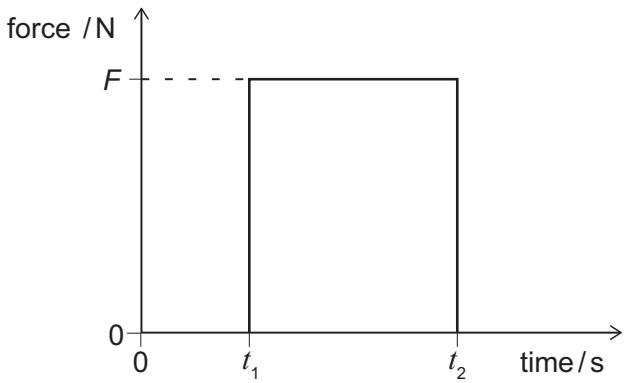
Which expression gives the magnitude of the momentum of the ball as it leaves the racket?
Which expression gives the magnitude of the momentum of the ball as it leaves the racket?
- A.
- B.
- C.
- D.
- E.
Answer: B
Question 53
1 markThe equations of two straight lines are and , where is a real constant.
For certain values of , the two lines are perpendicular.
Which of the following numbers is closest to the greatest such value of ?
For certain values of , the two lines are perpendicular.
Which of the following numbers is closest to the greatest such value of ?
- A.2.00
- B.1.75
- C.1.50
- D.1.00
- E.-0.25
- F.-0.50
Answer: B
Question 54
1 markThe acceleration versus time graph is for a ball dropped from rest, falling vertically and bouncing on the ground.
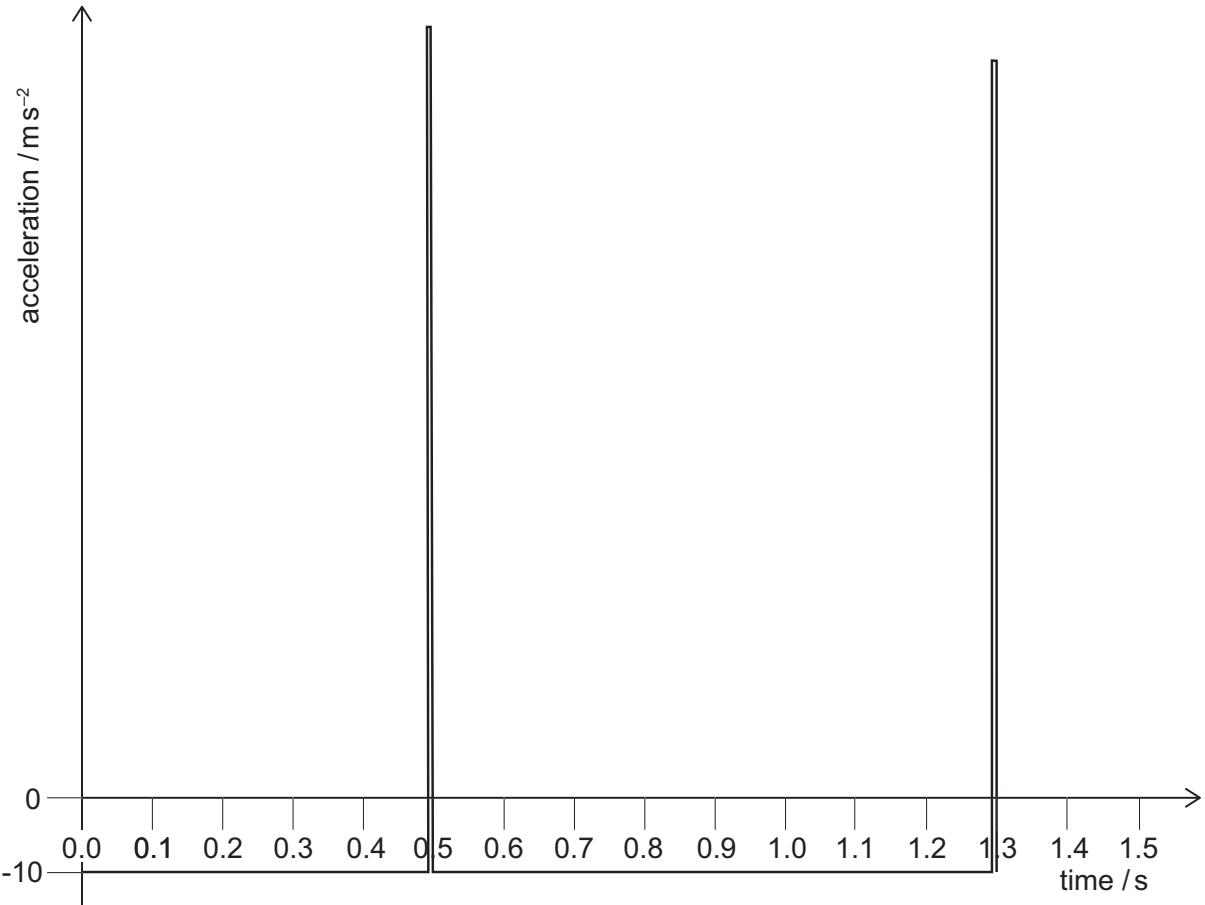
(Graph shows acceleration at -10 m/s^2, with vertical spikes at t=0.5s and t=1.3s indicating bounces. The time of contact with the ground can be ignored.)
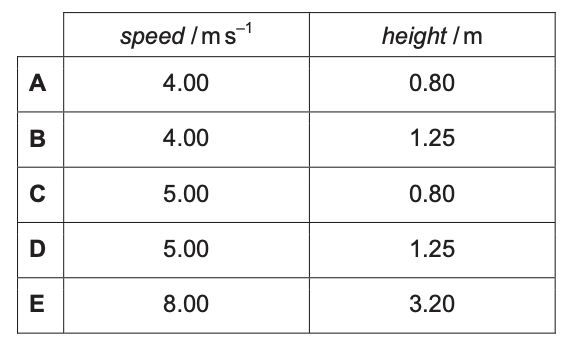
What is the speed of the ball immediately after hitting the ground for the first time, and what is the maximum height reached by the ball after the first bounce?
(gravitational field strength = )
(Graph shows acceleration at -10 m/s^2, with vertical spikes at t=0.5s and t=1.3s indicating bounces. The time of contact with the ground can be ignored.)
What is the speed of the ball immediately after hitting the ground for the first time, and what is the maximum height reached by the ball after the first bounce?
(gravitational field strength = )
- A.speed / : 4.00, height / m: 0.80
- B.speed / : 4.00, height / m: 1.25
- C.speed / : 5.00, height / m: 0.80
- D.speed / : 5.00, height / m: 1.25
- E.speed / : 8.00, height / m: 3.20
Answer: A