ENGAA 2019 (Paper 2)
The ENGAA 2019 (Paper 2) paper in full: all 20 questions, each with its answer. ENGAA is the Engineering Admissions Assessment. Sit it cold under exam timing, mark it, then work back through anything you missed using the solutions below.
Download the original PDF →Question 1
1 markNot in the current ESAT specification — included for completeness, but you won't be tested on it.
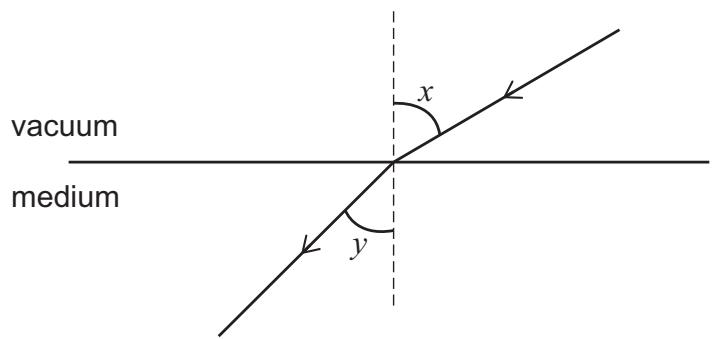
Two angles, and , are shown on the diagram.
When is , is .
When is , what is the value of ?
- A.
- B.
- C.1
- D.
- E.
Answer: A
Question 2
1 markNot in the current ESAT specification — included for completeness, but you won't be tested on it.

Each arrangement is connected, in turn, across the same battery which has a negligible internal resistance.
The total power developed in each of the arrangements is determined.
What is the order of the arrangements when placed in order of increasing power?
- A.X, Y, Z
- B.X, Z, Y
- C.Y, X, Z
- D.Y, Z, X
- E.Z, X, Y
- F.Z, Y, X
Answer: A
Question 3
1 markNot in the current ESAT specification — included for completeness, but you won't be tested on it.
The block is attached to a load of mass by a light, inextensible string which passes over a smooth pulley.
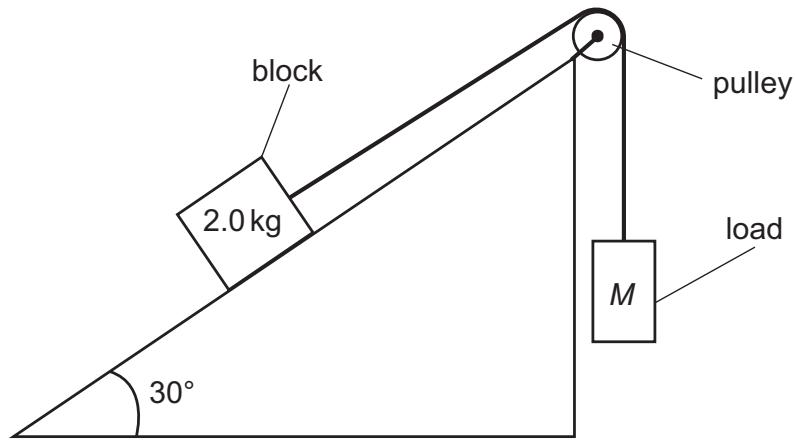
The load moves downwards at a constant speed.
A constant friction force of 5.0 N acts on the block while it moves.
What is the value of ?
(gravitational field strength = ; assume that air resistance is negligible)
- A.0.50 kg
- B.1.0 kg
- C.1.5 kg
- D.2.5 kg
- E.4.0 kg
- F.6.0 kg
Answer: C
Question 4
1 markNot in the current ESAT specification — included for completeness, but you won't be tested on it.
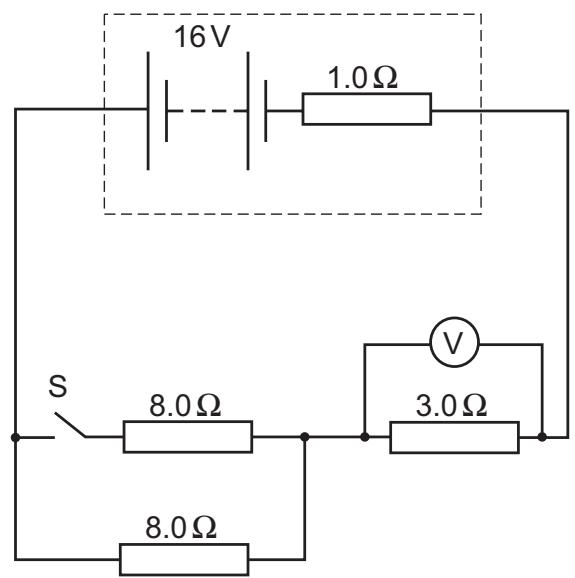
Which line in the table gives the voltmeter readings when switch S is in its open and closed states?
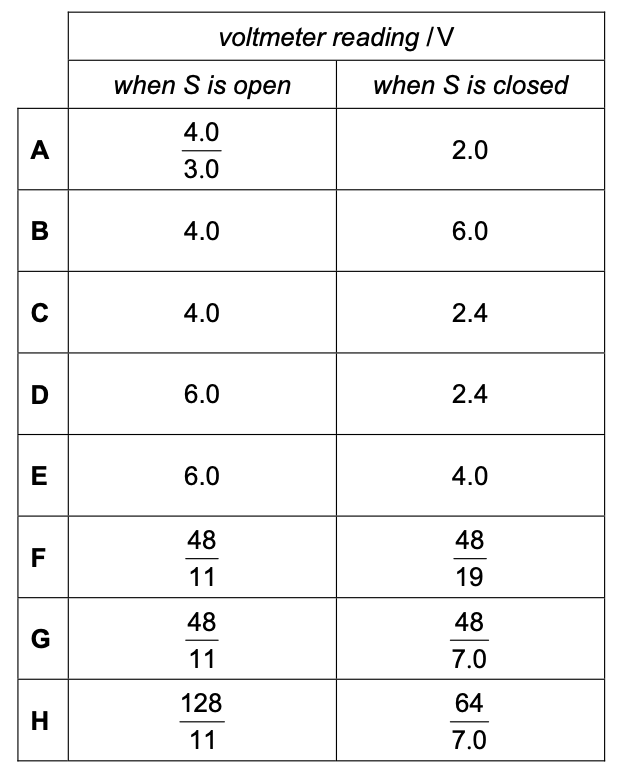
- A.voltmeter reading / V when S is open: 4.0, when S is closed: 2.0
- B.voltmeter reading / V when S is open: 4.0, when S is closed: 6.0
- C.voltmeter reading / V when S is open: 4.0, when S is closed: 2.4
- D.voltmeter reading / V when S is open: 6.0, when S is closed: 2.4
- E.voltmeter reading / V when S is open: 6.0, when S is closed: 4.0
- F.voltmeter reading / V when S is open: , when S is closed:
- G.voltmeter reading / V when S is open: , when S is closed:
- H.voltmeter reading / V when S is open: , when S is closed:
Answer: B
Question 5
1 markNot in the current ESAT specification — included for completeness, but you won't be tested on it.
The stationary wave is formed by the superposition of two longitudinal waves, each of amplitude 1.5 cm, travelling in opposite directions.
The distance between adjacent nodes in the stationary wave is 4.0 cm.
What is the total distance travelled by a particle at an antinode during a time interval of 1.0 minute?
- A.0 m
- B.72 m
- C.144 m
- D.192 m
- E.288 m
- F.576 m
Answer: E
Question 6
1 markNot in the current ESAT specification — included for completeness, but you won't be tested on it.
The ray strikes the boundary between the block and air at an angle to the boundary.
When , the ray is just at the threshold of being totally internally reflected.
Which of the following is an expression for the wavelength of the light in the material?
(The speed of light in air is .)
- A.
- B.
- C.
- D.
- E.
- F.
- G.
- H.
Answer: A
Question 7
1 markNot in the current ESAT specification — included for completeness, but you won't be tested on it.
The density of the stone from which the pyramid is made is .
Atmospheric pressure is 100 kPa.
What is the average pressure on the ground under the pyramid?
(gravitational field strength = ; volume of a pyramid = )
- A.98 kPa
- B.108 kPa
- C.198 kPa
- D.980 kPa
- E.1080 kPa
- F.2940 kPa
- G.3040 kPa
Answer: E
Question 8
1 markNot in the current ESAT specification — included for completeness, but you won't be tested on it.
A spherical bubble of gas forms at the bottom of a glass containing a fizzy drink.
The radius of the bubble at the point of formation, at the bottom of the drink, is .
The depth of the liquid in the glass is , and the density of the liquid of the drink is .
Atmospheric pressure is .
As the bubble rises, its radius changes.
Which expression gives the radius of the bubble when it is at a distance below the surface of the drink?
(gravitational field strength = ; volume of sphere = where is the radius; the mass and the temperature of the gas in the bubble remain constant)
- A.
- B.
- C.
- D.
- E.
- F.
Answer: C
Question 9
1 markNot in the current ESAT specification — included for completeness, but you won't be tested on it.
The slope is at an angle of to the horizontal.
The block reaches a speed of , at which point the slope becomes rough and the block begins to decelerate.
After travelling a distance of 4.0 m down the rough slope the block comes to rest.
What is the magnitude of the average friction force between the block and the rough slope?
(gravitational field strength = ; assume that air resistance is negligible)
- A.2.0 N
- B.6.0 N
- C.10 N
- D.12 N
- E.16 N
- F. N
- G.26 N
- H. N
Answer: G
Question 10
1 markNot in the current ESAT specification — included for completeness, but you won't be tested on it.
The normal contact force at the pivot is 800 N.
What is the weight of the beam and how far is the centre of gravity of the beam from the pivot?
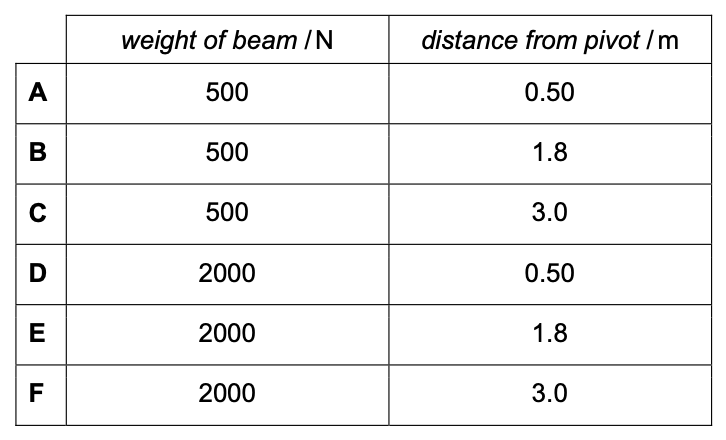
- A.weight of beam: 500 N, distance from pivot: 0.50 m
- B.weight of beam: 500 N, distance from pivot: 1.8 m
- C.weight of beam: 500 N, distance from pivot: 3.0 m
- D.weight of beam: 2000 N, distance from pivot: 0.50 m
- E.weight of beam: 2000 N, distance from pivot: 1.8 m
- F.weight of beam: 2000 N, distance from pivot: 3.0 m
Answer: E
Question 11
1 markNot in the current ESAT specification — included for completeness, but you won't be tested on it.
It travels 12.2 m in the 3rd second and 14.4 m in the 4th second after passing the road sign.
What was the speed of the car as it passed the road sign?
- A.
- B.
- C.
- D.
- E.
- F.
Answer: C
Question 12
1 markNot in the current ESAT specification — included for completeness, but you won't be tested on it.
The spring is stretched by a varying tension force that starts at a value of zero and increases at a constant rate of up to a maximum value.
When the force reaches its maximum value, the strain energy of the spring is 0.25 J.
What is the average power used to stretch the spring?
(Assume that the spring obeys Hooke's law.)
- A.0.010 W
- B.0.020 W
- C.0.040 W
- D.0.080 W
- E.1.0 W
- F.2.0 W
- G.4.0 W
- H.8.0 W
Answer: A
Question 13
1 markNot in the current ESAT specification — included for completeness, but you won't be tested on it.
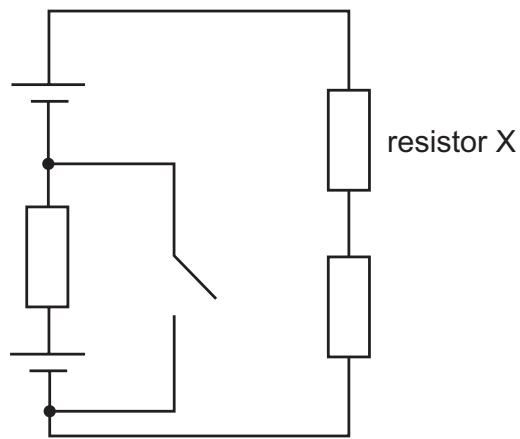
What is the power dissipated by resistor X after the switch is closed?
- A.
- B.
- C.
- D.
- E.
- F.
Answer: B
Question 14
1 markNot in the current ESAT specification — included for completeness, but you won't be tested on it.
The caravan is connected to the car by a metal bar of length and cross-sectional area .
The Young modulus of the metal from which the bar is made is .
The car and caravan have a constant forward acceleration and there are total resistive forces acting on the car and acting on the caravan.
What is the extension of the bar?
(Assume that the bar obeys Hooke's law and that the cross-sectional area of the bar remains unchanged.)
- A.
- B.
- C.
- D.
- E.
- F.
Answer: C
Question 15
1 markNot in the current ESAT specification — included for completeness, but you won't be tested on it.
P and S each have resistance . Q and R each have resistance .
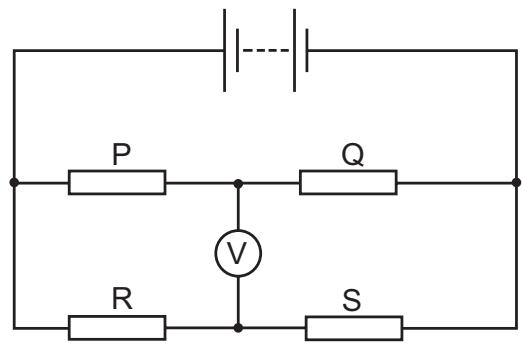
A fifth resistor, T, which has resistance , is to be added to the circuit in one of the following listed positions, as shown in the diagram:
1 in parallel with P
2 in series with Q
3 in parallel with R
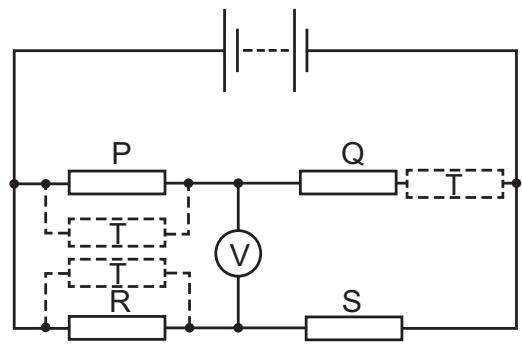
Which of the positions for resistor T causes an increase in the magnitude of the voltmeter reading?
- A.none of them
- B.1 only
- C.2 only
- D.3 only
- E.1 and 2 only
- F.1 and 3 only
- G.2 and 3 only
- H.1, 2 and 3
Answer: E
Question 16
1 markNot in the current ESAT specification — included for completeness, but you won't be tested on it.
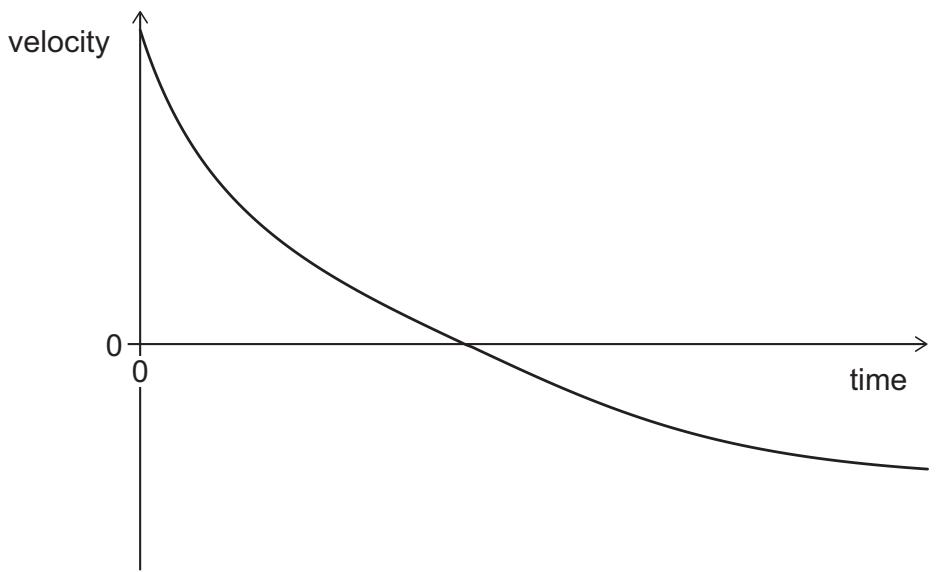
Which of the following statements is/are correct?
1 The magnitude of the acceleration of the ball is only equal to the magnitude of the acceleration of free fall when it is at its highest point.
2 The time taken for the upward journey of the ball is equal to the time taken for the journey back down to its starting position.
3 The maximum increase in the gravitational potential energy of the ball is less than its initial kinetic energy and greater than its kinetic energy when it returns to its starting position.
- A.none of them
- B.1 only
- C.2 only
- D.3 only
- E.1 and 2 only
- F.1 and 3 only
- G.2 and 3 only
- H.1, 2 and 3
Answer: F
Question 17
1 markNot in the current ESAT specification — included for completeness, but you won't be tested on it.
After 1.0 s the stone lands on a ledge at height above the level ground.
During this journey the vertical component of velocity of the stone is upwards for the first 0.60 s and downwards for the remaining 0.40 s.
What is the value of ?
(gravitational field strength = ; assume that air resistance is negligible)
- A.1.0 m
- B.1.6 m
- C.2.0 m
- D.3.0 m
- E.3.2 m
- F.6.0 m
- G.7.0 m
- H.11 m
Answer: A
Question 18
1 markNot in the current ESAT specification — included for completeness, but you won't be tested on it.
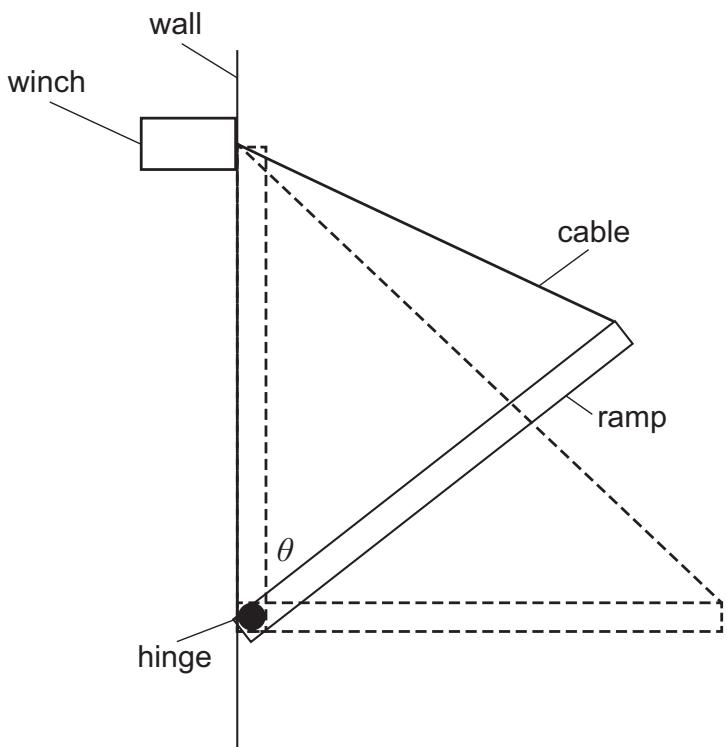
The ramp is lowered slowly, at constant speed, from its closed (vertical) position () to its open (horizontal) position ().
What is the maximum tension in the cable during this process?
(double-angle identities: ; )
- A.
- B.
- C.
- D.
- E.
- F.
- G.
Answer: B
Question 19
1 markNot in the current ESAT specification — included for completeness, but you won't be tested on it.
Which of the following expressions gives the total kinetic energy transferred to other forms of energy in the collision?
- A.0
- B.
- C.
- D.
- E.
- F.
- G.
Answer: B
Question 20
1 markNot in the current ESAT specification — included for completeness, but you won't be tested on it.
The critical angle for light of the same frequency incident on a boundary from medium Y to air is .
There is a boundary between medium X and medium Y. Light of the same frequency travelling in one of these mediums is incident on this boundary.
In which direction of incidence is there a critical angle at this boundary, and within what range is this critical angle?
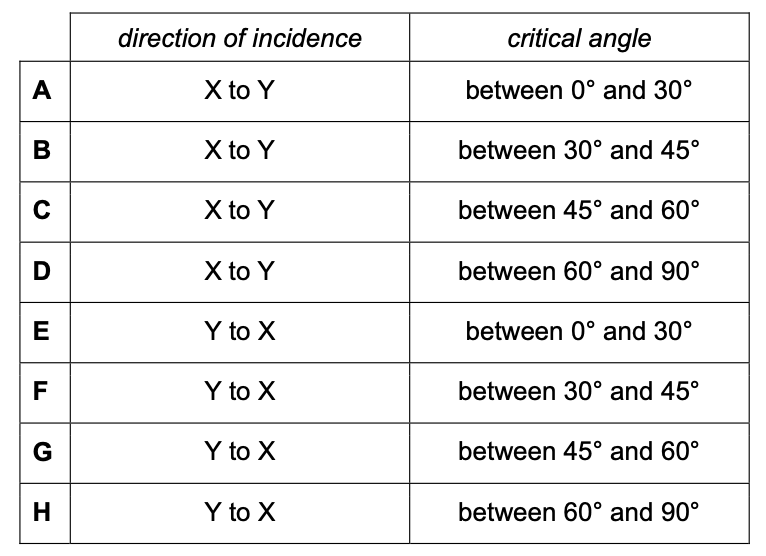
- A.direction of incidence: X to Y, critical angle: between and
- B.direction of incidence: X to Y, critical angle: between and
- C.direction of incidence: X to Y, critical angle: between and
- D.direction of incidence: X to Y, critical angle: between and
- E.direction of incidence: Y to X, critical angle: between and
- F.direction of incidence: Y to X, critical angle: between and
- G.direction of incidence: Y to X, critical angle: between and
- H.direction of incidence: Y to X, critical angle: between and
Answer: C