ENGAA 2019 D564/11
40 questions40 marks60Updated August 2025
The ENGAA 2019 D564/11 paper in full: all 40 questions, each with its answer. ENGAA is the Engineering Admissions Assessment. Sit it cold under exam timing, mark it, then work back through anything you missed using the solutions below.
Download the original PDF →Questions and answers are free. Full step-by-step worked solutions unlock with a free account. Start practising.
Question 1
1 mark- A.0
- B.
- C.
- D.
- E.10
- F.
- G.20
Answer: F
Question 2
1 markThe current-voltage graph for a diode is shown.
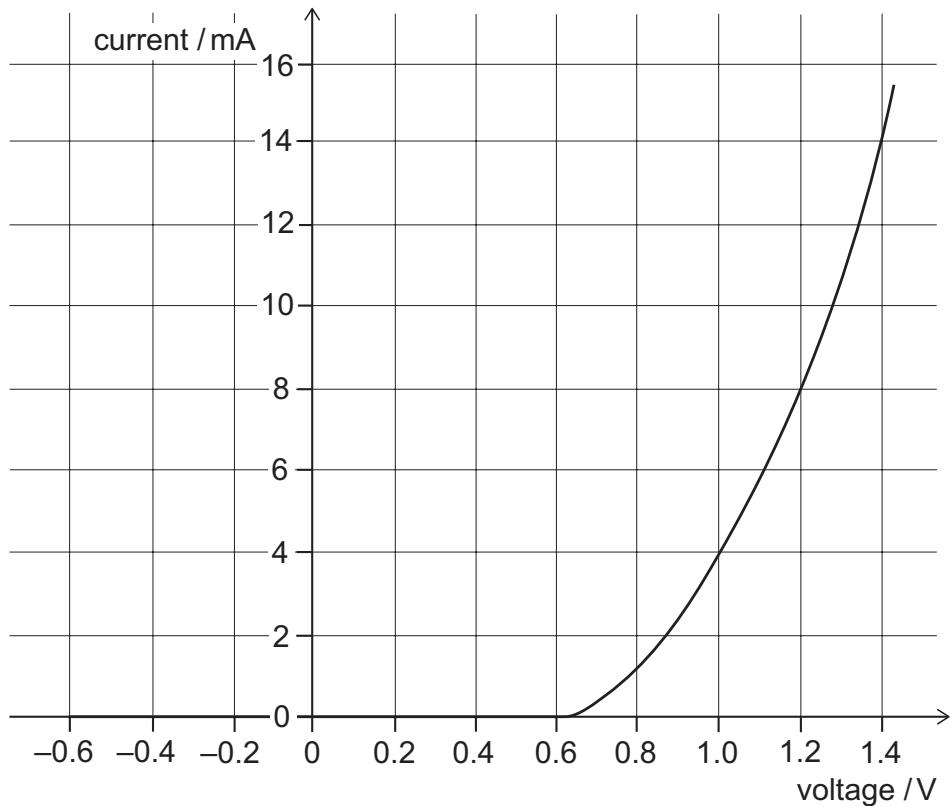
The diode is connected in series with a resistor and a 6.0 V battery. The current in the circuit is 8.0 mA.
What is the resistance of the resistor?
(Assume that the battery has negligible resistance.)
The diode is connected in series with a resistor and a 6.0 V battery. The current in the circuit is 8.0 mA.
What is the resistance of the resistor?
(Assume that the battery has negligible resistance.)
- A.
- B.
- C.
- D.
- E.
- F.
- G.
Answer: F
Question 3
1 markThe equation gives y in terms of x:
Which one of the following is a rearrangement for x in terms of y?
Which one of the following is a rearrangement for x in terms of y?
- A.
- B.
- C.
- D.
- E.
- F.
- G.
Answer: E
Question 4
1 markTwo electromagnetic waves P and Q travel in a vacuum and the ratio of their wavelengths is:
Which row in the table shows the ratio of their speeds, the ratio of their frequencies, and identifies the possible natures of P and Q?
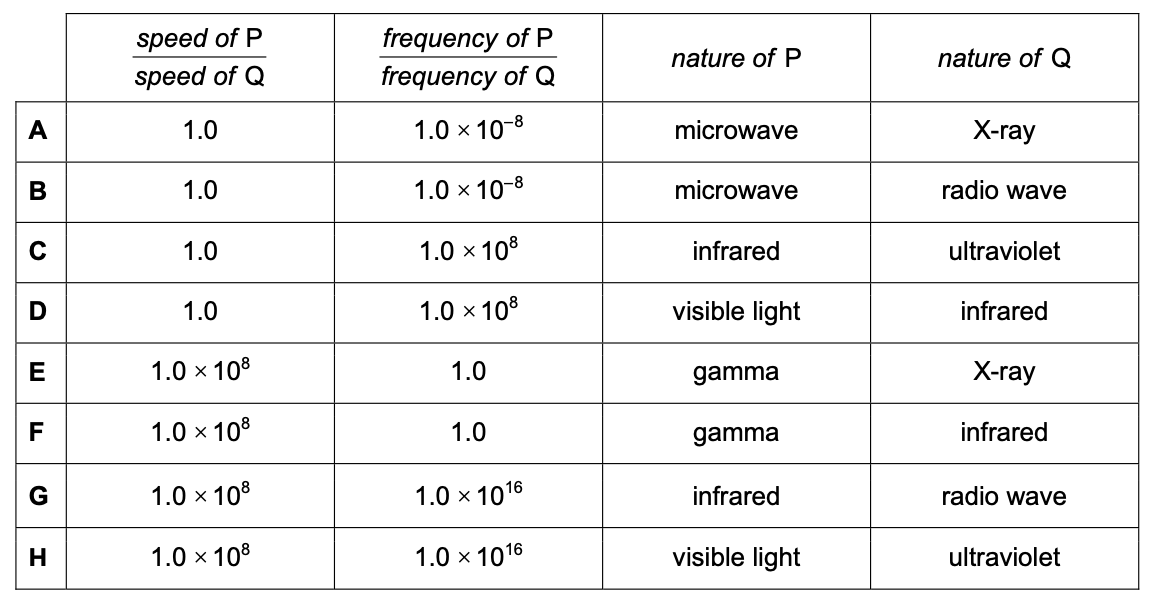
- A.speed of P speed of Q: 1.0, frequency of P frequency of Q: , nature of P: microwave, nature of Q: X-ray
- B.speed of P speed of Q: 1.0, frequency of P frequency of Q: , nature of P: microwave, nature of Q: radio wave
- C.speed of P speed of Q: 1.0, frequency of P frequency of Q: , nature of P: infrared, nature of Q: ultraviolet
- D.speed of P speed of Q: 1.0, frequency of P frequency of Q: , nature of P: visible light, nature of Q: infrared
- E.speed of P speed of Q: , frequency of P frequency of Q: 1.0, nature of P: gamma, nature of Q: X-ray
- F.speed of P speed of Q: , frequency of P frequency of Q: 1.0, nature of P: gamma, nature of Q: infrared
- G.speed of P speed of Q: , frequency of P frequency of Q: , nature of P: infrared, nature of Q: radio wave
- H.speed of P speed of Q: , frequency of P frequency of Q: , nature of P: visible light, nature of Q: ultraviolet
Answer: A
Question 5
1 markThe resistance to the motion of a car is directly proportional to the square of the speed of the car.
The car increases its speed by 20%.
What is the percentage increase in the resistance to the motion of the car?
The car increases its speed by 20%.
What is the percentage increase in the resistance to the motion of the car?
- A.20%
- B.24%
- C.44%
- D.120%
- E.224%
- F.240%
- G.400%
Answer: C
Question 6
1 markA water-tight cylinder with a thin, freely moving piston contains of trapped air at atmospheric pressure of .
When the cylinder is submerged in water of constant density , the volume of air in the cylinder decreases to .
The piston is at a depth h below the surface of the water and the water surface is open to the atmosphere.
What is the depth h?
(gravitational field strength = ; assume that the temperature of the air remains constant and that air is an ideal gas)
When the cylinder is submerged in water of constant density , the volume of air in the cylinder decreases to .
The piston is at a depth h below the surface of the water and the water surface is open to the atmosphere.
What is the depth h?
(gravitational field strength = ; assume that the temperature of the air remains constant and that air is an ideal gas)
- A.40 m
- B.50 m
- C.60 m
- D.400 m
- E.500 m
- F.600 m
Answer: A
Question 7
1 markThe equation of a curve is where p and q are constants.
The curve passes through the points (2, 6) and (4,-4).
What is the value of ?
The curve passes through the points (2, 6) and (4,-4).
What is the value of ?
- A.1
- B.2
- C.5
- D.6
- E.9
- F.16
Answer: E
Question 8
1 markThe secondary coil of an ideal, 100% efficient transformer is connected to a resistor by cables of total resistance . The current in the primary coil is 4.0 A. There are 240 turns in the primary coil and 4800 turns in the secondary coil.
What is the power produced as heat in the cables?
What is the power produced as heat in the cables?
- A.60 W
- B.300 W
- C.6000 W
- D.24000 W
- E.120000 W
- F.9600000 W
Answer: A
Question 9
1 markWhich of the following is a simplification of
- A.
- B.
- C.
- D.
- E.
- F.
Answer: D
Question 10
1 markTwo tanks of water are connected by a solid cylindrical copper bar of length and diameter .
The bar is insulated.
One tank contains water at and the other tank contains water at temperature .
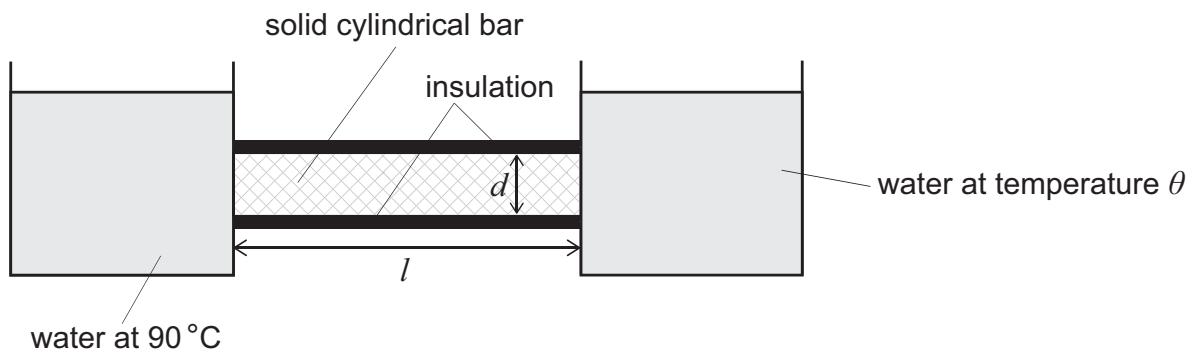
For which of the following conditions is thermal energy conducted along the bar at the lowest rate?
The bar is insulated.
One tank contains water at and the other tank contains water at temperature .
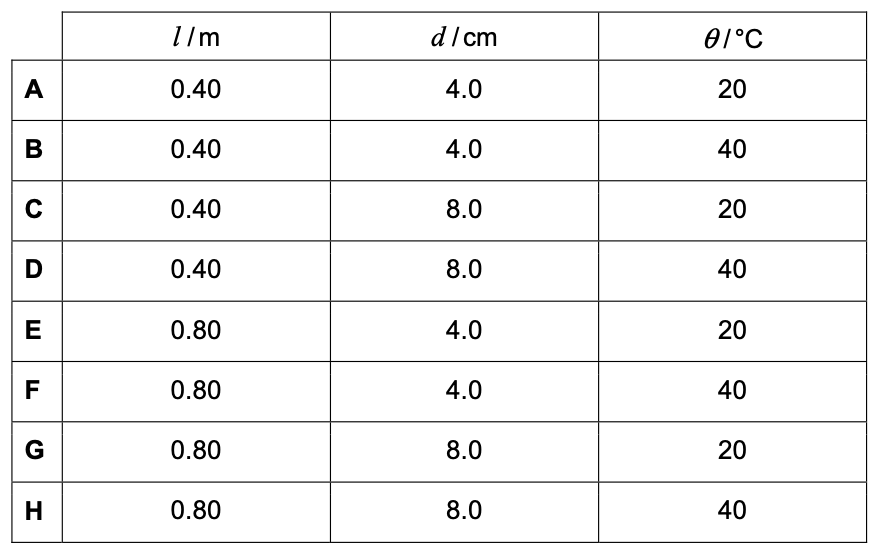
For which of the following conditions is thermal energy conducted along the bar at the lowest rate?
- A.: 0.40, : 4.0, : 20
- B.: 0.40, : 4.0, : 40
- C.: 0.40, : 8.0, : 20
- D.: 0.40, : 8.0, : 40
- E.: 0.80, : 4.0, : 20
- F.: 0.80, : 4.0, : 40
- G.: 0.80, : 8.0, : 20
- H.: 0.80, : 8.0, : 40
Answer: F
Question 11
1 markThe ball for a garden game is a solid sphere of volume .
For the children's version of the game the ball is a solid sphere made of the same material, but the radius is reduced by 25%.
What is the volume, in , of the children's ball?
For the children's version of the game the ball is a solid sphere made of the same material, but the radius is reduced by 25%.
What is the volume, in , of the children's ball?
- A.48
- B.81
- C.96
- D.108
- E.144
Answer: B
Question 12
1 markThe radioactive isotope X becomes the stable isotope Y after a succession of decays involving only the emission of alpha and beta () particles.
During the decay of one nucleus from X to Y, a total of seven particles are emitted. It is known that more of these particles are alpha particles than beta particles.
The atomic number of X is Z and the mass number of X is A.
Which row in the table could give the atomic number and the mass number of Y?
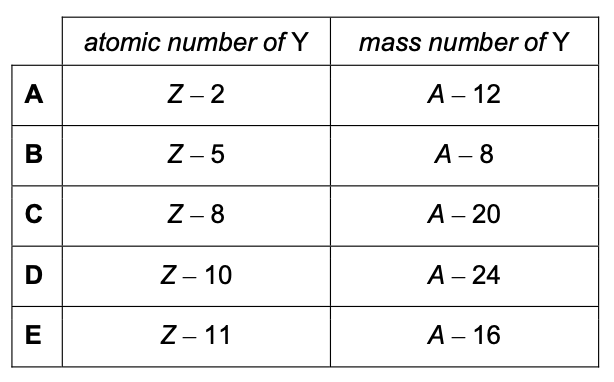
During the decay of one nucleus from X to Y, a total of seven particles are emitted. It is known that more of these particles are alpha particles than beta particles.
The atomic number of X is Z and the mass number of X is A.
Which row in the table could give the atomic number and the mass number of Y?
- A.atomic number of Y: Z-2, mass number of Y: A-12
- B.atomic number of Y: Z-5, mass number of Y: A-8
- C.atomic number of Y: Z-8, mass number of Y: A-20
- D.atomic number of Y: Z-10, mass number of Y: A-24
- E.atomic number of Y: Z-11, mass number of Y: A-16
Answer: C
Question 13
1 markThe diagram shows a right-angled triangle, with sides of length , and , all in cm.
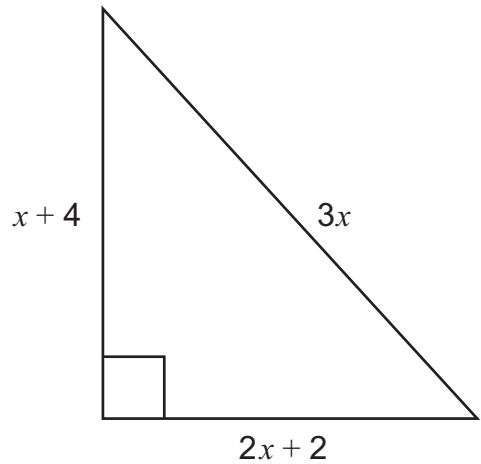
[diagram not to scale]
What is the area, in , of the triangle?
[diagram not to scale]
What is the area, in , of the triangle?
- A.10
- B.12
- C.28
- D.36
- E.40
- F.54
- G.70
Answer: F
Question 14
1 markThe kinetic energy of an object of mass 4.0kg, travelling in a straight line, increases from 32 J to 200 J in 3.0 seconds due to a constant resultant force.
What is the value of this resultant force?
What is the value of this resultant force?
- A.2.0 N
- B.4.0 N
- C.8.0 N
- D.24 N
- E.28 N
- F.56 N
Answer: C
Question 15
1 markPR and QS are the diagonals of a rhombus PQRS.
PR = cm
QS = cm
The area of PQRS is .
What is the difference, in cm, between the two possible lengths of PR?
PR = cm
QS = cm
The area of PQRS is .
What is the difference, in cm, between the two possible lengths of PR?
- A.
- B.
- C.
- D.8
- E.14
Answer: D
Question 16
1 markIn the following circuit, all five resistors have the same resistance.
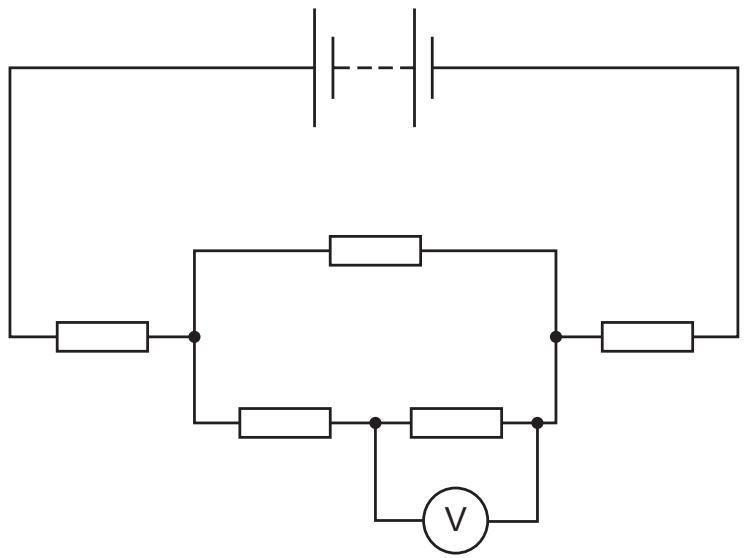
The reading on the voltmeter is 1.0V.
What is the voltage across the battery?
The reading on the voltmeter is 1.0V.
What is the voltage across the battery?
- A.4.0 V
- B.5.0 V
- C.6.0 V
- D.7.0 V
- E.8.0 V
- F.9.0 V
- G.10 V
Answer: E
Question 17
1 markThe diagram shows two congruent right-angled triangles PQR and TSR with right angles at Q and S, respectively.
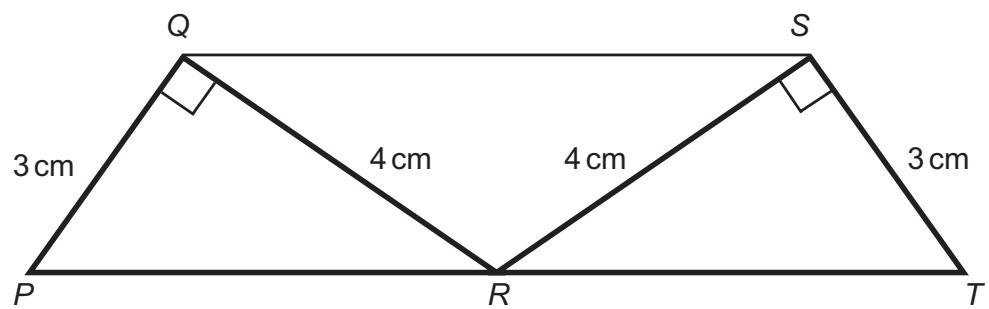
[diagram not to scale]
PQ = TS = 3 cm
QR = SR = 4 cm
PRT is a straight line.
What is the length, in cm, of QS?
[diagram not to scale]
PQ = TS = 3 cm
QR = SR = 4 cm
PRT is a straight line.
What is the length, in cm, of QS?
- A.4
- B.
- C.5.2
- D.
- E.6.4
- F.8.2
- G.10
Answer: E
Question 18
1 markA block is designed with a cylindrical channel to accommodate a hot-water pipe. The block is 100 cm long and it has a square cross-section of side 22.0 cm with a cylindrical hole in the middle, as shown in the diagram:
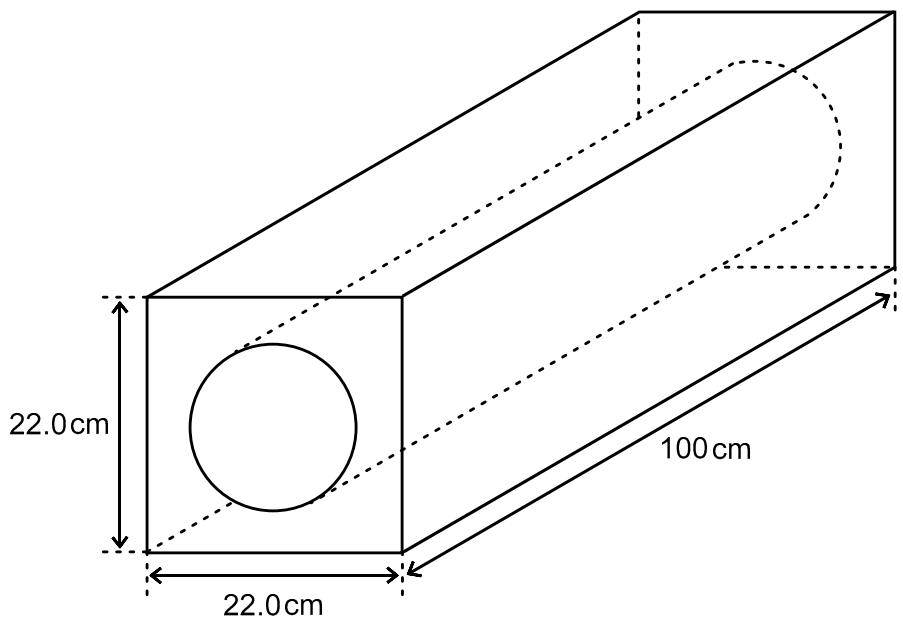
[diagram not to scale]
The diameter of the cylindrical hole is 14.0 cm and the density of the material from which the block is made is .
What is the mass of the block?
(take to be )
[diagram not to scale]
The diameter of the cylindrical hole is 14.0 cm and the density of the material from which the block is made is .
What is the mass of the block?
(take to be )
- A.1.32 kg
- B.3.30 kg
- C.13.2 kg
- D.33.0 kg
- E.132 kg
- F.330 kg
- G.1320 kg
- H.3300 kg
Answer: B
Question 19
1 markA solid pyramid has a square base of side length 12cm and a vertical height of h cm.
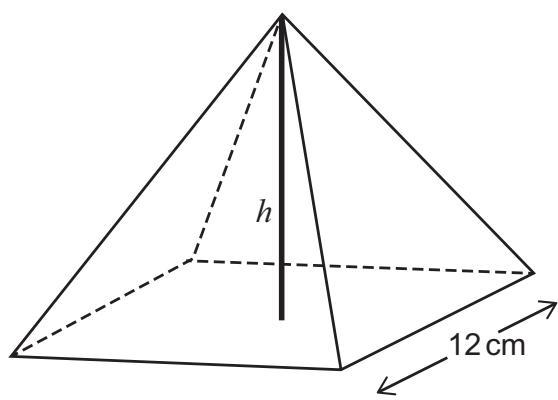
[diagram not to scale]
The volume of the pyramid, in , is equal to the total surface area of the pyramid, in .
What is the value of h?
(volume of pyramid =
[diagram not to scale]
The volume of the pyramid, in , is equal to the total surface area of the pyramid, in .
What is the value of h?
(volume of pyramid =
- A.
- B.
- C.6
- D.
- E.8
- F.
Answer: E
Question 20
1 markA sample initially contains equal numbers of atoms of a radioactive isotope X and a stable isotope Y.
Isotope X has a half-life of 3 years and decays in a single stage to the stable isotope Y.
What is the ratio
number of atoms of X: number of atoms of Y
in the sample 6 years later?
Isotope X has a half-life of 3 years and decays in a single stage to the stable isotope Y.
What is the ratio
number of atoms of X: number of atoms of Y
in the sample 6 years later?
- A.The sample contains only isotope Y.
- B.1:7
- C.1:4
- D.1:3
- E.7:4
Answer: B
Question 21
1 markFind the area of the shape bounded by the four lines:
- A.4
- B.12
- C.21
- D.25
- E.27
- F.30
Answer: C
Question 22
1 markA hydroelectric power station uses the water in a reservoir to power the generators. The water falls through a vertical height of 150m to the turbines which power the generators.
The efficiency of the power station is 90% and the output power of the power station is 1800 MW.
The gravitational field strength is and the density of water is .
What volume of water passes through the turbines in one minute?
The efficiency of the power station is 90% and the output power of the power station is 1800 MW.
The gravitational field strength is and the density of water is .
What volume of water passes through the turbines in one minute?
- A.
- B.
- C.
- D.
- E.
- F.
Answer: C
Question 23
1 markThe curve
has a local maximum when and a local minimum when
What is the value of p?
has a local maximum when and a local minimum when
What is the value of p?
- A.-9
- B.-3
- C.-1
- D.1
- E.3
- F.9
Answer: B
Question 24
1 markA car P of mass 1000 kg is travelling north at along a straight, horizontal road when it hits another car Q which is directly ahead of P and travelling in the same direction. Car Q has a mass of 500 kg and is travelling at .
The collision lasts for 0.20 s and immediately after the collision car Q is moving north at .
What is the speed of P immediately after the collision and what is the size of the average resultant force that acts on Q during the collision?
(Assume that no external forces act on the cars during the collision.)
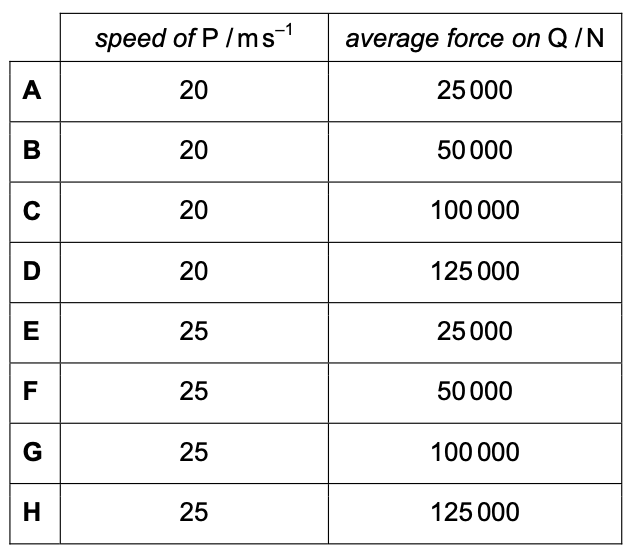
The collision lasts for 0.20 s and immediately after the collision car Q is moving north at .
What is the speed of P immediately after the collision and what is the size of the average resultant force that acts on Q during the collision?
(Assume that no external forces act on the cars during the collision.)
- A.speed of P / : 20, average force on Q / N: 25000
- B.speed of P / : 20, average force on Q / N: 50000
- C.speed of P / : 20, average force on Q / N: 100 000
- D.speed of P / : 20, average force on Q / N: 125000
- E.speed of P / : 25, average force on Q / N: 25000
- F.speed of P / : 25, average force on Q / N: 50000
- G.speed of P / : 25, average force on Q / N: 100 000
- H.speed of P / : 25, average force on Q / N: 125000
Answer: E
Question 25
1 markWhen simplified,
is written in the form where a and b are integers.
What is the value of b?
is written in the form where a and b are integers.
What is the value of b?
- A.-7
- B.-5
- C.-1
- D.1
- E.5
- F.7
Answer: B
Question 26
1 markA metal wire of length 0.50m has a uniform cross-sectional area of .
There is a current of 4.0 A in the wire.
What is the potential difference across the ends of the wire?
(resistivity of the metal = )
There is a current of 4.0 A in the wire.
What is the potential difference across the ends of the wire?
(resistivity of the metal = )
- A.0.05 V
- B.0.20 V
- C.0.80 V
- D.3.2 V
- E.5.0 V
- F.20 V
Answer: C
Question 27
1 markIt is given that
where
What are the possible values of ?
where
What are the possible values of ?
- A. or
- B. or
- C. or
- D. or
- E.3 or 2
Answer: D
Question 28
1 markA uniform square trap door of side 0.80 m and mass 14kg has a smooth hinge at one edge and is held open at an angle of 30° to the horizontal. It is supported by a single rigid rod placed so that it meets the surface of the trap door at 90° at a distance 0.10m from the top edge of the trap door, as shown.
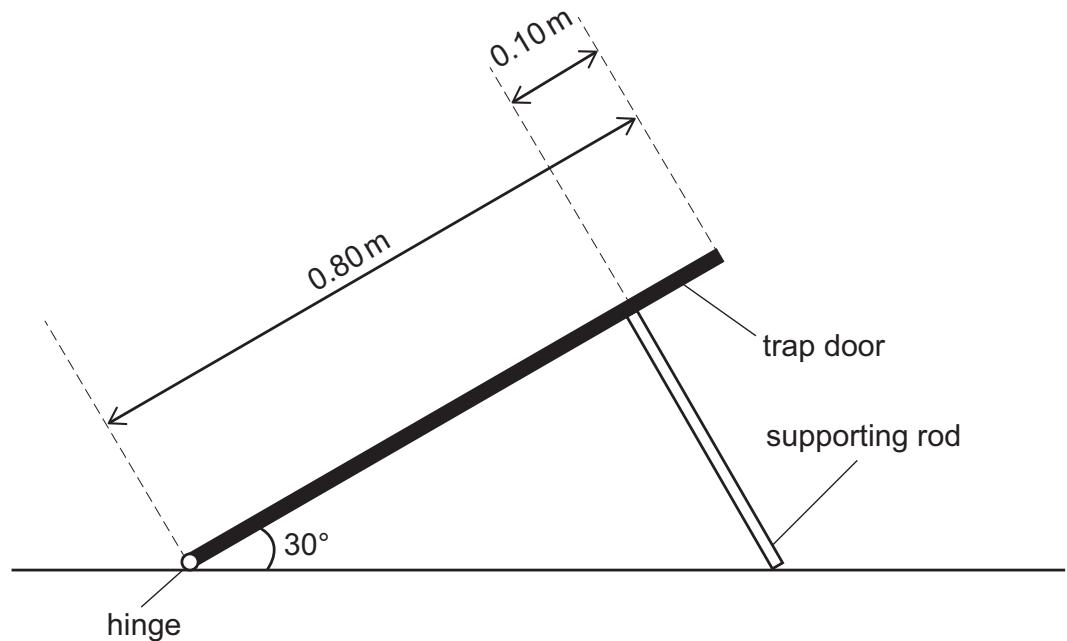
What is the normal contact force exerted on the trap door by the rod?
(gravitational field strength = )
What is the normal contact force exerted on the trap door by the rod?
(gravitational field strength = )
- A.40 N
- B. N
- C. N
- D.80 N
- E. N
- F. N
Answer: C
Question 29
1 markAn equilateral triangle of side 8 cm is drawn so that its vertices lie on the circumference of a circle, as shown in the diagram.
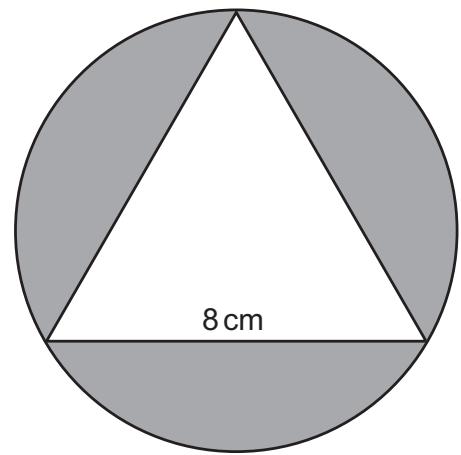
What is the total of the three areas shaded in the diagram, in ?
What is the total of the three areas shaded in the diagram, in ?
- A.
- B.
- C.
- D.
- E.
Answer: E
Question 30
1 markTwo small loudspeakers are placed side by side 30 cm apart.
They are connected to the same signal generator so that they emit sound of frequency 400 Hz in phase with one another.
The sounds both reach a microphone placed 40 cm directly in front of one of the two loudspeakers as shown.
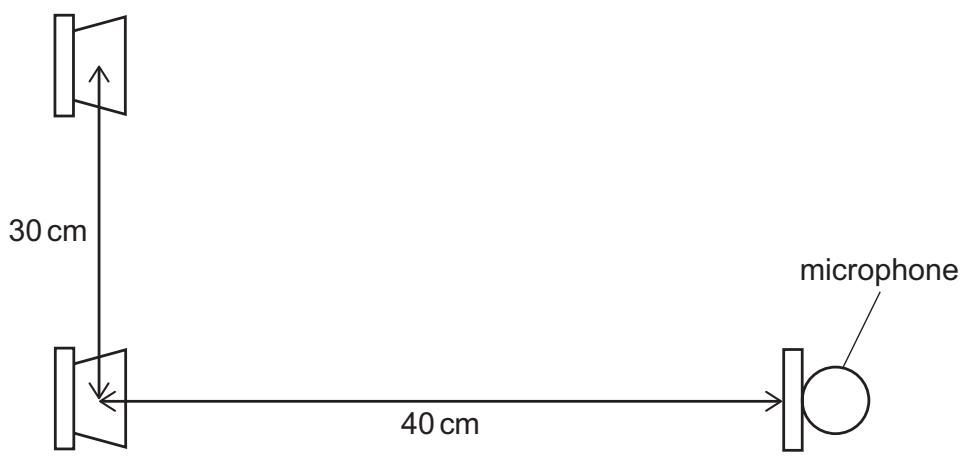
What is the phase difference between waves from the loudspeakers as they arrive at the microphone?
(speed of sound = )
They are connected to the same signal generator so that they emit sound of frequency 400 Hz in phase with one another.
The sounds both reach a microphone placed 40 cm directly in front of one of the two loudspeakers as shown.
What is the phase difference between waves from the loudspeakers as they arrive at the microphone?
(speed of sound = )
- A.30°
- B.36°
- C.45°
- D.60°
- E.72°
- F.90°
- G.120°
Answer: C
Question 31
1 markWhich one of the following is the real solution of the equation
- A.
- B.
- C.
- D.
- E.
- F.
Answer: B
Question 32
1 markAn astronaut on the Moon throws a ball vertically upwards. The ball has a mass of 2.0 g and is thrown upwards at .
What is the maximum height gained by the ball?
(gravitational field strength close to the Moon's surface = )
What is the maximum height gained by the ball?
(gravitational field strength close to the Moon's surface = )
- A.25 m
- B.50 m
- C.320 m
- D.2000 m
- E.3200 m
- F.4000 m
Answer: D
Question 33
1 markFor a particular function , it is given that:
and also:
Find the value of
and also:
Find the value of
- A.
- B.
- C.
- D.
- E.
Answer: A
Question 34
1 markA student has one resistor and another resistor of resistance R.
The student plots a graph of current I against potential difference V for the resistor and then for both resistors connected in parallel.
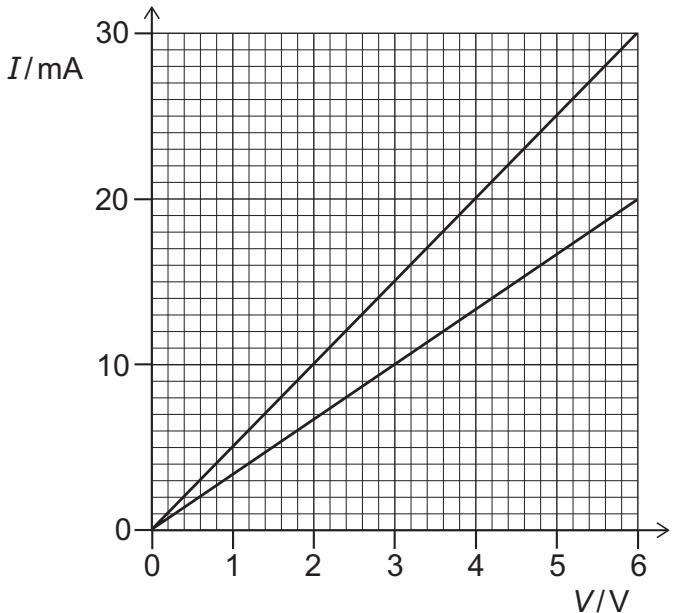
What is the resistance R?
The student plots a graph of current I against potential difference V for the resistor and then for both resistors connected in parallel.
What is the resistance R?
- A.
- B.
- C.
- D.
- E.
- F.
- G.
Answer: F
Question 35
1 markGiven that
what is the coefficient of in the expansion of in powers of x?
what is the coefficient of in the expansion of in powers of x?
- A.70
- B.162
- C.
- D.3024
- E.5670
- F.15120
- G.22680
Answer: E
Question 36
1 markA light, vertical, copper wire of length 2.4m and uniform cross-sectional area supports a load of mass 4.0 kg.
The Young modulus of copper is .
What is the strain energy in the wire?
(gravitational field strength = ; assume that the wire obeys Hooke's law and that the cross-sectional area remains constant)
The Young modulus of copper is .
What is the strain energy in the wire?
(gravitational field strength = ; assume that the wire obeys Hooke's law and that the cross-sectional area remains constant)
- A. J
- B. J
- C. J
- D. J
- E. J
- F. J
Answer: D
Question 37
1 markThe three internal angles in a triangle are , and , and
What is the value of in degrees?
What is the value of in degrees?
- A.15
- B.45
- C.75
- D.105
- E.135
Answer: D
Question 38
1 markLight travelling in a transparent liquid strikes the surface from below. The angle between the surface of the liquid and the direction of travel of the light is .
The light then travels along the surface between the liquid and the air as shown in the diagram.

Now, light travelling in air strikes the surface from above so that the angle between the surface and the direction of travel of this light is also .
After the light strikes the surface from above, the angle between the surface and the direction of travel of the refracted light is .
Which expression gives ?
(all angles are in degrees)
The light then travels along the surface between the liquid and the air as shown in the diagram.
Now, light travelling in air strikes the surface from above so that the angle between the surface and the direction of travel of this light is also .
After the light strikes the surface from above, the angle between the surface and the direction of travel of the refracted light is .
Which expression gives ?
(all angles are in degrees)
- A.
- B.
- C.
- D.
- E.
- F.
Answer: A
Question 39
1 markFind the complete set of values of x for which
- A.
- B.
- C.
- D. or
- E.
- F.
Answer: F
Question 40
1 markThe velocity-time graph is for an 80kg person in a lift that is moving vertically upwards.
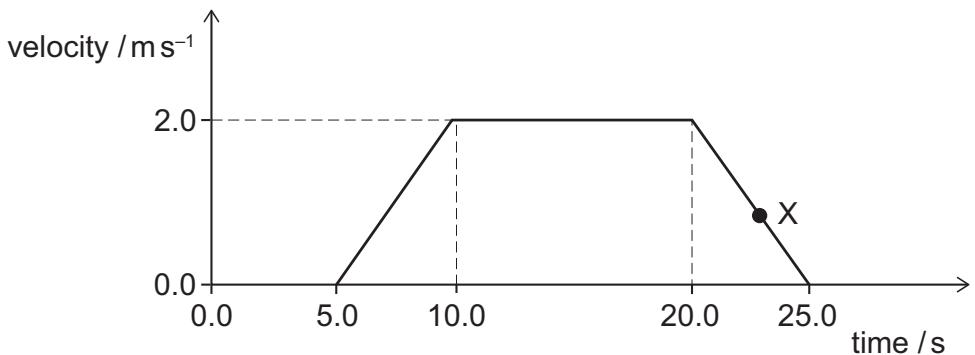
What is the magnitude of the contact force between the person and the lift floor at the time corresponding to X?
(gravitational field strength = )
What is the magnitude of the contact force between the person and the lift floor at the time corresponding to X?
(gravitational field strength = )
- A.640 N
- B.768 N
- C.800 N
- D.832 N
- E.960 N
Answer: B