ENGAA 2021
The ENGAA 2021 paper in full: all 20 questions, each with its answer. ENGAA is the Engineering Admissions Assessment. Sit it cold under exam timing, mark it, then work back through anything you missed using the solutions below.
Download the original PDF →Question 1
1 markNot in the current ESAT specification — included for completeness, but you won't be tested on it.
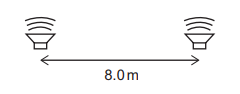
The loudspeakers emit sound waves of the same single frequency. The wave emitted by one loudspeaker is 180° out of phase with the wave emitted by the other loudspeaker.
A point P is in front of the loudspeakers. P is 18.0 m from one loudspeaker and 24.0 m from the other loudspeaker. As a result of superposition of the two waves arriving at P, the amplitude of the sound at position P is a minimum.
The speed of the sound is 336 ms⁻¹.
What is the lowest possible frequency of the sound?
- A.21 Hz
- B.28 Hz
- C.42 Hz
- D.56 Hz
- E.63 Hz
- F.84 Hz
Answer: D
Question 2
1 markNot in the current ESAT specification — included for completeness, but you won't be tested on it.
The acute angle between the plane and the horizontal is greater than 45°.
The forces acting on the block are: friction (F), weight (W) and normal contact force (N).
How do the magnitudes of the three forces compare?
- A.
- B.
- C.
- D.
- E.
- F.
Answer: C
Question 3
1 markNot in the current ESAT specification — included for completeness, but you won't be tested on it.
The length of the resistance wire is 20m and its cross-sectional area is . The wire is made from a material with resistivity and the current in it is 200 mA.
What is the voltage across the terminals of the power supply?
- A.4.0 V
- B.6.0 V
- C.9.9 V
- D.10.0 V
- E.10.1 V
- F.12.0 V
- G.14.0 V
Answer: G
Question 4
1 markNot in the current ESAT specification — included for completeness, but you won't be tested on it.
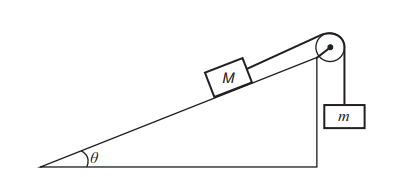
[diagram not to scale]
There is no friction between the plane and the object. The pulley is smooth, and the rope has negligible mass.
The angle of the plane to the horizontal is such that and .
The object with mass M accelerates down the slope.
Which expression describes the full range of possible values of M compared with m?
- A.
- B.
- C.
- D.
- E.
Answer: D
Question 5
1 markNot in the current ESAT specification — included for completeness, but you won't be tested on it.
An identical object Q is projected vertically upwards from the ground.
When Q reaches its maximum height, P collides with it. The two objects join together in such a way that there is no change to the area of cross section passing through the air.
The two combined objects then fall through the air as one object.
Which sketch graph shows the variation of velocity with time for object P before and after the collision?
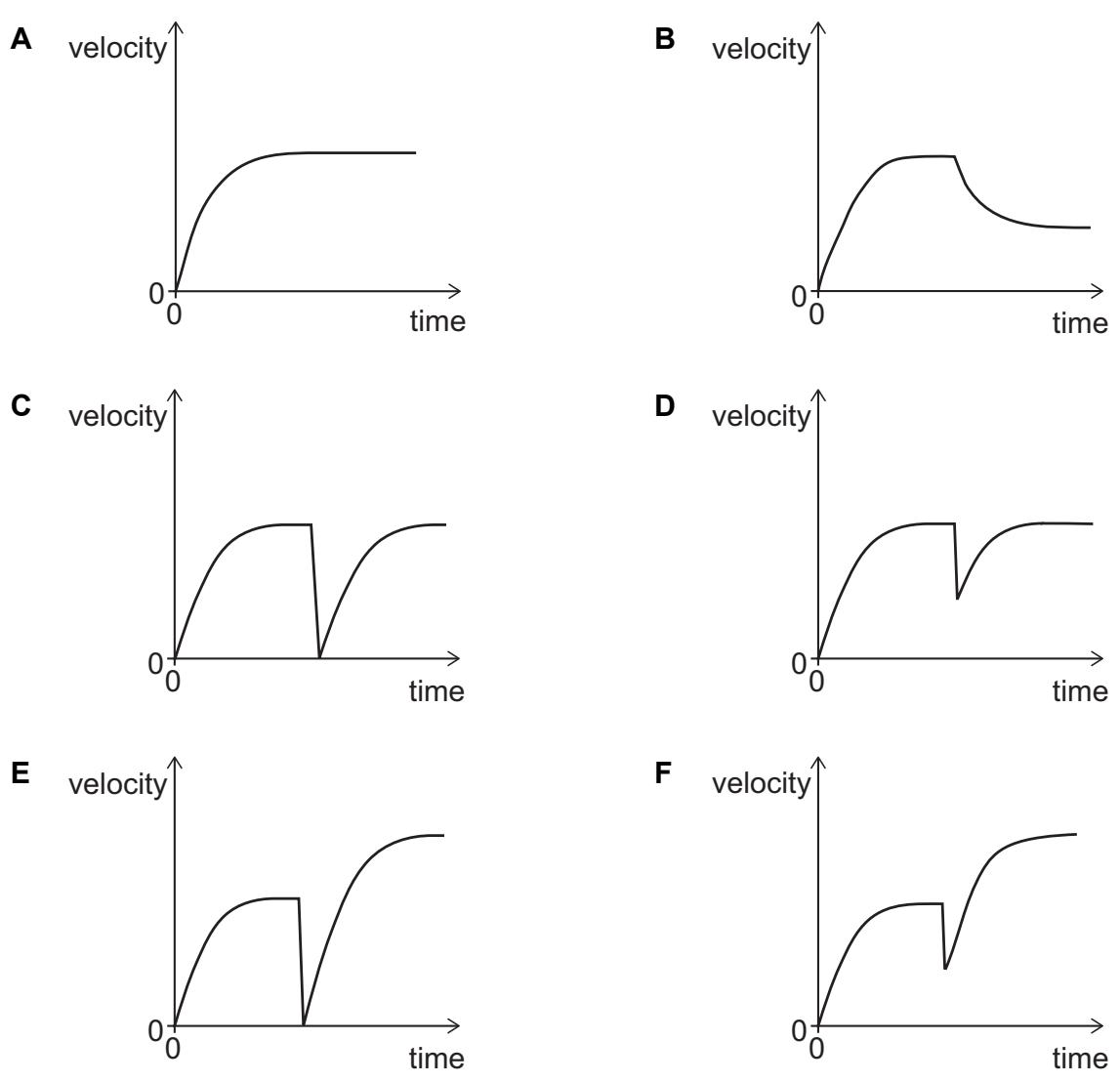
- A.Graph A
- B.Graph B
- C.Graph C
- D.Graph D
- E.Graph E
- F.Graph F
Answer: F
Question 6
1 markNot in the current ESAT specification — included for completeness, but you won't be tested on it.
The lorry is accelerated from rest by the engine in a horizontal straight line. The lorry experiences a total resistive force that is always proportional to the square of its speed.
The process is repeated for different values of P, and the maximum speed of the lorry is found to be proportional to , where n is a constant.
What is the value of n?
- A.
- B.
- C.1
- D.2
- E.3
Answer: A
Question 7
1 markNot in the current ESAT specification — included for completeness, but you won't be tested on it.
The cells are arranged in two rows connected in parallel. Each row contains 3 cells connected in series.
The battery pack is connected to an external resistor of resistance .
What is the electrical power transferred in the external resistor?
- A.2.7 W
- B.3.6 W
- C.7.5 W
- D.10.8 W
- E.13.5 W
- F.43.2 W
Answer: D
Question 8
1 markNot in the current ESAT specification — included for completeness, but you won't be tested on it.
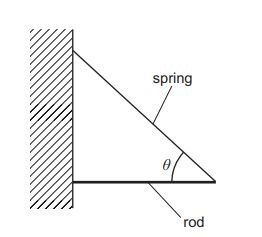
The spring constant of the spring is 20 Nm⁻¹ and the weight of the rod is 16 N.
The angle is such that and .
How much energy is stored in the spring?
- A.1.6 J
- B.2.5 J
- C.3.2 J
- D.4.4 J
- E.5.0 J
- F.6.4 J
- G.10 J
- H.40 J
Answer: B
Question 9
1 markNot in the current ESAT specification — included for completeness, but you won't be tested on it.
The displacement x of the object from its position at time t = 0 is given by
where x is in metres and t is in seconds.
At t = 5.0 s, what is the rate of change of momentum of the object?
- A.6.7 kg ms⁻²
- B.66.7 kg ms⁻²
- C.120 kg ms⁻²
- D.240 kg ms⁻²
- E.600 kg ms⁻²
Answer: D
Question 10
1 markNot in the current ESAT specification — included for completeness, but you won't be tested on it.
The arcs of circles shown in the gel are lines that represent the positions of the compressions (known as wavefronts) of the ultrasound wave that comes from U.
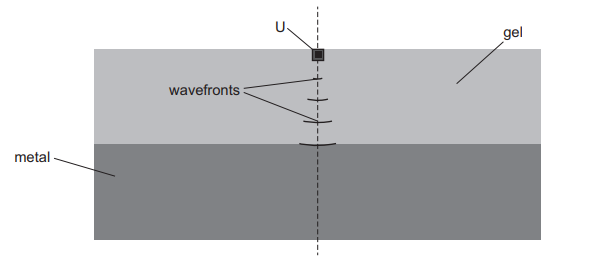
Ultrasound travels faster in the metal than in the gel.
The wavefronts in the metal are circular arcs with their centre at a point X that is on the dashed line.
Where on the dashed line is X?
- A.above U
- B.at U
- C.in the gel below U
- D.on the boundary between the gel and the metal
- E.in the metal
Answer: C
Question 11
1 markNot in the current ESAT specification — included for completeness, but you won't be tested on it.
The emfs of the power supplies and the magnitude and direction of the current in one part of the circuit are shown.
One point in the circuit is labelled P.
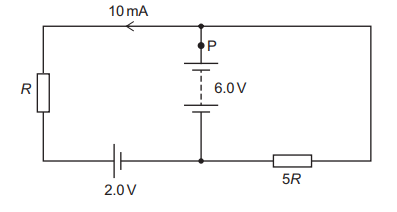
What is the magnitude of the current at P?
- A.3.0 mA
- B.7.0 mA
- C.8.5 mA
- D.11.5 mA
- E.13 mA
- F.25 mA
Answer: E
Question 12
1 markNot in the current ESAT specification — included for completeness, but you won't be tested on it.
Which graph shows the relationship between the extension of the wires and the unstretched length of the wires?
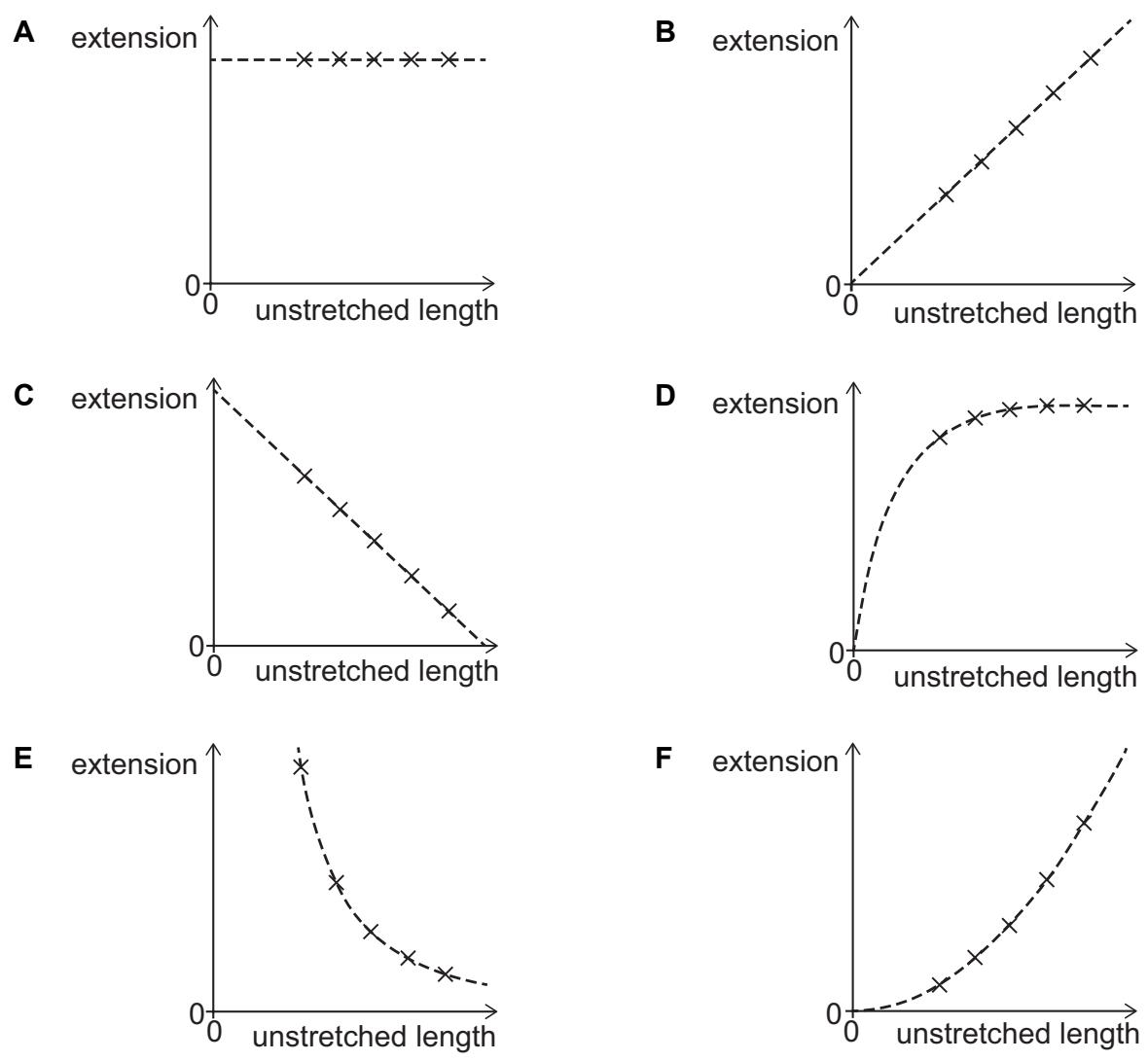
- A.Graph A: extension is constant with unstretched length.
- B.Graph B: extension is directly proportional to unstretched length.
- C.Graph C: extension is inversely proportional to unstretched length.
- D.Graph D: extension increases with unstretched length, with a decreasing slope.
- E.Graph E: extension decreases with unstretched length, hyperbolically.
- F.Graph F: extension increases quadratically with unstretched length.
Answer: F
Question 13
1 markNot in the current ESAT specification — included for completeness, but you won't be tested on it.
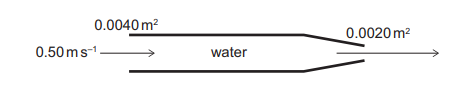
How much power must be supplied to the water to maintain the flow in this section of the pipe?
(Assume that the water is incompressible and that frictional forces can be neglected.)
- A.0.25 W
- B.0.50 W
- C.0.75 W
- D.1.0 W
- E.1.25 W
- F.1.5 W
- G.3.75 W
Answer: C
Question 14
1 markNot in the current ESAT specification — included for completeness, but you won't be tested on it.
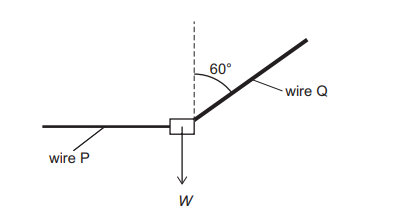
The radius of wire Q is twice the radius of wire P.
What is the ratio
(The wires do not exceed their limits of proportionality.)
- A.
- B.
- C.
- D.
- E.
- F.
- G.
Answer: E
Question 15
1 markNot in the current ESAT specification — included for completeness, but you won't be tested on it.
The diagram shows a ray of light travelling in the glass block striking the side of the block at the point labelled X. The acute angle between the ray and the side of the block is .
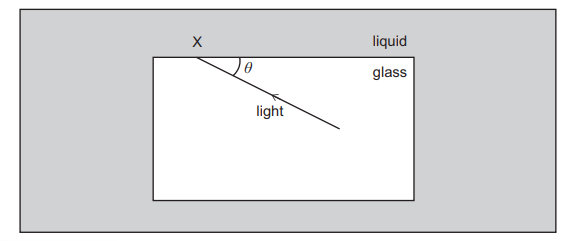
What is the full range of values of the acute angle for which light is refracted at X?
(The speed of light in a vacuum is .)
- A.
- B.
- C.
- D.
- E.
- F.
- G.
- H.
Answer: H
Question 16
1 markNot in the current ESAT specification — included for completeness, but you won't be tested on it.
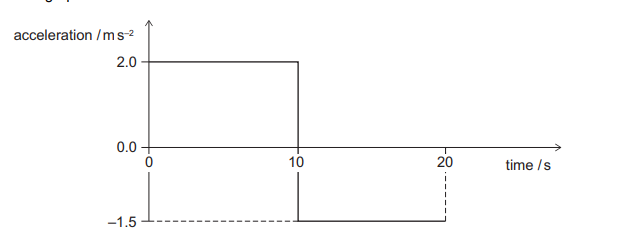
What is the displacement of the car from its starting position when t = 20 s?
- A.5.0 m
- B.25 m
- C.35 m
- D.175 m
- E.225 m
- F.375 m
Answer: E
Question 17
1 markNot in the current ESAT specification — included for completeness, but you won't be tested on it.
A mass of 8.7 g of a powder is poured into the measuring cylinder as shown in the diagram.
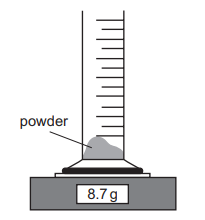
Liquid is poured into the cylinder to cover the powder completely. The powder does not dissolve. The reading on the measuring cylinder and the reading on the balance are recorded.
More liquid is added and a second pair of readings is recorded.
The table shows the two pairs of readings.
| reading on measuring cylinder / cm³ | reading on balance / g |
| :--- | :--- |
| 10.0 | 15.0 |
| 25.0 | 27.6 |
What is the density of the material from which the powder is made?
- A.0.414 g cm⁻³
- B.1.16 g cm⁻³
- C.1.31 g cm⁻³
- D.1.45 g cm⁻³
- E.2.00 g cm⁻³
- F.2.50 g cm⁻³
- G.3.48 g cm⁻³
- H.6.00 g cm⁻³
Answer: G
Question 18
1 markNot in the current ESAT specification — included for completeness, but you won't be tested on it.
The kinetic energy of the stone when it hits the ground is 125 J.
What is the distance from the bottom of the cliff to the point where the stone hits the ground?
(gravitational field strength = 10 N kg⁻¹; ignore air resistance and any effect of wind)
- A.60 m
- B.80 m
- C.120 m
- D.160 m
- E.200 m
Answer: C
Question 19
1 markNot in the current ESAT specification — included for completeness, but you won't be tested on it.
When the switch is closed, the current I in the component increases with time t as given by the equation
where k is a positive constant.
When the current reaches a value the component fails and the current falls instantly to zero.
How much electrical energy has been transferred to the component by the time it fails?
(All quantities are in standard SI units.)
- A.
- B.
- C.
- D.
- E.
- F.
Answer: A
Question 20
1 markNot in the current ESAT specification — included for completeness, but you won't be tested on it.
One rectangular face and the two triangular ends of the trough are vertical, as shown.
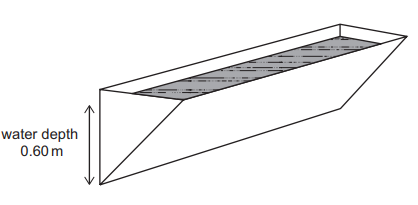
[diagram not to scale]
The trough contains water of depth 0.60 m measured on the vertical rectangular face.
What is the force exerted by the water on one triangular end of the trough?
(density of water = 1000 kg m⁻³; gravitational field strength = 10 N kg⁻¹)
- A.180 N
- B.270 N
- C.360 N
- D.540 N
- E.720 N
- F.1080 N
- G.6000 N
- H.12000 N
Answer: C