ENGAA 2022
The ENGAA 2022 paper in full: all 20 questions, each with its answer. ENGAA is the Engineering Admissions Assessment. Sit it cold under exam timing, mark it, then work back through anything you missed using the solutions below.
Download the original PDF →Question 1
1 markNot in the current ESAT specification — included for completeness, but you won't be tested on it.
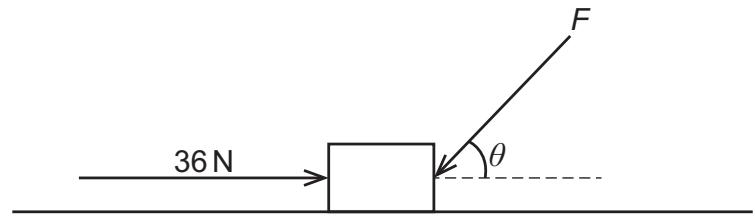
A force acts on the object at an acute angle to the horizontal, where .
A force of 36 N acts on the object towards the right.
The object is in equilibrium.
What is the magnitude of the normal contact force exerted on the object by the surface?
(gravitational field strength = )
- A.24 N
- B.27 N
- C.48 N
- D.51 N
- E.72 N
- F.75 N
Answer: E
Question 2
1 markNot in the current ESAT specification — included for completeness, but you won't be tested on it.
The spring is on the floor of an accelerating lift (elevator), and the spring supports a 30 kg mass.
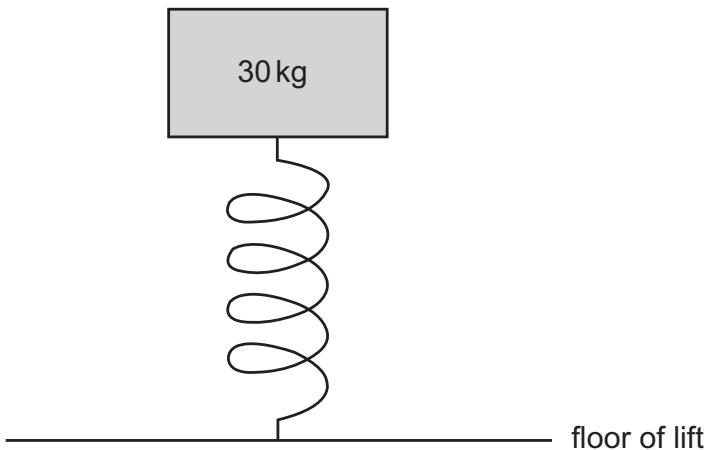
The lift is accelerating downwards at .
What is the difference between and the length of the spring when the lift is accelerating downwards?
(gravitational field strength = ; the spring obeys Hooke's law)
- A.0 cm
- B.2.0 cm
- C.8.0 cm
- D.10 cm
- E.12 cm
Answer: C
Question 3
1 markNot in the current ESAT specification — included for completeness, but you won't be tested on it.
What is the rate at which electrical energy is transferred to thermal energy in the overhead cable?
- A.1.28 kW
- B.2.56 kW
- C.5.12 kW
- D.32 kW
- E.64 kW
- F.128 kW
Answer: C
Question 4
1 markNot in the current ESAT specification — included for completeness, but you won't be tested on it.
A particle of the medium has zero displacement from its equilibrium position at 0.12 s intervals, and at no other times.
The wavelength of the wave is greater than 10.0 m.
Two points are 5.0 m apart along the direction of travel of the wave.
The phase difference between the particles at the two points at the same instant is radians.
What is the speed of the wave?
- A.
- B.
- C.
- D.
- E.
- F.
Answer: E
Question 5
1 markNot in the current ESAT specification — included for completeness, but you won't be tested on it.
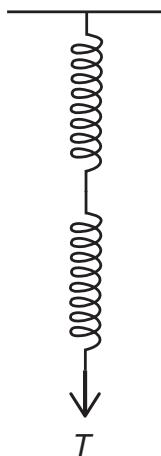
Springs P and Q are connected in series as shown. A downwards force is applied to the lower end.
Spring R is cut into four equal lengths, and the four pieces arranged symmetrically as shown. The two connecting bars have negligible mass. A downwards force is applied to the centre of the lower bar.
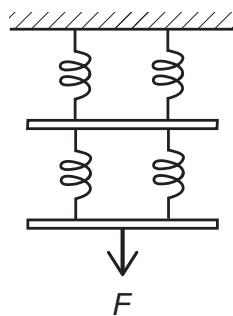
The total extensions of the two systems are equal. The springs obey Hooke's law.
Which expression gives in terms of ?
- A.
- B.
- C.
- D.
- E.
- F.
- G.
- H.
Answer: B
Question 6
1 markNot in the current ESAT specification — included for completeness, but you won't be tested on it.
A force is applied vertically downwards on the top face of the cube so that it compresses the height by .
The graph shows the variation of with .
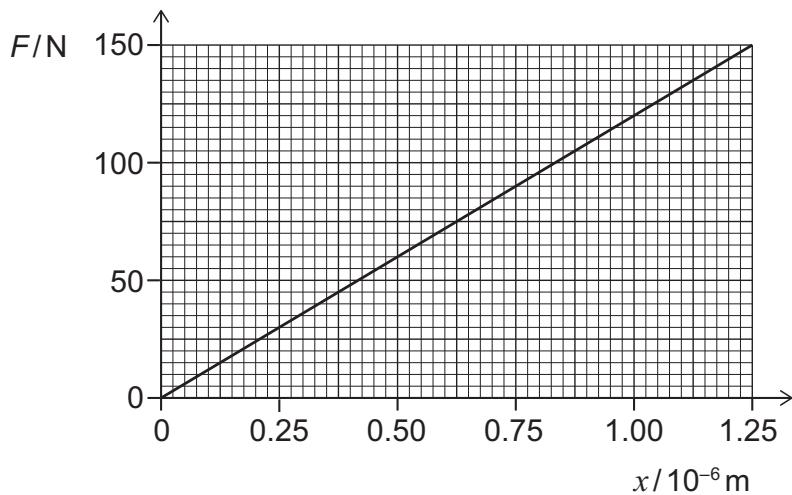
What is the Young modulus of the nylon?
(Assume that changes in horizontal cross-sectional area are negligible.)
- A.
- B.
- C.
- D.
- E.
- F.
- G.
Answer: F
Question 7
1 markNot in the current ESAT specification — included for completeness, but you won't be tested on it.
A motorbike travelling at a constant velocity passes the first lamppost at time s. It passes the fifth lamppost at s.
A car travelling in the same direction as the motorbike is accelerating at . At time s the car passes the first lamppost at a velocity of .
At what time does the car overtake the motorbike?
- A.1.5 s
- B.2.0 s
- C.2.5 s
- D.3.0 s
- E.3.5 s
- F.4.0 s
- G.5.0 s
Answer: D
Question 8
1 markNot in the current ESAT specification — included for completeness, but you won't be tested on it.
This function is
where is in watts and is in seconds.
The appliance is switched on at time .
The appliance has a constant efficiency of 90%.
What is the energy by the appliance during the period s to s after it is switched on?
- A.0.60 J
- B.0.70 J
- C.1.9 J
- D.2.9 J
- E.4.5 J
- F.17 J
- G.26 J
- H.41 J
Answer: D
Question 9
1 markNot in the current ESAT specification — included for completeness, but you won't be tested on it.
A ray of light travelling in air hits the cylinder at the centre of one circular face at a non-zero angle to the normal, and refracts as it enters the cylinder.
The ray then strikes the curved surface of the cylinder at an angle of incidence equal to the critical angle.
What is the value of ?
- A.
- B.
- C.
- D.
- E.
Answer: B
Question 10
1 markNot in the current ESAT specification — included for completeness, but you won't be tested on it.
The force causes the object's displacement to change with time according to the relationship
where is in metres and is in seconds.
What is the magnitude of the impulse on the object over this time interval?
- A.
- B.
- C.
- D.
- E.
- F.
Answer: F
Question 11
1 markNot in the current ESAT specification — included for completeness, but you won't be tested on it.
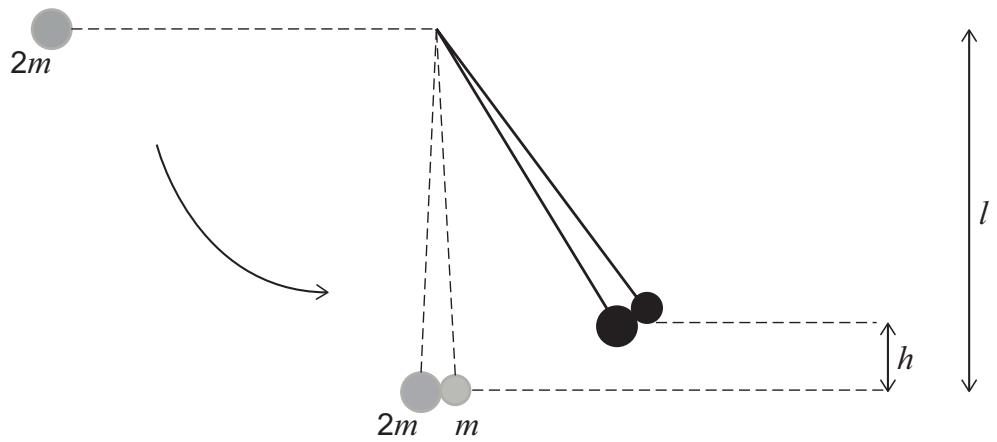
[diagram not to scale]
Which expression gives the height in terms of ?
(Assume that air resistance is negligible.)
- A.
- B.
- C.
- D.
- E.
- F.
- G.
Answer: C
Question 12
1 markNot in the current ESAT specification — included for completeness, but you won't be tested on it.
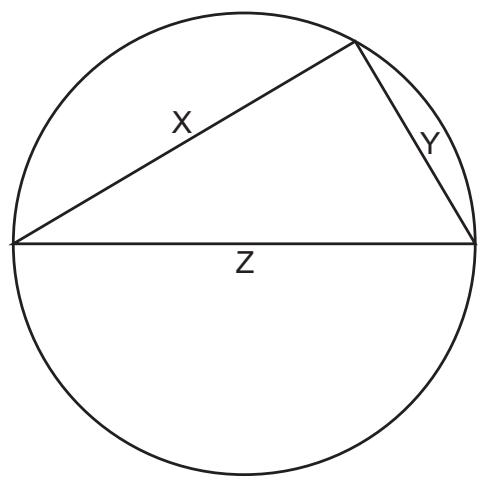
[diagram not to scale]
Wires X and Y each have twice the diameter of wire Z.
Wire X is 12 cm long. Wire Z is 15 cm long and is connected across a diameter of the ring.
A power supply is connected to the two corners of the triangle that lie on the diameter.
What is the value of the ratio ?
- A.
- B.
- C.
- D.
- E.
- F.
- G.
- H.5
Answer: G
Question 13
1 markNot in the current ESAT specification — included for completeness, but you won't be tested on it.
The rope is fixed horizontally between two supports that are 0.24 m apart.
When a 1.0 kg mass is suspended from the middle of the rope, the vertical displacement of the middle of the rope from its original position is 0.050 m.
The rope obeys Hooke's law. Assume that changes in cross-sectional area are negligible.
What is the Young modulus of the material from which the rope is made?
(gravitational field strength = )
- A.
- B.
- C.
- D.
- E.
- F.
- G.
Answer: F
Question 14
1 markNot in the current ESAT specification — included for completeness, but you won't be tested on it.
The time axis is shown to the same scale on all three graphs.
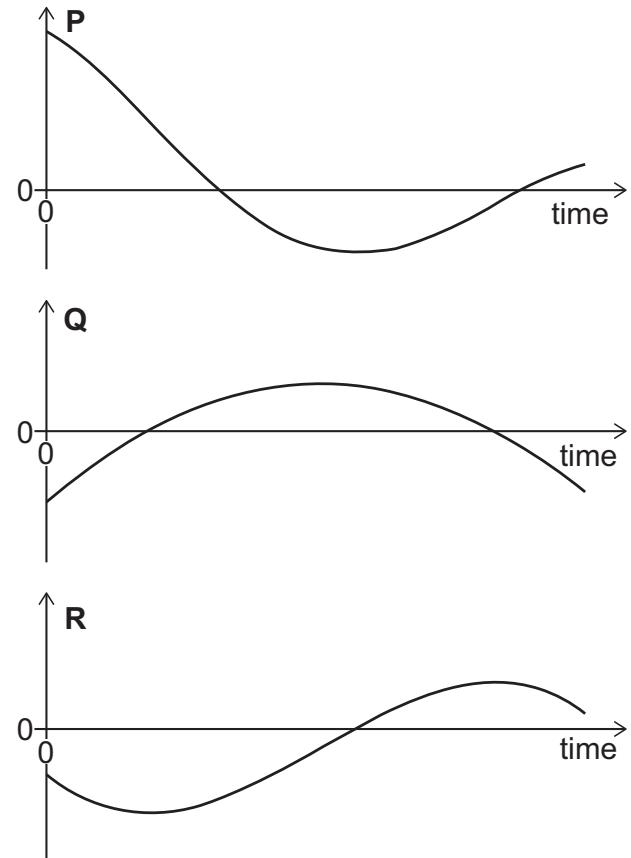
Which graph represents which quantity?
- A.graph P: acceleration, graph Q: displacement, graph R: velocity
- B.graph P: acceleration, graph Q: velocity, graph R: displacement
- C.graph P: displacement, graph Q: acceleration, graph R: velocity
- D.graph P: displacement, graph Q: velocity, graph R: acceleration
- E.graph P: velocity, graph Q: acceleration, graph R: displacement
- F.graph P: velocity, graph Q: displacement, graph R: acceleration
Answer: C
Question 15
1 markNot in the current ESAT specification — included for completeness, but you won't be tested on it.
The extension of the system is related to the force applied to it by
where is a constant.
A force of 2400 N increases the length of the system to 2.2 m.
How much work is done in increasing the length of the system from 3.0 m to 4.0 m?
- A.1.2 kJ
- B.60 kJ
- C.70 kJ
- D.120 kJ
- E.140 kJ
- F.740 kJ
Answer: E
Question 16
1 markNot in the current ESAT specification — included for completeness, but you won't be tested on it.
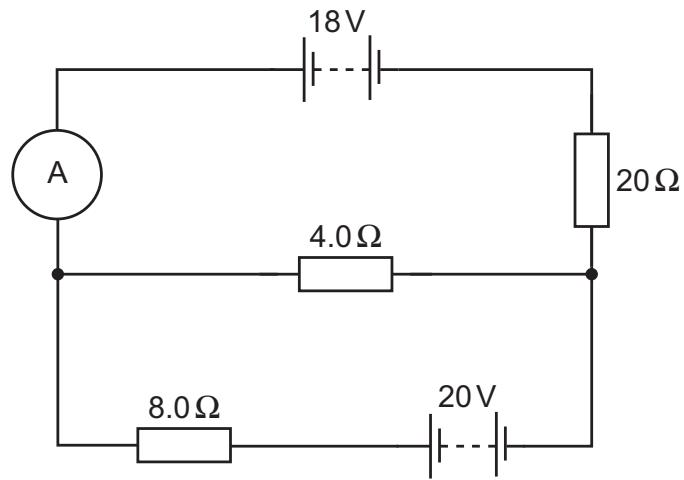
What is the reading on the ammeter?
- A.0.0029 A
- B.0.0071 A
- C.0.063 A
- D.0.083 A
- E.0.50 A
- F.0.65 A
- G.1.2 A
- H.2.0 A
Answer: E
Question 17
1 markNot in the current ESAT specification — included for completeness, but you won't be tested on it.
The lower diagram shows the positions of the same nine particles when a longitudinal wave is travelling through the medium. The wave is shown at time , travelling to the right.
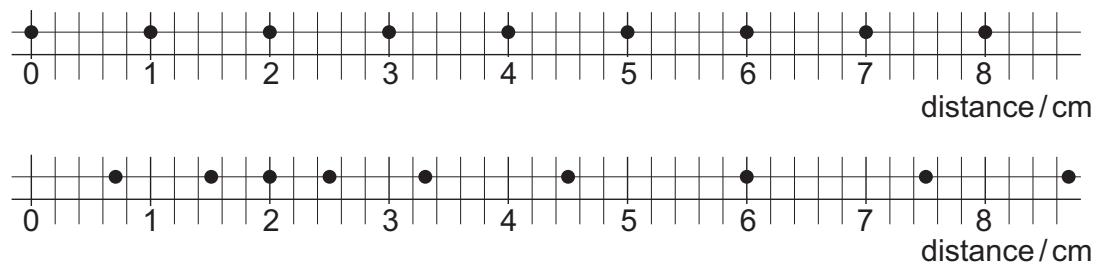
The frequency of the wave is 0.5 Hz.
Which graph represents the displacements of the particles at a later time s?
(On the graphs, positive displacement values represent particle displacements to the right.)
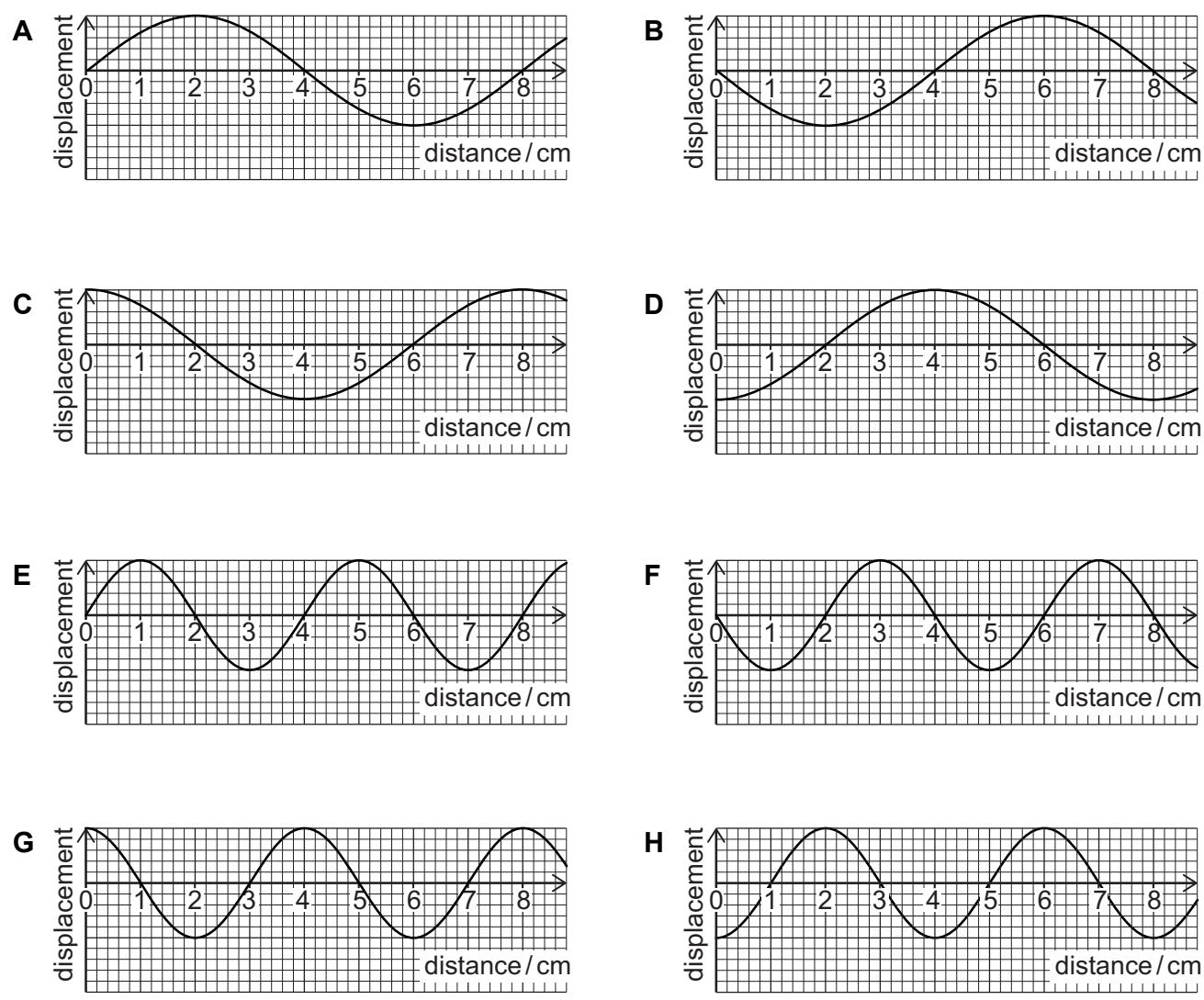
- A.Graph A: a sine wave.
- B.Graph B: a negative sine wave.
- C.Graph C: a cosine wave.
- D.Graph D: a negative cosine wave.
- E.Graph E: a sine wave with half the wavelength of A.
- F.Graph F: a negative sine wave with half the wavelength of B.
- G.Graph G: a cosine wave with half the wavelength of C.
- H.Graph H: a cosine wave with half the wavelength of D.
Answer: A
Question 18
1 markNot in the current ESAT specification — included for completeness, but you won't be tested on it.
The efficiency of the system is defined as
Which graph shows how the efficiency varies with the resistance of the external resistor?
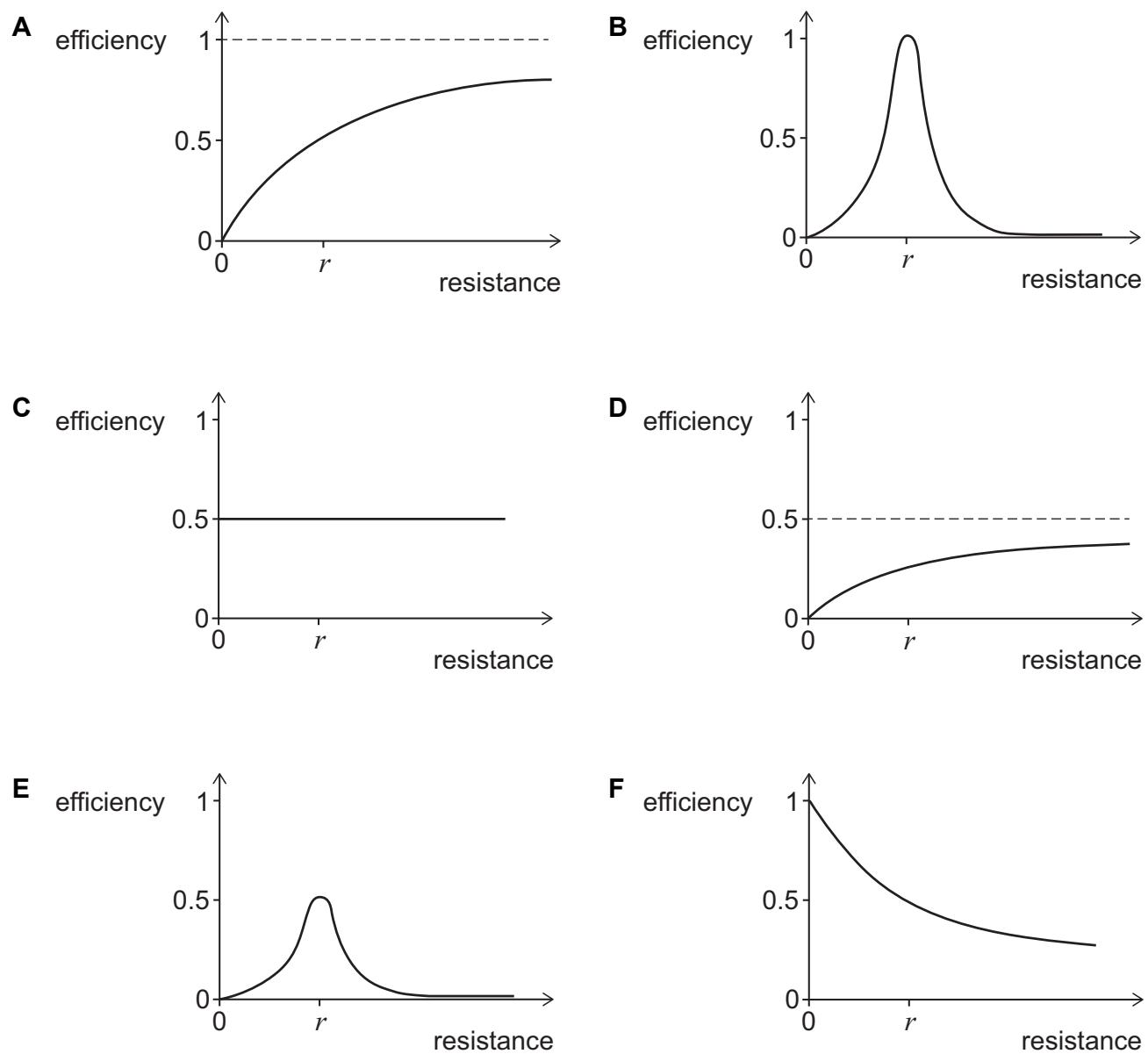
- A.Graph A: curve starting at (0,0), passing through (r, 0.5) and asymptotically approaching 1.
- B.Graph B: curve starting at (0,0), peaking, then decreasing towards 0.
- C.Graph C: horizontal line at efficiency = 0.5 for resistance > 0.
- D.Graph D: curve starting at (0,0) and asymptotically approaching 0.5.
- E.Graph E: curve starting at (0,0), peaking at resistance r, then decreasing towards 0.
- F.Graph F: curve starting at (0,1) and decreasing towards 0.
Answer: A
Question 19
1 markNot in the current ESAT specification — included for completeness, but you won't be tested on it.
At the point during its flight when the vertical component of its velocity is zero, the projectile splits into two pieces, P and Q, each of mass 5 kg.
Immediately after the projectile splits, piece P has velocity to the right.
What is the speed of piece Q immediately before it hits the ground?
(Assume that air resistance is negligible, and that the ground is horizontal.)
- A.
- B.
- C.
- D.
- E.
- F.
- G.
- H.
Answer: D
Question 20
1 markNot in the current ESAT specification — included for completeness, but you won't be tested on it.
where is the distance from its centre, is its radius and is the density at its centre.
What is the mass of the sphere?
(the surface area of a sphere of radius is equal to )
- A.
- B.
- C.
- D.
- E.
- F.
- G.
- H.
Answer: B