ENGAA 2022 D564/11
40 questions40 marks60Updated August 2025
The ENGAA 2022 D564/11 paper in full: all 40 questions, each with its answer. ENGAA is the Engineering Admissions Assessment. Sit it cold under exam timing, mark it, then work back through anything you missed using the solutions below.
Download the original PDF →Questions and answers are free. Full step-by-step worked solutions unlock with a free account. Start practising.
Question 1
1 markWhich one of the following is a simplification of
- A.
- B.
- C.
- D.
- E.
- F.
Answer: E
Question 2
1 markThere is a constant current in a conducting wire. A charge of 20 C passes through the wire in 1.5 minutes.
An 18 cm straight section of this wire lies in a uniform magnetic field. This section of wire is perpendicular to the direction of the field. The magnetic field strength is 0.15 T.
What is the magnitude of the magnetic force on this section of wire?
An 18 cm straight section of this wire lies in a uniform magnetic field. This section of wire is perpendicular to the direction of the field. The magnetic field strength is 0.15 T.
What is the magnitude of the magnetic force on this section of wire?
- A.0.0060 N
- B.0.36 N
- C.0.60 N
- D.0.81 N
- E.36 N
- F.49 N
- G.81 N
- H.4900 N
Answer: A
Question 3
1 markFind the complete set of values of that satisfy the inequality
- A.
- B.
- C.
- D.
- E.
- F.
- G.
- H.
Answer: D
Question 4
1 markTwo identical resistors are connected in parallel to a 6.0 V battery. The two resistors dissipate a total power of 0.15 W.
One of these resistors is removed from the circuit and connected to a 12 V battery.
How much charge passes through this resistor in 6.0 minutes?
One of these resistors is removed from the circuit and connected to a 12 V battery.
How much charge passes through this resistor in 6.0 minutes?
- A.0.025 C
- B.0.050 C
- C.0.15 C
- D.0.30 C
- E.0.75 C
- F.1.5 C
- G.9.0 C
- H.18 C
Answer: G
Question 5
1 markRob keeps a record of what he earns each day.
On Monday, he earned 50% less than he earned on Sunday.
On Tuesday, he earned 20% more than he earned on Monday.
On Wednesday, he earned 30% less than he earned on Tuesday.
On Wednesday, he earned £84.
How much did Rob earn on Sunday?
On Monday, he earned 50% less than he earned on Sunday.
On Tuesday, he earned 20% more than he earned on Monday.
On Wednesday, he earned 30% less than he earned on Tuesday.
On Wednesday, he earned £84.
How much did Rob earn on Sunday?
- A.£15.12
- B.£35.28
- C.£117.60
- D.£200
- E.£210
- F.£300
- G.£1200
Answer: D
Question 6
1 markUltrasound is used to find a crack inside a cuboid block of metal. An ultrasound probe is held in contact with the top surface of the metal block and perpendicular to the surface. A short pulse of ultrasound is sent into the metal block at time ms and reflects from both the crack and the bottom surface of the metal block.
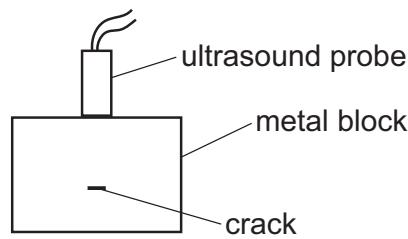
The times between the emission of the ultrasound pulse and the return of the reflections to the probe, and the strengths of the reflected pulses, are measured. The results are shown on the graph.
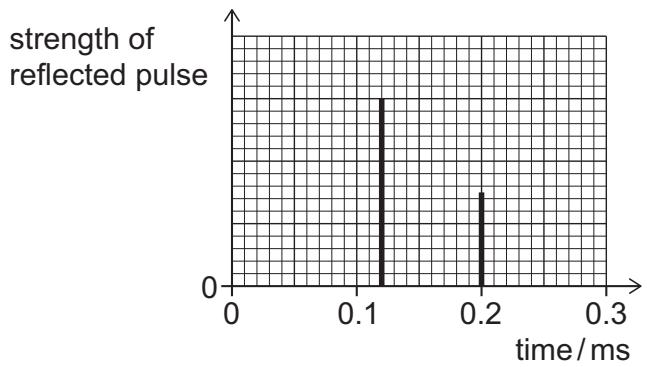
The speed of ultrasound in the metal is .
What is the distance between the of the metal block and the crack?
The times between the emission of the ultrasound pulse and the return of the reflections to the probe, and the strengths of the reflected pulses, are measured. The results are shown on the graph.
The speed of ultrasound in the metal is .
What is the distance between the of the metal block and the crack?
- A.0.2 m
- B.0.3 m
- C.0.4 m
- D.0.5 m
- E.0.6 m
- F.1.0 m
Answer: A
Question 7
1 markWhich one of the following is a simplification of
- A.
- B.
- C.
- D.
- E.
- F.
- G.
Answer: C
Question 8
1 markPower is supplied to an electric motor at 0.800 kW.
The motor has an efficiency of 60% and is switched on for half an hour.
How much energy is during this time?
The motor has an efficiency of 60% and is switched on for half an hour.
How much energy is during this time?
- A.0.160 J
- B.0.240 J
- C.160 J
- D.240 J
- E.576 J
- F.864 J
- G.576 000 J
- H.864 000 J
Answer: G
Question 9
1 markA rectangle PQRS has length cm and width cm as shown on the diagram.
A larger rectangle is made by adding 3 cm to both the length and the width of PQRS, as shown.
The larger rectangle has an area of .
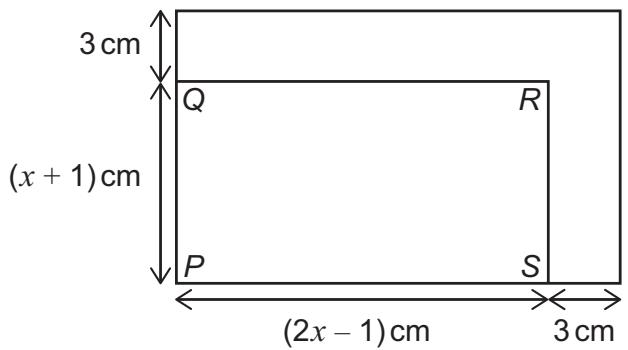
[diagram not to scale]
What is the ratio of PQ to PS?
A larger rectangle is made by adding 3 cm to both the length and the width of PQRS, as shown.
The larger rectangle has an area of .
[diagram not to scale]
What is the ratio of PQ to PS?
- A.1:2
- B.4:7
- C.5:8
- D.7:11
- E.10:17
- F.17:31
Answer: B
Question 10
1 markThe graph shows potential difference plotted against current for a filament lamp and a resistor.
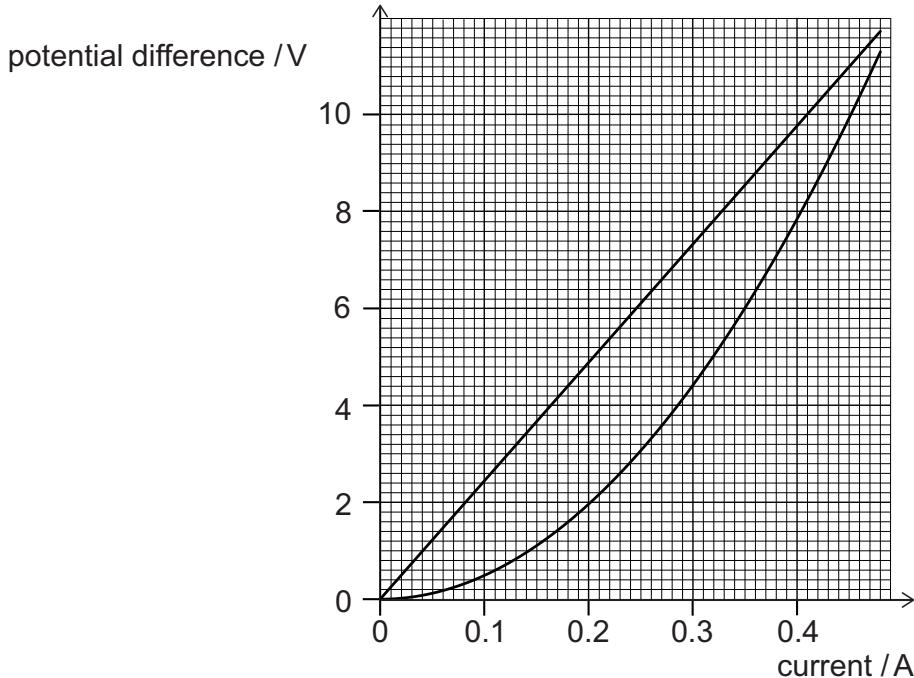
The lamp and the resistor are connected in parallel with each other to a 6.0 V power supply and the current in the lamp, , is recorded.
In a second circuit, the lamp and the resistor are now connected in series with each other to the same power supply, and the current in the resistor is 0.18 A. The potential difference across the lamp, , is recorded.
What are the values of in the first circuit and in the second circuit?
| | / A | / V |
|---|---|---|
| A | 0.25 | 1.6 |
| B | 0.25 | 3.0 |
| C | 0.25 | 4.4 |
| D | 0.35 | 1.6 |
| E | 0.35 | 3.0 |
| F | 0.35 | 4.4 |
The lamp and the resistor are connected in parallel with each other to a 6.0 V power supply and the current in the lamp, , is recorded.
In a second circuit, the lamp and the resistor are now connected in series with each other to the same power supply, and the current in the resistor is 0.18 A. The potential difference across the lamp, , is recorded.
What are the values of in the first circuit and in the second circuit?
| | / A | / V |
|---|---|---|
| A | 0.25 | 1.6 |
| B | 0.25 | 3.0 |
| C | 0.25 | 4.4 |
| D | 0.35 | 1.6 |
| E | 0.35 | 3.0 |
| F | 0.35 | 4.4 |
- A.,
- B.,
- C.,
- D.,
- E.,
- F.,
Answer: D
Question 11
1 markPQRS is a trapezium as shown.
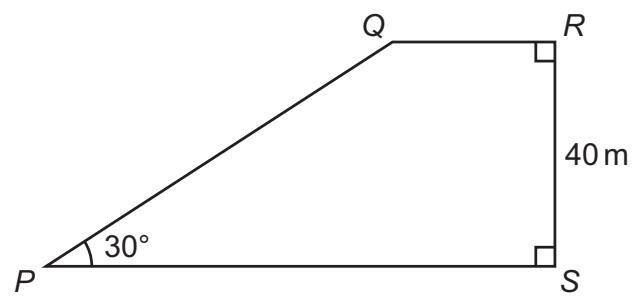
[diagram not to scale]
What is the length of PS, in metres?
[diagram not to scale]
What is the length of PS, in metres?
- A.45
- B.65
- C.80
- D.120
- E.
- F.
- G.
- H.
Answer: G
Question 12
1 markA transverse wave on a string has a speed of .
The horizontal distance between two points P and Q on the wave is 4.0 m, as shown in the diagram.
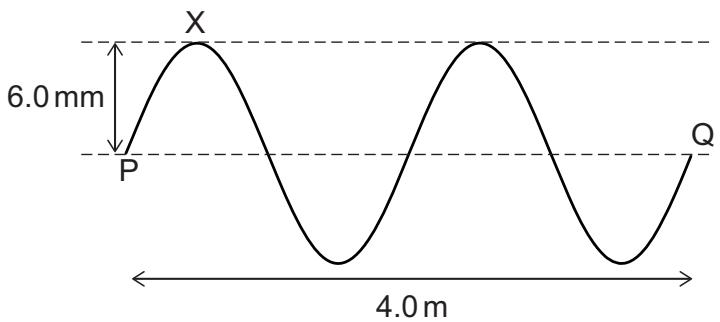
At time ms, point X on the string is at its maximum displacement of 6.0 mm above equilibrium.
What is the displacement of point X at time ms?
The horizontal distance between two points P and Q on the wave is 4.0 m, as shown in the diagram.
At time ms, point X on the string is at its maximum displacement of 6.0 mm above equilibrium.
What is the displacement of point X at time ms?
- A.6.0 mm above equilibrium
- B.between 0 mm and 6.0 mm above equilibrium
- C.0 mm
- D.between 0 mm and 6.0 mm below equilibrium
- E.6.0 mm below equilibrium
Answer: C
Question 13
1 markA solid cylinder has radius cm and height cm.
A cube has side length cm.
The total surface area of the cylinder is equal to four times the total surface area of the cube.
Which of the following is an expression for in terms of ?
A cube has side length cm.
The total surface area of the cylinder is equal to four times the total surface area of the cube.
Which of the following is an expression for in terms of ?
- A.
- B.
- C.
- D.
- E.
- F.
- G.
- H.
Answer: G
Question 14
1 markA piece of metal of mass 50 g is at thermal equilibrium in a hot liquid at temperature .
The metal is removed from the liquid and immediately placed in 100 g of water that is at 20 °C.
The water is stirred and reaches a final temperature of 26 °C.
| material | specific heat capacity / J kg °C |
|---|---|
| hot liquid | 2000 |
| metal | 350 |
| water | 4200 |
What is the temperature of the hot liquid?
(Assume that heat transfers to or from the surroundings are negligible.)
The metal is removed from the liquid and immediately placed in 100 g of water that is at 20 °C.
The water is stirred and reaches a final temperature of 26 °C.
| material | specific heat capacity / J kg °C |
|---|---|
| hot liquid | 2000 |
| metal | 350 |
| water | 4200 |
What is the temperature of the hot liquid?
(Assume that heat transfers to or from the surroundings are negligible.)
- A.38 °C
- B.51 °C
- C.150 °C
- D.170 °C
- E.480 °C
Answer: D
Question 15
1 markThe variables and are related by the equation:
Which of the following is a rearrangement to make the subject?
Which of the following is a rearrangement to make the subject?
- A.
- B.
- C.
- D.
- E.
- F.
Answer: E
Question 16
1 markA bar magnet is placed at position X close to one end of a coil and on the axis of the coil as shown.
The graph shows how the velocity of the magnet varies as it is then moved rapidly to position Y and back to position X.
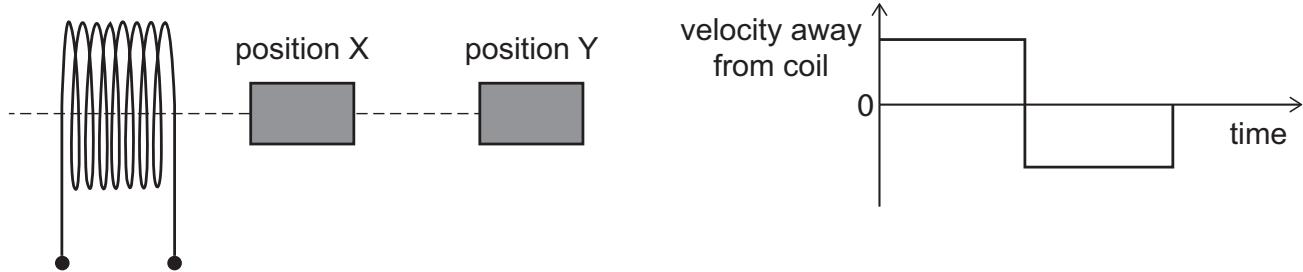
The magnetic field of the bar magnet still affects the coil when the magnet is at position Y.
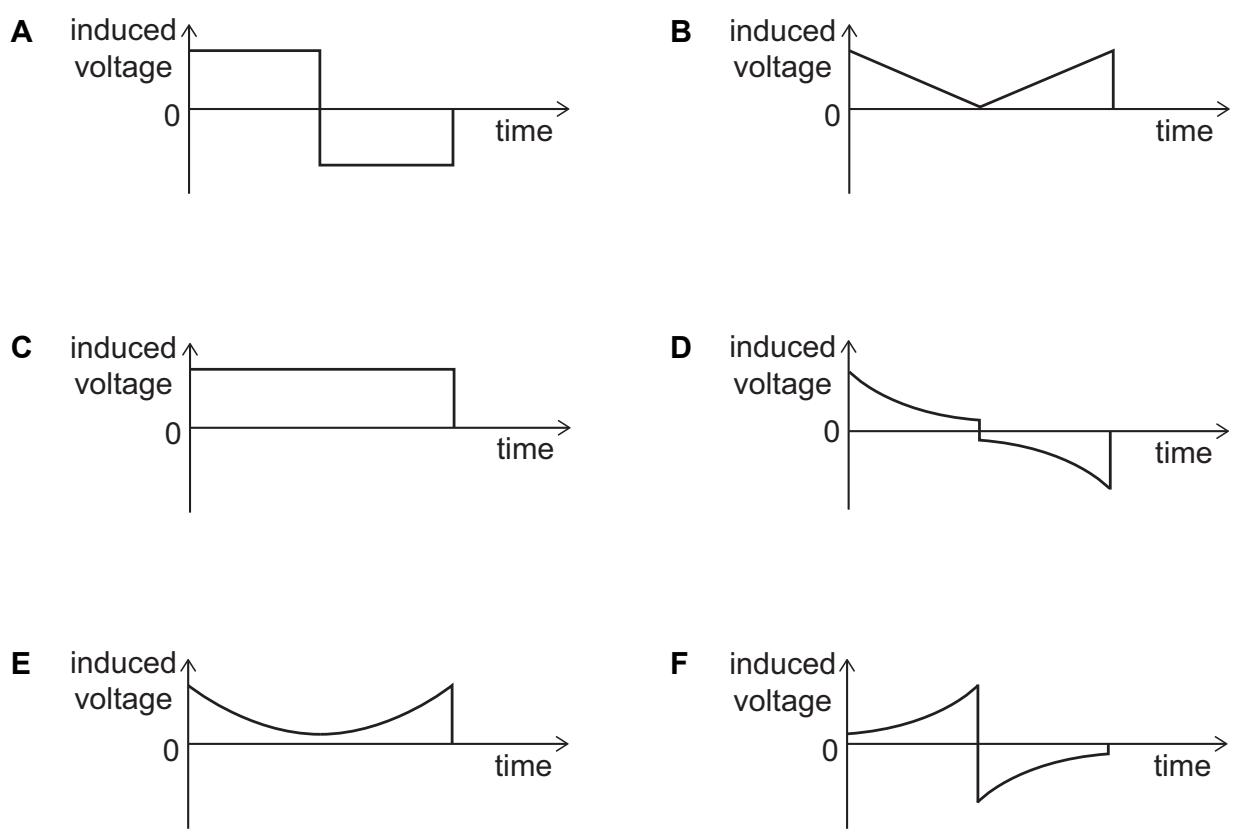
Which graph represents how the induced voltage in the coil changes as the magnet moves?
The graph shows how the velocity of the magnet varies as it is then moved rapidly to position Y and back to position X.
The magnetic field of the bar magnet still affects the coil when the magnet is at position Y.
Which graph represents how the induced voltage in the coil changes as the magnet moves?
- A.Graph A
- B.Graph B
- C.Graph C
- D.Graph D
- E.Graph E
- F.Graph F
Answer: D
Question 17
1 markThree different numbers are chosen at random from .
What is the probability that the three numbers form the three sides of a right-angled triangle?
What is the probability that the three numbers form the three sides of a right-angled triangle?
- A.
- B.
- C.
- D.
- E.
- F.
- G.
Answer: E
Question 18
1 markA small slider of mass 30 g is at rest near the bottom of a frictionless slope and in contact with a light uncompressed spring as shown.
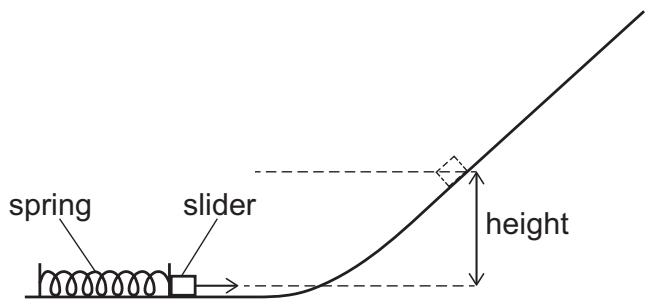
[diagram not to scale]
The spring is compressed by 5.0 cm and the slider remains in contact with it.
The spring is released and causes the slider to rise up the slope to a maximum vertical height of 20 cm.
The slider is replaced with one of mass 20 g.
The spring is now compressed by 15 cm, and the new slider remains in contact with it.
To what maximum vertical height does this new slider rise after it is released?
(the spring obeys Hooke's law; assume that air resistance is negligible)
[diagram not to scale]
The spring is compressed by 5.0 cm and the slider remains in contact with it.
The spring is released and causes the slider to rise up the slope to a maximum vertical height of 20 cm.
The slider is replaced with one of mass 20 g.
The spring is now compressed by 15 cm, and the new slider remains in contact with it.
To what maximum vertical height does this new slider rise after it is released?
(the spring obeys Hooke's law; assume that air resistance is negligible)
- A.40 cm
- B.60 cm
- C.90 cm
- D.120 cm
- E.180 cm
- F.270 cm
Answer: F
Question 19
1 markThe point (–1,5) is translated to the point (3, 2) by two successive translations.
The first translation is by the vector
The second translation is by the vector
What is the value of ?
The first translation is by the vector
The second translation is by the vector
What is the value of ?
- A.-14
- B.-7
- C.-5
- D.-1
- E.1
- F.5
- G.7
- H.14
Answer: D
Question 20
1 markA tall, smooth cylinder contains air at atmospheric pressure of Pa. The density of the air in the cylinder is .
A heavy piston is now placed in the top of the cylinder and allowed to fall slowly downwards, compressing the air until the piston rests in equilibrium.
The mass of the piston is 50.0 kg and its cross-sectional area is .
What is the density of the air in the cylinder when the piston rests in equilibrium?
(gravitational field strength = ; assume that the air behaves as an ideal gas and that the temperature remains constant)
A heavy piston is now placed in the top of the cylinder and allowed to fall slowly downwards, compressing the air until the piston rests in equilibrium.
The mass of the piston is 50.0 kg and its cross-sectional area is .
What is the density of the air in the cylinder when the piston rests in equilibrium?
(gravitational field strength = ; assume that the air behaves as an ideal gas and that the temperature remains constant)
- A.
- B.
- C.
- D.
- E.
- F.
Answer: E
Question 21
1 markFind the value of
- A.
- B.
- C.
- D.
- E.
- F.
Answer: A
Question 22
1 markThe diagram represents a stationary wave in a medium.
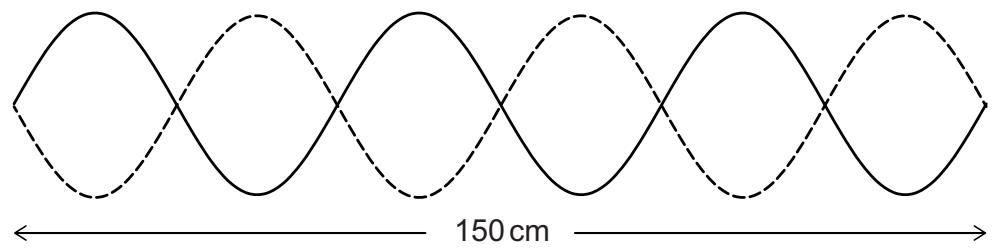
The transverse waves that are creating the stationary wave travel at a speed of through the medium.
What is the frequency of the transverse waves?
The transverse waves that are creating the stationary wave travel at a speed of through the medium.
What is the frequency of the transverse waves?
- A.75 Hz
- B.150 Hz
- C.200 Hz
- D.450 Hz
- E.600 Hz
- F.1200 Hz
Answer: E
Question 23
1 markThe diagram shows a semicircle of radius 5 units and a triangle.
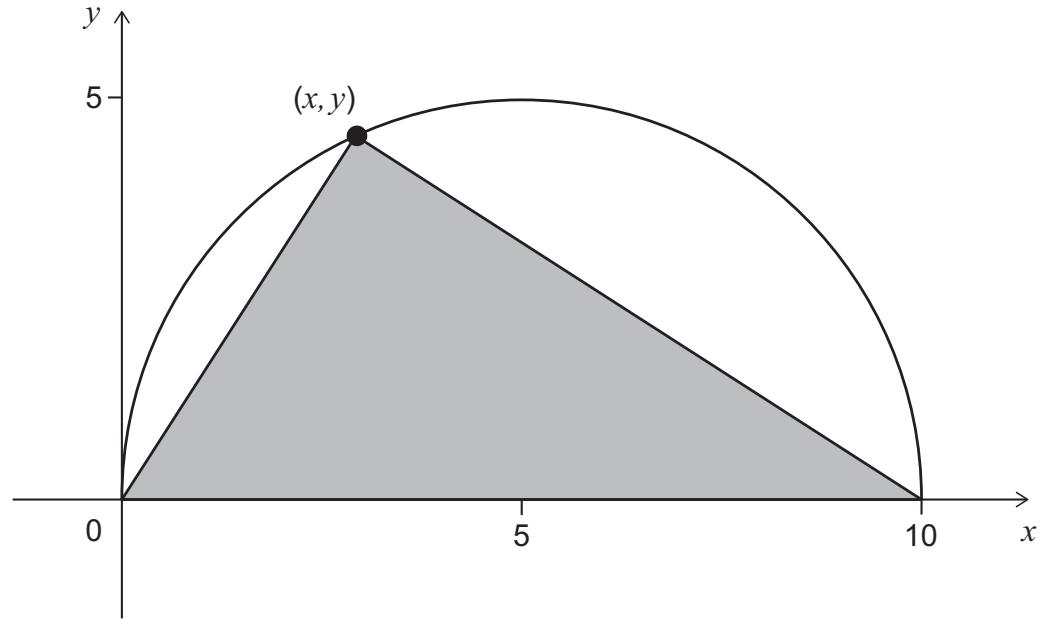
The triangle has vertices at (0,0), (10,0) and .
is a point on the arc of the semicircle.
Which of the following is an expression in terms of for the area of this triangle?
The triangle has vertices at (0,0), (10,0) and .
is a point on the arc of the semicircle.
Which of the following is an expression in terms of for the area of this triangle?
- A.
- B.
- C.
- D.
- E.
- F.
Answer: A
Question 24
1 markA stone is thrown vertically upwards from the surface of the Earth and reaches a maximum height .
The same stone is thrown vertically upwards from the surface of the Moon, with the same initial speed.
What is the maximum height reached by the stone thrown on the Moon?
(gravitational field strength on the Earth = ; gravitational field strength on the Moon = ; air resistance may be ignored)
The same stone is thrown vertically upwards from the surface of the Moon, with the same initial speed.
What is the maximum height reached by the stone thrown on the Moon?
(gravitational field strength on the Earth = ; gravitational field strength on the Moon = ; air resistance may be ignored)
- A.
- B.
- C.
- D.
- E.
- F.
- G.
- H.
Answer: A
Question 25
1 markFour mathematically similar solids, W, X, Y and Z, have the following properties:
The ratio of the lengths of W to the lengths of X is 1:2
The ratio of the surface area of X to the surface area of Y is 2:1
The ratio of the volume of Y to the volume of Z is 1:2
What is the order of the solids when arranged in volume?
The ratio of the lengths of W to the lengths of X is 1:2
The ratio of the surface area of X to the surface area of Y is 2:1
The ratio of the volume of Y to the volume of Z is 1:2
What is the order of the solids when arranged in volume?
- A.W Y X Z
- B.W Y Z X
- C.W Z Y X
- D.Y W X Z
- E.Y W Z X
- F.Y Z W X
Answer: B
Question 26
1 markA ray of light is incident on a boundary between a vacuum and medium X at an angle as shown:
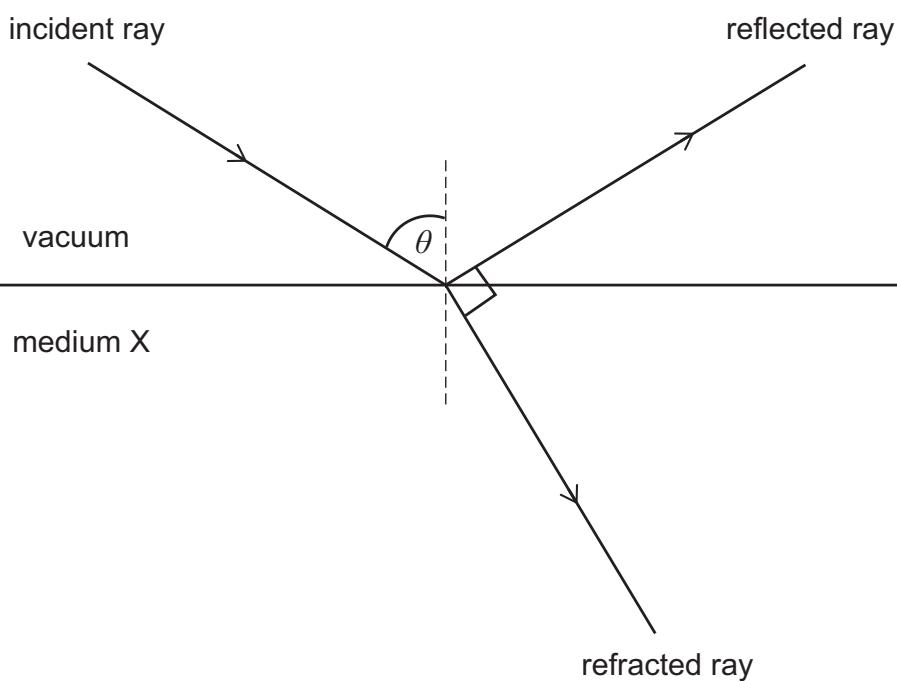
The incident ray is partially reflected and partially refracted. The angle between the reflected and refracted rays is 90°.
What is the refractive index of medium X?
The incident ray is partially reflected and partially refracted. The angle between the reflected and refracted rays is 90°.
What is the refractive index of medium X?
- A.
- B.
- C.
- D.
- E.
- F.
Answer: E
Question 27
1 markWhich one of the following expressions is equal to
- A.
- B.
- C.
- D.
- E.
- F.
Question 28
1 markAn electric train is travelling along a straight horizontal track. It passes a point Q on the track at time .
The distance that it then travels away from Q is given by the equation:
where and are constants.
Which of the following statements is/are correct?
The speed of the train increases with time at a constant rate.
The resultant force acting on the train increases with time.
The rate at which energy is transferred to the train increases with time.
The distance that it then travels away from Q is given by the equation:
where and are constants.
Which of the following statements is/are correct?
The speed of the train increases with time at a constant rate.
The resultant force acting on the train increases with time.
The rate at which energy is transferred to the train increases with time.
- A.none of them
- B.1 only
- C.2 only
- D.3 only
- E.1 and 2 only
- F.1 and 3 only
- G.2 and 3 only
- H.1, 2 and 3
Answer: F
Question 29
1 markEvaluate
- A.
- B.
- C.
- D.
- E.
- F.
Answer: B
Question 30
1 markA length of wire has resistance .
Another length of wire is made from the same material. This wire is twice as long as the first wire and has half the diameter.
Both wires have circular cross-sections.
The two wires are connected in parallel.
What is the total resistance of this combination?
Another length of wire is made from the same material. This wire is twice as long as the first wire and has half the diameter.
Both wires have circular cross-sections.
The two wires are connected in parallel.
What is the total resistance of this combination?
- A.
- B.
- C.
- D.
- E.
- F.
Answer: B
Question 31
1 markWhat is the complete set of real values of for which
- A.
- B.
- C.
- D.
- E.
- F.
Answer: A
Question 32
1 markAn empty bucket has a mass of 1.20 kg and an internal volume of . The bucket is used to lift water from a well.
The bucket is attached to a light, inextensible rope which winds onto a rotating cylinder of radius 0.200 m when a handle is turned.
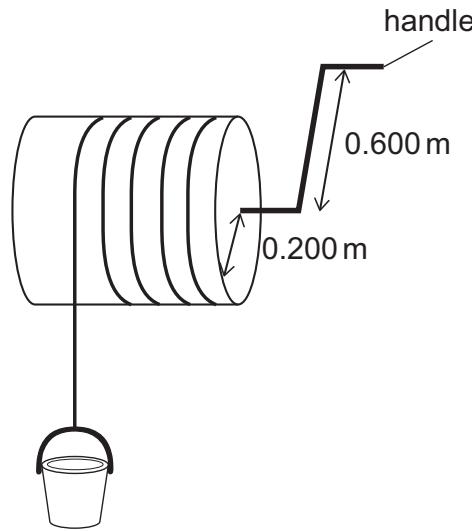
To lift a bucket completely full of water at constant speed, it is necessary to apply a force of 250 N to the handle that acts along the tangent to the circle of radius 0.600 m, in which the handle moves.
The energy required to lift the bucket is wasted energy.
What is the efficiency of the system in lifting water from the well?
(gravitational field strength = ; density of water = )
The bucket is attached to a light, inextensible rope which winds onto a rotating cylinder of radius 0.200 m when a handle is turned.
To lift a bucket completely full of water at constant speed, it is necessary to apply a force of 250 N to the handle that acts along the tangent to the circle of radius 0.600 m, in which the handle moves.
The energy required to lift the bucket is wasted energy.
What is the efficiency of the system in lifting water from the well?
(gravitational field strength = ; density of water = )
- A.2.00%
- B.2.16%
- C.20.0%
- D.21.6%
- E.60.0%
Answer: C
Question 33
1 markA sector of a circle has perimeter 24.
For what value of the radius does the sector have the maximum possible area?
For what value of the radius does the sector have the maximum possible area?
- A.
- B.
- C.
- D.6
- E.12
- F.18
- G.36
Answer: D
Question 34
1 markA uniform metre ruler has a mass of 100 g and is 1.00 m long.
A small object of mass 20 g is fixed at the 0 cm mark, and another small object of mass 80 g is fixed at the 100 cm mark.
The ruler is balanced on a pivot.
When the ruler is balanced, what distance is the pivot from the 0 cm mark?
A small object of mass 20 g is fixed at the 0 cm mark, and another small object of mass 80 g is fixed at the 100 cm mark.
The ruler is balanced on a pivot.
When the ruler is balanced, what distance is the pivot from the 0 cm mark?
- A.15 cm
- B.20 cm
- C.25 cm
- D.35 cm
- E.65 cm
- F.75 cm
- G.80 cm
- H.85 cm
Answer: E
Question 35
1 markThe curve intersects the x-axis at the points A and B, and has a minimum at the point C.
The rectangle ABDE has two of its vertices at A and B.
The point C lies on the edge DE, between D and E.
What is the area of the rectangle ABDE?
The rectangle ABDE has two of its vertices at A and B.
The point C lies on the edge DE, between D and E.
What is the area of the rectangle ABDE?
- A.6
- B.6.25
- C.30
- D.31.25
- E.35
- F.36.75
- G.42
- H.43.75
Answer: D
Question 36
1 markA circuit comprising two resistors and two batteries, with negligible internal resistance, is set up as shown in the diagram. The two junctions in the circuit are labelled X and Y.
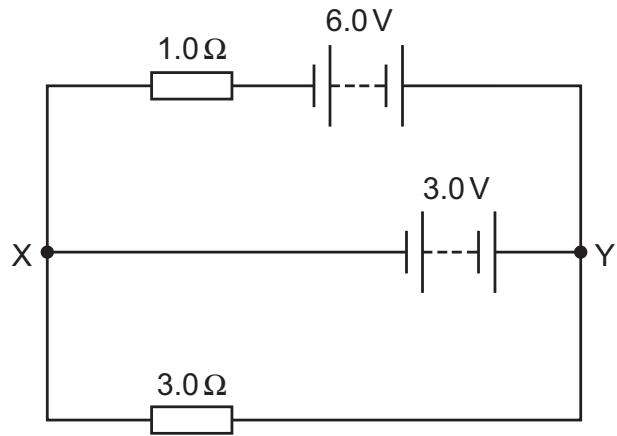
What are the magnitude and direction of the current in the 3.0 V battery?
What are the magnitude and direction of the current in the 3.0 V battery?
- A.magnitude of current / A: 1.0, direction of current: from X to Y
- B.magnitude of current / A: 2.0, direction of current: from X to Y
- C.magnitude of current / A: 2.25, direction of current: from X to Y
- D.magnitude of current / A: 6.0, direction of current: from X to Y
- E.magnitude of current / A: 1.0, direction of current: from Y to X
- F.magnitude of current / A: 2.0, direction of current: from Y to X
- G.magnitude of current / A: 2.25, direction of current: from Y to X
- H.magnitude of current / A: 6.0, direction of current: from Y to X
Answer: F
Question 37
1 markA straight line passes through the points and , where is a positive constant.
What is the perpendicular distance of the point from this line?
What is the perpendicular distance of the point from this line?
- A.
- B.
- C.
- D.
- E.
Answer: C
Question 38
1 markTwo isolated spheres have masses and . They are moving towards each other along the same straight line with speeds and respectively as shown:
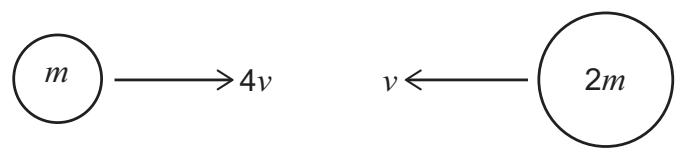
The spheres collide with each other and coalesce.
What is the loss of kinetic energy during the collision?
The spheres collide with each other and coalesce.
What is the loss of kinetic energy during the collision?
- A.
- B.
- C.
- D.
- E.
- F.
- G.
Answer: C
Question 39
1 markFind the sum of the real solutions to the equation
- A.8
- B.16
- C.
- D.
- E.
- F.
Answer: F
Question 40
1 markA steel cable has mass 64 kg and cross-sectional area .
The Young modulus of steel is Pa.
When the cable lies on horizontal ground its length is 40 m.
What is its extension when it is suspended freely from one end and hangs vertically?
(gravitational field strength = ; assume that the cable obeys Hooke's law)
The Young modulus of steel is Pa.
When the cable lies on horizontal ground its length is 40 m.
What is its extension when it is suspended freely from one end and hangs vertically?
(gravitational field strength = ; assume that the cable obeys Hooke's law)
- A.0 m
- B.
- C.
- D.
- E.
- F.
- G.
- H.
Answer: G