Mapped to the ESAT specification
NSAA 2016 Advanced Mathematics And Advanced Physics Part E
18 questions18 marksUpdated June 2026
Natural Sciences Admissions Assessment 2016 is one of the closest available past papers for the Engineering and Science Admissions Test. Below, all 18 questions are mapped to the ESAT topics they test, each with its answer. Sit it cold under exam timing, then work back through anything you missed using the solutions.
What this paper covers on the ESAT
Every question mapped to the Engineering and Science Admissions Test specification, so you know exactly which areas it tests.
Mathematics 1
- Algebra (5)
- Ratio and proportion (1)
Questions and answers are free. Full step-by-step worked solutions unlock with a free account. Start practising.
Question 73
1 markGiven that , where a, b, and c are positive real numbers, then
- A.
- B.
- C.
- D.
- E.
- F.
- G.
- H.
Answer: F
Question 74
1 markParticle P has a fixed mass of 2 kg and particle Q has a fixed mass of 5 kg.
The two particles are moving in opposite directions along a straight line on a smooth plane.
Particle P has a speed of 3 ms and particle Q has a speed of r ms.
The particles collide directly. After the collision the direction of each particle is reversed.
The speed of P is now 1 ms and the speed of Q is halved.
What is the value of r?
The two particles are moving in opposite directions along a straight line on a smooth plane.
Particle P has a speed of 3 ms and particle Q has a speed of r ms.
The particles collide directly. After the collision the direction of each particle is reversed.
The speed of P is now 1 ms and the speed of Q is halved.
What is the value of r?
- A.
- B.
- C.
- D.
- E.
Answer: C
Question 75
1 markWhich one of the following numbers is largest in value?
(All angles are given in radians.)
(All angles are given in radians.)
- A.
- B.
- C.
- D.
- E.
Answer: D
Question 76
1 markA parachutist falls from an aircraft and reaches a terminal velocity. After a while he opens his parachute and reaches a new (lower) terminal velocity.
Which graph shows how the total air resistance (drag) force acting on him and the parachute varies with time during the fall?
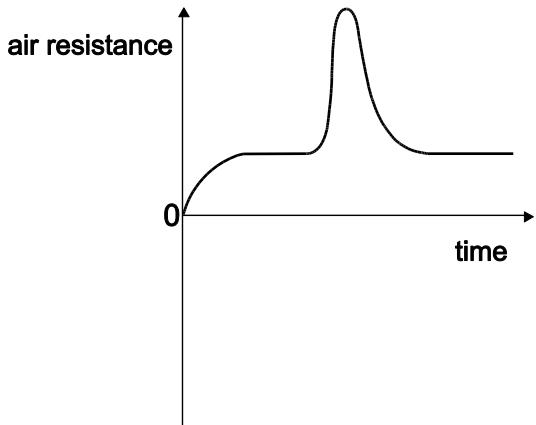
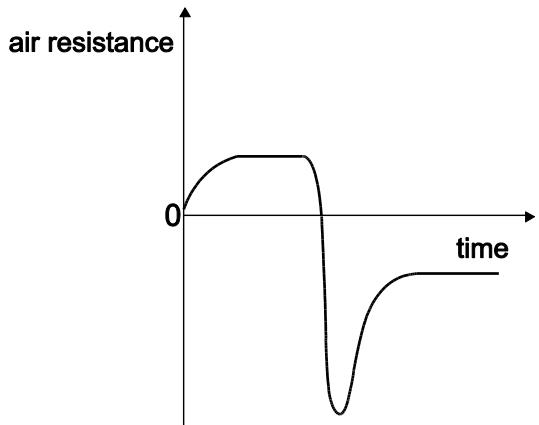
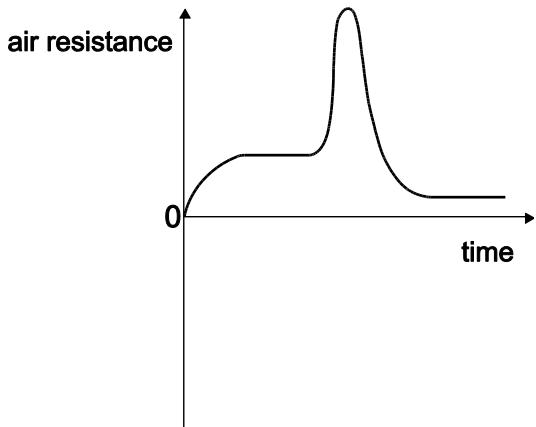
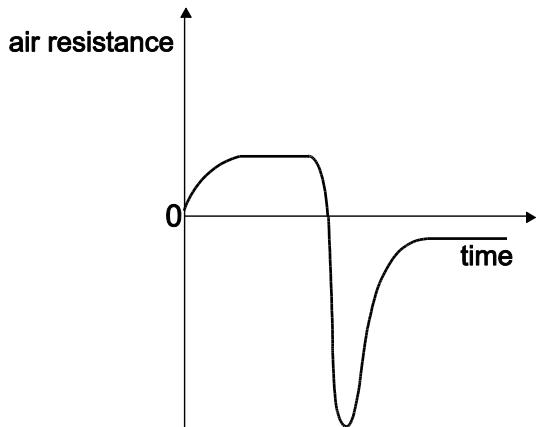
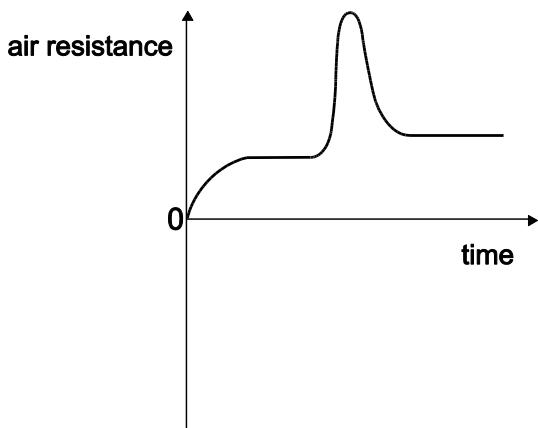
Which graph shows how the total air resistance (drag) force acting on him and the parachute varies with time during the fall?
- A.Graph of air resistance vs time. Starts at 0, increases to a plateau. A sharp spike upwards, then decreases to a second, lower plateau.
- B.Graph of air resistance vs time. Starts at 0, increases to a plateau. A sharp drop downwards into negative values, then rises to a second, lower plateau.
- C.Graph of air resistance vs time. Starts at 0, increases to a plateau. A sharp spike upwards, then decreases to a second plateau at the same level as the first.
- D.Graph of air resistance vs time. Starts at 0, increases to a plateau. A sharp drop downwards into negative values, then rises to a second plateau at the same level as the first.
- E.Graph of air resistance vs time. Starts at 0, increases to a plateau. A sharp spike upwards, then decreases to a second, lower plateau.
Answer: A
Question 77
1 markThe sum of the roots of the equation is
- A.3
- B.8
- C.
- D.
- E.
Answer: E
Question 78
1 markA heavy block of stone rests on a rough, horizontal surface.
The block is subject to a horizontal force that increases from zero at a constant rate.
Assume that the coefficient of friction is greater than zero and that its value is independent of whether or not the block is moving.
What happens to the block of stone?
(Assume air resistance is negligible.)
The block is subject to a horizontal force that increases from zero at a constant rate.
Assume that the coefficient of friction is greater than zero and that its value is independent of whether or not the block is moving.
What happens to the block of stone?
(Assume air resistance is negligible.)
- A.It moves forwards immediately and accelerates forwards with a constant acceleration.
- B.It remains stationary at first and then accelerates forwards with a constant acceleration.
- C.It remains stationary at first and then accelerates forwards with an increasing acceleration.
- D.It moves forwards immediately with a constant velocity.
- E.It remains stationary at first and then moves forwards with a constant velocity.
Answer: C
Question 79
1 markFor any real numbers a, b, and c where , consider these three statements:
1.
2.
3.
Which of the above statements must be true?
1.
2.
3.
Which of the above statements must be true?
- A.none of them
- B.1 only
- C.2 only
- D.3 only
- E.1 and 2 only
- F.1 and 3 only
- G.2 and 3 only
- H.1, 2 and 3
Answer: E
Question 80
1 markA white billiard ball of mass 0.20 kg is travelling horizontally at 3.0 ms and hits a red billiard ball of the same mass which is at rest. After the collision the white ball continues in the same direction with a speed of 1.0 ms.
What is the speed of the red ball immediately after the collision?
What is the speed of the red ball immediately after the collision?
- A.
- B.
- C.
- D.
- E.
Answer: C
Question 81
1 markThe sequence is given by the rule:
for
What is
for
What is
- A.150
- B.250
- C.-4750
- D.5150
- E.
- F.
Answer: A
Question 82
1 markA ball is dropped from a height of 16 m on to a horizontal surface, and on each bounce loses 50% of its kinetic energy.
After which bounce will the maximum height of the rebound fall to less than 160 cm for the first time?
(Assume air resistance is negligible, and the only external force acting on the ball while not in contact with the surface is gravity.)
After which bounce will the maximum height of the rebound fall to less than 160 cm for the first time?
(Assume air resistance is negligible, and the only external force acting on the ball while not in contact with the surface is gravity.)
- A.4th
- B.5th
- C.6th
- D.7th
- E.8th
Answer: A
Question 83
1 markHow many real roots does the equation have?
- A.0
- B.1
- C.2
- D.3
- E.4
Answer: C
Question 84
1 markA man of weight 600 N stands on a set of accurate weighing scales in a moving elevator (lift). The reading on the scales is 480 N.
Which statement correctly describes the motion of the elevator?
Which statement correctly describes the motion of the elevator?
- A.The elevator is moving downwards with constant speed.
- B.The elevator is moving downwards with decreasing speed.
- C.The elevator is moving upwards with increasing speed.
- D.The elevator is moving upwards with constant speed.
- E.The elevator is moving upwards with decreasing speed.
Answer: E
Question 85
1 markThe variables x and y and the constants a and b are real and positive. The variables x and y are related.
A graph of against is drawn.
For which one of the following relationships will this graph be a straight line?
A graph of against is drawn.
For which one of the following relationships will this graph be a straight line?
- A.
- B.
- C.
- D.
- E.
Answer: D
Question 86
1 markThe track for a tram is straight and horizontal. A tram is travelling along the track at a velocity of 12.0 ms when the brakes are applied. Because of this, the tram decelerates to rest at a constant rate of 1.50 ms.
What is the distance travelled by the tram over the total time for which it is decelerating?
What is the distance travelled by the tram over the total time for which it is decelerating?
- A.18.0 m
- B.48.0 m
- C.96.0 m
- D.108 m
- E.216 m
Answer: B
Question 87
1 markFor what values of the non-zero real number a does the quadratic equation
have distinct real roots?
have distinct real roots?
- A.all values of a
- B.
- C.
- D.
- E.no values of a
Answer: D
Question 88
1 markA particle of weight 5 N is held in position by two light ropes.
One of the ropes makes an angle of 60° with the upward vertical, the other is horizontal.
What is the tension in the horizontal rope?
One of the ropes makes an angle of 60° with the upward vertical, the other is horizontal.
What is the tension in the horizontal rope?
- A.
- B.
- C.
- D.
- E.
Answer: C
Question 89
1 markThe angle x is measured in radians and is such that .
The total length of any intervals for which and is
The total length of any intervals for which and is
- A.
- B.
- C.
- D.
- E.
- F.
- G.
Answer: B
Question 90
1 markA train consists of a powered engine travelling horizontally pulling two unpowered carriages.

The engine has a mass of 20 000 kg, and each carriage has a mass of 5000 kg. When the engine accelerates from rest it develops a thrust (driving force) of 15 000 N as shown.
Ignoring resistive forces, what is the tension (pulling force) T in the light and inextensible coupling between carriage 1 and carriage 2?
The engine has a mass of 20 000 kg, and each carriage has a mass of 5000 kg. When the engine accelerates from rest it develops a thrust (driving force) of 15 000 N as shown.
Ignoring resistive forces, what is the tension (pulling force) T in the light and inextensible coupling between carriage 1 and carriage 2?
- A.2500 N
- B.3750 N
- C.5000 N
- D.7500 N
- E.15 000 N
Answer: A