NSAA 2016 Advanced Mathematics And Advanced Physics S1
18 questions18 marksUpdated June 2026
The NSAA 2016 Advanced Mathematics And Advanced Physics S1 paper in full: all 18 questions, each with its answer. NSAA is the Natural Sciences Admissions Assessment. Sit it cold under exam timing, mark it, then work back through anything you missed using the solutions below.
Download the original PDF →Questions and answers are free. Full step-by-step worked solutions unlock with a free account. Start practising.
Question 73
When is substituted in the expression the result is 0.
When is substituted into the same expression, the result is - 3.5.
Find all possible value(s) of p.
When is substituted into the same expression, the result is - 3.5.
Find all possible value(s) of p.
- A.
- B. or
- C.
- D.
- E.there are no values for p
Question 74
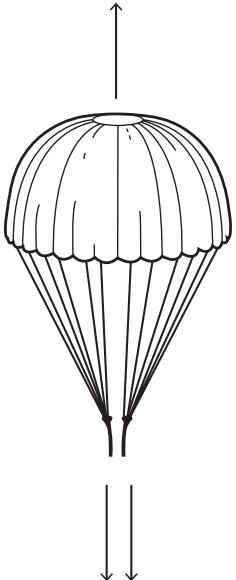
A parachutist is falling at terminal speed with his parachute open. The diagrams show, separately, the vertical forces acting on the parachute and the vertical forces acting on the parachutist.
The letters L, M, N, P, Q and R represent the magnitude of each force as indicated.

Consider the following equations:
Equation 1:
Equation 2:
Equation 3:
Equation 4:
Equation 5:
Which of these equations, if any, is/are the direct result of the application of Newton's Third Law to this situation?
The letters L, M, N, P, Q and R represent the magnitude of each force as indicated.
Consider the following equations:
Equation 1:
Equation 2:
Equation 3:
Equation 4:
Equation 5:
Which of these equations, if any, is/are the direct result of the application of Newton's Third Law to this situation?
- A.none of them
- B.3 only
- C.4 only
- D.5 only
- E.1 and 2 only
- F.3 and 4 only
- G.1, 2 and 5 only
- H.1, 2, 3, 4 and 5
Question 75
A square PQRS is drawn above the x-axis with the side PQ on the x-axis.
P is the point (-5, 0) and Q is the point (1, 0).
A circle is drawn inside the square with diameter equal in length to the side of the square.
Which one of the following is an equation of the circle?
P is the point (-5, 0) and Q is the point (1, 0).
A circle is drawn inside the square with diameter equal in length to the side of the square.
Which one of the following is an equation of the circle?
- A.
- B.
- C.
- D.
- E.
- F.
- G.
- H.
Question 76
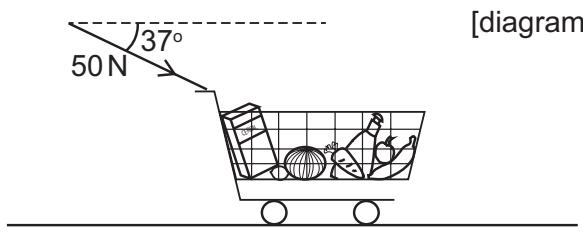
A shopper pushes a supermarket trolley a distance of 15 m in a straight line across a level, horizontal surface. The shopper applies a constant force of 50 N at an angle of 37° below the horizontal. The total weight of the trolley and its contents is 350 N.
What is the magnitude of the total vertical force that the surface exerts on the trolley and how much work is done by the pushing force?
(You may use the approximations .)
What is the magnitude of the total vertical force that the surface exerts on the trolley and how much work is done by the pushing force?
(You may use the approximations .)
- A.vertical force / N: 380, work done / J: 600
- B.vertical force / N: 380, work done / J: 750
- C.vertical force / N: 390, work done / J: 450
- D.vertical force / N: 390, work done / J: 750
- E.vertical force / N: 400, work done / J: 450
- F.vertical force / N: 400, work done / J: 600
Question 77
The first term of a convergent geometric series is 8.
The fifth term is 2.
The sixth term is real and positive.
What is the sum to infinity of this series?
(The sum to infinity of a convergent geometric series is given by , where a is the first term and r is the common ratio.)
The fifth term is 2.
The sixth term is real and positive.
What is the sum to infinity of this series?
(The sum to infinity of a convergent geometric series is given by , where a is the first term and r is the common ratio.)
- A.
- B.
- C.
- D.
- E.16
- F.
- G.
Question 78
A plank of non-uniform density which has a mass of 15 kg is used to make a see-saw. A pivot is placed under the centre of the plank as shown on the diagram.
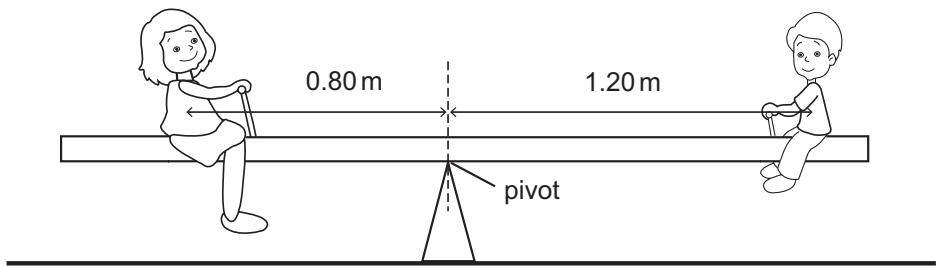
A boy of mass 35 kg sits at one end of the plank with his centre of gravity 1.20 m from the pivot. The see-saw balances when a woman of mass 60 kg sits on the plank on the other side of the pivot. Her centre of gravity is 0.80 m from the pivot.
Where is the centre of gravity of the plank and what is the magnitude of the force between the pivot and the plank?
(The gravitational field strength g is .)
A boy of mass 35 kg sits at one end of the plank with his centre of gravity 1.20 m from the pivot. The see-saw balances when a woman of mass 60 kg sits on the plank on the other side of the pivot. Her centre of gravity is 0.80 m from the pivot.
Where is the centre of gravity of the plank and what is the magnitude of the force between the pivot and the plank?
(The gravitational field strength g is .)
- A.distance from pivot: 0.40 m on left of pivot, force / N: 100
- B.distance from pivot: 0.40 m on left of pivot, force / N: 1100
- C.distance from pivot: at the pivot, force / N: 100
- D.distance from pivot: at the pivot, force / N: 1100
- E.distance from pivot: 0.20 m on right of pivot, force / N: 100
- F.distance from pivot: 0.20 m on right of pivot, force / N: 1100
- G.distance from pivot: 0.40 m on right of pivot, force / N: 100
- H.distance from pivot: 0.40 m on right of pivot, force / N: 1100
Question 79
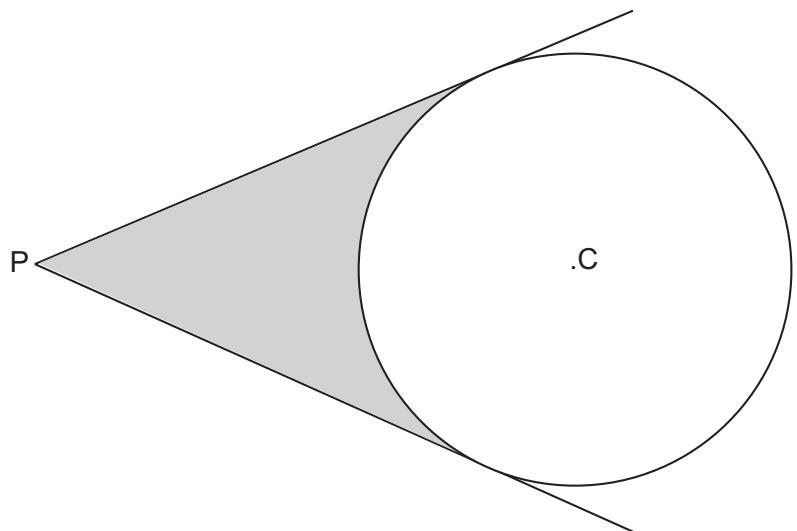
Tangents are drawn from a point P to a circle of radius 10 cm.
The centre of the circle is C and the distance PC is 20 cm.
Which one of the following is an expression for the shaded area in square centimetres?
The centre of the circle is C and the distance PC is 20 cm.
Which one of the following is an expression for the shaded area in square centimetres?
- A.
- B.
- C.
- D.
- E.
- F.
Question 80
A car of mass 200 kg on a fairground ride travels at a speed of at point X. The car is allowed to move down a sloping section of track without any energy input. The heights above the ground of points X and Y are shown. When the car reaches point Y its speed is .
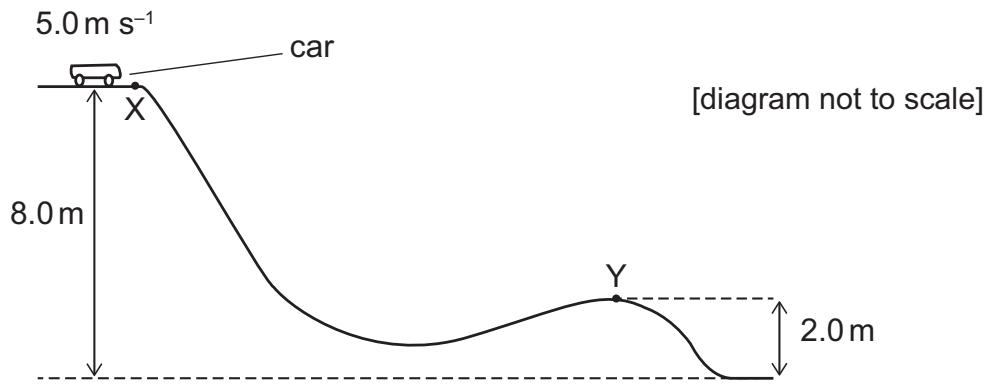
How much energy is transferred in overcoming resistive forces as the car travels from X to Y?
(The gravitational field strength g is .)
How much energy is transferred in overcoming resistive forces as the car travels from X to Y?
(The gravitational field strength g is .)
- A.3900 J
- B.6400 J
- C.7900 J
- D.10400 J
- E.11200 J
Question 81
Given that , which one of the following is true?
- A. or
- B. or
- C. or
- D. or
Question 82
The diagram shows a uniform, solid, heavy cube with side d. The cube rests with one of its edges in contact with a table that is perfectly level. A horizontal force P acts on another edge of the cube, and the cube is stationary.
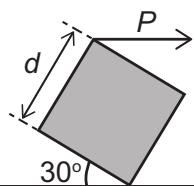
Below are four statements about the forces on the cube.
1 It is possible that there is no frictional force between the cube and the table.
2 There must be a frictional force acting to the left between the cube and the table.
3 There must be a frictional force acting to the right between the cube and the table.
4 Force P has a clockwise moment about the edge in contact with the table equal to .
Which of the statements is/are correct?
Below are four statements about the forces on the cube.
1 It is possible that there is no frictional force between the cube and the table.
2 There must be a frictional force acting to the left between the cube and the table.
3 There must be a frictional force acting to the right between the cube and the table.
4 Force P has a clockwise moment about the edge in contact with the table equal to .
Which of the statements is/are correct?
- A.1 only
- B.2 only
- C.3 only
- D.1 and 4 only
- E.2 and 4 only
- F.3 and 4 only
Question 83
The complete set of values of a for which the equation has two real distinct roots is
- A.no values of a
- B.
- C.
- D.
- E.
- F.
- G.
- H.all values of a
Question 84
An object is fired vertically upwards from the ground at time in still air at a speed of .
On the way up, what is the height of the object above the ground when it has a speed of , and at what time does it reach this height on the way down?
(The gravitational field strength g is . Air resistance can be ignored.)
On the way up, what is the height of the object above the ground when it has a speed of , and at what time does it reach this height on the way down?
(The gravitational field strength g is . Air resistance can be ignored.)
- A.height / m: 2.4, time / s: 0.60
- B.height / m: 2.4, time / s: 0.64
- C.height / m: 2.4, time / s: 1.0
- D.height / m: 2.4, time / s: 2.0
- E.height / m: 3.0, time / s: 0.60
- F.height / m: 3.0, time / s: 0.64
- G.height / m: 3.0, time / s: 1.0
- H.height / m: 3.0, time / s: 2.0
Question 85
The straight line with equation , where , is perpendicular to the line with equation .
The lines cut the x-axis at the points L and M respectively. The length of LM is 5 units.
What is the value of given that ?
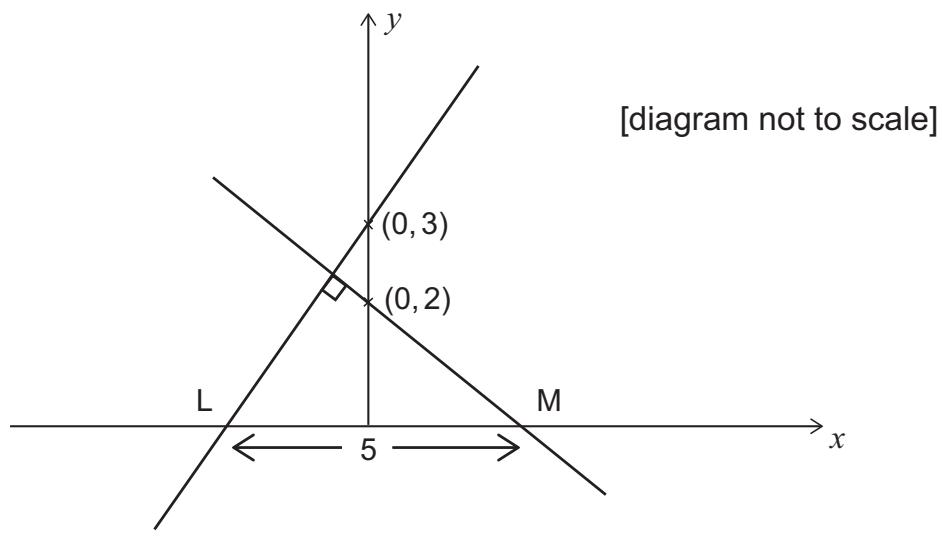
The lines cut the x-axis at the points L and M respectively. The length of LM is 5 units.
What is the value of given that ?
- A.
- B.
- C.
- D.
- E.
- F.
Question 86
The diagram shows a ball P, of mass 4.0 kg, moving to the right at directly towards a stationary ball Q, of mass 2.0 kg.
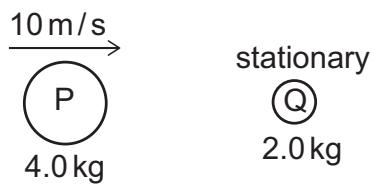
The balls collide but do not join together. Immediately after the collision ball Q moves at to the right.
What is the velocity of ball P immediately after the collision, and how much kinetic energy in total is lost during the collision?
The balls collide but do not join together. Immediately after the collision ball Q moves at to the right.
What is the velocity of ball P immediately after the collision, and how much kinetic energy in total is lost during the collision?
- A.velocity of ball P after collision: 0, kinetic energy lost during collision / J: 50
- B.velocity of ball P after collision: 0, kinetic energy lost during collision / J: 150
- C.velocity of ball P after collision: to the left, kinetic energy lost during collision / J: 50
- D.velocity of ball P after collision: to the left, kinetic energy lost during collision / J: 150
- E.velocity of ball P after collision: to the right, kinetic energy lost during collision / J: 50
- F.velocity of ball P after collision: to the right, kinetic energy lost during collision / J: 150
Question 87
where a is a positive constant.
Find the complete set of values of x for which is an increasing function.
Find the complete set of values of x for which is an increasing function.
- A.
- B.
- C.
- D.
- E.
- F.
- G.
- H.
Question 88
A point object of mass 2.0 kg is at rest on a level, horizontal surface. The coefficient of friction between the object and the surface is 0.25.
Two horizontal forces at right-angles to each other, with magnitudes 9.0 N and 12.0 N, are applied simultaneously to the object.
What is the magnitude of the acceleration of the object as it begins to move?
(The gravitational field strength g is .)
Two horizontal forces at right-angles to each other, with magnitudes 9.0 N and 12.0 N, are applied simultaneously to the object.
What is the magnitude of the acceleration of the object as it begins to move?
(The gravitational field strength g is .)
- A.
- B.
- C.
- D.
- E.
- F.
Question 89
The curve is translated by the vector and then reflected in the line .
Which one of the following is an equation of the resulting curve?
Which one of the following is an equation of the resulting curve?
- A.
- B.
- C.
- D.
- E.
- F.
- G.
- H.
Question 90
An object of mass 20 kg is pulled up a rough plane inclined at 30° to the horizontal by a light, inextensible cable attached via a frictionless pulley to a freely-falling 30 kg mass. The acceleration of the object along the plane is .
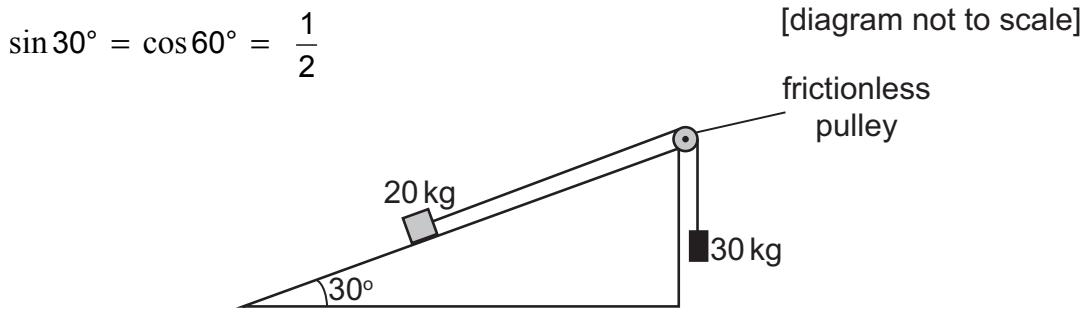
What is the frictional force between the object and the plane?
(Air resistance and the mass of the pulley can be ignored. The gravitational field strength g is .)
What is the frictional force between the object and the plane?
(Air resistance and the mass of the pulley can be ignored. The gravitational field strength g is .)
- A.25 N
- B.50 N
- C.75 N
- D.100 N
- E.150 N
- F.175 N
- G.250 N