Mapped to the ESAT specification
NSAA 2016 Biology Part D
18 questions18 marksUpdated June 2026
Natural Sciences Admissions Assessment 2016 is one of the closest available past papers for the Engineering and Science Admissions Test. Below, all 18 questions are mapped to the ESAT topics they test, each with its answer. Sit it cold under exam timing, then work back through anything you missed using the solutions.
What this paper covers on the ESAT
Every question mapped to the Engineering and Science Admissions Test specification, so you know exactly which areas it tests.
Mathematics 1
- Algebra (1)
- Geometry (1)
Chemistry
- Rates of reaction (1)
Biology
- Cells (3)
- DNA (3)
- Inheritance (3)
- Cell division and sex determination (2)
- Ecosystems (2)
- Enzymes (2)
- Animal physiology (1)
- Movement across membranes (1)
- Plant physiology (1)
- Variation (1)
Questions and answers are free. Full step-by-step worked solutions unlock with a free account. Start practising.
Question 55
1 markBetween 1954 and 1971 a mine in Northern Australia was releasing excess copper into the nearby Finnis River. Copper ions are poisonous and most of the types of fish living in the river died. The river still remains polluted with copper, but scientists have discovered one type of rainbow fish that is able to survive and live in the river.
A student wrote the following statements in order to explain this information.
1 One type of rainbow fish did not die out in the river because this type was able to adapt to the changing environment.
2 None of the other types of fish showed any type of genetic variation.
3 The presence of copper ions acted as a selective pressure.
Which of the student's statements could be correct?
A student wrote the following statements in order to explain this information.
1 One type of rainbow fish did not die out in the river because this type was able to adapt to the changing environment.
2 None of the other types of fish showed any type of genetic variation.
3 The presence of copper ions acted as a selective pressure.
Which of the student's statements could be correct?
- A.1 only
- B.1 and 2 only
- C.1 and 3 only
- D.2 and 3 only
- E.1, 2 and 3
Answer: C
Question 56
1 markThe diagram shows a plant cell.
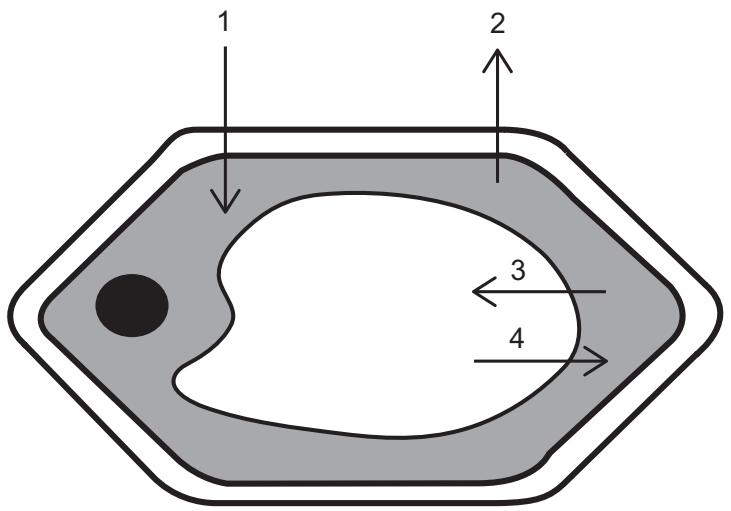
Which of the arrows on the diagram show the net movement of water molecules, by osmosis, when the cell is surrounded by a solution that is more concentrated than the solution in the cytoplasm?
Which of the arrows on the diagram show the net movement of water molecules, by osmosis, when the cell is surrounded by a solution that is more concentrated than the solution in the cytoplasm?
- A.1 only
- B.2 only
- C.1 and 3 only
- D.1 and 4 only
- E.2 and 3 only
- F.2 and 4 only
Answer: F
Question 57
1 markA student described a population of organisms as having the following features
1 single celled
2 chloroplasts present
3 cell wall present
Using this information, which type of organism could this describe?
1 single celled
2 chloroplasts present
3 cell wall present
Using this information, which type of organism could this describe?
- A.algae
- B.bacteria
- C.ferns
- D.fungi
- E.flowering plants
Answer: A
Question 58
1 markA student carried out an experiment to investigate how temperature affects the rate of activity of an enzyme found in potatoes. This enzyme breaks down the substrate hydrogen peroxide to produce water and oxygen.
The apparatus was set up as shown in the diagram and the experiment carried out at 30 °C.
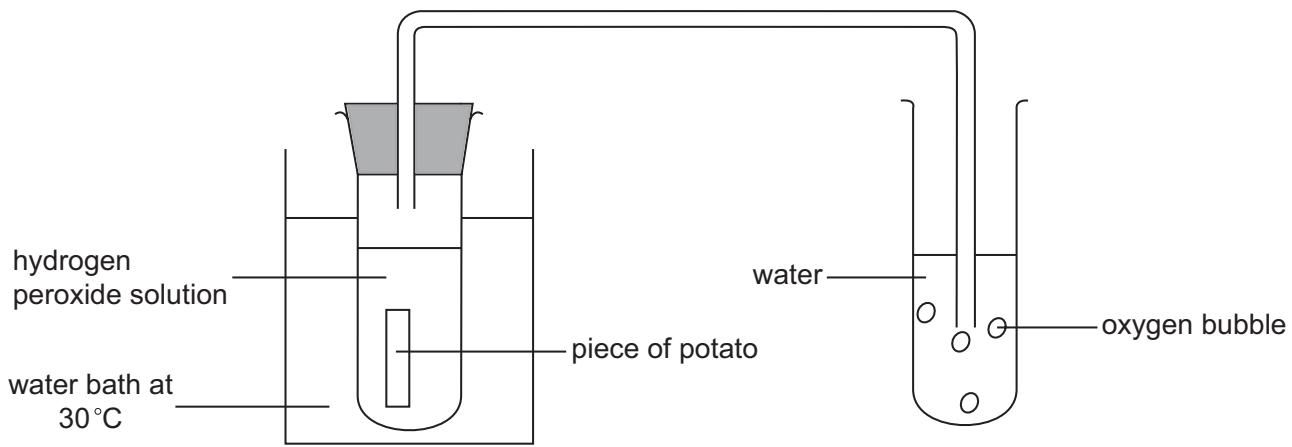
The student counted the number of bubbles of oxygen produced in one minute.
The experiment was repeated at 40 °C, 50 °C, 60 °C, and 70 °C.
The table shows the results collected by the student.
| temperature / °C | number of bubbles of oxygen gas produced in one minute |
| :--- | :--- |
| 30 | 32 |
| 40 | 27 |
| 50 | 23 |
| 60 | 8 |
| 70 | 2 |
A group of students were given these results and asked to calculate the percentage decrease in the number of bubbles produced between 30 °C and 60 °C. Each student was also asked to write a conclusion to explain the results. These are shown in the table below.
Which student correctly calculated the percentage decrease in the number of bubbles between 30 °C and 60 °C and wrote an appropriate conclusion which explains the reason for this decrease?
The apparatus was set up as shown in the diagram and the experiment carried out at 30 °C.
The student counted the number of bubbles of oxygen produced in one minute.
The experiment was repeated at 40 °C, 50 °C, 60 °C, and 70 °C.
The table shows the results collected by the student.
| temperature / °C | number of bubbles of oxygen gas produced in one minute |
| :--- | :--- |
| 30 | 32 |
| 40 | 27 |
| 50 | 23 |
| 60 | 8 |
| 70 | 2 |
A group of students were given these results and asked to calculate the percentage decrease in the number of bubbles produced between 30 °C and 60 °C. Each student was also asked to write a conclusion to explain the results. These are shown in the table below.
Which student correctly calculated the percentage decrease in the number of bubbles between 30 °C and 60 °C and wrote an appropriate conclusion which explains the reason for this decrease?
- A.percentage decrease in the number of bubbles between 30°C and 60°C: 20; conclusion: the high temperature causes the bonds maintaining the structure of the enzyme to break
- B.percentage decrease in the number of bubbles between 30°C and 60°C: 20; conclusion: the temperature of the environment is too hot and the enzyme dies
- C.percentage decrease in the number of bubbles between 30°C and 60°C: 75; conclusion: the high temperature causes the bonds maintaining the structure of the enzyme to break
- D.percentage decrease in the number of bubbles between 30°C and 60°C: 75; conclusion: the temperature of the environment is too hot and the enzyme dies
- E.percentage decrease in the number of bubbles between 30°C and 60°C: 300; conclusion: the high temperature causes the bonds maintaining the structure of the enzyme to break
- F.percentage decrease in the number of bubbles between 30°C and 60°C: 300; conclusion: the temperature of the environment is too hot and the enzyme dies
Answer: C
Question 59
1 markAlbinism is a recessive genetic condition that results in the absence of the pigment melanin in the skin, hair and eyes. In a population of 580000 people there were 29 albinos and 81200 symptomless carriers. One living cheek cell was collected from every individual in the population.
What is the number of albinism alleles in these cells?
What is the number of albinism alleles in these cells?
- A.0
- B.29
- C.58
- D.81229
- E.81258
- F.162458
Answer: E
Question 60
1 markA student set up the following apparatus at a temperature of 25 °C and at pH 7.
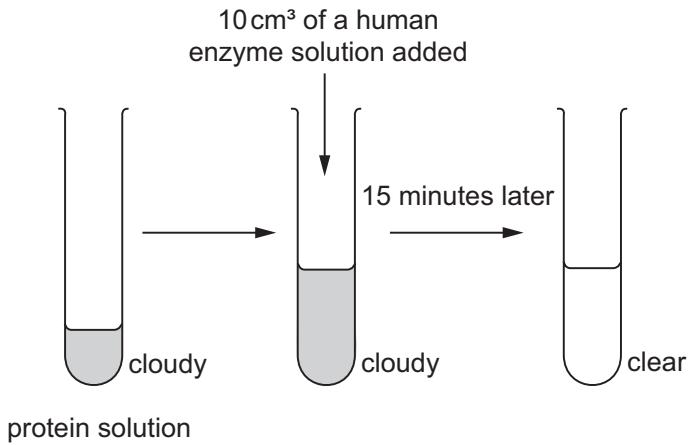
What could the student change so that it would take less than 15 minutes for the solution to become clear?
What could the student change so that it would take less than 15 minutes for the solution to become clear?
- A.Carry out the experiment at pH 7, but increase the temperature to 70 °C.
- B.Carry out the experiment, stirring the mixture once every 30 seconds.
- C.Carry out the experiment at a temperature of 25 °C and a pH of 13.
- D.Double the volume of both the protein solution and the enzyme solution.
- E.Halve the volume of both the protein solution and the enzyme solution.
Answer: B
Question 61
1 markThe diagram shows the apparatus used by a student to carry out an investigation into the rate of photosynthesis in pondweed.
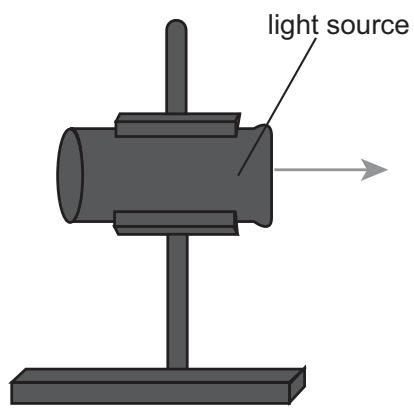
The student measured the distance the gas bubble moved along the capillary tube in 3 minutes as 16 mm. The student calculated the volume of gas produced using the distance moved and the diameter of the capillary tube which was 1.0 mm. After 3 minutes the rate of gas production is reduced.
Which row represents the correct statements for this experiment?
The student measured the distance the gas bubble moved along the capillary tube in 3 minutes as 16 mm. The student calculated the volume of gas produced using the distance moved and the diameter of the capillary tube which was 1.0 mm. After 3 minutes the rate of gas production is reduced.
Which row represents the correct statements for this experiment?
- A.volume of gas produced / mm³: ; reason for reduction in rate of gas production after 3 minutes: all enzyme active sites are occupied
- B.volume of gas produced / mm³: ; reason for reduction in rate of gas production after 3 minutes: carbon dioxide concentration is too low
- C.volume of gas produced / mm³: ; reason for reduction in rate of gas production after 3 minutes: carbon dioxide concentration is too low
- D.volume of gas produced / mm³: ; reason for reduction in rate of gas production after 3 minutes: photosynthesis enzymes denatured
- E.volume of gas produced / mm³: ; reason for reduction in rate of gas production after 3 minutes: carbon dioxide concentration is too low
- F.volume of gas produced / mm³: ; reason for reduction in rate of gas production after 3 minutes: photosynthesis enzymes denatured
- G.volume of gas produced / mm³: ; reason for reduction in rate of gas production after 3 minutes: all enzyme active sites are occupied
- H.volume of gas produced / mm³: ; reason for reduction in rate of gas production after 3 minutes: photosynthesis enzymes denatured
Answer: B
Question 62
1 markA student used a light microscope at a magnification of 40x to observe a slide of a stained non-dividing tissue. In the cells of this tissue, the student noted the presence of a large central vacuole and cytoplasm containing a single, stained, round structure.
Which of the following structures, if any, might the student also have seen in this tissue at this magnification?
1 cell wall
2 mitochondria
3 chromosomes
Which of the following structures, if any, might the student also have seen in this tissue at this magnification?
1 cell wall
2 mitochondria
3 chromosomes
- A.none of them
- B.1 only
- C.2 only
- D.3 only
- E.1 and 2 only
- F.1 and 3 only
- G.2 and 3 only
- H.1, 2 and 3
Answer: B
Question 63
1 markThe diagram shows the tip of a plant shoot, with two areas labelled P and Q.
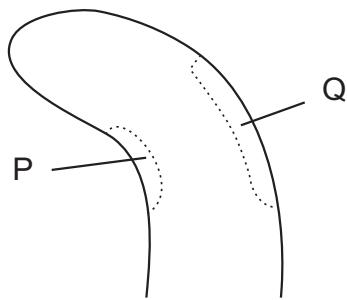
A student wrote the following statements to explain the growth of this shoot:
1 Cells at P are smaller than the cells at Q.
2 Concentration of plant hormone is higher at Q than P.
3 Unidirectional light has caused a change in the concentration of plant hormone at P.
Which of the student's statements, if any, could be correct?
A student wrote the following statements to explain the growth of this shoot:
1 Cells at P are smaller than the cells at Q.
2 Concentration of plant hormone is higher at Q than P.
3 Unidirectional light has caused a change in the concentration of plant hormone at P.
Which of the student's statements, if any, could be correct?
- A.none of them
- B.1 only
- C.2 only
- D.3 only
- E.1 and 2 only
- F.1 and 3 only
- G.2 and 3 only
- H.1, 2 and 3
Answer: H
Question 64
1 markIn an investigation, a molecule of DNA was extracted and separated into its single strands 1 and 2. The percentage of each base present in each strand was found.
The table shows some of the results for strand 1.
| DNA sample | base present (%) | | | |
| :--- | :--- | :--- | :--- | :--- |
| | adenine [A] | cytosine [C] | guanine [G] | thymine [T] |
| strand 1 | 26 | ? | 28 | 14 |
P, Q, R and S are the percentages of each base in the complementary strand 2.
| DNA sample | base present (%) | | | |
| :--- | :--- | :--- | :--- | :--- |
| | adenine [A] | cytosine [C] | guanine [G] | thymine [T] |
| strand 2 | P | Q | R | S |
A student calculates the following percentages for P, Q, R and S:
P 14%
Q 28%
R 26%
S 28%
Which of the percentages is/are correct?
The table shows some of the results for strand 1.
| DNA sample | base present (%) | | | |
| :--- | :--- | :--- | :--- | :--- |
| | adenine [A] | cytosine [C] | guanine [G] | thymine [T] |
| strand 1 | 26 | ? | 28 | 14 |
P, Q, R and S are the percentages of each base in the complementary strand 2.
| DNA sample | base present (%) | | | |
| :--- | :--- | :--- | :--- | :--- |
| | adenine [A] | cytosine [C] | guanine [G] | thymine [T] |
| strand 2 | P | Q | R | S |
A student calculates the following percentages for P, Q, R and S:
P 14%
Q 28%
R 26%
S 28%
Which of the percentages is/are correct?
- A.P only
- B.Q only
- C.R only
- D.S only
- E.P and Q only
- F.R and S only
Answer: E
Question 65
1 markCystic fibrosis is a condition of the respiratory system caused by abnormal ion transport in the lungs. It is a recessive genetic condition.
A female carrier has a child with a male who is also a carrier. What are the probabilities of the child having the characteristics described in the table below?
A female carrier has a child with a male who is also a carrier. What are the probabilities of the child having the characteristics described in the table below?
- A.probability that the child is a male with cystic fibrosis: ; probability that the child is a female who does not have cystic fibrosis but carries the recessive allele:
- B.probability that the child is a male with cystic fibrosis: ; probability that the child is a female who does not have cystic fibrosis but carries the recessive allele:
- C.probability that the child is a male with cystic fibrosis: ; probability that the child is a female who does not have cystic fibrosis but carries the recessive allele:
- D.probability that the child is a male with cystic fibrosis: ; probability that the child is a female who does not have cystic fibrosis but carries the recessive allele:
- E.probability that the child is a male with cystic fibrosis: ; probability that the child is a female who does not have cystic fibrosis but carries the recessive allele:
- F.probability that the child is a male with cystic fibrosis: ; probability that the child is a female who does not have cystic fibrosis but carries the recessive allele:
- G.probability that the child is a male with cystic fibrosis: ; probability that the child is a female who does not have cystic fibrosis but carries the recessive allele:
- H.probability that the child is a male with cystic fibrosis: ; probability that the child is a female who does not have cystic fibrosis but carries the recessive allele:
Answer: G
Question 66
1 markOrganisms interact with each other in many different ways, for example:
1 a tapeworm absorbing nutrients from a sheep intestine
2 a bacterial cell breaking down undigested food in a human gut
3 a leopard and a lion hunting an antelope
4 male deer fighting with each other to gain a mate
5 oak trees growing close to each other in a wood
Which of the statements is/are an example of intraspecific competition?
1 a tapeworm absorbing nutrients from a sheep intestine
2 a bacterial cell breaking down undigested food in a human gut
3 a leopard and a lion hunting an antelope
4 male deer fighting with each other to gain a mate
5 oak trees growing close to each other in a wood
Which of the statements is/are an example of intraspecific competition?
- A.1 only
- B.2 only
- C.4 only
- D.2 and 3 only
- E.4 and 5 only
- F.1, 2 and 5 only
- G.1, 3 and 4 only
Answer: E
Question 67
1 markA diploid cell from a type of fly that contains 8 chromosomes, divides to form sperm cells.
Which row is correct for the number of strands of DNA in each sperm cell and the number of sperm cells produced?
Which row is correct for the number of strands of DNA in each sperm cell and the number of sperm cells produced?
- A.number of strands of DNA in each sperm cell: 4; number of sperm cells produced: 2
- B.number of strands of DNA in each sperm cell: 4; number of sperm cells produced: 4
- C.number of strands of DNA in each sperm cell: 8; number of sperm cells produced: 2
- D.number of strands of DNA in each sperm cell: 8; number of sperm cells produced: 4
- E.number of strands of DNA in each sperm cell: 16; number of sperm cells produced: 2
- F.number of strands of DNA in each sperm cell: 16; number of sperm cells produced: 4
Answer: D
Question 68
1 markA healthy human is running a race over a distance of 1500 metres as fast as possible.
Which row shows molecules that would be in a higher concentration in a vein carrying blood away from an actively contracting leg muscle of the runner compared to an artery carrying blood to the capillaries in the muscle?
Key
✓ higher
X not higher
Which row shows molecules that would be in a higher concentration in a vein carrying blood away from an actively contracting leg muscle of the runner compared to an artery carrying blood to the capillaries in the muscle?
Key
✓ higher
X not higher
- A.glucose: higher, carbon dioxide: higher, lactic acid: higher
- B.glucose: not higher, carbon dioxide: higher, lactic acid: higher
- C.glucose: not higher, carbon dioxide: not higher, lactic acid: higher
- D.glucose: not higher, carbon dioxide: not higher, lactic acid: not higher
- E.glucose: higher, carbon dioxide: higher, lactic acid: not higher
- F.glucose: higher, carbon dioxide: not higher, lactic acid: not higher
- G.glucose: not higher, carbon dioxide: higher, lactic acid: not higher
Answer: B
Question 69
1 markThe sex of species Q is controlled by two chromosomes X and Y.
The sex of females of species Q is controlled by inheriting the same combination of sex chromosomes as healthy male humans. The sex of males in species Q is inherited in the same way as healthy female humans.
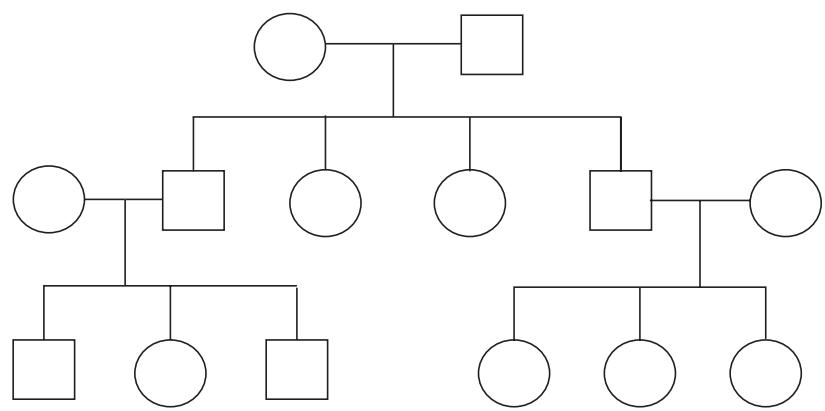
The family tree for one population of species Q is shown.
Key:
○ female
□ male
What is the ratio in its simplest form of males to females and the total number of Y chromosomes in this family tree?
The sex of females of species Q is controlled by inheriting the same combination of sex chromosomes as healthy male humans. The sex of males in species Q is inherited in the same way as healthy female humans.
The family tree for one population of species Q is shown.
Key:
○ female
□ male
What is the ratio in its simplest form of males to females and the total number of Y chromosomes in this family tree?
- A.ratio: 1:0.5; total number of Y chromosomes: 9
- B.ratio: 1.8:1; total number of Y chromosomes: 9
- C.ratio: 5:9; total number of Y chromosomes: 5
- D.ratio: 5:9; total number of Y chromosomes: 9
- E.ratio: 9:5; total number of Y chromosomes: 9
- F.ratio: 9:5; total number of Y chromosomes: 19
- G.ratio: 1:2; total number of Y chromosomes: 19
Answer: D
Question 70
1 markThe graph shows how a number of factors vary with the distance down a river, after a source of pollution flowed in.
(Assume the oxygen concentration is changing only based on the species present in the river.)
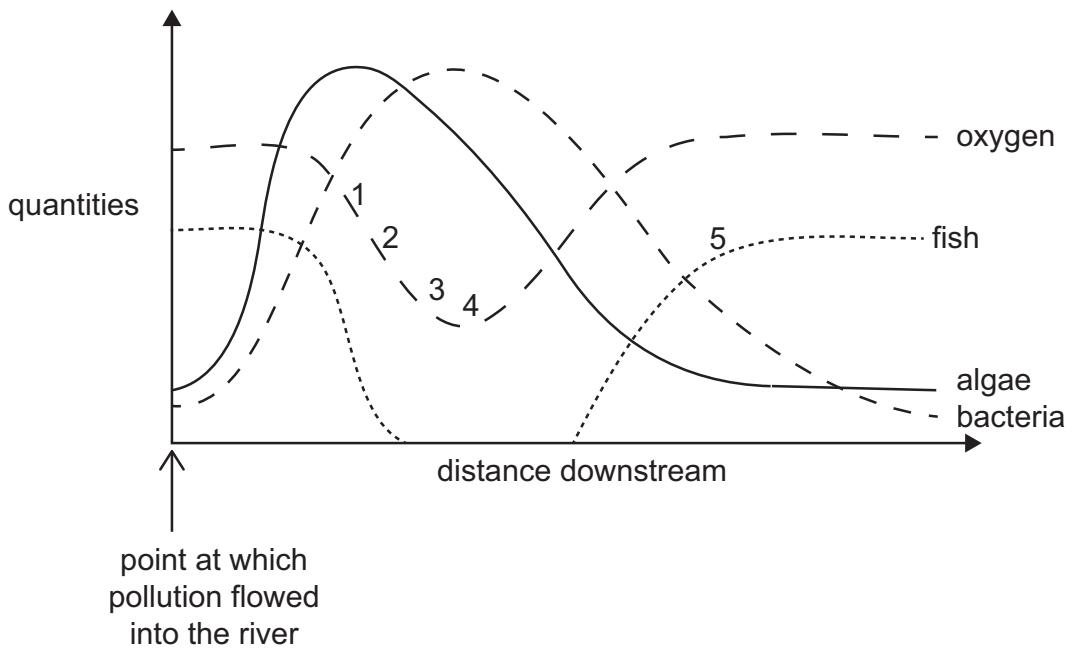
Which one of the statements below can be correctly concluded from the graph?
(Assume the oxygen concentration is changing only based on the species present in the river.)
Which one of the statements below can be correctly concluded from the graph?
- A.At point 1, the oxygen concentration is decreasing because of increased anaerobic respiration.
- B.At point 2, the oxygen concentration is decreasing because high numbers of algae are photosynthesising.
- C.At point 3, the oxygen concentration is decreasing because bacteria are using up more oxygen than the algae are producing.
- D.At point 4, the number of bloodworms and sludgeworms will be lowest because they lack oxygen.
- E.At point 5, fish numbers increase because there is less competition with algae for oxygen.
Answer: C
Question 71
1 markThe graph shows the effect of increasing the substrate concentration on an enzyme-controlled reaction when all the other variables were kept constant.
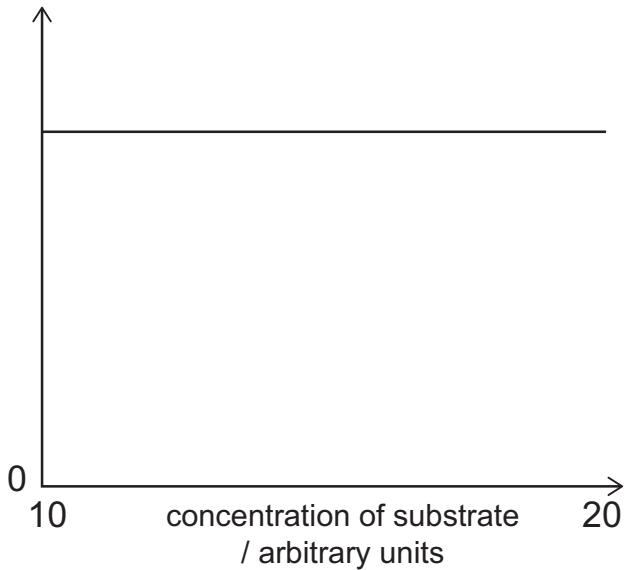
Which of the following labels, if any, could be correct for the y-axis?
1 rate of substrate loss/mg min⁻¹
2 rate of enzyme-substrate complex formation/number of complexes s⁻¹
3 rate of product formed per enzyme molecule/mg min⁻¹
Which of the following labels, if any, could be correct for the y-axis?
1 rate of substrate loss/mg min⁻¹
2 rate of enzyme-substrate complex formation/number of complexes s⁻¹
3 rate of product formed per enzyme molecule/mg min⁻¹
- A.none of them
- B.1 only
- C.2 only
- D.3 only
- E.1 and 2 only
- F.1 and 3 only
- G.2 and 3 only
- H.1, 2 and 3
Answer: H
Question 72
1 markThe table shows the DNA base triplet codes that are valid for this question and the amino acids that they code for.
| DNA base triplet | amino acid |
| :--- | :--- |
| CGT | arginine |
| CGC | arginine |
| CGA | arginine |
| CGG | arginine |
| CTG | leucine |
| CCG | proline |
| CAG | glutamine |
| CAT | histidine |
| AGT | serine |
Consider the part of the DNA sequence shown:
... CGC AGT ... →
Two mutations will occur in the DNA sequence. The initial mutation is an insertion of an additional base between the first and second bases in the sequence. The second mutation, which takes place some time after the first mutation, is a deletion that removes one base from the sequence.
Assuming that this DNA sequence is part of a longer sequence coding for a protein, and that no other mutations are occurring, what are the probabilities of the following?
| DNA base triplet | amino acid |
| :--- | :--- |
| CGT | arginine |
| CGC | arginine |
| CGA | arginine |
| CGG | arginine |
| CTG | leucine |
| CCG | proline |
| CAG | glutamine |
| CAT | histidine |
| AGT | serine |
Consider the part of the DNA sequence shown:
... CGC AGT ... →
Two mutations will occur in the DNA sequence. The initial mutation is an insertion of an additional base between the first and second bases in the sequence. The second mutation, which takes place some time after the first mutation, is a deletion that removes one base from the sequence.
Assuming that this DNA sequence is part of a longer sequence coding for a protein, and that no other mutations are occurring, what are the probabilities of the following?
- A.probability that after the first mutation, the first triplet in this sequence does not code for arginine: ; probability that after the second mutation, both of the triplets in this sequence code for arginine:
- B.probability that after the first mutation, the first triplet in this sequence does not code for arginine: ; probability that after the second mutation, both of the triplets in this sequence code for arginine:
- C.probability that after the first mutation, the first triplet in this sequence does not code for arginine: ; probability that after the second mutation, both of the triplets in this sequence code for arginine:
- D.probability that after the first mutation, the first triplet in this sequence does not code for arginine: ; probability that after the second mutation, both of the triplets in this sequence code for arginine:
- E.probability that after the first mutation, the first triplet in this sequence does not code for arginine: ; probability that after the second mutation, both of the triplets in this sequence code for arginine:
- F.probability that after the first mutation, the first triplet in this sequence does not code for arginine: ; probability that after the second mutation, both of the triplets in this sequence code for arginine:
- G.probability that after the first mutation, the first triplet in this sequence does not code for arginine: ; probability that after the second mutation, both of the triplets in this sequence code for arginine:
- H.probability that after the first mutation, the first triplet in this sequence does not code for arginine: ; probability that after the second mutation, both of the triplets in this sequence code for arginine:
Answer: E