NSAA 2016 Biology S1
18 questions18 marksUpdated June 2026
The NSAA 2016 Biology S1 paper in full: all 18 questions, each with its answer. NSAA is the Natural Sciences Admissions Assessment. Sit it cold under exam timing, mark it, then work back through anything you missed using the solutions below.
Download the original PDF →Questions and answers are free. Full step-by-step worked solutions unlock with a free account. Start practising.
Question 55
Which of the following describe(s) a role of mitosis?
1 formation of gametes
2 growth of cells
3 repair of cells
4 replacement of skin cells
1 formation of gametes
2 growth of cells
3 repair of cells
4 replacement of skin cells
- A.1 only
- B.2 only
- C.3 only
- D.4 only
- E.1 and 2 only
- F.3 and 4 only
- G.1, 3 and 4 only
- H.1, 2, 3 and 4
Answer: D
Question 56
The graph shows oxygen supply and demand in muscle cells during exercise.
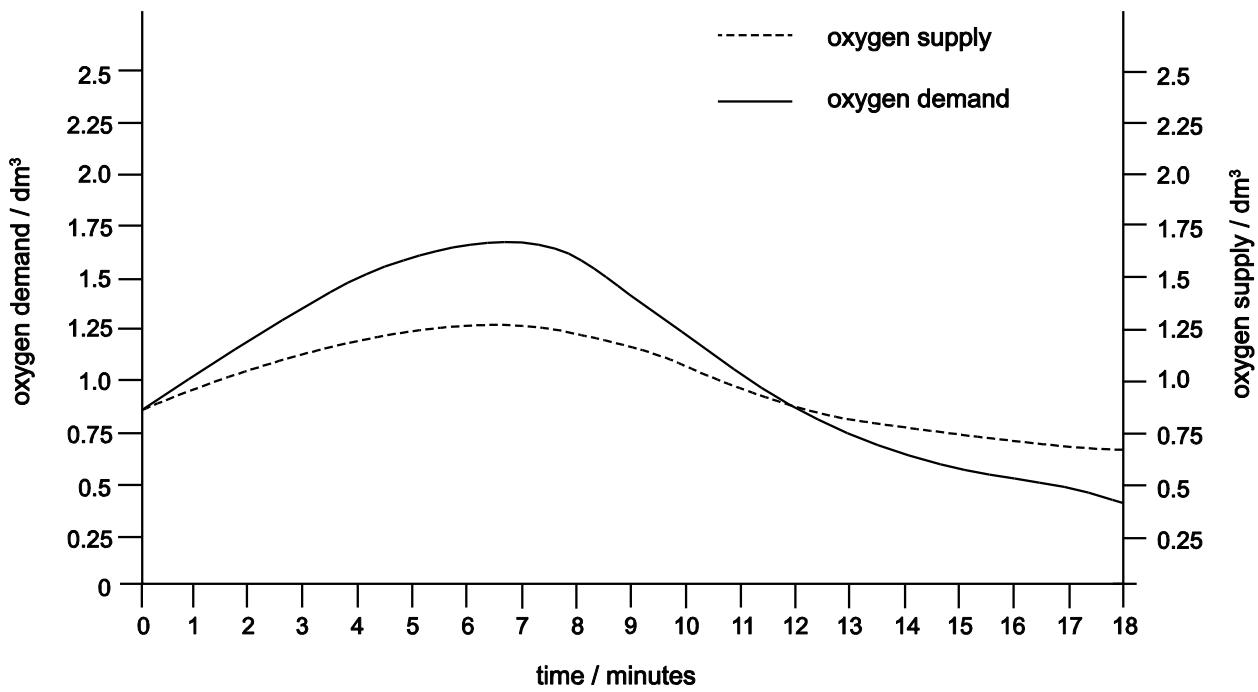
Which statement correctly describes what is happening in the muscle cells between 0 and 11 minutes?
Which statement correctly describes what is happening in the muscle cells between 0 and 11 minutes?
- A.Anaerobic respiration only is taking place.
- B.More oxygen is being supplied than is required.
- C.Aerobic respiration only is taking place.
- D.Both anaerobic and aerobic respiration are taking place.
Answer: D
Question 57
Which of the four statements below about natural selection are correct?
1 Competition occurs between individuals of the same species.
2 Competition occurs between individuals of different species.
3 Selection can lead to evolution.
4 Selection can lead to extinction.
1 Competition occurs between individuals of the same species.
2 Competition occurs between individuals of different species.
3 Selection can lead to evolution.
4 Selection can lead to extinction.
- A.1 and 3 only
- B.2 and 4 only
- C.1, 2 and 4 only
- D.1, 3 and 4 only
- E.2, 3 and 4 only
- F.1, 2, 3 and 4
Answer: F
Question 58
A student carried out an experiment to investigate the effect of temperature on the rate of photosynthesis. All of the other variables were kept constant.
The graph shows the results obtained.
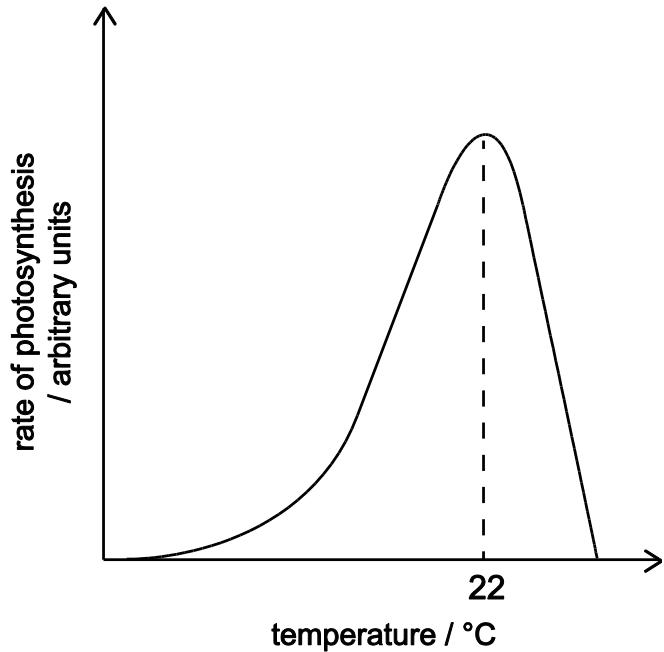
The student considered the graph and made the following conclusions.
1 Up to 22°C temperature is limiting the rate of photosynthesis.
2 At temperatures higher than 22°C not all of the enzymes work so the rate of photosynthesis drops.
3 As the temperature increases across the temperature range studied, the rate of photosynthesis increases due to increased kinetic energy.
Which of the student's conclusions is/are correct?
The graph shows the results obtained.
The student considered the graph and made the following conclusions.
1 Up to 22°C temperature is limiting the rate of photosynthesis.
2 At temperatures higher than 22°C not all of the enzymes work so the rate of photosynthesis drops.
3 As the temperature increases across the temperature range studied, the rate of photosynthesis increases due to increased kinetic energy.
Which of the student's conclusions is/are correct?
- A.1 only
- B.2 only
- C.3 only
- D.1 and 2 only
- E.1 and 3 only
- F.2 and 3 only
- G.1, 2 and 3
Answer: D
Question 59
The karyogram below is a photograph of the chromosomes taken from a single human cell.
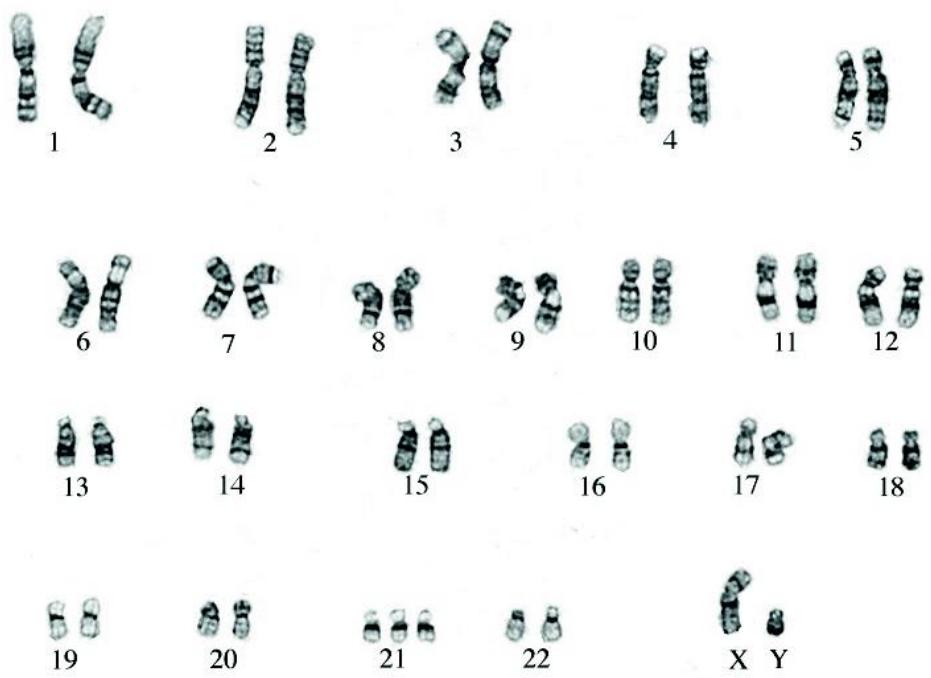
Using the karyogram, which of the following statements is/are correct?
1 The person is healthy with no visible mutations.
2 These chromosomes come from a male cell.
3 The cell used could have been a white blood cell.
Using the karyogram, which of the following statements is/are correct?
1 The person is healthy with no visible mutations.
2 These chromosomes come from a male cell.
3 The cell used could have been a white blood cell.
- A.1 only
- B.2 only
- C.3 only
- D.1 and 2 only
- E.1 and 3 only
- F.2 and 3 only
- G.1, 2 and 3
Answer: F
Question 60
Which of the following statements is/are correct about a stem cell extracted from the bone marrow of a healthy human donor to be given to a patient?
1 It can undergo meiosis to form genetically identical offspring.
2 It may contain 46 chromosomes.
3 It could differentiate to become a white blood cell.
1 It can undergo meiosis to form genetically identical offspring.
2 It may contain 46 chromosomes.
3 It could differentiate to become a white blood cell.
- A.1 only
- B.2 only
- C.3 only
- D.1 and 2 only
- E.1 and 3 only
- F.2 and 3 only
- G.1, 2 and 3
- H.none of them
Answer: F
Question 61
A student studied an area of grassland by randomly distributing 25 equal-sized quadrats.
The student counted the numbers of daisies, dandelions, plantains and buttercups in each quadrat.
[Image of a table showing the number of daisies, dandelions, plantains, and buttercups found in 25 different quadrats.]
The student then calculated the frequency of occurrence for each type of plant.
Which frequency of occurrence is correct for the daisy species?
The student counted the numbers of daisies, dandelions, plantains and buttercups in each quadrat.
[Image of a table showing the number of daisies, dandelions, plantains, and buttercups found in 25 different quadrats.]
The student then calculated the frequency of occurrence for each type of plant.
Which frequency of occurrence is correct for the daisy species?
- A.0.25
- B.0.33
- C.0.40
- D.3.00
- E.4.00
Answer: C
Question 62
A person's ear lobes can be attached to the side of their head or unattached. The allele for attached ear lobes is recessive to the allele for unattached ear lobes.
The pedigree diagram below shows the ear lobe attachment in one family.
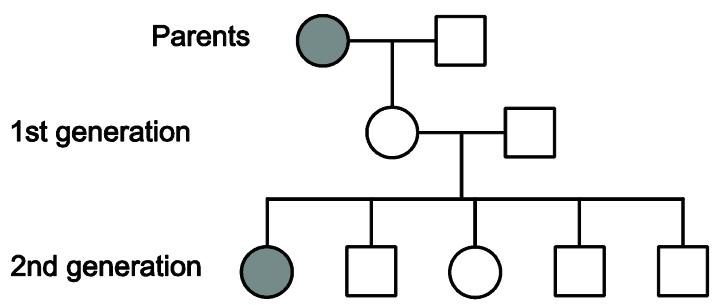
What is the maximum possible number of heterozygous individuals in this pedigree diagram?
The pedigree diagram below shows the ear lobe attachment in one family.
What is the maximum possible number of heterozygous individuals in this pedigree diagram?
- A.2
- B.3
- C.4
- D.5
- E.6
- F.7
- G.8
- H.9
Answer: F
Question 63
The graph below shows the effect of different concentrations of sodium chloride (NaCl) solution on the percentage haemolysis of human red blood cells. Haemolysis occurs when the cells swell and then burst open.
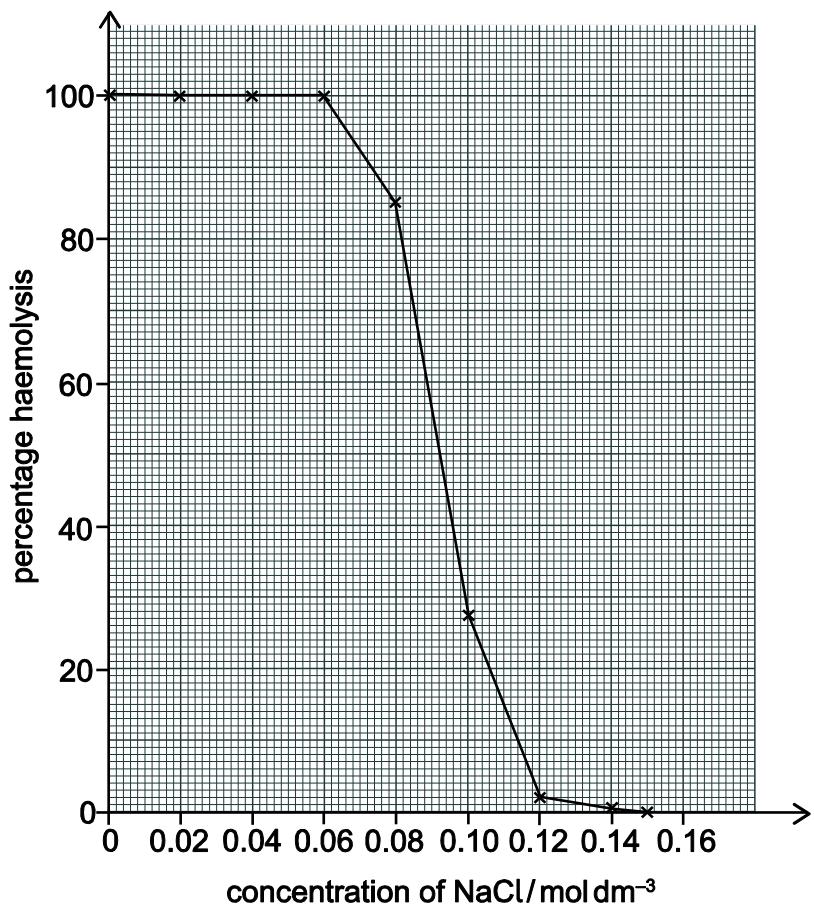
Which letter correctly describes the effect of changing the concentration of NaCl from 0.12 mol dm⁻³ to 0.084 mol dm⁻³ on percentage haemolysis?
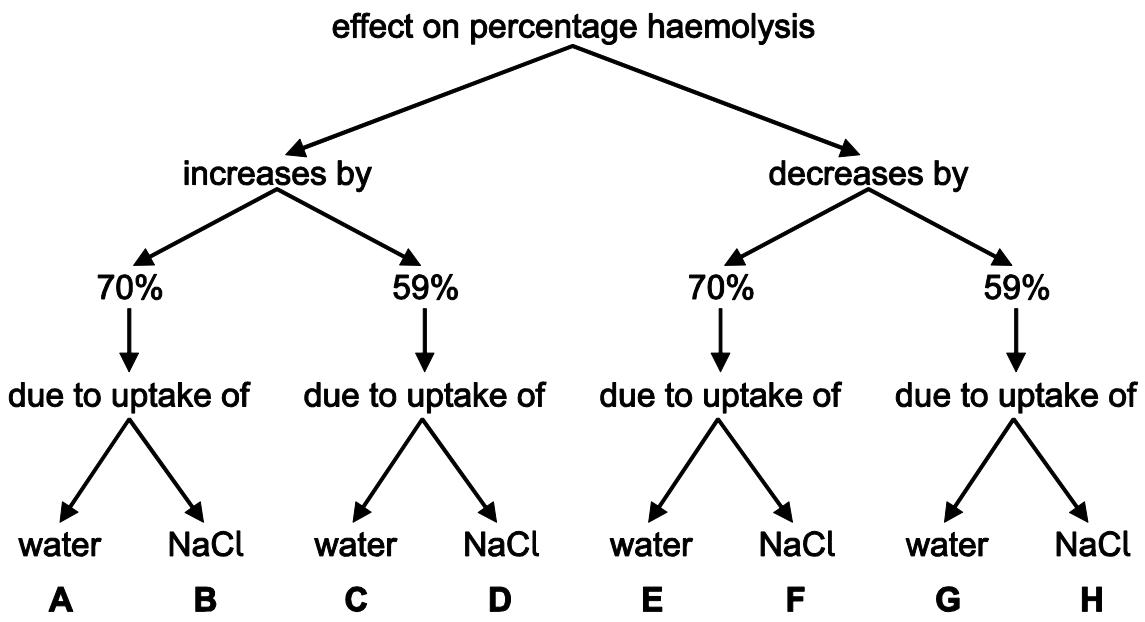
Which letter correctly describes the effect of changing the concentration of NaCl from 0.12 mol dm⁻³ to 0.084 mol dm⁻³ on percentage haemolysis?
- A.increases by 70% due to uptake of water
- B.increases by 70% due to uptake of NaCl
- C.increases by 59% due to uptake of water
- D.increases by 59% due to uptake of NaCl
- E.decreases by 70% due to uptake of water
- F.decreases by 70% due to uptake of NaCl
- G.decreases by 59% due to uptake of water
- H.decreases by 59% due to uptake of NaCl
Answer: A
Question 64
An experiment was set up to show the effect of light on shoots subject to the same intensity of light after 24 hours and various different treatments.
At the start of the experiment all the shoots were the same height and all were growing vertically.
The diagram shows the results of an experiment on the effect of light on young shoots, after 24 hours of exposure to the light.
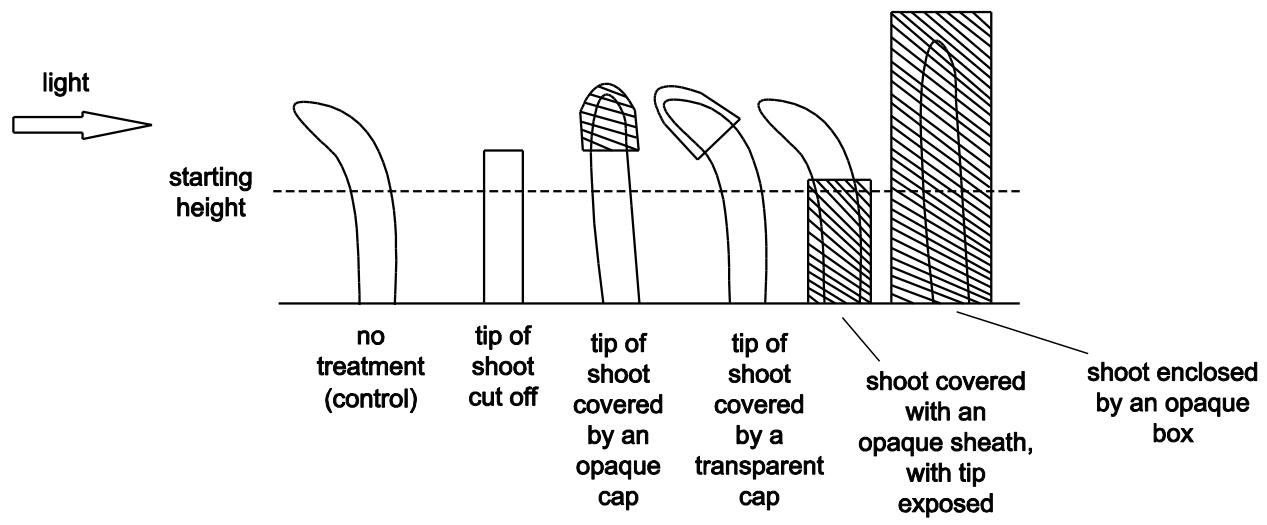
Which of the following statements about the results is/are correct?
1 All uncovered shoots showed a positive phototropic response.
2 Covering any part of the shoot prevented a phototropic response.
3 Shoots grow taller only when exposed to light.
At the start of the experiment all the shoots were the same height and all were growing vertically.
The diagram shows the results of an experiment on the effect of light on young shoots, after 24 hours of exposure to the light.
Which of the following statements about the results is/are correct?
1 All uncovered shoots showed a positive phototropic response.
2 Covering any part of the shoot prevented a phototropic response.
3 Shoots grow taller only when exposed to light.
- A.1 only
- B.2 only
- C.3 only
- D.1 and 2 only
- E.1 and 3 only
- F.2 and 3 only
- G.1, 2 and 3
- H.none of them
Answer: H
Question 65
An isolated island in Canada has populations of moose and wolves. Moose are the main source of food for the wolves. The graph shows changes in the populations of the two species of animal from 1959 to 2008.
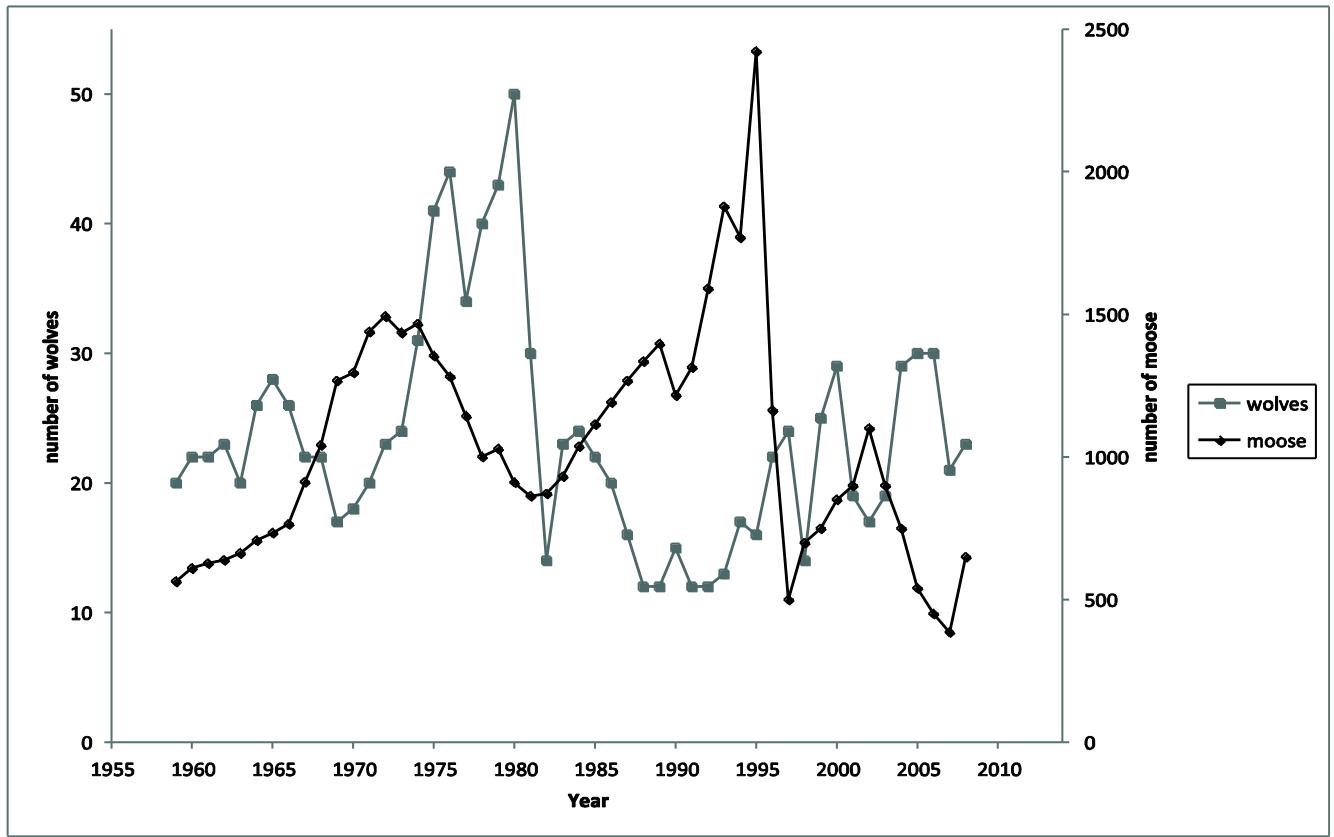
A student listed four trends in the populations of moose and wolves from 1959 to 2008.
1 Increases in wolf population are always after increases in moose population.
2 The wolf population is always lower than the moose population.
3 There were more wolves than moose in 1965.
4 When the wolf population is low there is an increase in the moose population.
Which of the student's statements are correct?
A student listed four trends in the populations of moose and wolves from 1959 to 2008.
1 Increases in wolf population are always after increases in moose population.
2 The wolf population is always lower than the moose population.
3 There were more wolves than moose in 1965.
4 When the wolf population is low there is an increase in the moose population.
Which of the student's statements are correct?
- A.1 and 2 only
- B.1 and 3 only
- C.1 and 4 only
- D.2 and 4 only
- E.3 and 4 only
Answer: D
Question 66
The sex of a species of fruit fly is determined by the number of X chromosomes relative to the number of non-sex chromosomes (A) in a cell. This is called the X:A ratio.
A fruit fly will be male if X:A = 0.5:1 and female if X:A = 1:1
The Y chromosome contains genes necessary for making sperm.
Which row of the table correctly shows the sex of the five fruit flies with different numbers of these chromosomes?
A fruit fly will be male if X:A = 0.5:1 and female if X:A = 1:1
The Y chromosome contains genes necessary for making sperm.
Which row of the table correctly shows the sex of the five fruit flies with different numbers of these chromosomes?
- A.XAA: female, XYAA: female, XXAA: female, XXYAA: male, XXYYAA: male
- B.XAA: female, XYAA: female, XXAA: male, XXYAA: male, XXYYAA: male
- C.XAA: female, XYAA: male, XXAA: female, XXYAA: male, XXYYAA: female
- D.XAA: female, XYAA: male, XXAA: female, XXYAA: male, XXYYAA: male
- E.XAA: male, XYAA: female, XXAA: male, XXYAA: female, XXYYAA: female
- F.XAA: male, XYAA: female, XXAA: male, XXYAA: female, XXYYAA: male
- G.XAA: male, XYAA: male, XXAA: female, XXYAA: female, XXYYAA: female
- H.XAA: male, XYAA: male, XXAA: female, XXYAA: female, XXYYAA: male
Answer: G
Question 67
The diagram shows part of the carbon cycle.
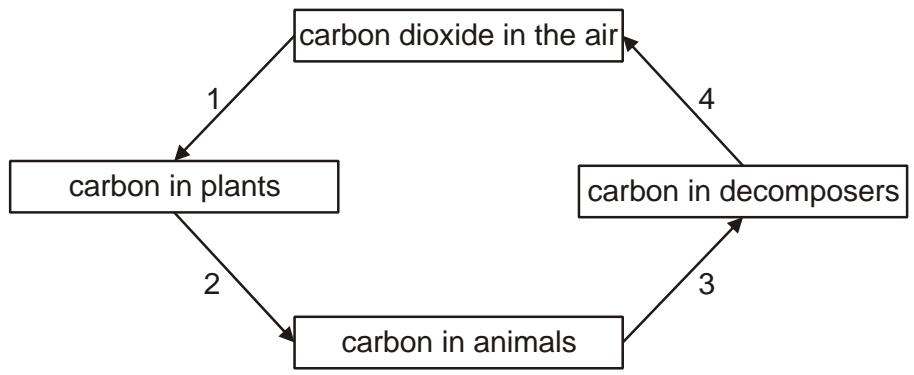
Which row shows the numbered processes that use digestive or respiratory enzymes?
Which row shows the numbered processes that use digestive or respiratory enzymes?
- A.process or processes that involve digestive enzymes: 1 only, process or processes that involve respiratory enzymes: 2 and 3 only
- B.process or processes that involve digestive enzymes: 2 only, process or processes that involve respiratory enzymes: 1 and 4 only
- C.process or processes that involve digestive enzymes: 3 only, process or processes that involve respiratory enzymes: 2 and 4 only
- D.process or processes that involve digestive enzymes: 4 only, process or processes that involve respiratory enzymes: 2 and 3 only
- E.process or processes that involve digestive enzymes: 2 and 3 only, process or processes that involve respiratory enzymes: 1 only
- F.process or processes that involve digestive enzymes: 3 and 4 only, process or processes that involve respiratory enzymes: 2 only
- G.process or processes that involve digestive enzymes: 1 and 4 only, process or processes that involve respiratory enzymes: 3 only
- H.process or processes that involve digestive enzymes: 2 and 3 only, process or processes that involve respiratory enzymes: 4 only
Answer: H
Question 68
A student carried out an experiment on an enzyme-catalysed reaction using amylase. The amylase was added to the substrate and left to react.
The graph shows the results of this experiment.
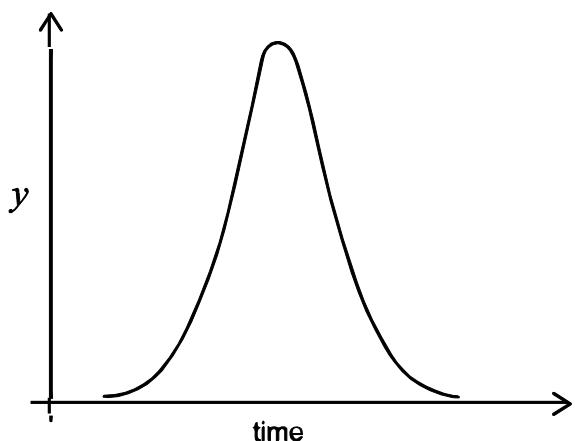
What should the label be on the y-axis?
The graph shows the results of this experiment.
What should the label be on the y-axis?
- A.enzyme concentration
- B.enzyme-substrate complex concentration
- C.pH
- D.product concentration
- E.substrate concentration
Answer: B
Question 69
Which of the statements about the genetic modification of a bacterium to produce human insulin are correct?
1 Human insulin DNA is cut out using an enzyme.
2 This DNA is inserted into the nucleus of a bacterium.
3 The modified bacterium is cultured.
4 The bacterial cells are injected into humans with diabetes.
1 Human insulin DNA is cut out using an enzyme.
2 This DNA is inserted into the nucleus of a bacterium.
3 The modified bacterium is cultured.
4 The bacterial cells are injected into humans with diabetes.
- A.1 and 2 only
- B.1 and 3 only
- C.2 and 4 only
- D.3 and 4 only
- E.1, 2 and 3 only
- F.1, 3 and 4 only
Answer: B
Question 70
Which of the following could be produced when a mutation occurs in a cheek cell of an organism?
1 a change in the sequence of amino acids used to make a protein
2 an advantageous allele that can be passed on to the offspring of that organism
3 a change of an essential cell process that causes the death of the cell
1 a change in the sequence of amino acids used to make a protein
2 an advantageous allele that can be passed on to the offspring of that organism
3 a change of an essential cell process that causes the death of the cell
- A.1 only
- B.2 only
- C.3 only
- D.1 and 2 only
- E.1 and 3 only
- F.2 and 3 only
- G.1, 2 and 3
Answer: E
Question 71
The genetic condition represented by the shading is caused by the presence of at least one allele for the condition.
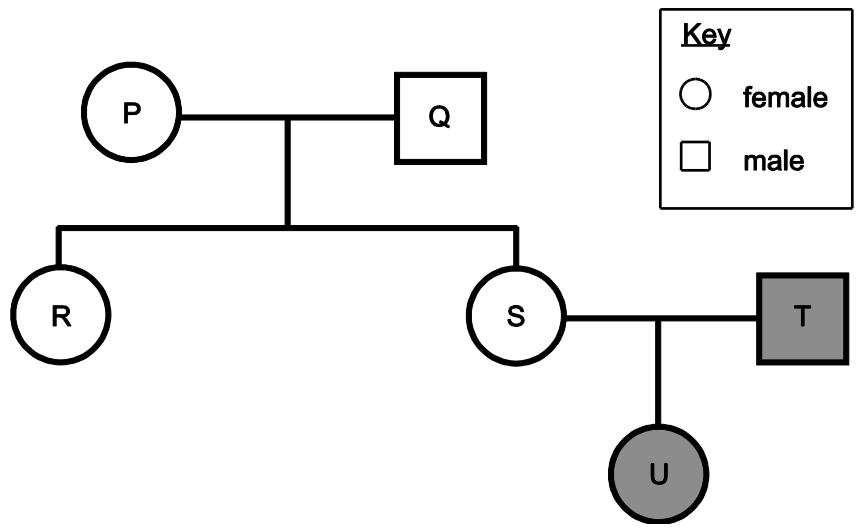
Which of the following are possible reasons why U has the condition?
1 The condition is dominant.
2 The sperm from T carried the allele for the condition.
3 A mutation is present in an egg of S.
Which of the following are possible reasons why U has the condition?
1 The condition is dominant.
2 The sperm from T carried the allele for the condition.
3 A mutation is present in an egg of S.
- A.1 and 2 only
- B.1 and 3 only
- C.2 and 3 only
- D.1, 2 and 3
- E.none of them
Answer: D
Question 72
Which of the following could be found in an adult liver cell?
1 starch
2 at least one X chromosome
3 gene for amylase
1 starch
2 at least one X chromosome
3 gene for amylase
- A.1 only
- B.2 only
- C.3 only
- D.1 and 2 only
- E.1 and 3 only
- F.2 and 3 only
- G.1, 2 and 3
- H.none of them
Answer: F