NSAA 2016 Chemistry S1
18 questions18 marksUpdated June 2026
The NSAA 2016 Chemistry S1 paper in full: all 18 questions, each with its answer. NSAA is the Natural Sciences Admissions Assessment. Sit it cold under exam timing, mark it, then work back through anything you missed using the solutions below.
Download the original PDF →Questions and answers are free. Full step-by-step worked solutions unlock with a free account. Start practising.
Question 37
Which one of the following atoms or ions contains the same number of neutrons and electrons as ?
- A.
- B.
- C.
- D.
- E.
Question 38
Solid titanium oxide does not conduct electricity and cannot be electrolysed.
When molten, titanium oxide is a conductor and can be electrolysed.
During electrolysis 7.2 g of titanium are formed for every 3.6 dm³ of oxygen at room temperature and pressure.
Which of the following statements, if any, are correct?
1 After electrolysis, the titanium atoms produced have a noble gas electron configuration.
2 When molten, titanium oxide electrons are delocalised and so they move to carry the charge.
3 The empirical formula of titanium oxide is .
(: Ti = 48; molar gas volume = 24 dm³ at room temperature and pressure)
When molten, titanium oxide is a conductor and can be electrolysed.
During electrolysis 7.2 g of titanium are formed for every 3.6 dm³ of oxygen at room temperature and pressure.
Which of the following statements, if any, are correct?
1 After electrolysis, the titanium atoms produced have a noble gas electron configuration.
2 When molten, titanium oxide electrons are delocalised and so they move to carry the charge.
3 The empirical formula of titanium oxide is .
(: Ti = 48; molar gas volume = 24 dm³ at room temperature and pressure)
- A.none of them
- B.1 only
- C.2 only
- D.3 only
- E.1 and 2 only
- F.1 and 3 only
- G.2 and 3 only
- H.1, 2, and 3
Question 39
In which, if any, of the following reactions are covalent bonds both broken and formed?
1 burning sodium in oxygen
2 electrolysis of aqueous sodium chloride
3 displacement of iron from iron oxide by heating with aluminium powder
1 burning sodium in oxygen
2 electrolysis of aqueous sodium chloride
3 displacement of iron from iron oxide by heating with aluminium powder
- A.none of them
- B.1 only
- C.2 only
- D.3 only
- E.1 and 2
- F.1 and 3
- G.2 and 3
- H.1, 2 and 3
Question 40
In a reversible reaction, gaseous reactants P and Q form gaseous products R and S.
An increase in temperature was found to increase both the rate of reaction and the yield at equilibrium.
An increase in pressure was found to increase the rate of reaction but the yield at equilibrium was unaffected.
Which equation could represent the reaction?
An increase in temperature was found to increase both the rate of reaction and the yield at equilibrium.
An increase in pressure was found to increase the rate of reaction but the yield at equilibrium was unaffected.
Which equation could represent the reaction?
- A.
- B.
- C.
- D.
- E.
- F.
Question 41
Several oxides of bromine have been identified. Analysis of 2.4 g of one of these compounds showed it to contain 1.6 g of bromine.
What is the empirical formula of this compound?
(: bromine = 80; oxygen = 16)
What is the empirical formula of this compound?
(: bromine = 80; oxygen = 16)
- A.
- B.
- C.
- D.
- E.
- F.
Question 42
The most common ion of antimony, , has 48 electrons.
Antimony has two isotopes. One isotope has 70 neutrons and has an abundance of 60%. The second isotope has 72 neutrons and has an abundance of 40%.
What is the relative atomic mass of antimony?
Antimony has two isotopes. One isotope has 70 neutrons and has an abundance of 60%. The second isotope has 72 neutrons and has an abundance of 40%.
What is the relative atomic mass of antimony?
- A.70.8
- B.71.0
- C.71.2
- D.121.8
- E.122.0
- F.122.2
Question 43
A chromatogram was produced for 4 separate dyes (W, X, Y and Z) using filter paper and a water solvent.
A second chromatogram was produced using a mixture of two of the dyes, again using filter paper and a water solvent:
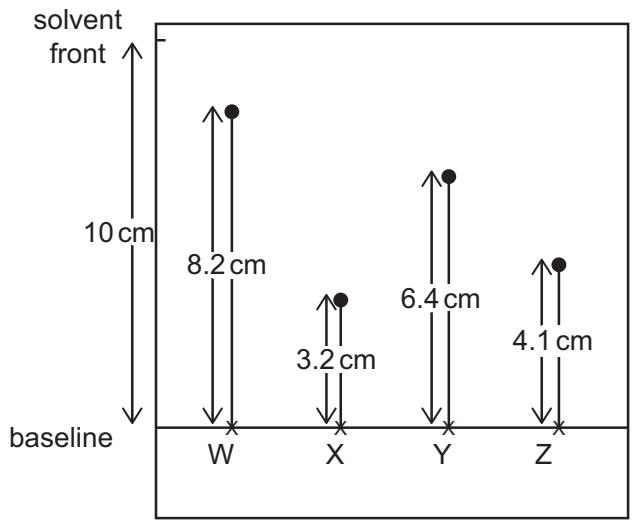
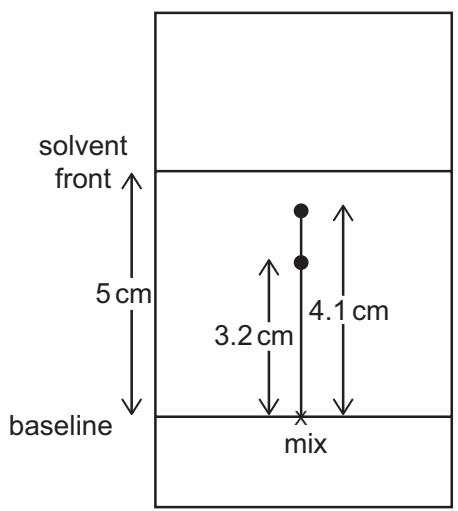
[diagram not to scale]
Which of the following statements, if any, are correct?
1 The concentration of dye W must be twice the concentration of dye Z.
2 The mobile phase is the filter paper.
3 The mixture in the second chromatogram contained dyes W and Y.
A second chromatogram was produced using a mixture of two of the dyes, again using filter paper and a water solvent:
[diagram not to scale]
Which of the following statements, if any, are correct?
1 The concentration of dye W must be twice the concentration of dye Z.
2 The mobile phase is the filter paper.
3 The mixture in the second chromatogram contained dyes W and Y.
- A.none of them
- B.1 only
- C.2 only
- D.3 only
- E.1 and 2 only
- F.1 and 3 only
- G.2 and 3 only
- H.1, 2 and 3
Question 44
The graphs show results of two experiments (W and Z) involving the catalytic decomposition of hydrogen peroxide.
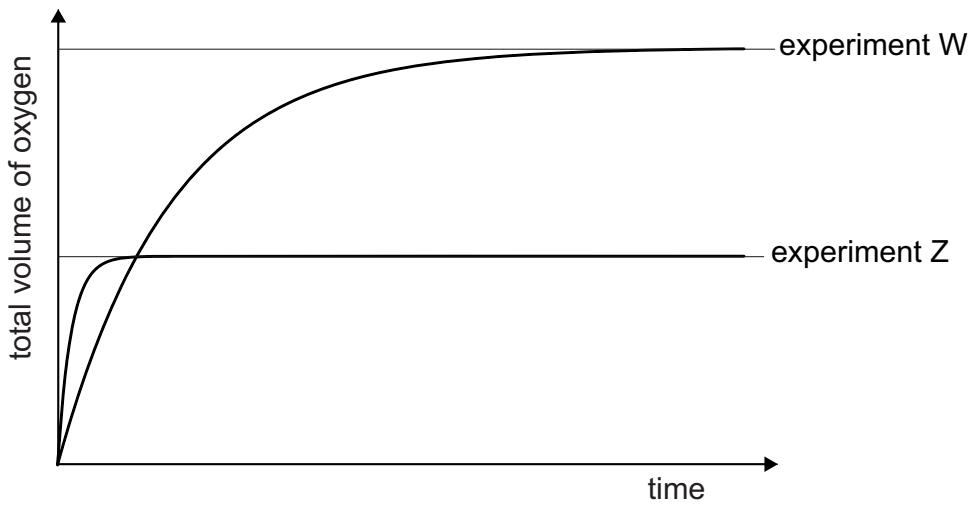
Assuming all other conditions are kept constant, which one of the following options would lead to the results shown?
Assuming all other conditions are kept constant, which one of the following options would lead to the results shown?
- A.experiment W: 100 cm³ of 1.0 mol dm⁻³ hydrogen peroxide; experiment Z: 50 cm³ of 2.0 mol dm⁻³ hydrogen peroxide
- B.experiment W: catalyst is in lumps; experiment Z: catalyst is finely divided
- C.experiment W: reaction carried out at 25 °C; experiment Z: reaction carried out at 50 °C
- D.experiment W: 2.0 g manganese(IV) oxide used; experiment Z: 1.0 g manganese(IV) oxide used
- E.experiment W: 100 cm³ of 1.0 mol dm⁻³ hydrogen peroxide; experiment Z: 25 cm³ of 2.0 mol dm⁻³ hydrogen peroxide
Question 45
Two of the following equations represent redox reactions:
1
2
3
4
Which two equations represent redox reactions?
1
2
3
4
Which two equations represent redox reactions?
- A.1 and 2
- B.1 and 3
- C.1 and 4
- D.2 and 3
- E.2 and 4
- F.3 and 4
Question 46
Copper, Cu, reacts with concentrated nitric acid, , to produce a solution of copper(II) nitrate, water and compound X.
Compound X does not contain copper or hydrogen.
The balanced equation for the reaction shows 3 moles of copper reacting with to produce 4 moles of water.
What is the identity of compound X?
Compound X does not contain copper or hydrogen.
The balanced equation for the reaction shows 3 moles of copper reacting with to produce 4 moles of water.
What is the identity of compound X?
- A.NO
- B.
- C.
- D.
- E.
Question 47
During the electrolysis of a saturated solution of sodium chloride, 2.4 dm³ of hydrogen gas was collected in time t at one of the electrodes.
Assuming no products dissolve, which row in the table correctly gives the mass or volume of the given product collected at the given electrode in time t?
(: Na = 23; Cl = 35.5; H = 1, 1 mole of gas occupies 24 dm³ at room temperature and pressure)
Assuming no products dissolve, which row in the table correctly gives the mass or volume of the given product collected at the given electrode in time t?
(: Na = 23; Cl = 35.5; H = 1, 1 mole of gas occupies 24 dm³ at room temperature and pressure)
- A.mass or volume: 0.1 g, product: hydrogen, electrode: negative
- B.mass or volume: 2.3 g, product: sodium, electrode: negative
- C.mass or volume: 2.4 dm³, product: chlorine, electrode: positive
- D.mass or volume: 2.4 dm³, product: chlorine, electrode: negative
- E.mass or volume: 2.4 dm³, product: oxygen, electrode: positive
- F.mass or volume: 3.55 g, product: chlorine, electrode: positive
- G.mass or volume: 1.2 dm³, product: oxygen, electrode: negative
Question 48
The heat energy change for a reaction is - 100 kJ mol⁻¹, and the activation energy is + 150 kJ mol⁻¹.
What is the activation energy for the reverse reaction?
What is the activation energy for the reverse reaction?
- A.- 250 kJ mol⁻¹
- B.- 150 kJ mol⁻¹
- C.- 50 kJ mol⁻¹
- D.+ 50 kJ mol⁻¹
- E.+ 150 kJ mol⁻¹
- F.+ 250 kJ mol⁻¹
Question 49
The following tests were carried out on separate samples of two monoprotic acids, HX and HY. HX is a strong acid and HY is a weak acid. Both acids had a concentration of 1 mol dm⁻³.
1 Measure the time taken for a 1 cm strip of magnesium to react completely when added to 25 cm³ of each acid.
2 Measure the volume of 1 mol dm⁻³ sodium hydroxide solution needed to completely neutralise 20 cm³ of each acid.
3 Measure the electrical conductance of each acid using a conductivity meter.
Each test was carried out under the same conditions.
Which of the tests, considered independently, if any, would show that HX was a stronger acid than HY?
1 Measure the time taken for a 1 cm strip of magnesium to react completely when added to 25 cm³ of each acid.
2 Measure the volume of 1 mol dm⁻³ sodium hydroxide solution needed to completely neutralise 20 cm³ of each acid.
3 Measure the electrical conductance of each acid using a conductivity meter.
Each test was carried out under the same conditions.
Which of the tests, considered independently, if any, would show that HX was a stronger acid than HY?
- A.none of them
- B.1 only
- C.2 only
- D.3 only
- E.1 and 2 only
- F.1 and 3 only
- G.2 and 3 only
- H.1, 2 and 3
Question 50
A 1.50 g sample of impure anhydrous sodium carbonate was added to 100 cm³ of excess dilute hydrochloric acid. The impurity is unreactive.
The volume of gas released was 240 cm³ at room temperature and pressure.
What is the mass of the impurity?
(: Na = 23; C = 12; O = 16; molar gas volume = 24000 cm³ at room temperature and pressure)
The volume of gas released was 240 cm³ at room temperature and pressure.
What is the mass of the impurity?
(: Na = 23; C = 12; O = 16; molar gas volume = 24000 cm³ at room temperature and pressure)
- A.0.44 g
- B.0.53 g
- C.0.67 g
- D.0.83 g
- E.0.97 g
- F.1.06 g
Question 51
0.35 g of lithium metal reacts with excess water at room temperature. Any gas produced in the reaction is collected and its volume measured at room temperature and pressure.
Assuming 1 mole of gas occupies 24.0 dm³ at room temperature and pressure, what is the volume of gas collected?
(: Li = 7)
Assuming 1 mole of gas occupies 24.0 dm³ at room temperature and pressure, what is the volume of gas collected?
(: Li = 7)
- A.0.00 cm³
- B.0.60 cm³
- C.1.20 cm³
- D.25.0 cm³
- E.50.0 cm³
- F.600 cm³
- G.1200 cm³
Question 52
Sodium sulfate was prepared by neutralising 25.0 cm³ of 0.1 mol dm⁻³ sodium hydroxide with exactly 50.0 cm³ of sulfuric acid.
What is the concentration of the sulfuric acid in g dm⁻³?
(: = 98)
What is the concentration of the sulfuric acid in g dm⁻³?
(: = 98)
- A.0.025 g dm⁻³
- B.0.050 g dm⁻³
- C.0.250 g dm⁻³
- D.2.45 g dm⁻³
- E.4.90 g dm⁻³
- F.9.80 g dm⁻³
Question 53
During electrolysis of an aqueous solution of sodium sulfate the half equations for the electrode reactions are:
Anode (positive electrode):
Cathode (negative electrode):
Which of the following deductions, if any, can be made from these equations?
1 The ratio by moles of hydrogen to oxygen produced at the electrodes is 1:1.
2 The sodium sulfate solution will become more concentrated as the electrolysis proceeds.
3 The whole solution will become acidic due to formation of ions at the anode.
Anode (positive electrode):
Cathode (negative electrode):
Which of the following deductions, if any, can be made from these equations?
1 The ratio by moles of hydrogen to oxygen produced at the electrodes is 1:1.
2 The sodium sulfate solution will become more concentrated as the electrolysis proceeds.
3 The whole solution will become acidic due to formation of ions at the anode.
- A.none of them
- B.1 only
- C.2 only
- D.3 only
- E.1 and 2 only
- F.1 and 3 only
- G.2 and 3 only
- H.1, 2 and 3
Question 54
The structure of ethanol is given below:
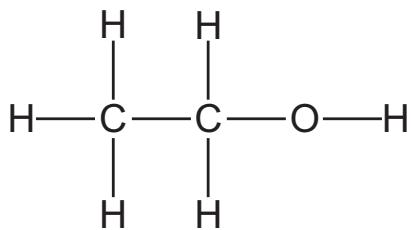
Given the equation below and the overall enthalpy change for the reaction, which option correctly identifies the bond energy of the C-O bond in ethanol?
(Mean bond energy (kJ mol⁻¹): H-H = +436; C-C = +346; C−H = +413; O−H = +464; C=C = +611)
Given the equation below and the overall enthalpy change for the reaction, which option correctly identifies the bond energy of the C-O bond in ethanol?
(Mean bond energy (kJ mol⁻¹): H-H = +436; C-C = +346; C−H = +413; O−H = +464; C=C = +611)
- A.103 kJ mol⁻¹
- B.316 kJ mol⁻¹
- C.361 kJ mol⁻¹
- D.707 kJ mol⁻¹
- E.825 kJ mol⁻¹