NSAA 2016 Chemistry S1
18 questions18 marksUpdated June 2026
The NSAA 2016 Chemistry S1 paper in full: all 18 questions, each with its answer. NSAA is the Natural Sciences Admissions Assessment. Sit it cold under exam timing, mark it, then work back through anything you missed using the solutions below.
Download the original PDF →Questions and answers are free. Full step-by-step worked solutions unlock with a free account. Start practising.
Question 37
The colours of three indicators are shown.
| indicator | colour at low pH | colour at high pH | pH at which colour change takes place |
| :--- | :--- | :--- | :--- |
| methyl orange | red | yellow | 4.0 |
| bromothymol blue | yellow | blue | 6.5 |
| phenolphthalein | colourless | pink | 9.0 |
Equal volumes of these three indicators were mixed and the mixture was added to a solution of pH 5.0.
What colour would be seen?
| indicator | colour at low pH | colour at high pH | pH at which colour change takes place |
| :--- | :--- | :--- | :--- |
| methyl orange | red | yellow | 4.0 |
| bromothymol blue | yellow | blue | 6.5 |
| phenolphthalein | colourless | pink | 9.0 |
Equal volumes of these three indicators were mixed and the mixture was added to a solution of pH 5.0.
What colour would be seen?
- A.blue
- B.green
- C.orange
- D.purple
- E.yellow
Answer: E
Question 38
When concentrated aqueous sodium chloride solution is electrolysed using inert electrodes a reaction occurs at each electrode.
Which is the correct combination of elements actually produced at the electrodes in this electrolysis?
Which is the correct combination of elements actually produced at the electrodes in this electrolysis?
- A.positive electrode = chlorine; negative electrode = hydrogen
- B.positive electrode = chlorine; negative electrode = sodium
- C.positive electrode = oxygen; negative electrode = hydrogen
- D.positive electrode = oxygen; negative electrode = sodium
- E.positive electrode = sodium; negative electrode = chlorine
Answer: A
Question 39
Which substance (A-E) in the table could have a giant covalent structure?
| substance | melting point / °C | boiling point / °C | electrical conductivity when solid | electrical conductivity when molten |
| :--- | :--- | :--- | :--- | :--- |
| A | 1700 | 2200 | none | none |
| B | 800 | 1470 | none | good |
| C | 98 | 880 | good | good |
| D | -20 | 58 | none | none |
| E | -39 | 357 | good | good |
| substance | melting point / °C | boiling point / °C | electrical conductivity when solid | electrical conductivity when molten |
| :--- | :--- | :--- | :--- | :--- |
| A | 1700 | 2200 | none | none |
| B | 800 | 1470 | none | good |
| C | 98 | 880 | good | good |
| D | -20 | 58 | none | none |
| E | -39 | 357 | good | good |
- A.A
- B.B
- C.C
- D.D
- E.E
Answer: A
Question 40
Chemicals A and B react to form products Y and Z. The reaction goes to completion. The equation for the reaction is:
Equimolar samples of A and B were mixed and the concentrations of A and Z were measured over time. Which of the following graphs could represent this reaction?
(Note: All graphs plot concentration / mol dm⁻³ on the y-axis against time / min on the x-axis. The solid line represents [A] and the dotted line represents [Z].)
Graph 1: [A] starts at 1.0, decreases to 0.0. [Z] starts at 0.0, increases to 0.5. Both plateau at time ≈ 4.
Graph 2: [A] starts at 1.0, decreases to 0.5. [Z] starts at 0.0, increases to 0.25. Both plateau at time ≈ 4.
Graph 3: [A] starts at 1.0, decreases to 0.0. [Z] starts at 0.0, increases to 1.0. Both plateau at time ≈ 4.
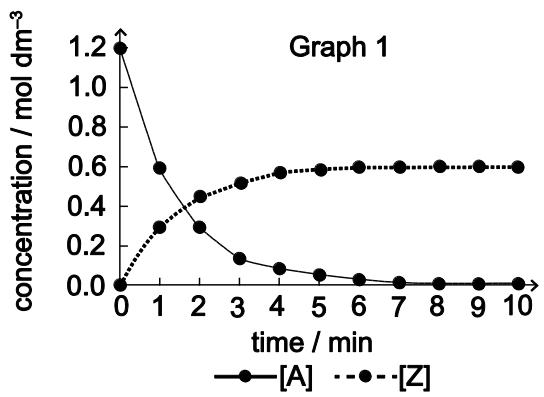
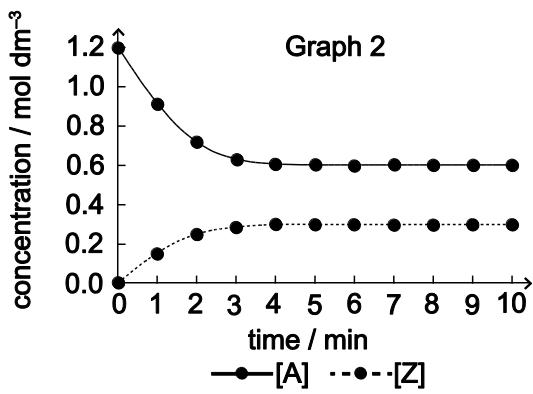
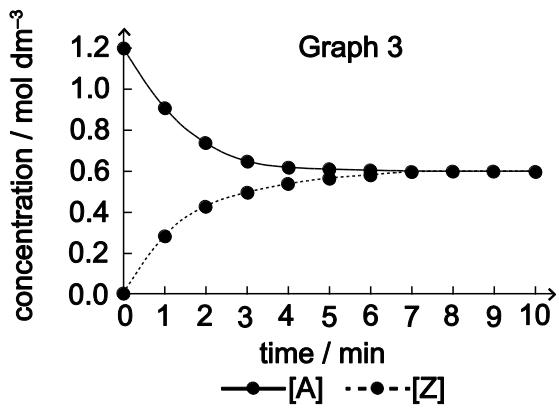
Equimolar samples of A and B were mixed and the concentrations of A and Z were measured over time. Which of the following graphs could represent this reaction?
(Note: All graphs plot concentration / mol dm⁻³ on the y-axis against time / min on the x-axis. The solid line represents [A] and the dotted line represents [Z].)
Graph 1: [A] starts at 1.0, decreases to 0.0. [Z] starts at 0.0, increases to 0.5. Both plateau at time ≈ 4.
Graph 2: [A] starts at 1.0, decreases to 0.5. [Z] starts at 0.0, increases to 0.25. Both plateau at time ≈ 4.
Graph 3: [A] starts at 1.0, decreases to 0.0. [Z] starts at 0.0, increases to 1.0. Both plateau at time ≈ 4.
- A.Graph 1 only
- B.Graph 2 only
- C.Graph 3 only
- D.Graphs 1 and 2 only
- E.Graphs 2 and 3 only
Answer: A
Question 41
An oxide of iron has the formula and contains both and ions.
Which one of the following is the fraction of iron ions that are in the state?
Which one of the following is the fraction of iron ions that are in the state?
- A.
- B.
- C.
- D.
- E.
Answer: B
Question 42
An element has a mass number of 40 and an atomic number of 20.
Which statement(s) about this element is/are correct?
1 Its atomic nucleus has a relative mass of 20.
2 It is a noble gas.
3 It would form a negative ion.
4 It is in group 2 of the periodic table.
5 It is a non-metallic element.
Which statement(s) about this element is/are correct?
1 Its atomic nucleus has a relative mass of 20.
2 It is a noble gas.
3 It would form a negative ion.
4 It is in group 2 of the periodic table.
5 It is a non-metallic element.
- A.1, 2 and 3 only
- B.1, 3 and 4 only
- C.1, 4 and 5 only
- D.2, 3 and 5 only
- E.4 only
- F.5 only
Answer: E
Question 43
The reaction between nitrogen and hydrogen to form ammonia is exothermic.
The bond energies in the three molecules are as shown.
N ≡ N
H-H
N-H
Which statement can be deduced from this information?
The bond energies in the three molecules are as shown.
N ≡ N
H-H
N-H
Which statement can be deduced from this information?
- A.
- B.
- C.
- D.
- E.
Answer: E
Question 44
In which two of the following equations is the **first reactant** an oxidising agent?
1
2
3
4
1
2
3
4
- A.1 and 2
- B.1 and 4
- C.2 and 3
- D.2 and 4
- E.3 and 4
Answer: C
Question 45
What volume of water vapour measured at room temperature and pressure would be produced from an ice cube of mass 6.00 g if it all evaporated?
(: H = 1; O = 16, molar volume of a gas at room temperature and pressure = 24 )
(: H = 1; O = 16, molar volume of a gas at room temperature and pressure = 24 )
- A.240
- B.1800
- C.4800
- D.8000
- E.24 000
Answer: D
Question 46
A compound of iodine and oxygen contains 63.5 g of iodine and 20.0 g of oxygen.
Which one of the following is its empirical formula?
(: I = 127; O = 16)
Which one of the following is its empirical formula?
(: I = 127; O = 16)
- A.
- B.
- C.
- D.
- E.
- F.
Answer: E
Question 47
Listed are the electronic configurations for the atoms of different elements.
Which one represents the most reactive non-metal?
Which one represents the most reactive non-metal?
- A.2, 4
- B.2, 6
- C.2, 7
- D.2, 8, 1
- E.2, 8, 6
- F.2, 8, 7
Answer: C
Question 48
Naturally occurring chlorine is a mixture of two isotopes with mass number 35 and 37. The isotope with mass number 35 is three times as common as the isotope with mass number 37.
Naturally occurring bromine is a mixture of two isotopes with mass numbers 79 and 81. They are present in equal amounts.
What fraction of the naturally occurring compound has a relative molecular mass of 128?
(: H = 1; C = 12)
Naturally occurring bromine is a mixture of two isotopes with mass numbers 79 and 81. They are present in equal amounts.
What fraction of the naturally occurring compound has a relative molecular mass of 128?
(: H = 1; C = 12)
- A.
- B.
- C.
- D.
- E.
Answer: C
Question 49
A mixture of equal parts of hexane (bp 68 °C) and heptane (bp 98 °C) is distilled using a fractionating column.
The temperature of the liquid in the flask and the temperature at the top of the fractionating column are measured.
Which one of the following shows the likely temperatures when the first drops of distillate are collected?
The temperature of the liquid in the flask and the temperature at the top of the fractionating column are measured.
Which one of the following shows the likely temperatures when the first drops of distillate are collected?
- A.temperature in flask / °C: 83, temperature at top of column / °C: 68
- B.temperature in flask / °C: 98, temperature at top of column / °C: 68
- C.temperature in flask / °C: 83, temperature at top of column / °C: 83
- D.temperature in flask / °C: 98, temperature at top of column / °C: 83
- E.temperature in flask / °C: 98, temperature at top of column / °C: 98
Answer: A
Question 50
Carbon, in the form of coke, is used to reduce iron oxide in a blast furnace. The three stages are shown below:
1
2
3
If 12 g of carbon is used in stage 2 and all the carbon monoxide produced is used in stage 3, what mass of carbon dioxide is produced in stage 3?
(: C = 12; O = 16)
1
2
3
If 12 g of carbon is used in stage 2 and all the carbon monoxide produced is used in stage 3, what mass of carbon dioxide is produced in stage 3?
(: C = 12; O = 16)
- A.17.8 g
- B.35.6 g
- C.44 g
- D.88 g
- E.132 g
Answer: D
Question 51
The following exothermic, reversible reaction is used in the manufacture of sulfuric acid from sulfur dioxide and oxygen:
Which one of the following statements about this reaction is correct?
Which one of the following statements about this reaction is correct?
- A.Pressure has no effect on the position of equilibrium.
- B.Raising the temperature moves the equilibrium to the right.
- C.At equilibrium no sulfur dioxide is being changed into sulfur trioxide.
- D.The addition of a catalyst speeds up the forward reaction more than the backward reaction.
- E.Before equilibrium is reached, the rate of the forward reaction is greater than the rate of the backward reaction.
Answer: E
Question 52
An impure sample of sodium hydroxide has a mass of 1.20 g. All the sodium hydroxide completely reacts with a minimum of 50.0 of 0.50 hydrochloric acid.
What is the percentage purity of the sodium hydroxide sample?
(: H = 1; O = 16; Na = 23; Cl = 35.5)
What is the percentage purity of the sodium hydroxide sample?
(: H = 1; O = 16; Na = 23; Cl = 35.5)
- A.37.5%
- B.41.6%
- C.72.7%
- D.75.0%
- E.83.3%
- F.90.4%
Answer: E
Question 53
A sample of an alkali XOH of mass 2.8 g was dissolved in water.
This solution was neutralised by 12.5 of sulfuric acid of concentration 2.0 .
What is the relative atomic mass of X?
(: H = 1; O = 16; S = 32)
This solution was neutralised by 12.5 of sulfuric acid of concentration 2.0 .
What is the relative atomic mass of X?
(: H = 1; O = 16; S = 32)
- A.13
- B.26
- C.39
- D.52
- E.65
- F.78
Answer: C
Question 54
The equation summarises the reaction of copper and dilute nitric acid.
What values of s and t are needed to balance the equation?
What values of s and t are needed to balance the equation?
- A.s = 1, t = 1
- B.s = 2, t = 1
- C.s = 4, t = 1
- D.s = 2, t = 2
- E.s = 4, t = 2
Answer: D