NSAA 2016 D568/1
The NSAA 2016 D568/1 paper in full: all 90 questions, each with its answer. NSAA is the Natural Sciences Admissions Assessment. Sit it cold under exam timing, mark it, then work back through anything you missed using the solutions below.
Download the original PDF →Question 1
1 mark- A.
- B.
- C.
- D.
- E.
- F.
- G.
- H.
Answer: G
Question 2
1 mark- A.
- B.
- C.
- D.1
- E.
- F.
- G.
- H.5
Answer: B
Question 3
1 markWhich one of the following gives the ratio Q:S in its simplest form?
- A.1:2
- B.2:1
- C.3:4
- D.3:25
- E.4:3
- F.25:3
Answer: C
Question 4
1 markThe mean age increases by exactly 2 years when two new members join.
What is the mean age of the two new members?
- A.20 years
- B.22 years
- C.30 years
- D.40 years
- E.50 years
- F.52 years
Answer: E
Question 5
1 markThe value of the scanner depreciates by 20% every year.
By how much has the scanner reduced in value after 2 years?
- A.£600
- B.£3000
- C.£5400
- D.£6000
- E.£9000
- F.£9600
- G.£12000
Answer: C
Question 6
1 markThe bearing of the point C from A is 330° and the bearing of C from B is 060°
Find the distance BC.
- A.2 km
- B. km
- C.4 km
- D. km
- E. km
Answer: B
Question 7
1 markx is inversely proportional to the square root of y.
When x = 8, y = 9.
What is the value of y when x = 6?
- A.
- B.2
- C.
- D.
- E.12
- F.16
Answer: F
Question 8
1 markPQ = cm, RS = cm and the vertical height QR = x cm.
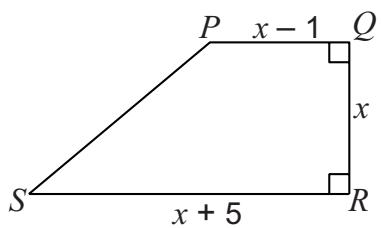
[diagram not to scale]
The area of the trapezium is 120 cm².
What is the length of RS?
- A.9 cm
- B.10 cm
- C.11 cm
- D.12 cm
- E.15 cm
- F.17 cm
Answer: E
Question 9
1 mark- A.
- B.
- C.
- D.
- E.
- F.
Answer: B
Question 10
1 markThe height of the cylinder is 10m.
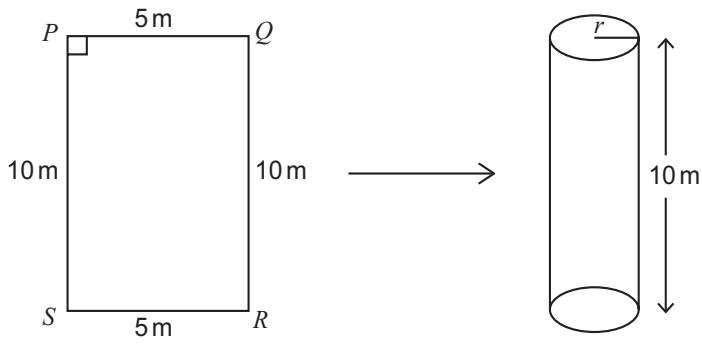
[diagram not to scale]
What is the volume, in cubic metres, enclosed by this cylinder?
- A.
- B.
- C.
- D.
- E.
- F.
Answer: C
Question 11
1 mark- A.
- B.
- C.
- D.
- E.
- F.
Answer: A
Question 12
1 mark46 of the students were girls.
36 of the students chose tennis, and of these were boys; 25 girls chose swimming, and 27 students chose archery.
A boy is picked at random. What is the probability that he chose swimming?
- A.
- B.
- C.
- D.
- E.
Answer: D
Question 13
1 mark- A.
- B.
- C.
- D.
- E.
- F.
Answer: D
Question 14
1 markThe polygon has n sides.
The side PQ is extended to T such that PQT is a straight line.
The length of RQ is the same as the length of RT.
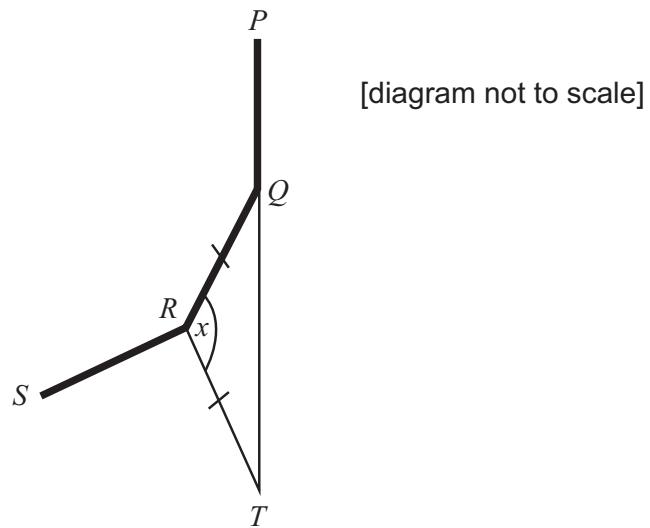
Find an equation for n in terms of x, where x is the size of angle in degrees.
- A.
- B.
- C.
- D.
- E.
- F.
- G.
Answer: E
Question 15
1 markThe probability of an overweight adult having Type 2 diabetes is ; this probability is 6 times the probability of an adult who is not overweight having the disease.
An adult is chosen at random from the population.
What is the probability the chosen adult has Type 2 diabetes?
- A.
- B.
- C.
- D.
- E.
- F.
Answer: B
Question 16
1 markFind a and b.
- A.
- B.
- C.
- D.
- E.
- F.
- G.
- H.
Answer: A
Question 17
1 markAn enlargement of the rhombus has sides of length cm.
What is the scale factor of the enlargement?
- A.
- B.2
- C.
- D.4
- E.
Answer: C
Question 18
1 markWhat is the complete set of values of p for which the gradient of this line is finite and greater than zero?
- A.
- B.
- C.
- D.
- E.
- F.
Answer: F
Question 19
1 markWhich line of the table describes how the expansion of the universe has affected the frequency and wavelength of these electromagnetic waves?
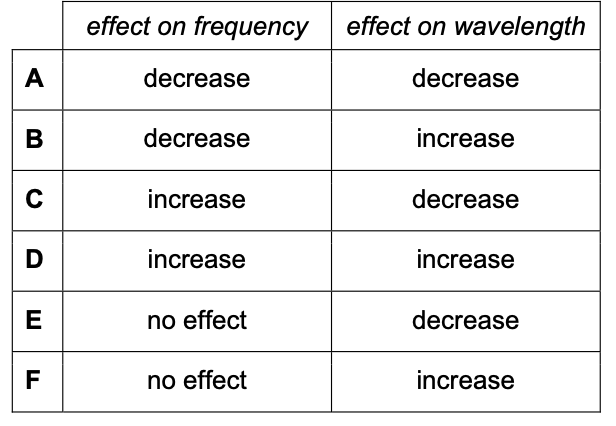
- A.effect on frequency: decrease, effect on wavelength: decrease
- B.effect on frequency: decrease, effect on wavelength: increase
- C.effect on frequency: increase, effect on wavelength: decrease
- D.effect on frequency: increase, effect on wavelength: increase
- E.effect on frequency: no effect, effect on wavelength: decrease
- F.effect on frequency: no effect, effect on wavelength: increase
Answer: B
Question 20
1 markWhich combination of emissions produces this change?
- A.3 alpha
- B.2 alpha and 1 beta
- C.2 alpha and 2 beta
- D.1 alpha and 2 beta
- E.3 beta
Answer: D
Question 21
1 mark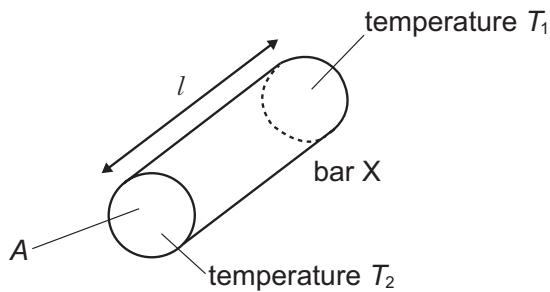
The curved surface of the bar is perfectly insulated and thermal energy is conducted from the hotter end of the bar to the colder end. Changes in l, A, and may alter the rate at which thermal energy is conducted along the copper bar. In which case is the rate of conduction of thermal energy along the insulated bar the same as for bar X?
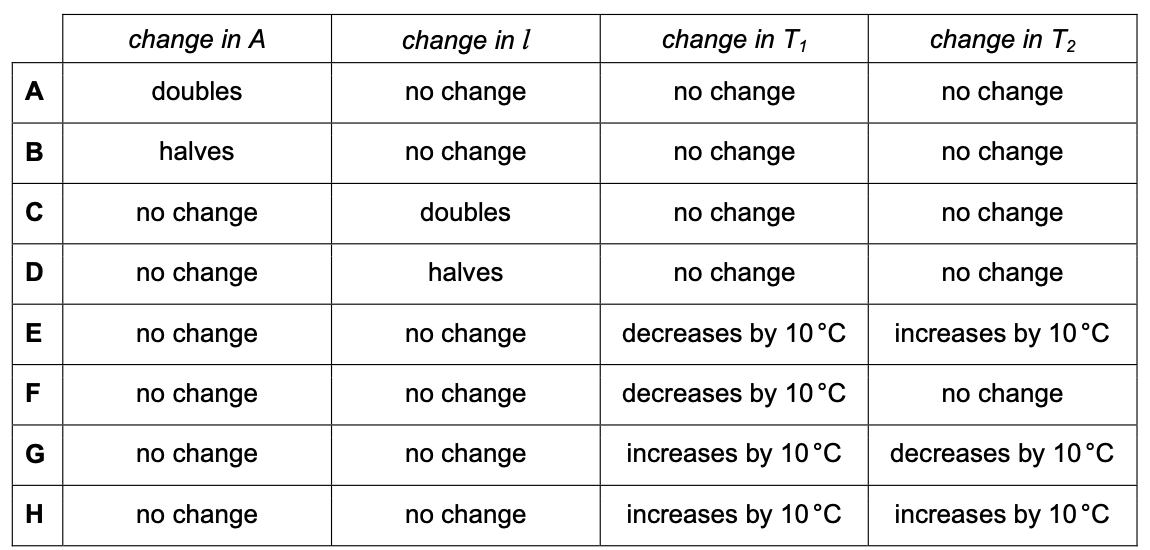
- A.change in A: doubles, change in l: no change, change in T1: no change, change in T2: no change
- B.change in A: halves, change in l: no change, change in T1: no change, change in T2: no change
- C.change in A: no change, change in l: doubles, change in T1: no change, change in T2: no change
- D.change in A: no change, change in l: halves, change in T1: no change, change in T2: no change
- E.change in A: no change, change in l: no change, change in T1: decreases by 10°C, change in T2: increases by 10°C
- F.change in A: no change, change in l: no change, change in T1: decreases by 10°C, change in T2: no change
- G.change in A: no change, change in l: no change, change in T1: increases by 10°C, change in T2: decreases by 10°C
- H.change in A: no change, change in l: no change, change in T1: increases by 10°C, change in T2: increases by 10°C
Answer: H
Question 22
1 mark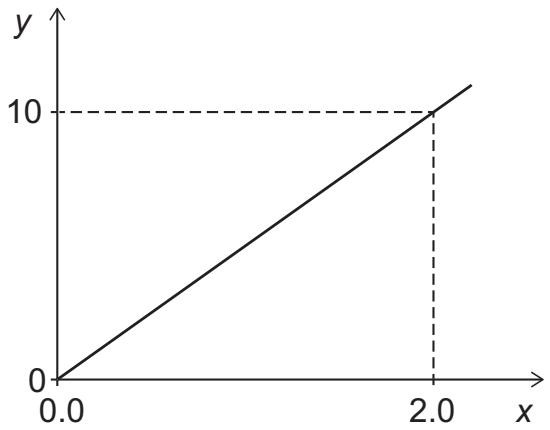
(The scales on both axes are in the appropriate S.I. units, and the gravitational field strength g is .)
Which two of the following could the graph represent?
1. kinetic energy against velocity for an object of mass 10kg undergoing free-fall
2. potential energy against height for an object of mass 20 kg being lifted by a constant external force
3. velocity against time for an object of mass 20 kg being accelerated by a resultant force of 100 N
4. work done by an external force of 5N against distance moved for an object of mass 12 kg being moved at constant speed by (and in the direction of) the external force
- A.1 and 2
- B.1 and 3
- C.1 and 4
- D.2 and 3
- E.2 and 4
- F.3 and 4
Answer: F
Question 23
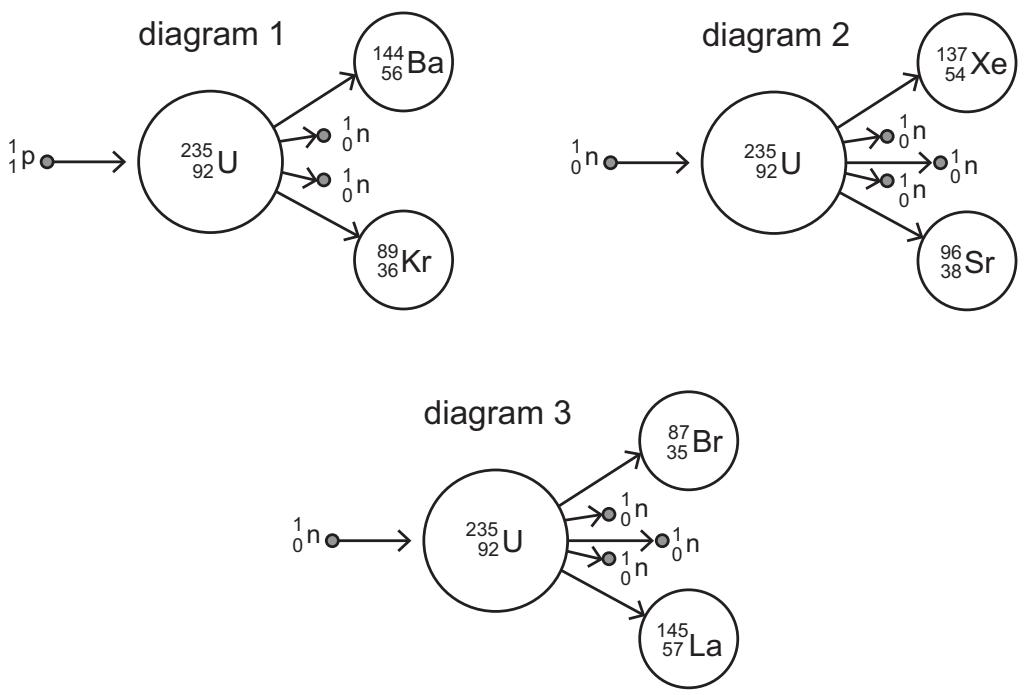
1 markWhich of the diagrams, if any, could represent this process?
- A.none of them
- B.1 only
- C.2 only
- D.3 only
- E.1 and 2 only
- F.1 and 3 only
- G.2 and 3 only
- H.1, 2 and 3
Answer: C
Question 24
1 markWhat is the maximum power dissipated in the 5.0 resistor?
- A.7.2 W
- B.18 W
- C.27 W
- D.45 W
- E.72 W
- F.75 W
Answer: D
Question 25
1 mark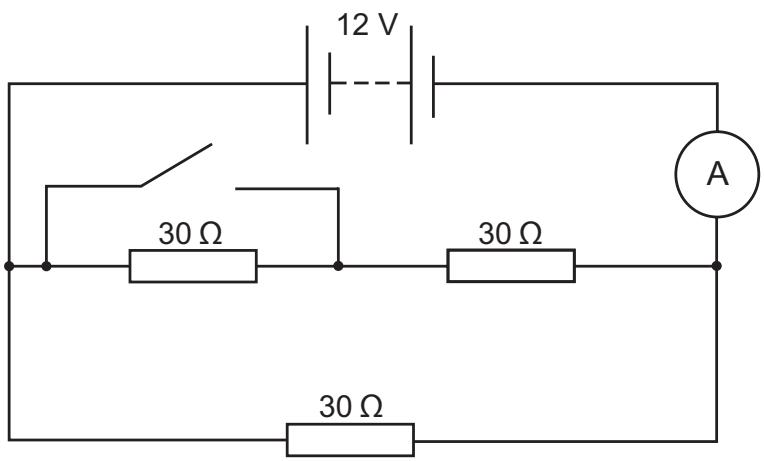
Initially the switch is open.
What happens to the reading on the ammeter when the switch is closed?
- A.It decreases by 0.20 A.
- B.It decreases by 0.40 A.
- C.It decreases by 0.60 A.
- D.It decreases by 0.80 A.
- E.It increases by 0.20 A.
- F.It increases by 0.40 A.
- G.It increases by 0.60 A.
- H.It increases by 0.80 A.
Answer: E
Question 26
1 markwhere R is the radius of the star, T is its surface temperature and k is a constant.
The power currently radiated by the Sun is W. Towards the end of the Sun's life its radius will increase by a factor of a hundred and its surface temperature will decrease by a factor of two.
What will be the power radiated by the Sun when these changes have occurred?
- A. W
- B. W
- C. W
- D. W
- E. W
- F. W
- G. W
- H. W
Answer: D
Question 27
1 markWhat is the total distance travelled by a particle of the medium in one minute?
- A.900 cm
- B.1200 cm
- C.1800 cm
- D.2400 cm
- E.3600 cm
- F.4800 cm
Answer: E
Question 28
1 mark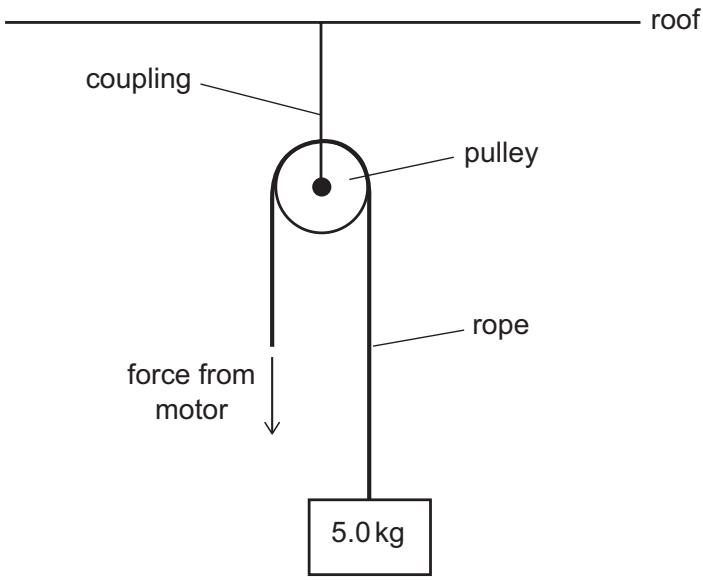
The motor needs to cause the mass to accelerate upwards at .
What is the minimum tension force that the coupling must be able to withstand without breaking?
(The gravitational field strength g is . The pulley system is frictionless and has negligible mass. The rope has negligible mass and is inextensible.)
- A.4.0 N
- B.8.0 N
- C.46 N
- D.50 N
- E.54 N
- F.92 N
- G.104 N
- H.108 N
Answer: H
Question 29
1 mark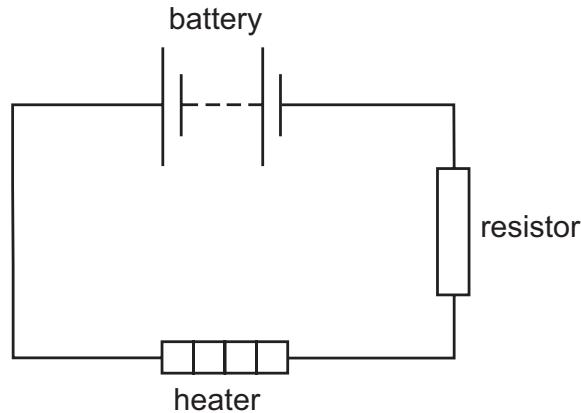
The total resistance of the circuit is 15 . In 3.0 minutes, 180 J of electrical energy is transferred into other forms in the heater.
How much charge flows through the heater in the 3.0 minutes and what is the voltage across the heater?
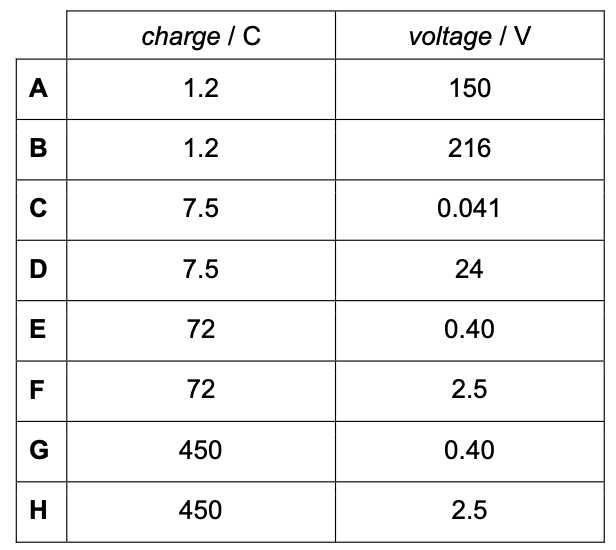
- A.charge / C: 1.2, voltage / V: 150
- B.charge / C: 1.2, voltage / V: 216
- C.charge / C: 7.5, voltage / V: 0.041
- D.charge / C: 7.5, voltage / V: 24
- E.charge / C: 72, voltage / V: 0.40
- F.charge / C: 72, voltage / V: 2.5
- G.charge / C: 450, voltage / V: 0.40
- H.charge / C: 450, voltage / V: 2.5
Answer: F
Question 30
1 mark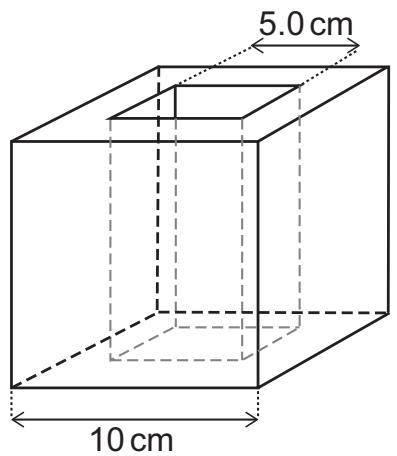
What is the density of the material from which the block is made?
(The gravitational field strength g is .)
- A.
- B.
- C.
- D.
- E.
- F.
- G.
- H.
Answer: F
Question 31
1 markBalls P and R have shiny surfaces. Balls Q and S have dull surfaces.
Balls P and Q are in a room at 20°C. Balls R and S are in a room at 40 °C.
The temperature of each ball at a given moment in time is shown on the diagram.
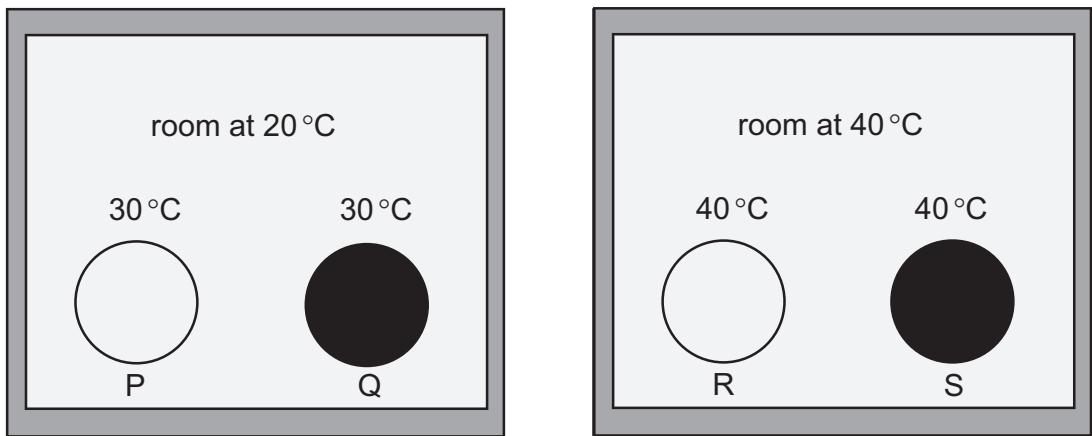
Which two balls lose thermal energy by convection, and which ball emits thermal radiation at the greatest rate?
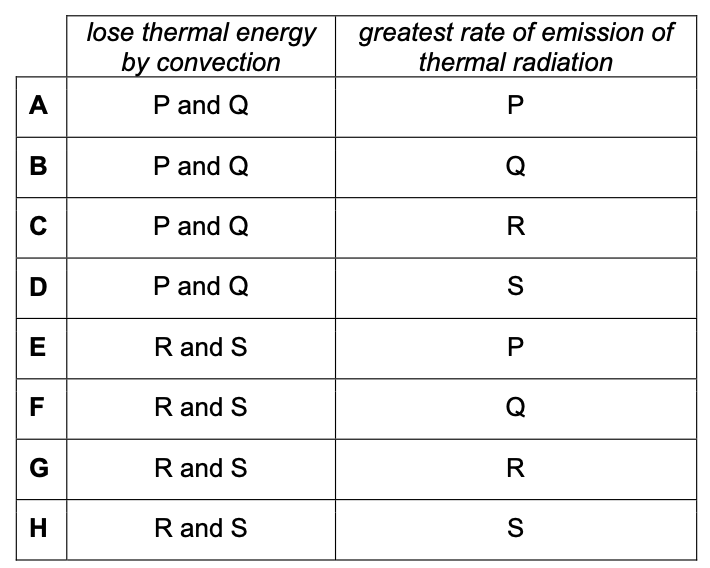
- A.lose thermal energy by convection: P and Q, greatest rate of emission of thermal radiation: P
- B.lose thermal energy by convection: P and Q, greatest rate of emission of thermal radiation: Q
- C.lose thermal energy by convection: P and Q, greatest rate of emission of thermal radiation: R
- D.lose thermal energy by convection: P and Q, greatest rate of emission of thermal radiation: S
- E.lose thermal energy by convection: R and S, greatest rate of emission of thermal radiation: P
- F.lose thermal energy by convection: R and S, greatest rate of emission of thermal radiation: Q
- G.lose thermal energy by convection: R and S, greatest rate of emission of thermal radiation: R
- H.lose thermal energy by convection: R and S, greatest rate of emission of thermal radiation: S
Answer: D
Question 32
1 mark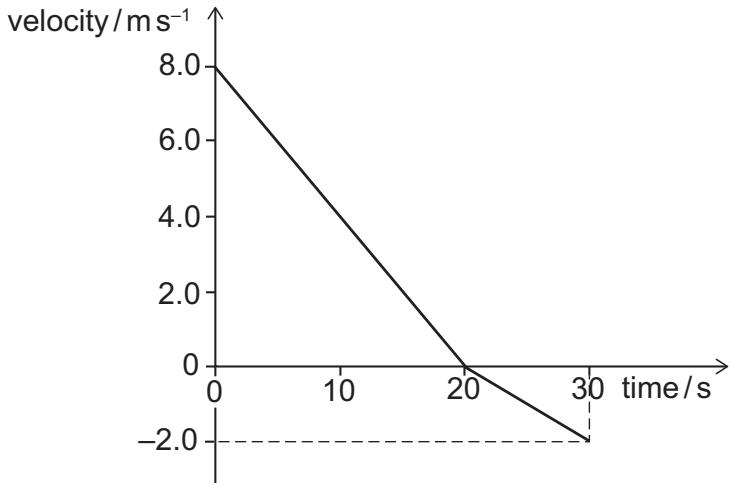
What total distance did the object travel in the 30s, how far from its starting position was it at the end of the 30s, and what was its average speed over the 30 s?
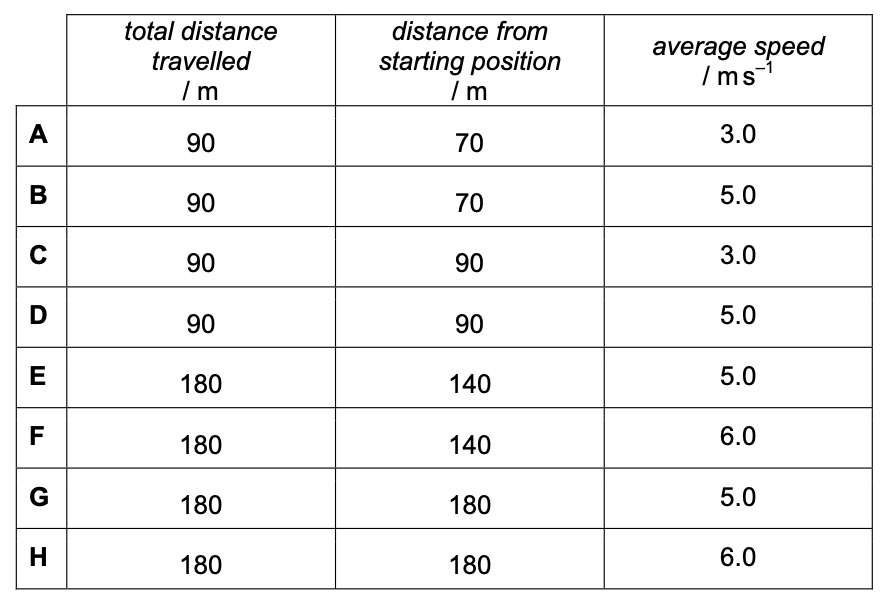
- A.total distance travelled / m: 90, distance from starting position / m: 70, average speed / ms⁻¹: 3.0
- B.total distance travelled / m: 90, distance from starting position / m: 70, average speed / ms⁻¹: 5.0
- C.total distance travelled / m: 90, distance from starting position / m: 90, average speed / ms⁻¹: 3.0
- D.total distance travelled / m: 90, distance from starting position / m: 90, average speed / ms⁻¹: 5.0
- E.total distance travelled / m: 180, distance from starting position / m: 140, average speed / ms⁻¹: 5.0
- F.total distance travelled / m: 180, distance from starting position / m: 140, average speed / ms⁻¹: 6.0
- G.total distance travelled / m: 180, distance from starting position / m: 180, average speed / ms⁻¹: 5.0
- H.total distance travelled / m: 180, distance from starting position / m: 180, average speed / ms⁻¹: 6.0
Answer: A
Question 33
1 markWhich graph could represent how the numbers of nuclei of X and Y that are present in the sample vary with time?
(All graphs cover the same period of time.)
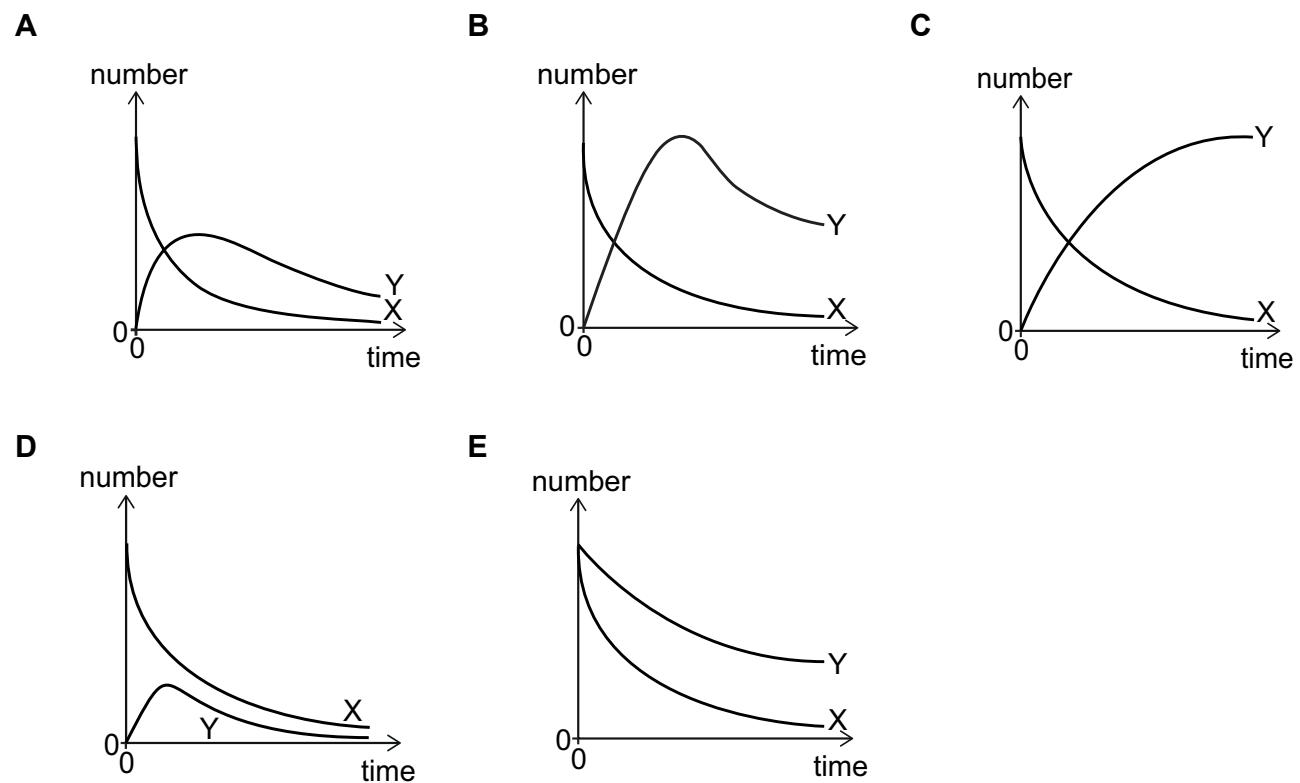
- A.Graph A
- B.Graph B
- C.Graph C
- D.Graph D
- E.Graph E
Answer: A
Question 34
1 markA particular sample of bronze contains 10% tin by volume. (In other words, 10% of the total volume of the sample is tin and 90% of it is copper.)
What percentage of the mass of the sample is tin?
(Density of tin = Y and density of copper = X.)
- A.
- B.
- C.
- D.
- E.
- F.
- G.
- H.
Answer: G
Question 35
1 mark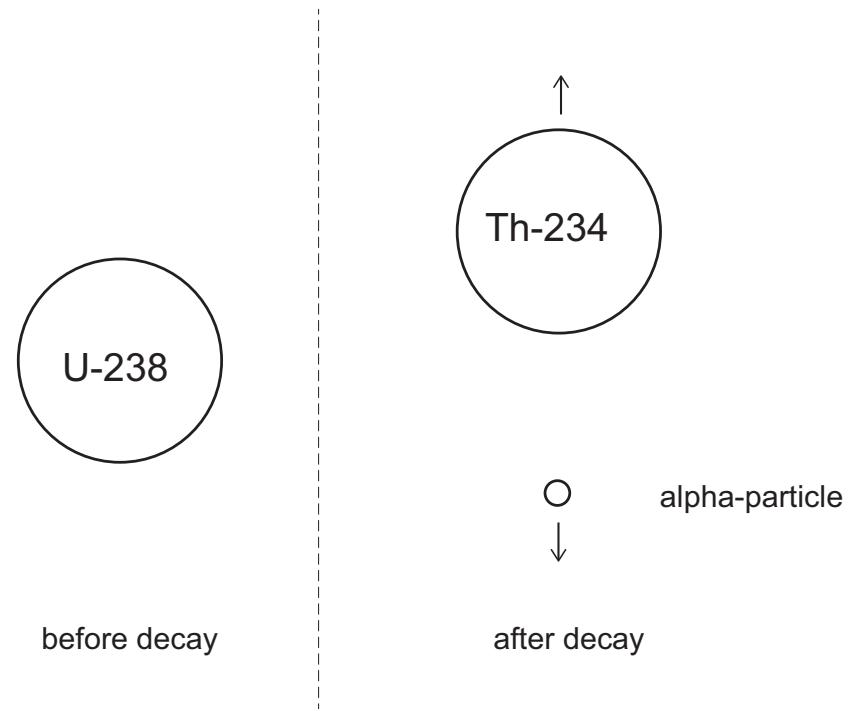
What is the kinetic energy of the alpha particle?
- A.
- B.
- C.
- D.
- E.E
Answer: D
Question 36
1 mark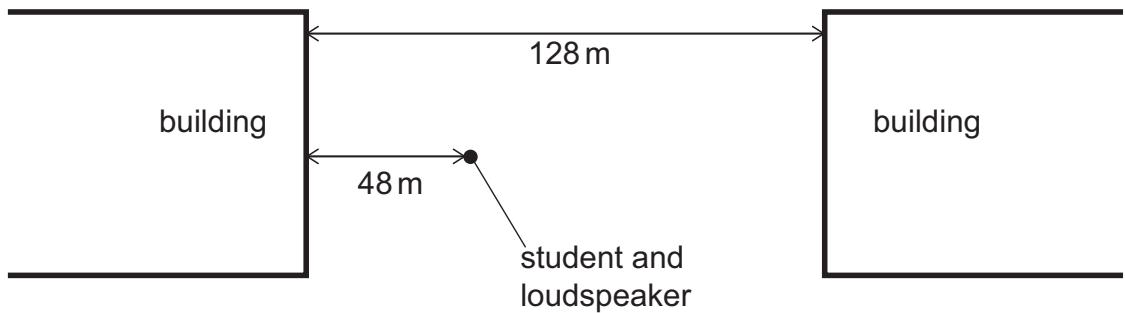
The loudspeaker is connected to a signal generator that causes it to emit regular clicks. The rate at which the clicks are produced is gradually increased from zero until each echo coincides with a new click being emitted by the loudspeaker.
What is the frequency of emission of clicks when this happens?
(The speed of sound in air = 320 ms⁻¹.)
- A.2.0 Hz
- B.2.5 Hz
- C.3.3 Hz
- D.4.0 Hz
- E.5.3 Hz
- F.6.7 Hz
- G.10 Hz
Answer: G
Question 37
1 mark- A.
- B.
- C.
- D.
- E.
Answer: D
Question 38
1 markWhen molten, titanium oxide is a conductor and can be electrolysed.
During electrolysis 7.2 g of titanium are formed for every 3.6 dm³ of oxygen at room temperature and pressure.
Which of the following statements, if any, are correct?
1. After electrolysis, the titanium atoms produced have a noble gas electron configuration.
2. When molten, titanium oxide electrons are delocalised and so they move to carry the charge.
3. The empirical formula of titanium oxide is .
(: Ti = 48; molar gas volume = 24 dm³ at room temperature and pressure)
- A.none of them
- B.1 only
- C.2 only
- D.3 only
- E.1 and 2 only
- F.1 and 3 only
- G.2 and 3 only
- H.1, 2, and 3
Answer: D
Question 39
1 mark1. burning sodium in oxygen
2. electrolysis of aqueous sodium chloride
3. displacement of iron from iron oxide by heating with aluminium powder
- A.none of them
- B.1 only
- C.2 only
- D.3 only
- E.1 and 2
- F.1 and 3
- G.2 and 3
- H.1, 2 and 3
Answer: C
Question 40
1 markAn increase in temperature was found to increase both the rate of reaction and the yield at equilibrium.
An increase in pressure was found to increase the rate of reaction but the yield at equilibrium was unaffected.
Which equation could represent the reaction?
- A. is +ve
- B. is +ve
- C. is +ve
- D. is -ve
- E. is -ve
- F. is -ve
Answer: C
Question 41
1 markWhat is the empirical formula of this compound?
(: bromine = 80; oxygen = 16)
- A.
- B.
- C.
- D.
- E.
- F.
Answer: C
Question 42
1 markAntimony has two isotopes. One isotope has 70 neutrons and has an abundance of 60%. The second isotope has 72 neutrons and has an abundance of 40%.
What is the relative atomic mass of antimony?
- A.70.8
- B.71.0
- C.71.2
- D.121.8
- E.122.0
- F.122.2
Answer: D
Question 43
1 markA second chromatogram was produced using a mixture of two of the dyes, again using filter paper and a water solvent:
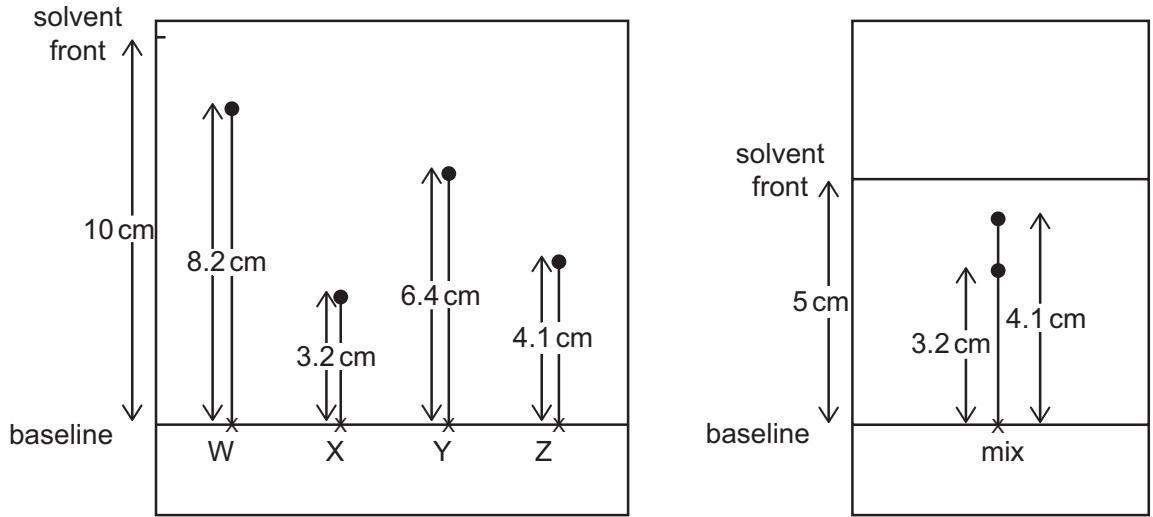
[diagram not to scale]
Which of the following statements, if any, are correct?
1. The concentration of dye W must be twice the concentration of dye Z.
2. The mobile phase is the filter paper.
3. The mixture in the second chromatogram contained dyes W and Y.
- A.none of them
- B.1 only
- C.2 only
- D.3 only
- E.1 and 2 only
- F.1 and 3 only
- G.2 and 3 only
- H.1, 2 and 3
Answer: D
Question 44
1 mark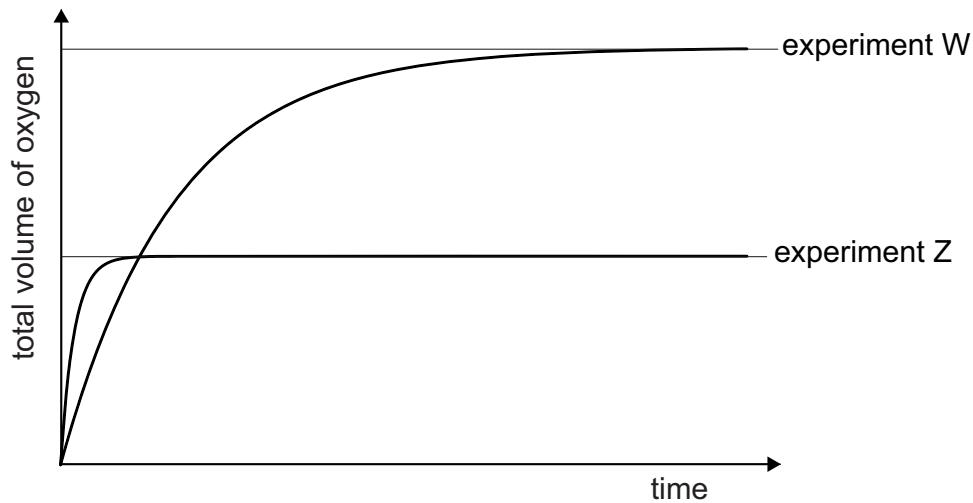
Assuming all other conditions are kept constant, which one of the following options would lead to the results shown?
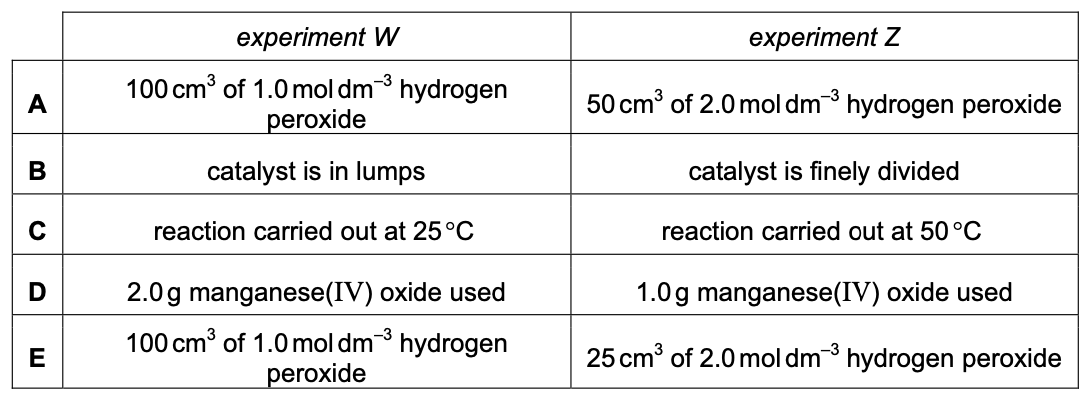
- A.experiment W: 100 cm³ of 1.0 mol dm⁻³ hydrogen peroxide, experiment Z: 50 cm³ of 2.0 mol dm⁻³ hydrogen peroxide
- B.experiment W: catalyst is in lumps, experiment Z: catalyst is finely divided
- C.experiment W: reaction carried out at 25 °C, experiment Z: reaction carried out at 50 °C
- D.experiment W: 2.0 g manganese(IV) oxide used, experiment Z: 1.0 g manganese(IV) oxide used
- E.experiment W: 100 cm³ of 1.0 mol dm⁻³ hydrogen peroxide, experiment Z: 25 cm³ of 2.0 mol dm⁻³ hydrogen peroxide
Answer: E
Question 45
1 mark1.
2.
3.
4.
Which two equations represent redox reactions?
- A.1 and 2
- B.1 and 3
- C.1 and 4
- D.2 and 3
- E.2 and 4
- F.3 and 4
Answer: C
Question 46
1 markCompound X does not contain copper or hydrogen.
The balanced equation for the reaction shows 3 moles of copper reacting with to produce 4 moles of water.
What is the identity of compound X?
- A.NO
- B.
- C.
- D.
- E.
Answer: A
Question 47
1 markAssuming no products dissolve, which row in the table correctly gives the mass or volume of the given product collected at the given electrode in time t?
(: Na = 23; Cl = 35.5; H = 1, 1 mole of gas occupies 24 dm³ at room temperature and pressure)
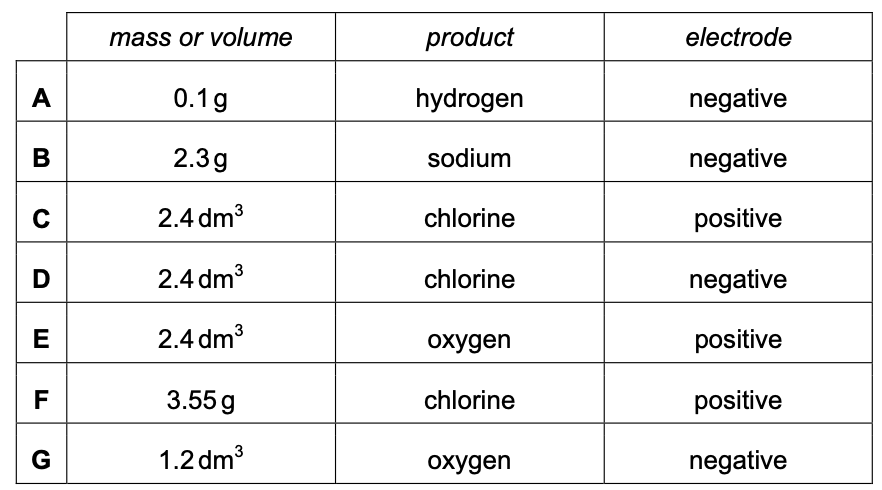
- A.mass or volume: 0.1 g, product: hydrogen, electrode: negative
- B.mass or volume: 2.3 g, product: sodium, electrode: negative
- C.mass or volume: 2.4 dm³, product: chlorine, electrode: positive
- D.mass or volume: 2.4 dm³, product: chlorine, electrode: negative
- E.mass or volume: 2.4 dm³, product: oxygen, electrode: positive
- F.mass or volume: 3.55 g, product: chlorine, electrode: positive
- G.mass or volume: 1.2 dm³, product: oxygen, electrode: negative
Answer: C
Question 48
1 markWhat is the activation energy for the reverse reaction?
- A.– 250 kJ mol⁻¹
- B.– 150 kJ mol⁻¹
- C.– 50 kJ mol⁻¹
- D.+ 50 kJ mol⁻¹
- E.+ 150 kJ mol⁻¹
- F.+ 250 kJ mol⁻¹
Answer: F
Question 49
1 mark1. Measure the time taken for a 1 cm strip of magnesium to react completely when added to 25 cm³ of each acid.
2. Measure the volume of 1 mol dm⁻³ sodium hydroxide solution needed to completely neutralise 20 cm³ of each acid.
3. Measure the electrical conductance of each acid using a conductivity meter.
Each test was carried out under the same conditions.
Which of the tests, considered independently, if any, would show that HX was a stronger acid than HY?
- A.none of them
- B.1 only
- C.2 only
- D.3 only
- E.1 and 2 only
- F.1 and 3 only
- G.2 and 3 only
- H.1, 2 and 3
Answer: F
Question 50
1 markThe volume of gas released was 240 cm³ at room temperature and pressure.
What is the mass of the impurity?
(: Na = 23; C = 12; O = 16; molar gas volume = 24000 cm³ at room temperature and pressure)
- A.0.44 g
- B.0.53 g
- C.0.67 g
- D.0.83 g
- E.0.97 g
- F.1.06 g
Answer: A
Question 51
1 markAssuming 1 mole of gas occupies 24.0 dm³ at room temperature and pressure, what is the volume of gas collected?
(: Li = 7)
- A.0.00 cm³
- B.0.60 cm³
- C.1.20 cm³
- D.25.0 cm³
- E.50.0 cm³
- F.600 cm³
- G.1200 cm³
Answer: F
Question 52
1 markWhat is the concentration of the sulfuric acid in g dm⁻³?
()
- A.0.025 g dm⁻³
- B.0.050 g dm⁻³
- C.0.250 g dm⁻³
- D.2.45 g dm⁻³
- E.4.90 g dm⁻³
- F.9.80 g dm⁻³
Answer: D
Question 53
1 markAnode (positive electrode):
Cathode (negative electrode):
Which of the following deductions, if any, can be made from these equations?
1. The ratio by moles of hydrogen to oxygen produced at the electrodes is 1:1.
2. The sodium sulfate solution will become more concentrated as the electrolysis proceeds.
3. The whole solution will become acidic due to formation of ions at the anode.
- A.none of them
- B.1 only
- C.2 only
- D.3 only
- E.1 and 2 only
- F.1 and 3 only
- G.2 and 3 only
- H.1, 2 and 3
Answer: C
Question 54
1 mark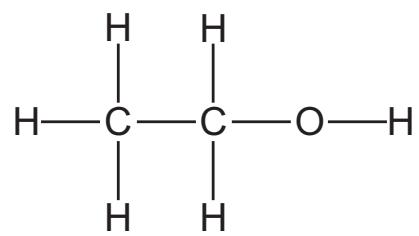
Given the equation below and the overall enthalpy change for the reaction, which option correctly identifies the bond energy of the C–O bond in ethanol?
(Mean bond energy (kJ mol⁻¹): H-H = +436; C-C = +346; C-H = +413; O-H = +464; C=C = +611)
- A.103 kJ mol⁻¹
- B.316 kJ mol⁻¹
- C.361 kJ mol⁻¹
- D.707 kJ mol⁻¹
- E.825 kJ mol⁻¹
Answer: C
Question 55
1 markA student wrote the following statements in order to explain this information.
1. One type of rainbow fish did not die out in the river because this type was able to adapt to the changing environment.
2. None of the other types of fish showed any type of genetic variation.
3. The presence of copper ions acted as a selective pressure.
Which of the student's statements could be correct?
- A.1 only
- B.1 and 2 only
- C.1 and 3 only
- D.2 and 3 only
- E.1, 2 and 3
Answer: C
Question 56
1 mark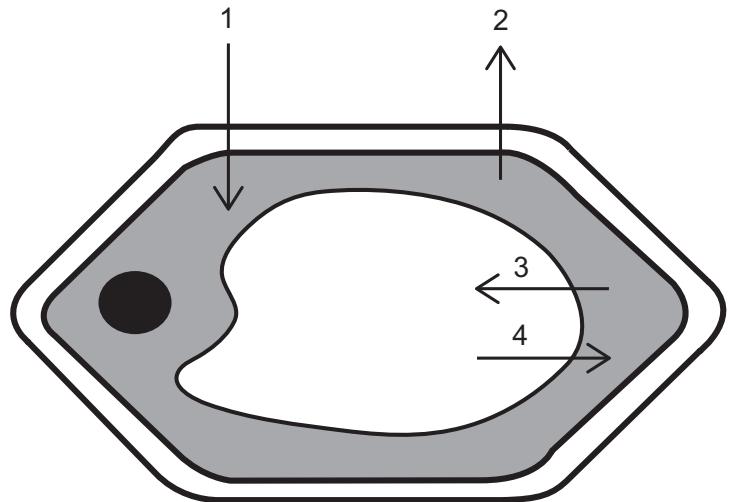
Which of the arrows on the diagram show the net movement of water molecules, by osmosis, when the cell is surrounded by a solution that is more concentrated than the solution in the cytoplasm?
- A.1 only
- B.2 only
- C.1 and 3 only
- D.1 and 4 only
- E.2 and 3 only
- F.2 and 4 only
Answer: F
Question 57
1 mark1. single celled
2. chloroplasts present
3. cell wall present
Using this information, which type of organism could this describe?
- A.algae
- B.bacteria
- C.ferns
- D.fungi
- E.flowering plants
Answer: A
Question 58
1 mark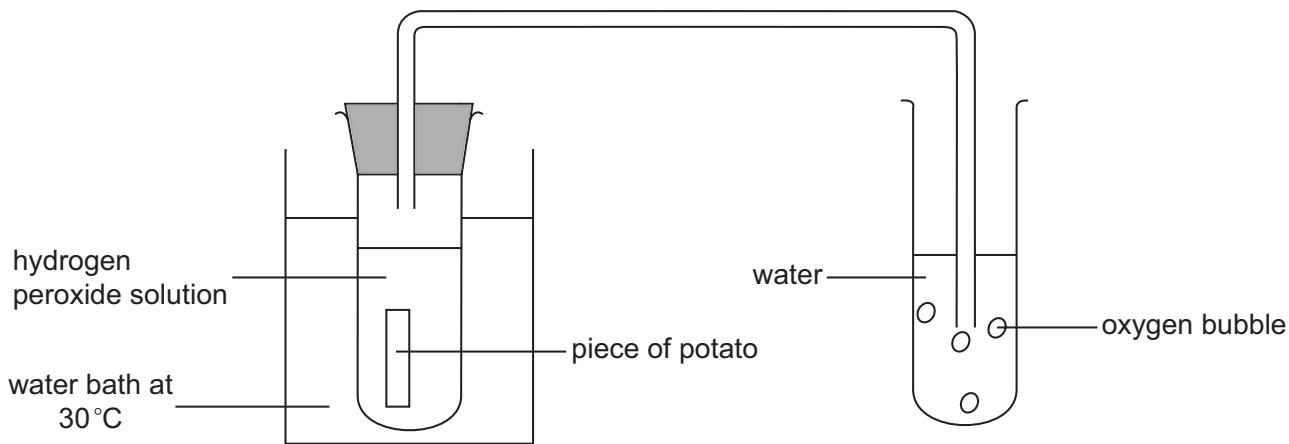
The student counted the number of bubbles of oxygen produced in one minute. The experiment was repeated at 40 °C, 50 °C, 60 °C, and 70 °C. The table shows the results collected by the student.

A group of students were given these results and asked to calculate the percentage decrease in the number of bubbles produced between 30°C and 60 °C. Each student was also asked to write a conclusion to explain the results. These are shown in the table below.
Which student correctly calculated the percentage decrease in the number of bubbles between 30°C and 60 °C and wrote an appropriate conclusion which explains the reason for this decrease?
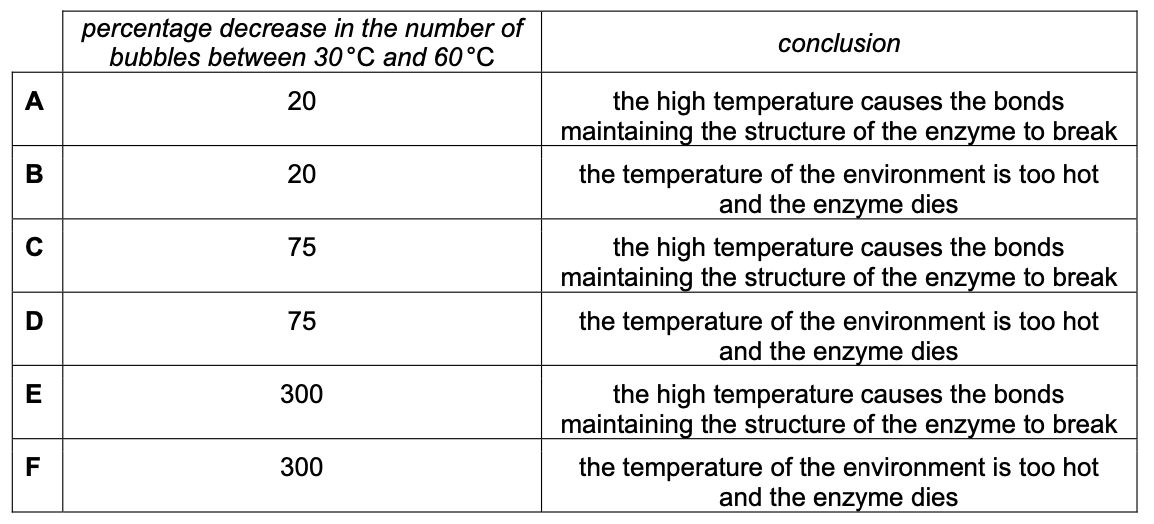
- A.percentage decrease: 20, conclusion: the high temperature causes the bonds maintaining the structure of the enzyme to break
- B.percentage decrease: 20, conclusion: the temperature of the environment is too hot and the enzyme dies
- C.percentage decrease: 75, conclusion: the high temperature causes the bonds maintaining the structure of the enzyme to break
- D.percentage decrease: 75, conclusion: the temperature of the environment is too hot and the enzyme dies
- E.percentage decrease: 300, conclusion: the high temperature causes the bonds maintaining the structure of the enzyme to break
- F.percentage decrease: 300, conclusion: the temperature of the environment is too hot and the enzyme dies
Answer: C
Question 59
1 markWhat is the number of albinism alleles in these cells?
- A.0
- B.29
- C.58
- D.81229
- E.81258
- F.162458
Answer: E
Question 60
1 mark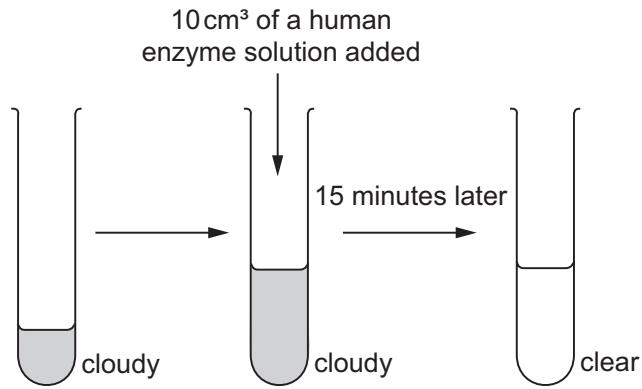
What could the student change so that it would take less than 15 minutes for the solution to become clear?
- A.Carry out the experiment at pH 7, but increase the temperature to 70°C.
- B.Carry out the experiment, stirring the mixture once every 30 seconds.
- C.Carry out the experiment at a temperature of 25 °C and a pH of 13.
- D.Double the volume of both the protein solution and the enzyme solution.
- E.Halve the volume of both the protein solution and the enzyme solution.
Answer: B
Question 61
1 mark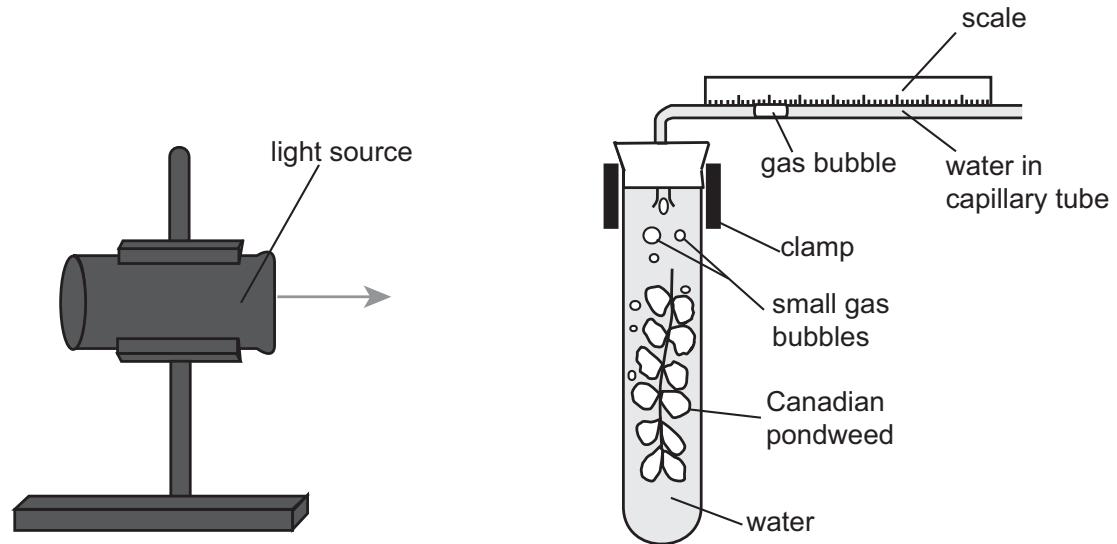
Which row represents the correct statements for this experiment?
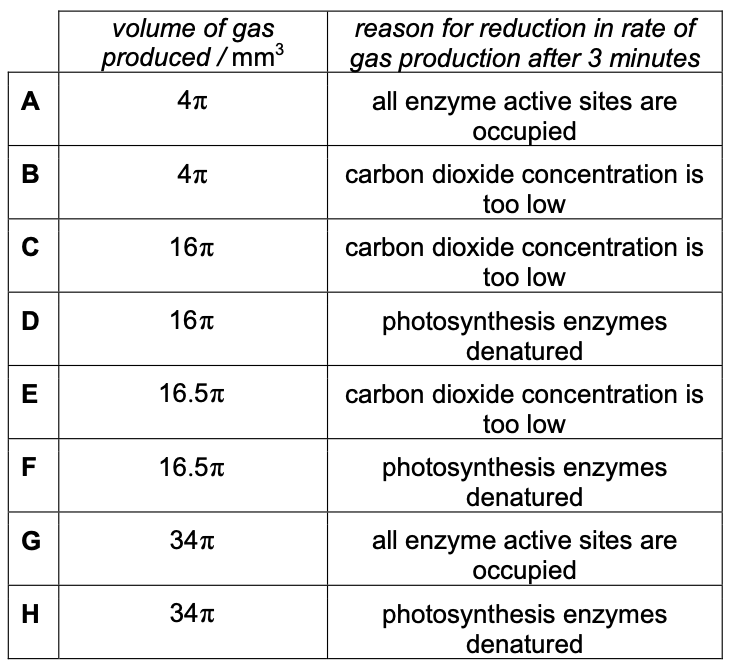
- A.volume of gas produced / mm³: , reason for reduction: all enzyme active sites are occupied
- B.volume of gas produced / mm³: , reason for reduction: carbon dioxide concentration is too low
- C.volume of gas produced / mm³: , reason for reduction: carbon dioxide concentration is too low
- D.volume of gas produced / mm³: , reason for reduction: photosynthesis enzymes denatured
- E.volume of gas produced / mm³: , reason for reduction: carbon dioxide concentration is too low
- F.volume of gas produced / mm³: , reason for reduction: photosynthesis enzymes denatured
- G.volume of gas produced / mm³: , reason for reduction: all enzyme active sites are occupied
- H.volume of gas produced / mm³: , reason for reduction: photosynthesis enzymes denatured
Answer: B
Question 62
1 markWhich of the following structures, if any, might the student also have seen in this tissue at this magnification?
1. cell wall
2. mitochondria
3. chromosomes
- A.none of them
- B.1 only
- C.2 only
- D.3 only
- E.1 and 2 only
- F.1 and 3 only
- G.2 and 3 only
- H.1, 2 and 3
Answer: B
Question 63
1 mark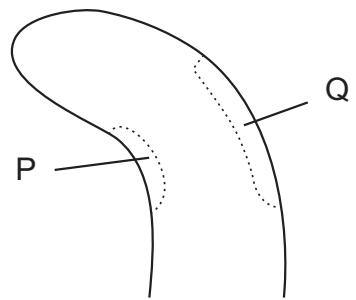
A student wrote the following statements to explain the growth of this shoot:
1. Cells at P are smaller than the cells at Q.
2. Concentration of plant hormone is higher at Q than P.
3. Unidirectional light has caused a change in the concentration of plant hormone at P.
Which of the student's statements, if any, could be correct?
- A.none of them
- B.1 only
- C.2 only
- D.3 only
- E.1 and 2 only
- F.1 and 3 only
- G.2 and 3 only
- H.1, 2 and 3
Answer: H
Question 64
1 markThe table shows some of the results for strand 1.

P, Q, R and S are the percentages of each base in the complementary strand 2.

A student calculates the following percentages for P, Q, R and S:
P 14%
Q 28%
R 26%
S 28%
Which of the percentages is/are correct?
- A.P only
- B.Q only
- C.R only
- D.S only
- E.P and Q only
- F.R and S only
Answer: E
Question 65
1 markA female carrier has a child with a male who is also a carrier. What are the probabilities of the child having the characteristics described in the table below?
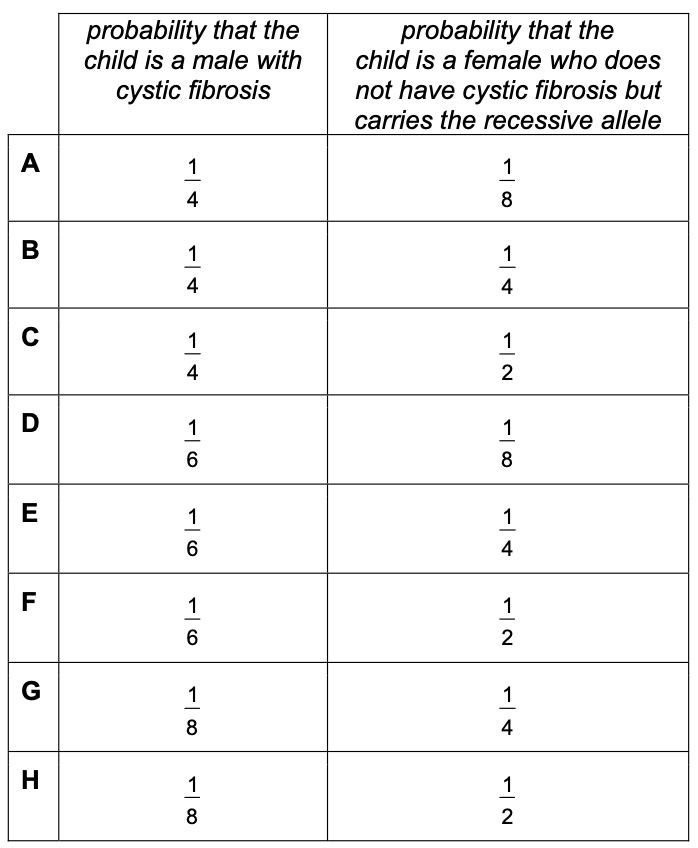
- A.probability that the child is a male with cystic fibrosis: 1/4, probability that the child is a female who does not have cystic fibrosis but carries the recessive allele: 1/8
- B.probability that the child is a male with cystic fibrosis: 1/4, probability that the child is a female who does not have cystic fibrosis but carries the recessive allele: 1/4
- C.probability that the child is a male with cystic fibrosis: 1/4, probability that the child is a female who does not have cystic fibrosis but carries the recessive allele: 1/2
- D.probability that the child is a male with cystic fibrosis: 1/6, probability that the child is a female who does not have cystic fibrosis but carries the recessive allele: 1/8
- E.probability that the child is a male with cystic fibrosis: 1/6, probability that the child is a female who does not have cystic fibrosis but carries the recessive allele: 1/4
- F.probability that the child is a male with cystic fibrosis: 1/6, probability that the child is a female who does not have cystic fibrosis but carries the recessive allele: 1/2
- G.probability that the child is a male with cystic fibrosis: 1/8, probability that the child is a female who does not have cystic fibrosis but carries the recessive allele: 1/4
- H.probability that the child is a male with cystic fibrosis: 1/8, probability that the child is a female who does not have cystic fibrosis but carries the recessive allele: 1/2
Answer: G
Question 66
1 mark1. a tapeworm absorbing nutrients from a sheep intestine
2. a bacterial cell breaking down undigested food in a human gut
3. a leopard and a lion hunting an antelope
4. male deer fighting with each other to gain a mate
5. oak trees growing close to each other in a wood
Which of the statements is/are an example of intraspecific competition?
- A.1 only
- B.2 only
- C.4 only
- D.2 and 3 only
- E.4 and 5 only
- F.1, 2 and 5 only
- G.1, 3 and 4 only
Answer: E
Question 67
1 markWhich row is correct for the number of strands of DNA in each sperm cell and the number of sperm cells produced?
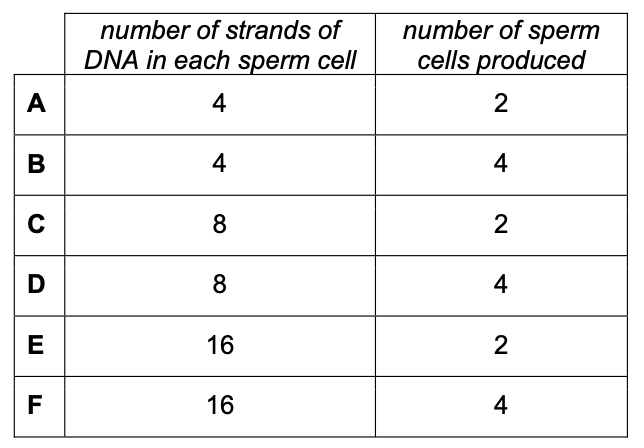
- A.number of strands of DNA in each sperm cell: 4, number of sperm cells produced: 2
- B.number of strands of DNA in each sperm cell: 4, number of sperm cells produced: 4
- C.number of strands of DNA in each sperm cell: 8, number of sperm cells produced: 2
- D.number of strands of DNA in each sperm cell: 8, number of sperm cells produced: 4
- E.number of strands of DNA in each sperm cell: 16, number of sperm cells produced: 2
- F.number of strands of DNA in each sperm cell: 16, number of sperm cells produced: 4
Answer: D
Question 68
1 markWhich row shows molecules that would be in a higher concentration in a vein carrying blood away from an actively contracting leg muscle of the runner compared to an artery carrying blood to the capillaries in the muscle?
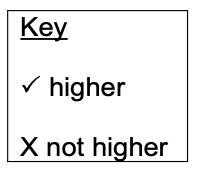
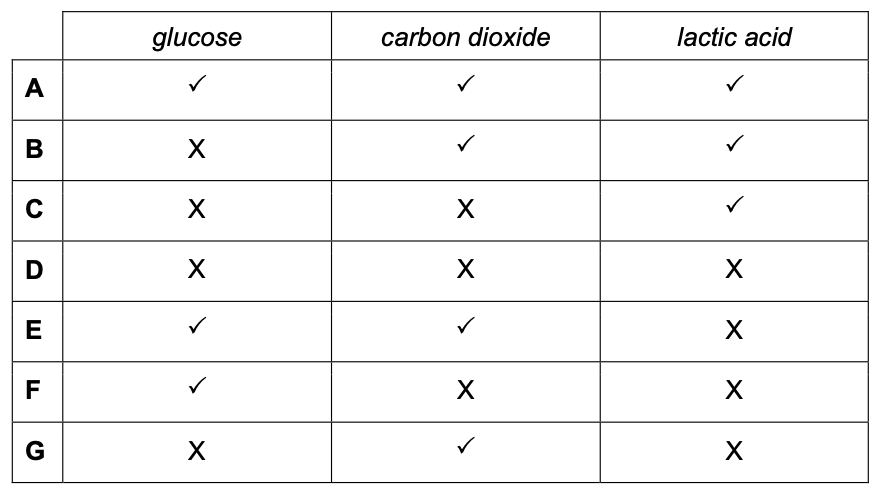
- A.glucose: ✓, carbon dioxide: ✓, lactic acid: ✓
- B.glucose: X, carbon dioxide: ✓, lactic acid: ✓
- C.glucose: X, carbon dioxide: X, lactic acid: ✓
- D.glucose: X, carbon dioxide: X, lactic acid: X
- E.glucose: ✓, carbon dioxide: ✓, lactic acid: X
- F.glucose: ✓, carbon dioxide: X, lactic acid: X
- G.glucose: X, carbon dioxide: ✓, lactic acid: X
Answer: B
Question 69
1 markThe sex of females of species Q is controlled by inheriting the same combination of sex chromosomes as healthy male humans. The sex of males in species Q is inherited in the same way as healthy female humans.
The family tree for one population of species Q is shown.
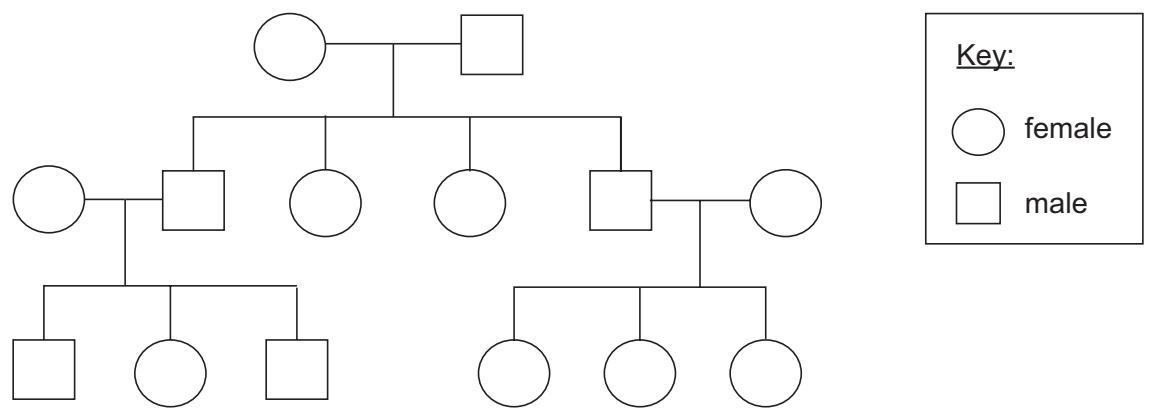
What is the ratio in its simplest form of males to females and the total number of Y chromosomes in this family tree?
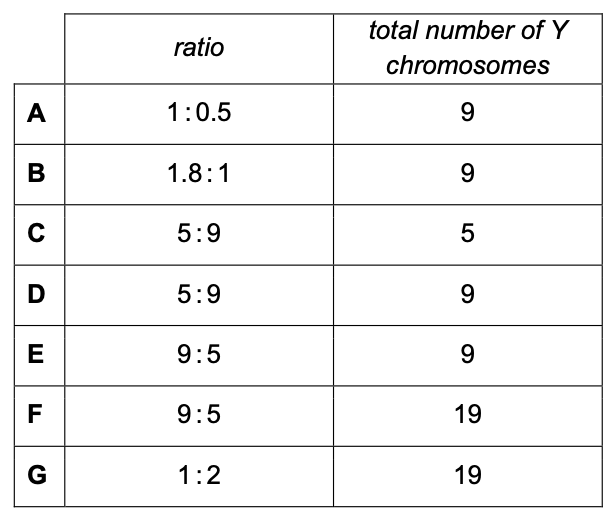
- A.ratio: 1:0.5, total number of Y chromosomes: 9
- B.ratio: 1.8:1, total number of Y chromosomes: 9
- C.ratio: 5:9, total number of Y chromosomes: 5
- D.ratio: 5:9, total number of Y chromosomes: 9
- E.ratio: 9:5, total number of Y chromosomes: 9
- F.ratio: 9:5, total number of Y chromosomes: 19
- G.ratio: 1:2, total number of Y chromosomes: 19
Answer: D
Question 70
1 mark(Assume the oxygen concentration is changing only based on the species present in the river.)
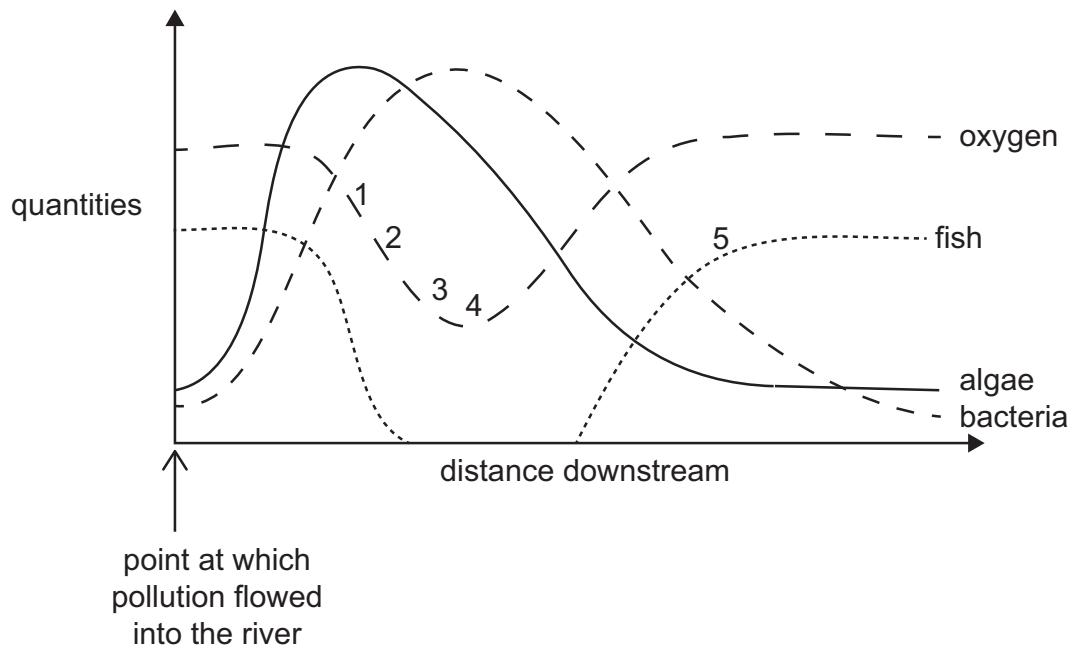
Which one of the statements below can be correctly concluded from the graph?
- A.At point 1, the oxygen concentration is decreasing because of increased anaerobic respiration.
- B.At point 2, the oxygen concentration is decreasing because high numbers of algae are photosynthesising.
- C.At point 3, the oxygen concentration is decreasing because bacteria are using up more oxygen than the algae are producing.
- D.At point 4, the number of bloodworms and sludgeworms will be lowest because they lack oxygen.
- E.At point 5, fish numbers increase because there is less competition with algae for oxygen.
Answer: C
Question 71
1 mark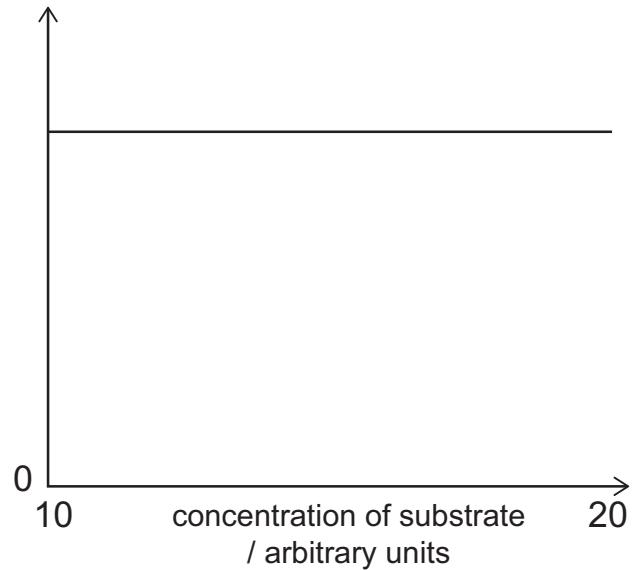
Which of the following labels, if any, could be correct for the y-axis?
1. rate of substrate loss/mg min⁻¹
2. rate of enzyme-substrate complex formation/number of complexes s⁻¹
3. rate of product formed per enzyme molecule/mg min⁻¹
- A.none of them
- B.1 only
- C.2 only
- D.3 only
- E.1 and 2 only
- F.1 and 3 only
- G.2 and 3 only
- H.1, 2 and 3
Answer: H
Question 72
1 mark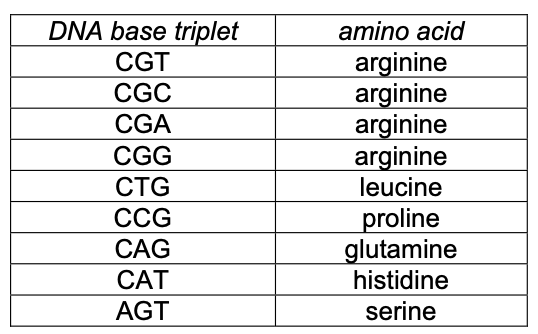
Consider the part of the DNA sequence shown:
... CGC AGT ... ->
Two mutations will occur in the DNA sequence. The initial mutation is an insertion of an additional base between the first and second bases in the sequence. The second mutation, which takes place some time after the first mutation, is a deletion that removes one base from the sequence.
Assuming that this DNA sequence is part of a longer sequence coding for a protein, and that no other mutations are occurring, what are the probabilities of the following?
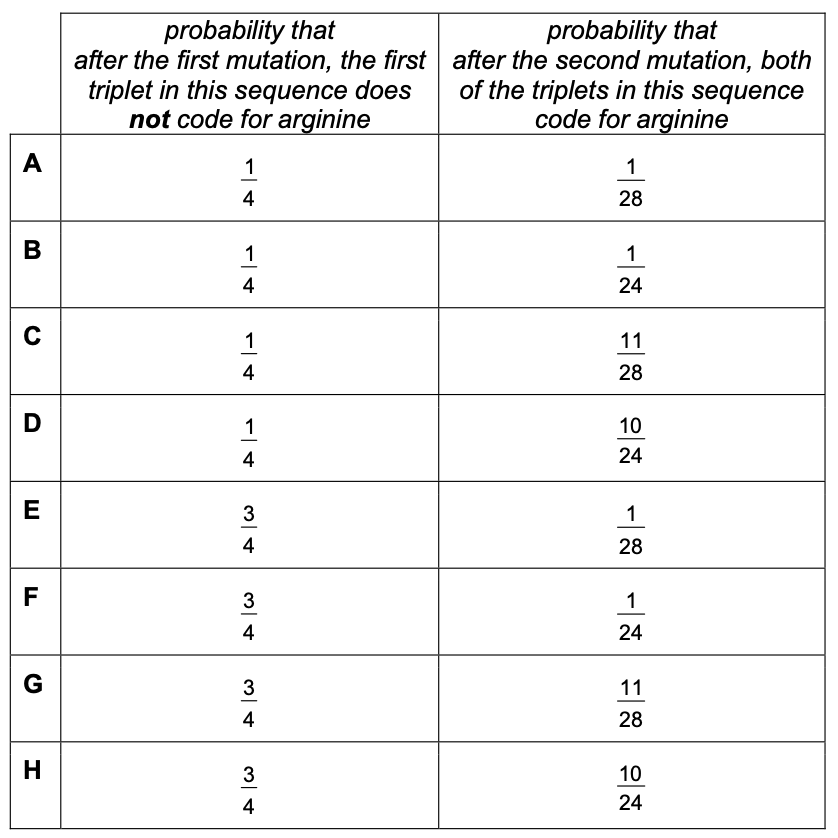
- A.probability that after the first mutation, the first triplet in this sequence does not code for arginine: 1/4, probability that after the second mutation, both of the triplets in this sequence code for arginine: 1/28
- B.probability that after the first mutation, the first triplet in this sequence does not code for arginine: 1/4, probability that after the second mutation, both of the triplets in this sequence code for arginine: 1/24
- C.probability that after the first mutation, the first triplet in this sequence does not code for arginine: 1/4, probability that after the second mutation, both of the triplets in this sequence code for arginine: 11/28
- D.probability that after the first mutation, the first triplet in this sequence does not code for arginine: 1/4, probability that after the second mutation, both of the triplets in this sequence code for arginine: 10/24
- E.probability that after the first mutation, the first triplet in this sequence does not code for arginine: 3/4, probability that after the second mutation, both of the triplets in this sequence code for arginine: 1/28
- F.probability that after the first mutation, the first triplet in this sequence does not code for arginine: 3/4, probability that after the second mutation, both of the triplets in this sequence code for arginine: 1/24
- G.probability that after the first mutation, the first triplet in this sequence does not code for arginine: 3/4, probability that after the second mutation, both of the triplets in this sequence code for arginine: 11/28
- H.probability that after the first mutation, the first triplet in this sequence does not code for arginine: 3/4, probability that after the second mutation, both of the triplets in this sequence code for arginine: 10/24
Answer: E
Question 73
1 markWhen x = 1 is substituted into the same expression, the result is – 3.5.
Find all possible value(s) of p.
- A.
- B. or
- C.
- D.
- E.there are no values for p
Answer: C
Question 74
1 markThe letters L, M, N, P, Q and R represent the magnitude of each force as indicated.
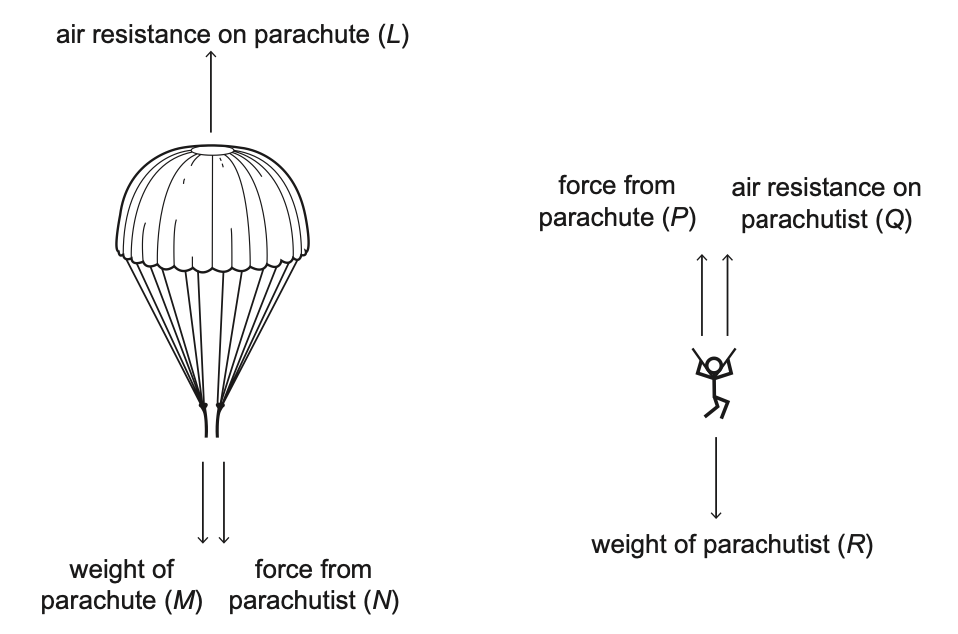
Consider the following equations:
Equation 1:
Equation 2:
Equation 3:
Equation 4:
Equation 5:
Which of these equations, if any, is/are the direct result of the application of Newton's Third Law to this situation?
- A.none of them
- B.3 only
- C.4 only
- D.5 only
- E.1 and 2 only
- F.3 and 4 only
- G.1, 2 and 5 only
- H.1, 2, 3, 4 and 5
Answer: C
Question 75
1 markP is the point (–5, 0) and Q is the point (1, 0).
A circle is drawn inside the square with diameter equal in length to the side of the square.
Which one of the following is an equation of the circle?
- A.
- B.
- C.
- D.
- E.
- F.
- G.
- H.
Answer: C
Question 76
1 mark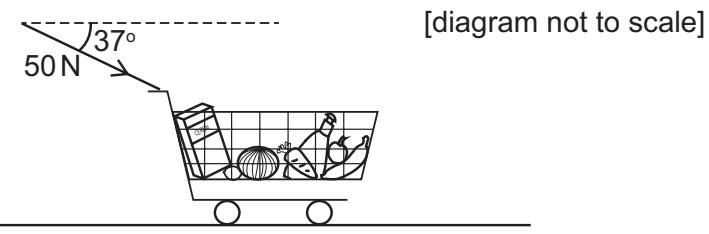
What is the magnitude of the total vertical force that the surface exerts on the trolley and how much work is done by the pushing force?
(You may use the approximations .)
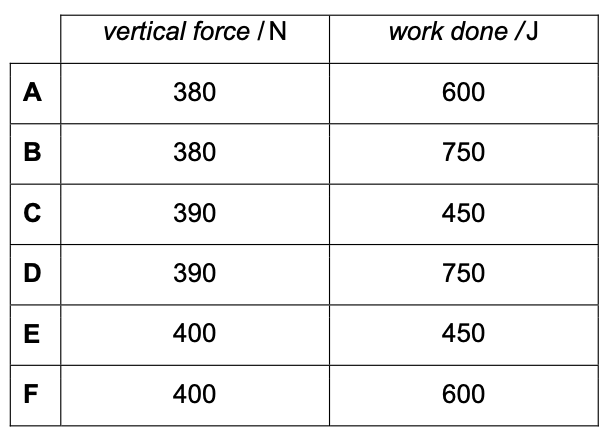
- A.vertical force / N: 380, work done / J: 600
- B.vertical force / N: 380, work done / J: 750
- C.vertical force / N: 390, work done / J: 450
- D.vertical force / N: 390, work done / J: 750
- E.vertical force / N: 400, work done / J: 450
- F.vertical force / N: 400, work done / J: 600
Answer: A
Question 77
1 markThe fifth term is 2.
The sixth term is real and positive.
What is the sum to infinity of this series?
(The sum to infinity of a convergent geometric series is given by , where a is the first term and r is the common ratio.)
- A.
- B.
- C.
- D.
- E.16
- F.
- G.
Answer: C
Question 78
1 mark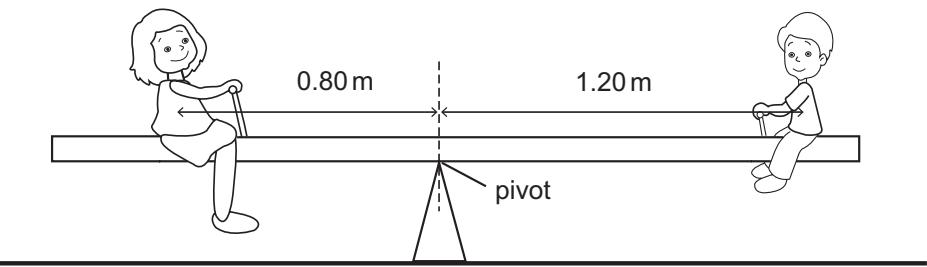
[diagram not to scale]
A boy of mass 35 kg sits at one end of the plank with his centre of gravity 1.20 m from the pivot. The see-saw balances when a woman of mass 60 kg sits on the plank on the other side of the pivot. Her centre of gravity is 0.80 m from the pivot.
Where is the centre of gravity of the plank and what is the magnitude of the force between the pivot and the plank?
(The gravitational field strength g is .)
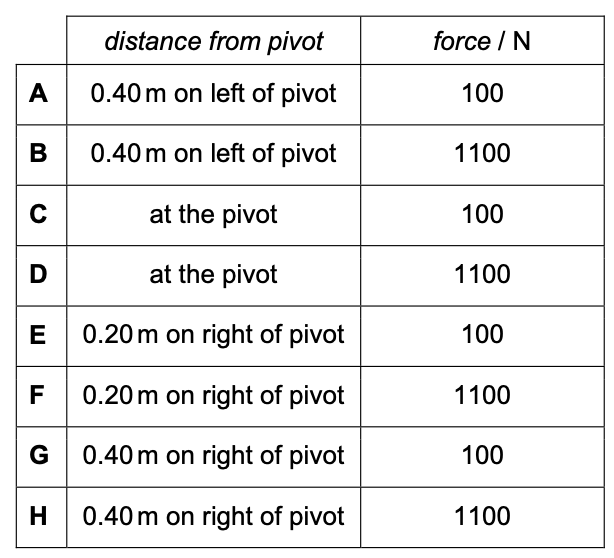
- A.distance from pivot: 0.40 m on left of pivot, force / N: 100
- B.distance from pivot: 0.40 m on left of pivot, force / N: 1100
- C.distance from pivot: at the pivot, force / N: 100
- D.distance from pivot: at the pivot, force / N: 1100
- E.distance from pivot: 0.20 m on right of pivot, force / N: 100
- F.distance from pivot: 0.20 m on right of pivot, force / N: 1100
- G.distance from pivot: 0.40 m on right of pivot, force / N: 100
- H.distance from pivot: 0.40 m on right of pivot, force / N: 1100
Answer: H
Question 79
1 markThe centre of the circle is C and the distance PC is 20 cm.
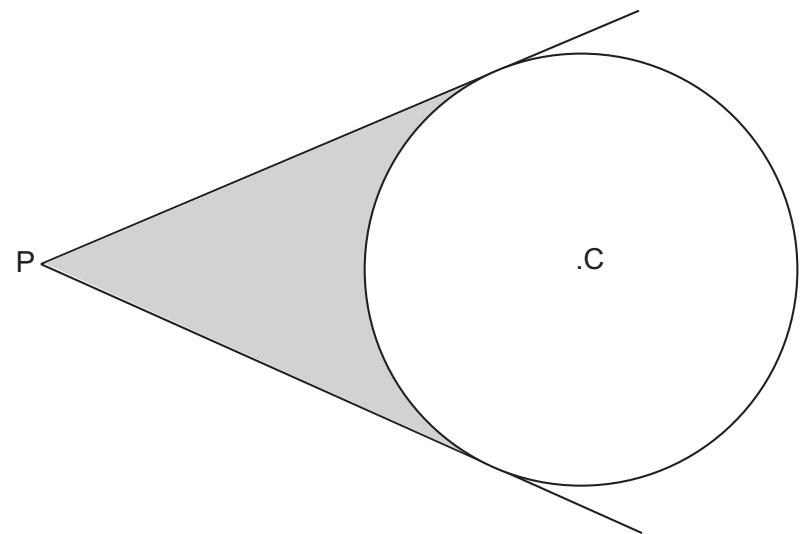
Which one of the following is an expression for the shaded area in square centimetres?
- A.
- B.
- C.
- D.
- E.
- F.
Answer: A
Question 80
1 mark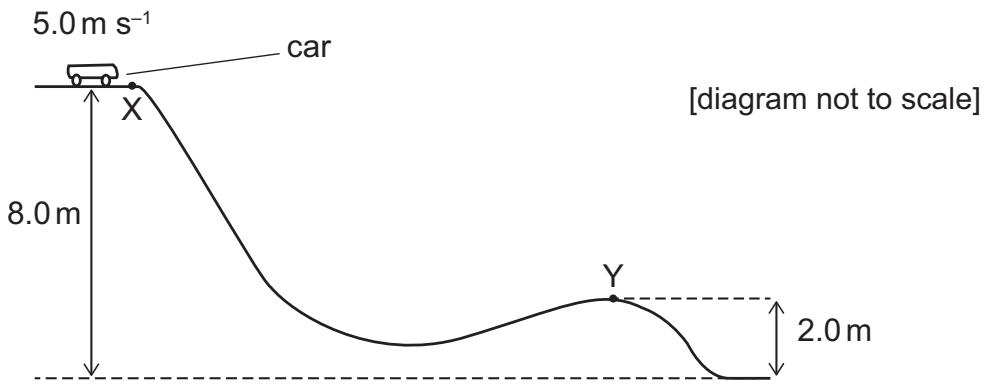
How much energy is transferred in overcoming resistive forces as the car travels from X to Y?
(The gravitational field strength g is .)
- A.3900 J
- B.6400 J
- C.7900 J
- D.10400 J
- E.11200 J
Answer: B
Question 81
1 mark- A. or
- B. or
- C. or
- D. or
Answer: D
Question 82
1 mark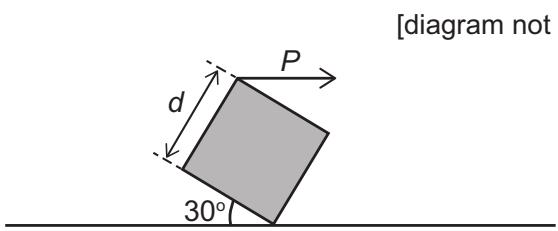
[diagram not to scale]
Below are four statements about the forces on the cube.
1. It is possible that there is no frictional force between the cube and the table.
2. There must be a frictional force acting to the left between the cube and the table.
3. There must be a frictional force acting to the right between the cube and the table.
4. Force P has a clockwise moment about the edge in contact with the table equal to .
Which of the statements is/are correct?
- A.1 only
- B.2 only
- C.3 only
- D.1 and 4 only
- E.2 and 4 only
- F.3 and 4 only
Answer: B
Question 83
1 mark- A.no values of a
- B.
- C.
- D.
- E.
- F.
- G.
- H.all values of a
Answer: G
Question 84
1 markOn the way up, what is the height of the object above the ground when it has a speed of , and at what time does it reach this height on the way down?
(The gravitational field strength g is . Air resistance can be ignored.)
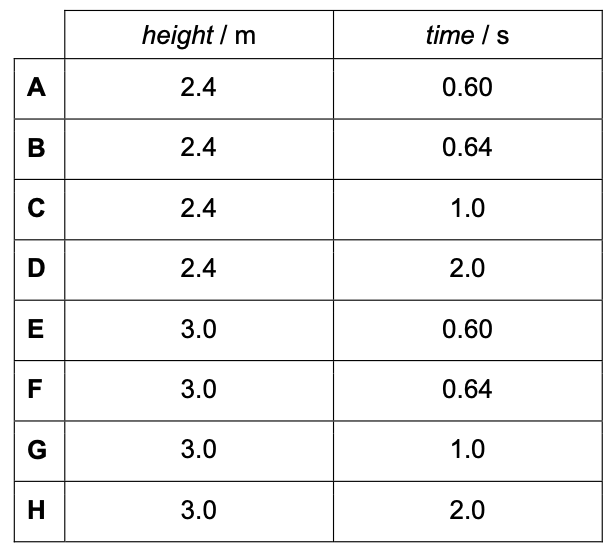
- A.height / m: 2.4, time / s: 0.60
- B.height / m: 2.4, time / s: 0.64
- C.height / m: 2.4, time / s: 1.0
- D.height / m: 2.4, time / s: 2.0
- E.height / m: 3.0, time / s: 0.60
- F.height / m: 3.0, time / s: 0.64
- G.height / m: 3.0, time / s: 1.0
- H.height / m: 3.0, time / s: 2.0
Answer: G
Question 85
1 markThe lines cut the x-axis at the points L and M respectively. The length of LM is 5 units.
What is the value of given that ?
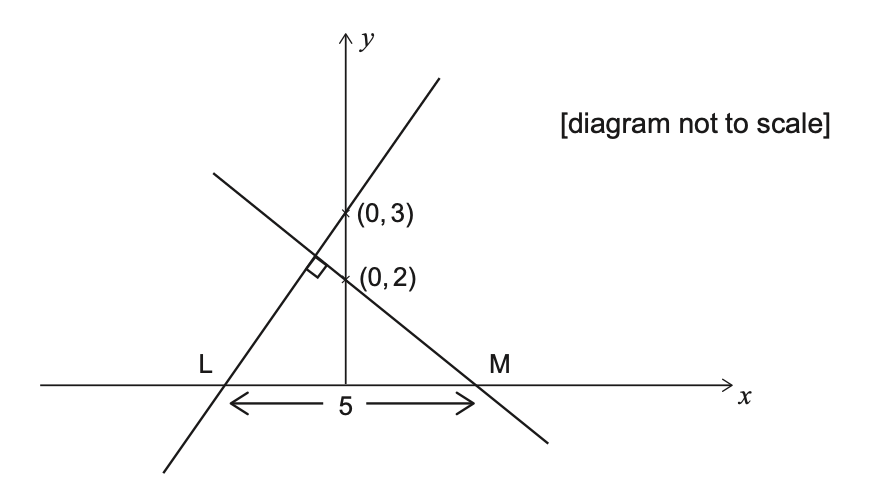
- A.
- B.
- C.
- D.
- E.
- F.
Answer: D
Question 86
1 mark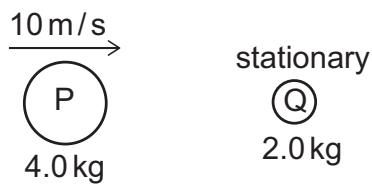
The balls collide but do not join together. Immediately after the collision ball Q moves at to the right.
What is the velocity of ball P immediately after the collision, and how much kinetic energy in total is lost during the collision?
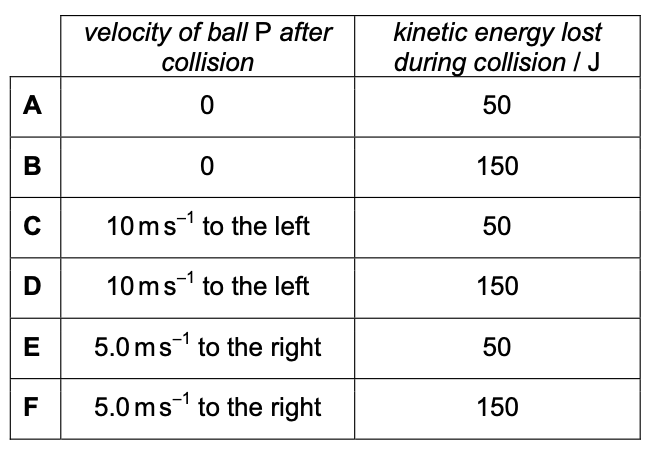
- A.velocity of ball P after collision: 0, kinetic energy lost during collision / J: 50
- B.velocity of ball P after collision: 0, kinetic energy lost during collision / J: 150
- C.velocity of ball P after collision: to the left, kinetic energy lost during collision / J: 50
- D.velocity of ball P after collision: to the left, kinetic energy lost during collision / J: 150
- E.velocity of ball P after collision: to the right, kinetic energy lost during collision / J: 50
- F.velocity of ball P after collision: to the right, kinetic energy lost during collision / J: 150
Answer: E
Question 87
1 markFind the complete set of values of x for which is an increasing function.
- A.
- B.
- C.
- D.
- E.
- F.
- G.
- H.
Answer: G
Question 88
1 markTwo horizontal forces at right-angles to each other, with magnitudes 9.0 N and 12.0 N, are applied simultaneously to the object.
What is the magnitude of the acceleration of the object as it begins to move?
(The gravitational field strength g is .)
- A.
- B.
- C.
- D.
- E.
- F.
Answer: A
Question 89
1 markWhich one of the following is an equation of the resulting curve?
- A.
- B.
- C.
- D.
- E.
- F.
- G.
- H.
Answer: E
Question 90
1 mark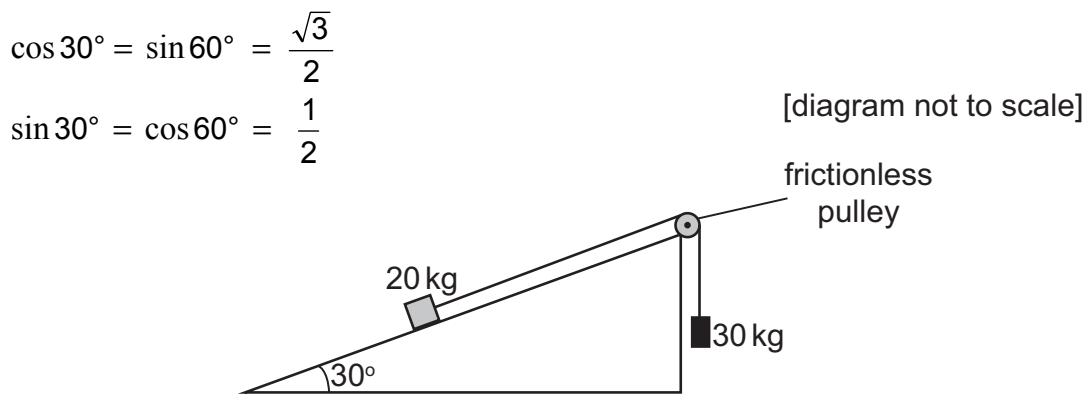
What is the frictional force between the object and the plane?
(Air resistance and the mass of the pulley can be ignored. The gravitational field strength g is .)
- A.25 N
- B.50 N
- C.75 N
- D.100 N
- E.150 N
- F.175 N
- G.250 N
Answer: C