Mapped to the ESAT specification
NSAA 2016 Mathematics Part A (Paper 2)
18 questions18 marksUpdated June 2026
Natural Sciences Admissions Assessment 2016 is one of the closest available past papers for the Engineering and Science Admissions Test. Below, all 18 questions are mapped to the ESAT topics they test, each with its answer. Sit it cold under exam timing, then work back through anything you missed using the solutions.
What this paper covers on the ESAT
Every question mapped to the Engineering and Science Admissions Test specification, so you know exactly which areas it tests.
Mathematics 1
- Geometry (6)
- Algebra (5)
- Number (4)
- Ratio and proportion (1)
Questions and answers are free. Full step-by-step worked solutions unlock with a free account. Start practising.
Question 1
1 markA square piece of metal has a semicircular piece cut out of it as shown. The area of the remaining metal is 100 cm².
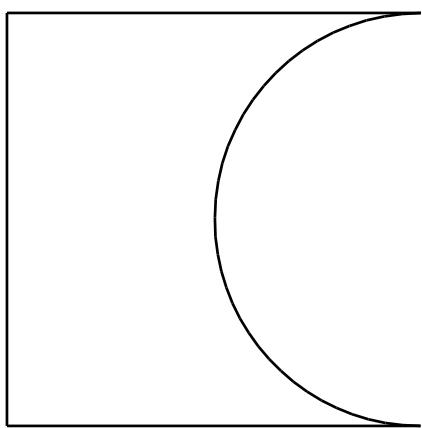
[diagram not to scale]
Which one of the following is a correct expression for the length of the side of the square in centimetres?
[diagram not to scale]
Which one of the following is a correct expression for the length of the side of the square in centimetres?
- A.
- B.
- C.
- D.
- E.
Answer: A
Question 2
1 markIn a right-angled triangle PQR the hypotenuse is the side PR.
The length of side PQ is 20 cm and the ratio RQ:PQ is 1:2
What is the length of the perpendicular from the hypotenuse to the point Q?
The length of side PQ is 20 cm and the ratio RQ:PQ is 1:2
What is the length of the perpendicular from the hypotenuse to the point Q?
- A. cm
- B. cm
- C. cm
- D. cm
- E. cm
Answer: E
Question 3
1 markA cube has sides of unit length. What is the length of a line joining a vertex to the midpoint of one of the opposite faces (the dashed line in the diagram below)?
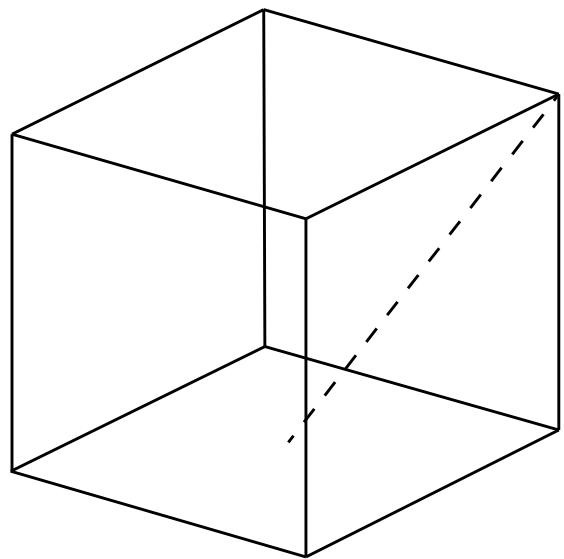
[diagram not to scale]
[diagram not to scale]
- A.
- B.
- C.
- D.
- E.
Answer: A
Question 4
1 markIf you look at a clock and the time is 9.45, what is the angle between the hour and the minute hands?
- A.0°
- B.7.5°
- C.15°
- D.22.5°
- E.30°
Answer: D
Question 5
1 markThe right-angled triangle shown has horizontal and vertical sides measuring cm and cm respectively.
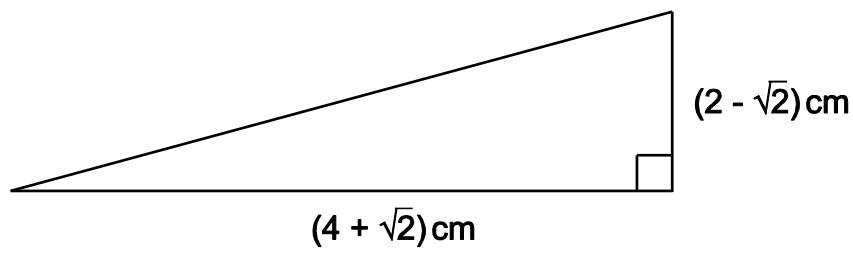
[diagram not to scale]
Calculate the area of the triangle.
[diagram not to scale]
Calculate the area of the triangle.
- A.
- B.
- C.
- D.
Answer: B
Question 6
1 markA solid sphere of radius fits inside a hollow cylinder. The cylinder has the same internal diameter and length as the diameter of the sphere.
The volume of a sphere is , where is the radius of the sphere.
What fraction of the space inside the cylinder is taken up by the sphere?
The volume of a sphere is , where is the radius of the sphere.
What fraction of the space inside the cylinder is taken up by the sphere?
- A.
- B.
- C.
- D.
- E.
Answer: D
Question 7
1 markWhich of the expressions below has the largest value for ?
- A.
- B.
- C.
- D.
- E.
Answer: A
Question 8
1 markA shape is formed by drawing a triangle ABC inside the triangle ADE.
BC is parallel to DE.
AB = 4 cm BC = x cm DE = x + 3cm DB = x - 4 cm
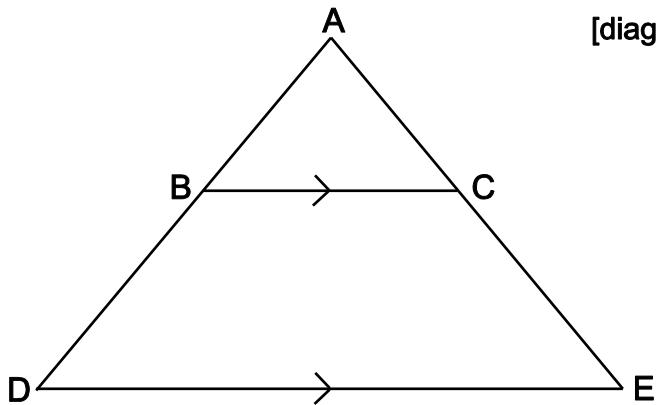
[diagram not to scale]
Calculate the length of DE.
BC is parallel to DE.
AB = 4 cm BC = x cm DE = x + 3cm DB = x - 4 cm
[diagram not to scale]
Calculate the length of DE.
- A.5 cm
- B.7 cm
- C.9 cm
- D.4+2\sqrt{7}\cm
- E.7+2\sqrt{7}\cm
Answer: C
Question 9
1 markTwo variables are connected by the relation:
is increased by 40%.
To the nearest percent, describe the change in in percentage terms.
is increased by 40%.
To the nearest percent, describe the change in in percentage terms.
- A.29% decrease
- B.44% decrease
- C.49% decrease
- D.51% decrease
- E.80% decrease
- F.96% decrease
Answer: C
Question 10
1 markThree variables x, y and z are known to be related to each other in the following ways:
x is directly proportional to the square of z.
y is inversely proportional to the cube of z.
Which of the following correctly describes the relationship between x and y?
x is directly proportional to the square of z.
y is inversely proportional to the cube of z.
Which of the following correctly describes the relationship between x and y?
- A.The square of x is directly proportional to the cube of y.
- B.The square of x is inversely proportional to the cube of y.
- C.The cube of x is directly proportional to the square of y.
- D.The cube of x is inversely proportional to the square of y.
- E.x is directly proportional to .
Answer: D
Question 11
1 markIn the triangle PQR shown below:
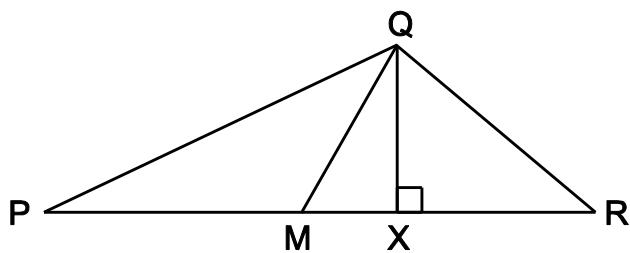
[diagram not to scale]
X lies on PR
is 90°
M is the midpoint of PR.
What is ?
[diagram not to scale]
X lies on PR
is 90°
M is the midpoint of PR.
What is ?
- A.
- B.
- C.
- D.
- E.
Answer: C
Question 12
1 markSolve the inequality
- A.
- B. and
- C. and
- D. or
Answer: D
Question 13
1 markThe total surface area of a cylinder, measured in square centimetres, is numerically the same as its volume, measured in cubic centimetres.
The radius of the cylinder is cm, the height is cm.
Express in terms of .
The radius of the cylinder is cm, the height is cm.
Express in terms of .
- A.
- B.
- C.
- D.
- E.
Answer: A
Question 14
1 markHow many different integers, , are there such that the difference between and 7 is less than 1?
- A.0
- B.2
- C.4
- D.6
- E.8
Answer: D
Question 15
1 markThe square PQRS is positioned so that its vertices are at the points with coordinates:
(1, 1), (-1, 1), (-1, -1) and (1, -1).
The square is rotated clockwise through 90° about the origin and then reflected in the line .
Which transformation will return the square to its original orientation?
(1, 1), (-1, 1), (-1, -1) and (1, -1).
The square is rotated clockwise through 90° about the origin and then reflected in the line .
Which transformation will return the square to its original orientation?
- A.A reflection in the x-axis.
- B.A reflection in the y-axis.
- C.A reflection in the line .
- D.A rotation of 90° clockwise about the origin.
- E.A rotation of 90° anticlockwise about the origin.
Answer: B
Question 16
1 markA design is set up by joining the points which are one third of the way along the sides of a square. This forms a second square as shown.
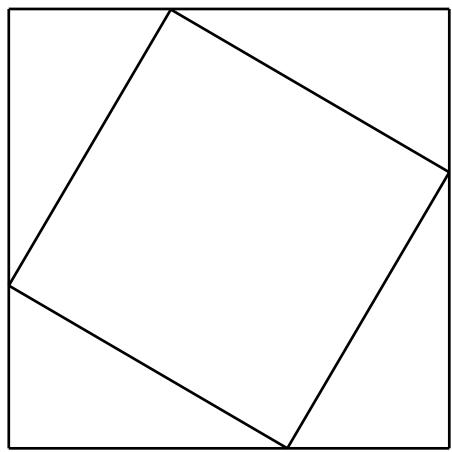
[diagram not to scale]
This process is repeated.
Calculate the area of the fourth square as a fraction of the original square.
[diagram not to scale]
This process is repeated.
Calculate the area of the fourth square as a fraction of the original square.
- A.
- B.
- C.
- D.
- E.
Answer: C
Question 17
1 markThe equation connects the variables and .
The following changes are made:
x and y are both increased by 50%
z is decreased by 20%
P is doubled and Q remains the same.
What is the resulting percentage change in ?
The following changes are made:
x and y are both increased by 50%
z is decreased by 20%
P is doubled and Q remains the same.
What is the resulting percentage change in ?
- A.2.5% decrease
- B.2.5% increase
- C.10% decrease
- D.10% increase
- E.20% decrease
- F.20% increase
Answer: C
Question 18
1 markI have two six-sided dice, each with faces numbered from 1 to 6. One of the dice is fair, but the other is not; it will land on numbers 1 to 5 with equal probability, but lands on 6 with a different probability.
When I roll the dice the probability that I get a total of 12 is .
What is the probability that I get a total of 2 when I roll the dice?
When I roll the dice the probability that I get a total of 12 is .
What is the probability that I get a total of 2 when I roll the dice?
- A.
- B.
- C.
- D.
- E.
Answer: B