NSAA 2016 Physics S1
18 questions18 marksUpdated June 2026
The NSAA 2016 Physics S1 paper in full: all 18 questions, each with its answer. NSAA is the Natural Sciences Admissions Assessment. Sit it cold under exam timing, mark it, then work back through anything you missed using the solutions below.
Download the original PDF →Questions and answers are free. Full step-by-step worked solutions unlock with a free account. Start practising.
Question 19
In the 1920s scientists discovered that the universe is expanding. One consequence of this expansion is that the intense gamma-ray radiation that filled the early universe has now been shifted to the microwave region of the electromagnetic spectrum.
Which line of the table describes how the expansion of the universe has affected the frequency and wavelength of these electromagnetic waves?
Which line of the table describes how the expansion of the universe has affected the frequency and wavelength of these electromagnetic waves?
- A.effect on frequency: decrease, effect on wavelength: decrease
- B.effect on frequency: decrease, effect on wavelength: increase
- C.effect on frequency: increase, effect on wavelength: decrease
- D.effect on frequency: increase, effect on wavelength: increase
- E.effect on frequency: no effect, effect on wavelength: decrease
- F.effect on frequency: no effect, effect on wavelength: increase
Answer: B
Question 20
A nuclide changes by radioactive decay into the nuclide .
Which combination of emissions produces this change?
Which combination of emissions produces this change?
- A.3 alpha
- B.2 alpha and 1 beta
- C.2 alpha and 2 beta
- D.1 alpha and 2 beta
- E.3 beta
Answer: D
Question 21
A cylindrical copper bar X of length has a cross-sectional area . The colder end of the bar is kept at temperature and the hotter end is kept at temperature .
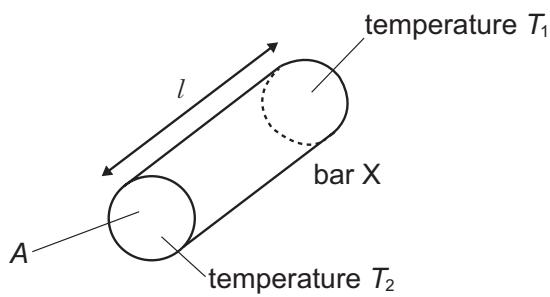
The curved surface of the bar is perfectly insulated and thermal energy is conducted from the hotter end of the bar to the colder end.
Changes in , , and may alter the rate at which thermal energy is conducted along the copper bar.
In which case is the rate of conduction of thermal energy along the insulated bar the same as for bar X?
The curved surface of the bar is perfectly insulated and thermal energy is conducted from the hotter end of the bar to the colder end.
Changes in , , and may alter the rate at which thermal energy is conducted along the copper bar.
In which case is the rate of conduction of thermal energy along the insulated bar the same as for bar X?
- A.change in A: doubles, change in l: no change, change in T1: no change, change in T2: no change
- B.change in A: halves, change in l: no change, change in T1: no change, change in T2: no change
- C.change in A: no change, change in l: doubles, change in T1: no change, change in T2: no change
- D.change in A: no change, change in l: halves, change in T1: no change, change in T2: no change
- E.change in A: no change, change in l: no change, change in T1: decreases by 10°C, change in T2: increases by 10°C
- F.change in A: no change, change in l: no change, change in T1: decreases by 10°C, change in T2: no change
- G.change in A: no change, change in l: no change, change in T1: increases by 10 °C, change in T2: decreases by 10°C
- H.change in A: no change, change in l: no change, change in T1: increases by 10 °C, change in T2: increases by 10°C
Answer: H
Question 22
The graph shown of quantity against quantity represents the motion of a body.
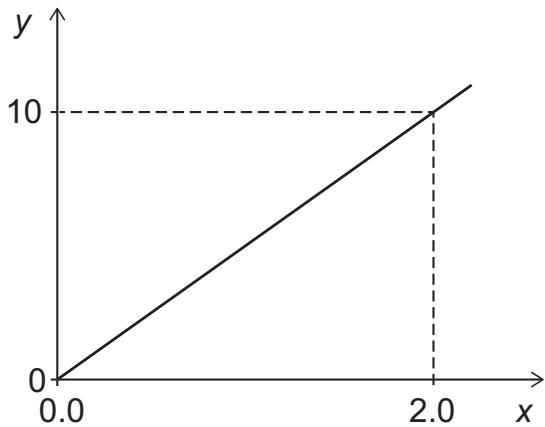
(The scales on both axes are in the appropriate S.I. units, and the gravitational field strength is .)
Which two of the following could the graph represent?
1 kinetic energy against velocity for an object of mass 10kg undergoing free-fall
2 potential energy against height for an object of mass 20 kg being lifted by a constant external force
3 velocity against time for an object of mass 20 kg being accelerated by a resultant force of 100 N
4 work done by an external force of 5N against distance moved for an object of mass 12 kg being moved at constant speed by (and in the direction of) the external force
(The scales on both axes are in the appropriate S.I. units, and the gravitational field strength is .)
Which two of the following could the graph represent?
1 kinetic energy against velocity for an object of mass 10kg undergoing free-fall
2 potential energy against height for an object of mass 20 kg being lifted by a constant external force
3 velocity against time for an object of mass 20 kg being accelerated by a resultant force of 100 N
4 work done by an external force of 5N against distance moved for an object of mass 12 kg being moved at constant speed by (and in the direction of) the external force
- A.1 and 2
- B.1 and 3
- C.1 and 4
- D.2 and 3
- E.2 and 4
- F.3 and 4
Answer: F
Question 23
A uranium-235 nucleus can undergo fission to produce two smaller nuclei.
Which of the diagrams, if any, could represent this process?
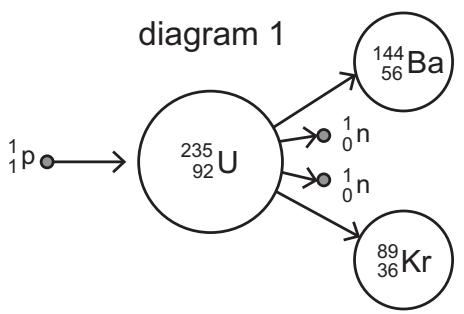
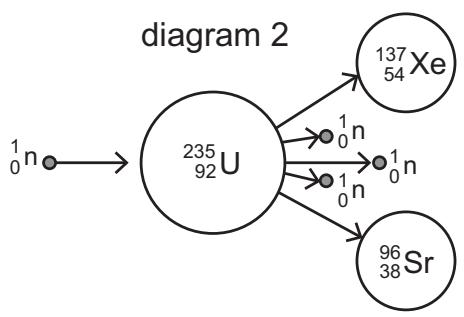
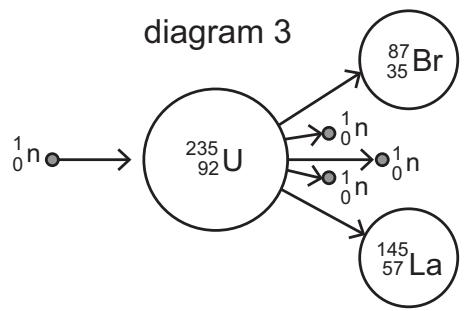
Which of the diagrams, if any, could represent this process?
- A.none of them
- B.1 only
- C.2 only
- D.3 only
- E.1 and 2 only
- F.1 and 3 only
- G.2 and 3 only
- H.1, 2 and 3
Answer: C
Question 24
A circuit consists of a 5.0 resistor and a variable resistor connected in series with a 24 V battery. The variable resistor has a minimum resistance of 3.0 and a maximum resistance of 15 . The battery and the connecting wires have negligible resistance.
What is the maximum power dissipated in the 5.0 resistor?
What is the maximum power dissipated in the 5.0 resistor?
- A.7.2 W
- B.18 W
- C.27 W
- D.45 W
- E.72 W
- F.75 W
Answer: D
Question 25
The diagram shows a 12V battery, a switch and three resistors. Each resistor has a resistance of 30 .
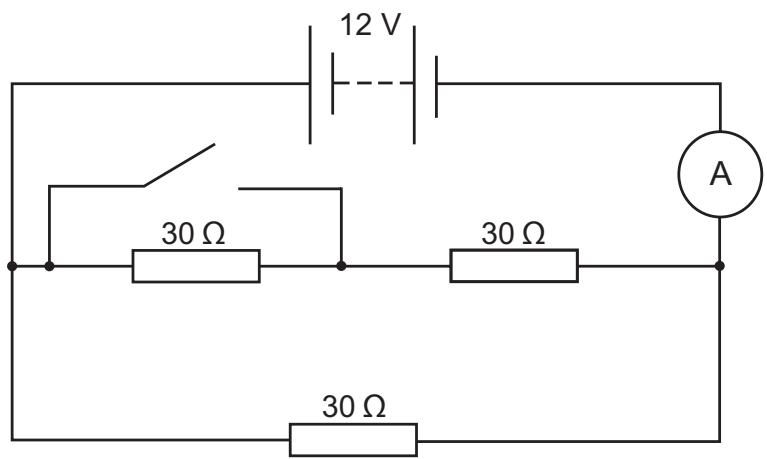
Initially the switch is open.
What happens to the reading on the ammeter when the switch is closed?
Initially the switch is open.
What happens to the reading on the ammeter when the switch is closed?
- A.It decreases by 0.20 A.
- B.It decreases by 0.40 A.
- C.It decreases by 0.60 A.
- D.It decreases by 0.80 A.
- E.It increases by 0.20 A.
- F.It increases by 0.40 A.
- G.It increases by 0.60 A.
- H.It increases by 0.80 A.
Answer: E
Question 26
The total power radiated by a star is given by:
where is the radius of the star, is its surface temperature and is a constant.
The power currently radiated by the Sun is W. Towards the end of the Sun's life its radius will increase by a factor of a hundred and its surface temperature will decrease by a factor of two.
What will be the power radiated by the Sun when these changes have occurred?
where is the radius of the star, is its surface temperature and is a constant.
The power currently radiated by the Sun is W. Towards the end of the Sun's life its radius will increase by a factor of a hundred and its surface temperature will decrease by a factor of two.
What will be the power radiated by the Sun when these changes have occurred?
- A. W
- B. W
- C. W
- D. W
- E. W
- F. W
- G. W
- H. W
Answer: D
Question 27
A transverse wave travelling through a medium has a frequency of 5.0 Hz, a wavelength of 4.0 cm and an amplitude of 3.0 cm.
What is the total distance travelled by a particle of the medium in one minute?
What is the total distance travelled by a particle of the medium in one minute?
- A.900 cm
- B.1200 cm
- C.1800 cm
- D.2400 cm
- E.3600 cm
- F.4800 cm
Answer: E
Question 28
A motor is used to lift a mass of 5.0 kg using a pulley system as shown in the diagram. The pulley is secured to the roof using a coupling.
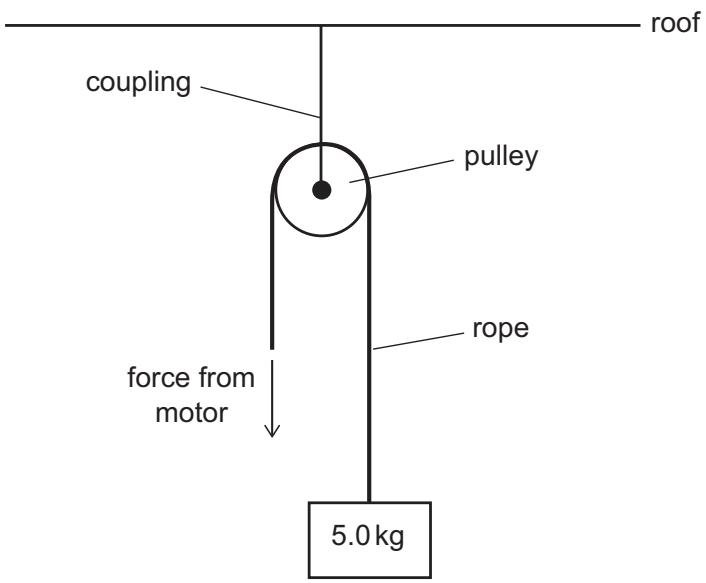
The motor needs to cause the mass to accelerate upwards at .
What is the minimum tension force that the coupling must be able to withstand without breaking?
(The gravitational field strength is . The pulley system is frictionless and has negligible mass. The rope has negligible mass and is inextensible.)
The motor needs to cause the mass to accelerate upwards at .
What is the minimum tension force that the coupling must be able to withstand without breaking?
(The gravitational field strength is . The pulley system is frictionless and has negligible mass. The rope has negligible mass and is inextensible.)
- A.4.0 N
- B.8.0 N
- C.46 N
- D.50 N
- E.54 N
- F.92 N
- G.104 N
- H.108 N
Answer: H
Question 29
A heater is connected in series with a resistor and a 6.0 V battery in the circuit shown.
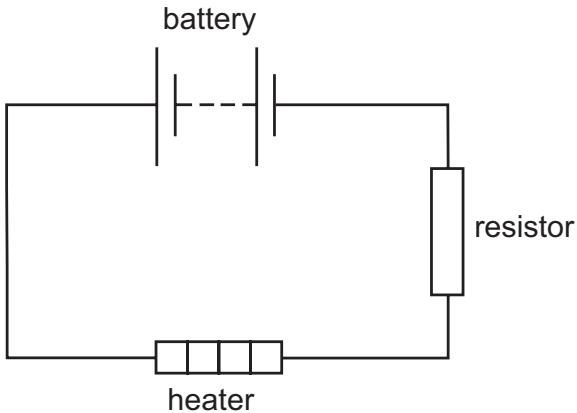
The total resistance of the circuit is . In 3.0 minutes, 180 J of electrical energy is transferred into other forms in the heater.
How much charge flows through the heater in the 3.0 minutes and what is the voltage across the heater?
The total resistance of the circuit is . In 3.0 minutes, 180 J of electrical energy is transferred into other forms in the heater.
How much charge flows through the heater in the 3.0 minutes and what is the voltage across the heater?
- A.charge / C: 1.2, voltage / V: 150
- B.charge / C: 1.2, voltage / V: 216
- C.charge / C: 7.5, voltage / V: 0.041
- D.charge / C: 7.5, voltage / V: 24
- E.charge / C: 72, voltage / V: 0.40
- F.charge / C: 72, voltage / V: 2.5
- G.charge / C: 450, voltage / V: 0.40
- H.charge / C: 450, voltage / V: 2.5
Answer: F
Question 30
A cubic block has a hole through it with a square cross-section. The dimensions are shown on the diagram. The weight of the block is 30 N.
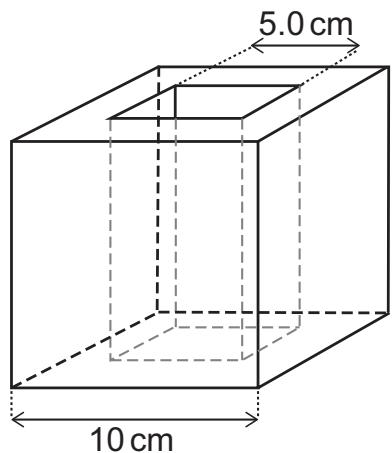
What is the density of the material from which the block is made?
(The gravitational field strength is .)
What is the density of the material from which the block is made?
(The gravitational field strength is .)
- A.
- B.
- C.
- D.
- E.
- F.
- G.
- H.
Answer: F
Question 31
The diagram shows four solid steel balls P, Q, R and S which are of identical size.
Balls P and R have shiny surfaces. Balls Q and S have dull surfaces.
Balls P and Q are in a room at 20°C. Balls R and S are in a room at 40 °C.
The temperature of each ball at a given moment in time is shown on the diagram.
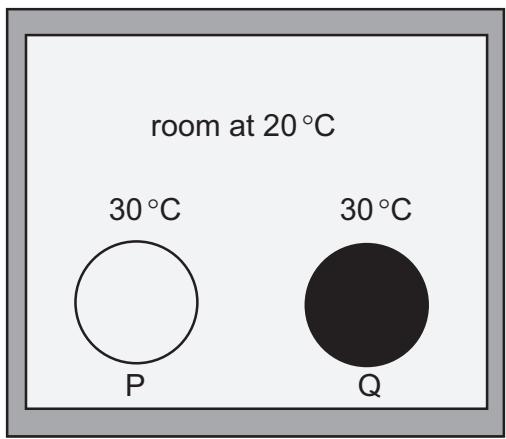
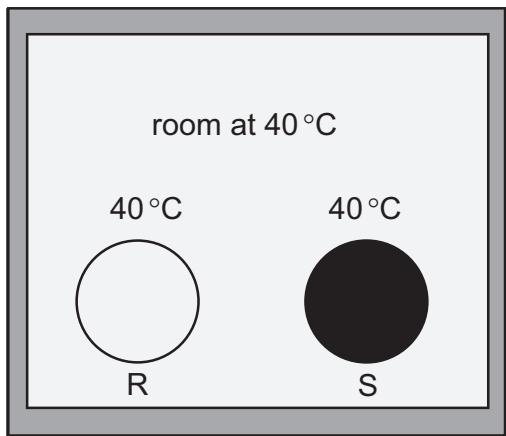
Which two balls lose thermal energy by convection, and which ball emits thermal radiation at the greatest rate?
Balls P and R have shiny surfaces. Balls Q and S have dull surfaces.
Balls P and Q are in a room at 20°C. Balls R and S are in a room at 40 °C.
The temperature of each ball at a given moment in time is shown on the diagram.
Which two balls lose thermal energy by convection, and which ball emits thermal radiation at the greatest rate?
- A.lose thermal energy by convection: P and Q, greatest rate of emission of thermal radiation: P
- B.lose thermal energy by convection: P and Q, greatest rate of emission of thermal radiation: Q
- C.lose thermal energy by convection: P and Q, greatest rate of emission of thermal radiation: R
- D.lose thermal energy by convection: P and Q, greatest rate of emission of thermal radiation: S
- E.lose thermal energy by convection: R and S, greatest rate of emission of thermal radiation: P
- F.lose thermal energy by convection: R and S, greatest rate of emission of thermal radiation: Q
- G.lose thermal energy by convection: R and S, greatest rate of emission of thermal radiation: R
- H.lose thermal energy by convection: R and S, greatest rate of emission of thermal radiation: S
Answer: D
Question 32
The diagram shows the velocity-time graph for an object travelling in a straight line over a period of 30 s.
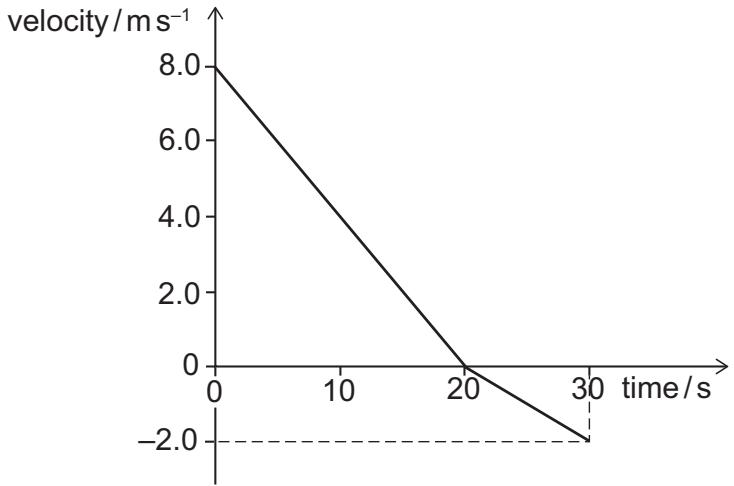
What total distance did the object travel in the 30s, how far from its starting position was it at the end of the 30s, and what was its average speed over the 30 s?
What total distance did the object travel in the 30s, how far from its starting position was it at the end of the 30s, and what was its average speed over the 30 s?
- A.total distance travelled / m: 90, distance from starting position / m: 70, average speed / ms⁻¹: 3.0
- B.total distance travelled / m: 90, distance from starting position / m: 70, average speed / ms⁻¹: 5.0
- C.total distance travelled / m: 90, distance from starting position / m: 90, average speed / ms⁻¹: 3.0
- D.total distance travelled / m: 90, distance from starting position / m: 90, average speed / ms⁻¹: 5.0
- E.total distance travelled / m: 180, distance from starting position / m: 140, average speed / ms⁻¹: 5.0
- F.total distance travelled / m: 180, distance from starting position / m: 140, average speed / ms⁻¹: 6.0
- G.total distance travelled / m: 180, distance from starting position / m: 180, average speed / ms⁻¹: 5.0
- H.total distance travelled / m: 180, distance from starting position / m: 180, average speed / ms⁻¹: 6.0
Answer: A
Question 33
A sample of a radioactive isotope X decays to one other radioactive isotope Y. Y has a half-life that is double that of X. Initially only X is present.
Which graph could represent how the numbers of nuclei of X and Y that are present in the sample vary with time?
(All graphs cover the same period of time.)
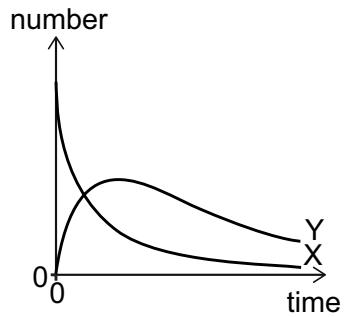
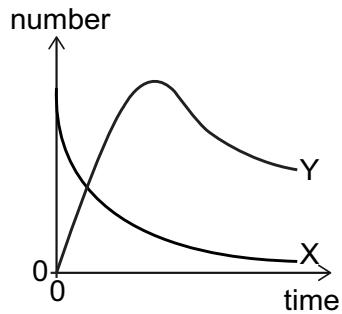
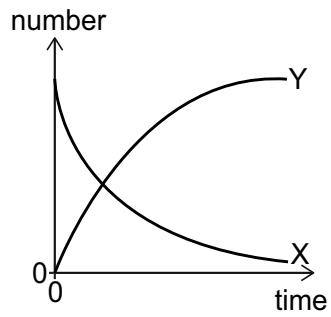
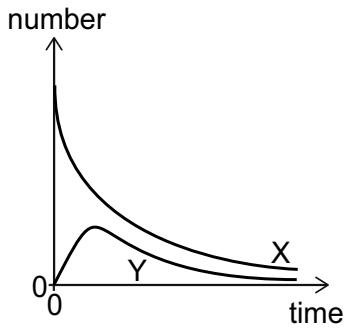
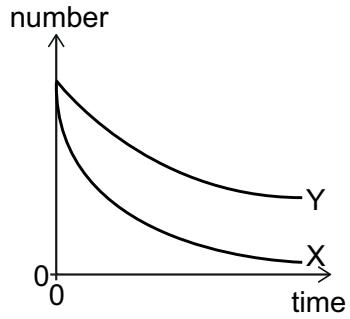
Which graph could represent how the numbers of nuclei of X and Y that are present in the sample vary with time?
(All graphs cover the same period of time.)
- A.Graph A
- B.Graph B
- C.Graph C
- D.Graph D
- E.Graph E
Answer: A
Question 34
Bronze is a mixture of tin and copper.
A particular sample of bronze contains 10% tin by volume. (In other words, 10% of the total volume of the sample is tin and 90% of it is copper.)
What percentage of the mass of the sample is tin?
(Density of tin = and density of copper = .)
A particular sample of bronze contains 10% tin by volume. (In other words, 10% of the total volume of the sample is tin and 90% of it is copper.)
What percentage of the mass of the sample is tin?
(Density of tin = and density of copper = .)
- A.
- B.
- C.
- D.
- E.
- F.
- G.
- H.
Answer: G
Question 35
When a stationary uranium-238 nucleus decays by alpha emission it forms a nucleus of thorium-234. The total kinetic energy produced by the decay is .
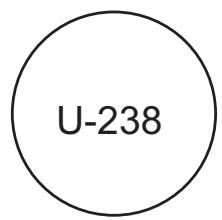
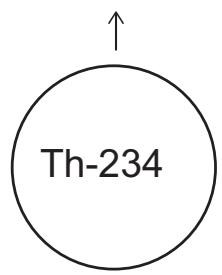
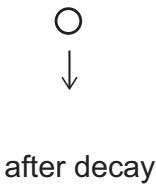
What is the kinetic energy of the alpha particle?
What is the kinetic energy of the alpha particle?
- A.
- B.
- C.
- D.
- E.
Answer: D
Question 36
A student carries out an experiment to measure the speed of sound. A loudspeaker that emits sound in all directions is placed between two buildings that are 128 m apart as shown. The student and loudspeaker are 48 m from one of the buildings.
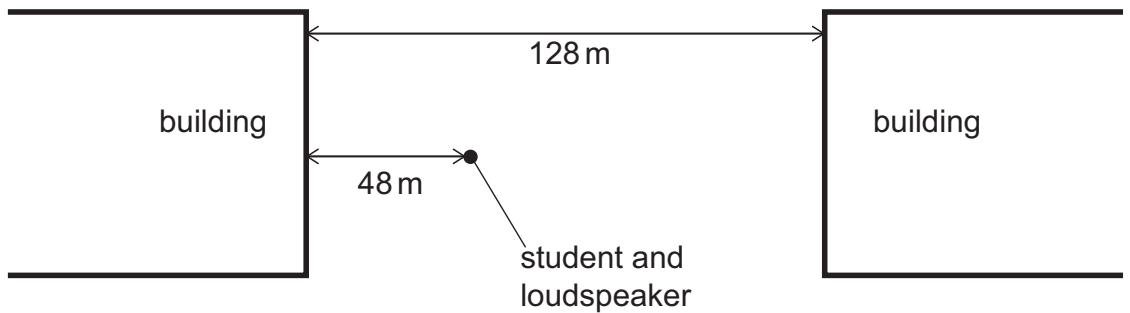
The loudspeaker is connected to a signal generator that causes it to emit regular clicks. The rate at which the clicks are produced is gradually increased from zero until each echo coincides with a new click being emitted by the loudspeaker.
What is the frequency of emission of clicks when this happens?
(The speed of sound in air = .)
The loudspeaker is connected to a signal generator that causes it to emit regular clicks. The rate at which the clicks are produced is gradually increased from zero until each echo coincides with a new click being emitted by the loudspeaker.
What is the frequency of emission of clicks when this happens?
(The speed of sound in air = .)
- A.2.0 Hz
- B.2.5 Hz
- C.3.3 Hz
- D.4.0 Hz
- E.5.3 Hz
- F.6.7 Hz
- G.10 Hz
Answer: G