NSAA 2016 Physics S1
18 questions18 marksUpdated June 2026
The NSAA 2016 Physics S1 paper in full: all 18 questions, each with its answer. NSAA is the Natural Sciences Admissions Assessment. Sit it cold under exam timing, mark it, then work back through anything you missed using the solutions below.
Download the original PDF →Questions and answers are free. Full step-by-step worked solutions unlock with a free account. Start practising.
Question 19
Shortly after opening her parachute, a free-fall parachutist of mass 60 kg (including equipment) experiences the forces shown in the diagram.
drag (air resistance) = 900 N
[diagram not to scale]
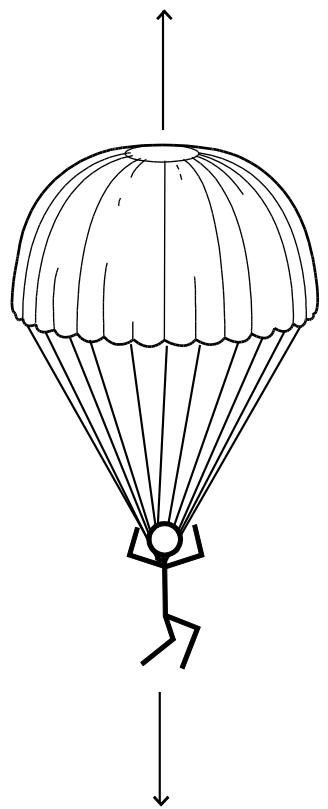
weight = 600 N
Which line in the table gives the size and direction of the acceleration of the parachutist at this instant?
drag (air resistance) = 900 N
[diagram not to scale]
weight = 600 N
Which line in the table gives the size and direction of the acceleration of the parachutist at this instant?
- A.size of acceleration/: 5.0, direction of acceleration: downwards
- B.size of acceleration/: 10.0, direction of acceleration: downwards
- C.size of acceleration/: 5.0, direction of acceleration: upwards
- D.size of acceleration/: 10.0, direction of acceleration: upwards
- E.size of acceleration/: 0.0, direction of acceleration: -
Answer: C
Question 20
The displacement/time graph shown represents a wave of wavelength 1.5 cm.
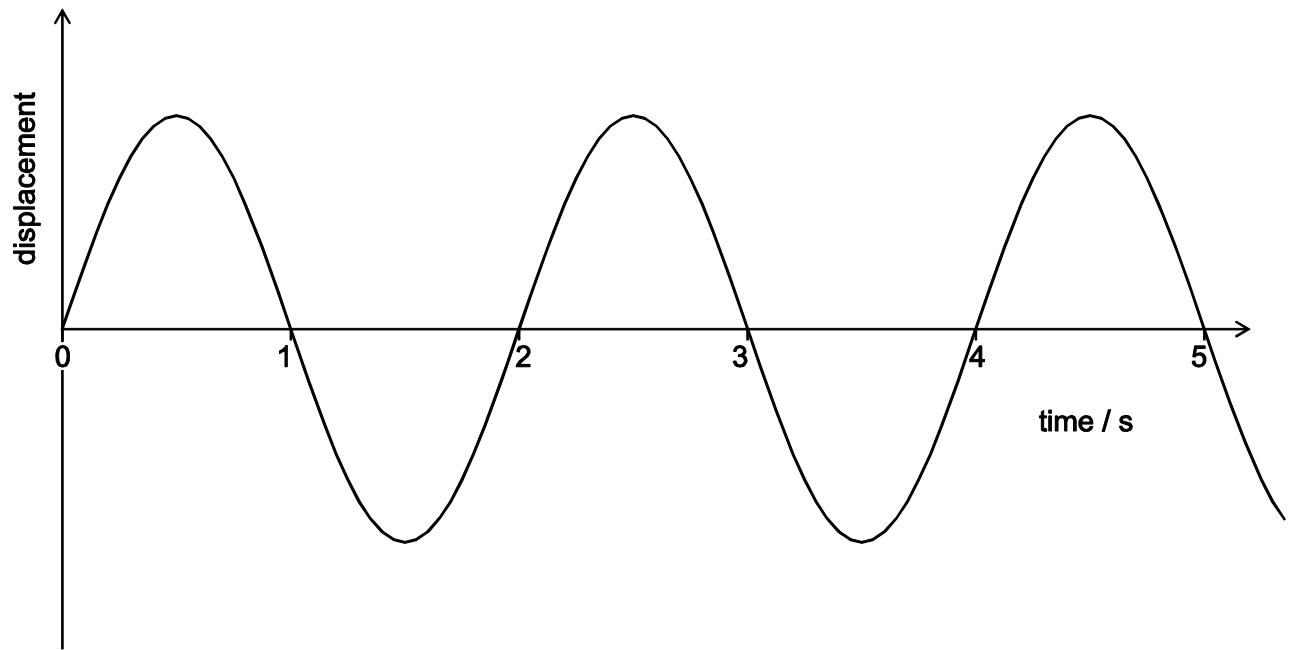
What is the speed of the wave?
What is the speed of the wave?
- A.0.33
- B.0.67
- C.0.75
- D.1.33
- E.1.5
- F.3.0
Answer: C
Question 21
A point mass travelling at a constant speed has a momentum of 30 Ns and a kinetic energy of 150 J.
What is the mass of the object?
What is the mass of the object?
- A.2 kg
- B.3 kg
- C.5 kg
- D.6 kg
- E.10 kg
- F.15 kg
Answer: B
Question 22
Which of the following is a correct unit of potential difference (voltage)?
- A.amp per ohm
- B.coulomb per joule
- C.joule per second
- D.newton per coulomb
- E.watt per amp
Answer: E
Question 23
Two radioactive sources X and Y have half-lives of 4.8 hours and 8.0 hours respectively. Both decay directly to form only stable isotopes.
The activity of a sample of the source X is 320 Bq, and the activity of a sample of the source Y is 480 Bq. The two samples are now combined.
What is the activity of the combination of X and Y 24 hours later?
(An activity of 1 Bq is 1 decay per second.)
The activity of a sample of the source X is 320 Bq, and the activity of a sample of the source Y is 480 Bq. The two samples are now combined.
What is the activity of the combination of X and Y 24 hours later?
(An activity of 1 Bq is 1 decay per second.)
- A.25 Bq
- B.50 Bq
- C.55 Bq
- D.70 Bq
- E.100 Bq
- F.140 Bq
Answer: D
Question 24
An object of mass 5.0 kg falls from rest and hits the ground at a speed of 20 . Air resistance is negligible.
From what height has the object fallen?
(gravitational field strength = 10 )
From what height has the object fallen?
(gravitational field strength = 10 )
- A.10 m
- B.20 m
- C.50 m
- D.100 m
- E.200 m
- F.1000 m
Answer: B
Question 25
A cyclist and a bike have a combined mass of 100 kg. The cyclist free-wheels (rolls without pedalling) at a constant speed of 0.80 down a slope where the cyclist descends 1.0 m for each 10 m travelled along the road, as shown in the diagram.
[diagram not to scale]
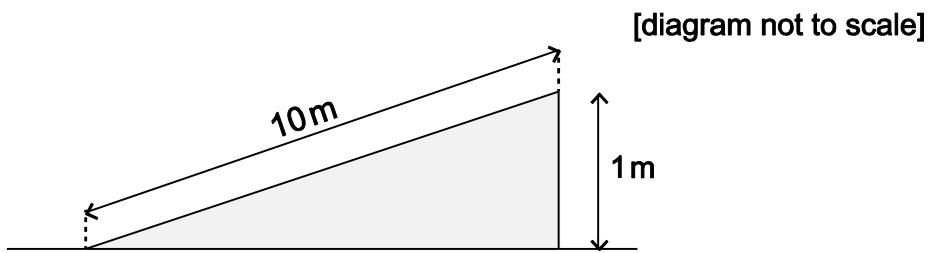
Calculate the loss in gravitational potential energy as the cyclist loses 100 m in vertical height and hence calculate the total resistive force on the cyclist and bike.
(gravitational field strength = 10 )
[diagram not to scale]
Calculate the loss in gravitational potential energy as the cyclist loses 100 m in vertical height and hence calculate the total resistive force on the cyclist and bike.
(gravitational field strength = 10 )
- A.loss in gravitational potential energy/J: 3200, resistive force/N:
- B.loss in gravitational potential energy/J: 3200, resistive force/N: 3.2
- C.loss in gravitational potential energy/J: 3200, resistive force/N:
- D.loss in gravitational potential energy/J: 100 000, resistive force/N:
- E.loss in gravitational potential energy/J: 100 000, resistive force/N: 100
- F.loss in gravitational potential energy/J: 100 000, resistive force/N:
Answer: E
Question 26
An electric motor is used to lift a load of 3.0 kg from rest through a height of 5.0 m in a time of 1.5 s. At the end of the lift the load is at rest again. The motor is connected to a 25 V d.c. supply.
Assuming that the system is 100% efficient, what is the average current in the motor during the lift?
(gravitational field strength = 10 )
Assuming that the system is 100% efficient, what is the average current in the motor during the lift?
(gravitational field strength = 10 )
- A.0.40 A
- B.0.60 A
- C.0.80 A
- D.4.0 A
- E.9.0 A
Answer: D
Question 27
A ball is thrown vertically upwards and leaves the thrower's hand with a speed of 12 . You may assume that all of the initial kinetic energy of the ball has been converted into gravitational potential energy when the ball reaches its highest point.
What is the height above the thrower's hand to which it rises?
(gravitational field strength = 10 )
What is the height above the thrower's hand to which it rises?
(gravitational field strength = 10 )
- A.7.2 m
- B.14.4 m
- C.24 m
- D.60 m
- E.120 m
Answer: A
Question 28
A lorry of mass , and travelling initially at speed along a horizontal road, is brought to rest by an average horizontal braking force in time .
Ignoring any other resistive forces, what distance is travelled by the lorry during this time?
(gravitational field strength = 10 )
Ignoring any other resistive forces, what distance is travelled by the lorry during this time?
(gravitational field strength = 10 )
- A.
- B.
- C.
- D.
- E.
- F.
Answer: C
Question 29
Nuclide is an unstable isotope which decays in two stages into nuclide Z as shown:
What are the values of and ?
(Consider only alpha and beta decays.)
What are the values of and ?
(Consider only alpha and beta decays.)
- A.,
- B.,
- C.,
- D.,
- E.,
- F.,
Answer: B
Question 30
A pulse of frequency 100 kHz is emitted from an ultrasound scanner, and is reflected from a foetus 10 cm below the transmitter placed on the mother's abdomen. The speed of sound within the mother's body is 500 .
How long after its emission from the scanner does it take for the pulse to reach the receiver which is adjacent to the transmitter?
How long after its emission from the scanner does it take for the pulse to reach the receiver which is adjacent to the transmitter?
- A.0.20 ms
- B.0.40 ms
- C.0.50 ms
- D.0.80 ms
- E.1.0 ms
Answer: B
Question 31
The diagrams below show either velocity-time or distance-time graphs for four different objects, P, Q, R and S.
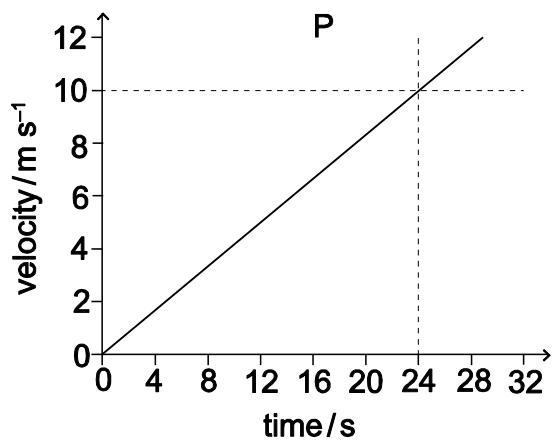
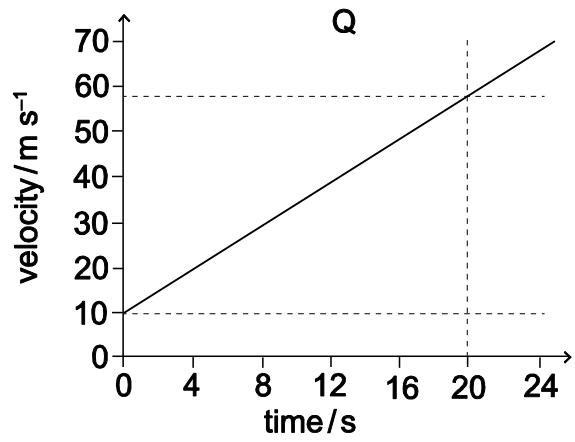
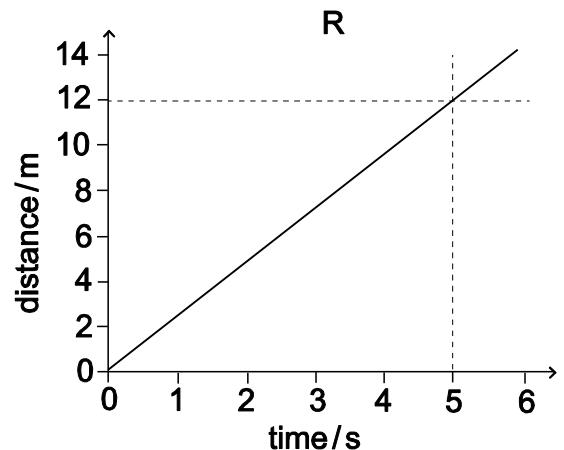
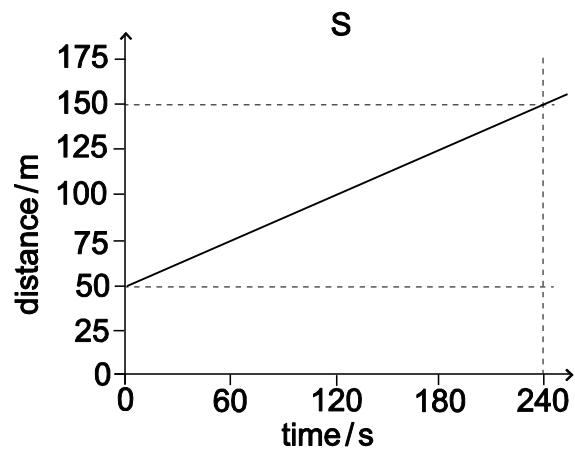
Which graph(s) show an object accelerating at 2.4 ?
Which graph(s) show an object accelerating at 2.4 ?
- A.P only
- B.Q only
- C.R only
- D.S only
- E.P and Q only
- F.Q and R only
- G.P and S only
Answer: B
Question 32
Consider this graph.
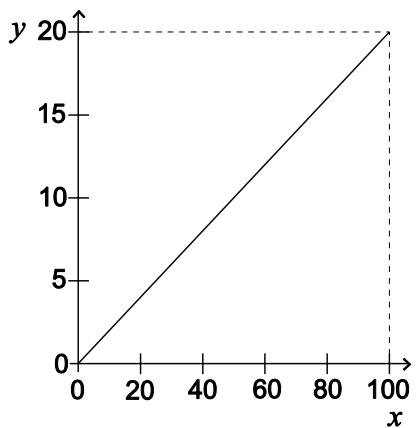
Which one of the following could the graph not represent if all quantities are in SI units?
Which one of the following could the graph not represent if all quantities are in SI units?
- A.The variation of the acceleration (y-axis) of a body of mass 5.0 kg with the resultant force acting on the body (x-axis).
- B.The variation of the current (y-axis) through a 5.0 resistor with the applied voltage (x-axis).
- C.The variation of the kinetic energy (y-axis) of a body of mass 0.4 kg with the square of its speed (x-axis).
- D.The variation of the wavelength (y-axis) of waves with a speed of 0.2 with their frequency (x-axis).
- E.The variation of the work done (y-axis) by a force of 0.2 N with the distance it moves through in the direction of the force (x-axis).
Answer: D
Question 33
Which one of the following statements about nuclear physics is true?
- A.The process of emission of a gamma ray from a nucleus is called nuclear fission.
- B.The half-life of a radioactive substance is half the time taken for its nuclei to decay.
- C.The number of neutrons in a nucleus is its atomic number (proton number) minus its mass number.
- D.When a nucleus emits a beta particle, there is no change in the number of particles it contains.
- E.When a nucleus emits an alpha particle, one of its neutrons becomes a proton plus an electron.
Answer: D
Question 34
Two resistors with resistance ohms and ohms are connected in series with a battery that has a voltage across its terminals.
Which formula gives the power dissipated by the resistor with resistance ohms?
Which formula gives the power dissipated by the resistor with resistance ohms?
- A.
- B.
- C.
- D.
- E.
- F.
Answer: D
Question 35
The graph represents the motion of a vehicle during part of a journey.
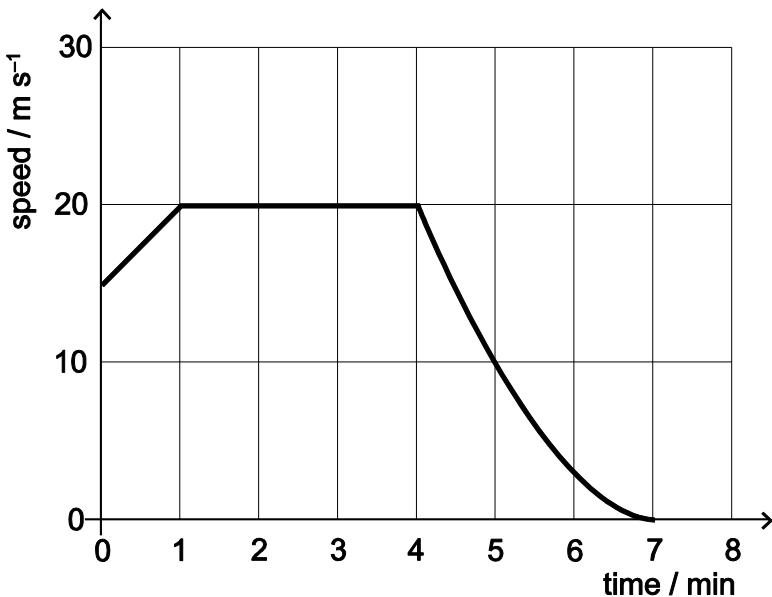
What is the best estimate of the distance travelled during the part of the journey shown?
What is the best estimate of the distance travelled during the part of the journey shown?
- A.100.00 m
- B.107.50 m
- C.115.00 m
- D.6.00 km
- E.6.45 km
- F.6.90 km
Answer: D
Question 36
A sound wave is produced by a loudspeaker cone, which creates pulses of pressure by moving back and forth between two points X and Y as shown in the diagram.
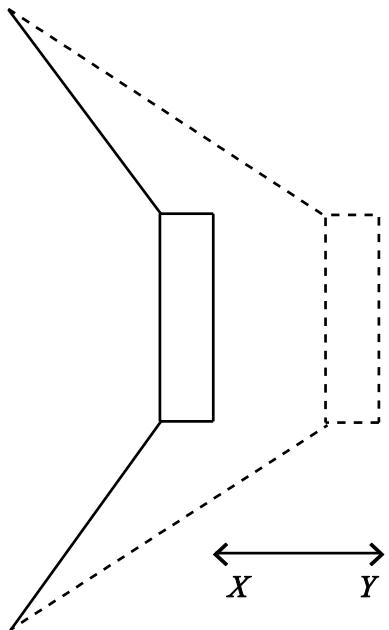
[diagram not to scale]
The distance between points X and Y is 5.0 mm and the loudspeaker produces pulses of high pressure every 0.20 milliseconds.
The following statements about the sound wave produced are made:
P It has a speed of 25 .
Q It has an amplitude of 5.0 mm.
R It has a wavelength of 5.5 mm.
S It has a frequency of 5.0 kHz.
Which of these statements can be correctly deduced from the information given?
[diagram not to scale]
The distance between points X and Y is 5.0 mm and the loudspeaker produces pulses of high pressure every 0.20 milliseconds.
The following statements about the sound wave produced are made:
P It has a speed of 25 .
Q It has an amplitude of 5.0 mm.
R It has a wavelength of 5.5 mm.
S It has a frequency of 5.0 kHz.
Which of these statements can be correctly deduced from the information given?
- A.P only
- B.S only
- C.P and Q only
- D.P and R only
- E.Q and S only
- F.R and S only
- G.P, R and S only
Answer: B