NSAA 2017 Chemistry D568/11C
18 questions18 marks27Updated October 2025
The NSAA 2017 Chemistry D568/11C paper in full: all 18 questions, each with its answer. NSAA is the Natural Sciences Admissions Assessment. Sit it cold under exam timing, mark it, then work back through anything you missed using the solutions below.
Download the original PDF →Questions and answers are free. Full step-by-step worked solutions unlock with a free account. Start practising.
Question 37
Consider the atoms/ions below:
Which of the following statements is/are correct?
1 Both and have the same electronic configuration.
2 has double the number of neutrons that are in .
3 The sum of the numbers of electrons in and is equal to the number of electrons in .
Which of the following statements is/are correct?
1 Both and have the same electronic configuration.
2 has double the number of neutrons that are in .
3 The sum of the numbers of electrons in and is equal to the number of electrons in .
- A.none of them
- B.1 only
- C.2 only
- D.3 only
- E.1 and 2 only
- F.1 and 3 only
- G.2 and 3 only
- H.1, 2 and 3
Answer: F
Question 38
Which two of the following reactions involve oxidation?
1
2
3
4
1
2
3
4
- A.1 and 2 only
- B.1 and 3 only
- C.1 and 4 only
- D.2 and 3 only
- E.2 and 4 only
- F.3 and 4 only
Answer: B
Question 39
Hydrochloric acid (HCl) is a strong acid. Properties of a solution of 1.00 mol dm hydrochloric acid include:
1 It turns blue litmus indicator red.
2 On reaction with sodium carbonate gaseous carbon dioxide is evolved.
3 25.0 cm³ of this acid solution neutralises 25.0 cm³ of 1.00 mol dm sodium hydroxide solution.
Ethanoic acid (CHCOOH) is a weak acid.
Which of the three properties is/are also correct for a 1.00 mol dm solution of ethanoic acid?
1 It turns blue litmus indicator red.
2 On reaction with sodium carbonate gaseous carbon dioxide is evolved.
3 25.0 cm³ of this acid solution neutralises 25.0 cm³ of 1.00 mol dm sodium hydroxide solution.
Ethanoic acid (CHCOOH) is a weak acid.
Which of the three properties is/are also correct for a 1.00 mol dm solution of ethanoic acid?
- A.none of them
- B.1 only
- C.2 only
- D.3 only
- E.1 and 2 only
- F.1 and 3 only
- G.2 and 3 only
- H.1, 2 and 3
Answer: H
Question 40
Consider the following reactions:
Reaction Q: is - ve
Reaction R: is + ve
The following actions could be applied independently to each reaction (Q and R) above:
1 increase the pressure
2 increase the temperature
3 use a suitable catalyst
Assuming that all other conditions remain constant, which of these actions will increase the initial rate of reaction and increase the yield of products for both reactions Q and R?
Reaction Q: is - ve
Reaction R: is + ve
The following actions could be applied independently to each reaction (Q and R) above:
1 increase the pressure
2 increase the temperature
3 use a suitable catalyst
Assuming that all other conditions remain constant, which of these actions will increase the initial rate of reaction and increase the yield of products for both reactions Q and R?
- A.none of them
- B.1 only
- C.1 or 2 only
- D.1 or 3 only
- E.2 only
- F.2 or 3 only
- G.3 only
- H.1, 2 or 3
Answer: A
Question 41
Study the chromatogram below showing the spots obtained, labelled (i) to (v), from two sweets and pure samples of the food additives, labelled Q, R and S.
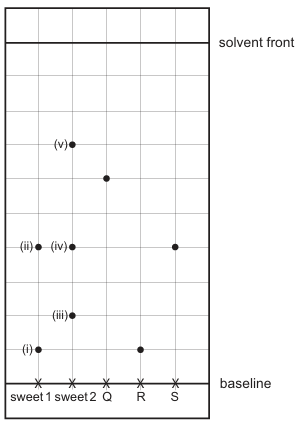
Which of the following statements about the chromatogram is/are correct?
1 Both sweet 1 and 2 contain additives R and S.
2 The value for spot (iv) is half that for spot (iii).
3 The value for spot (v) is 0.7.
Which of the following statements about the chromatogram is/are correct?
1 Both sweet 1 and 2 contain additives R and S.
2 The value for spot (iv) is half that for spot (iii).
3 The value for spot (v) is 0.7.
- A.none of them
- B.1 only
- C.2 only
- D.3 only
- E.1 and 2 only
- F.1 and 3 only
- G.2 and 3 only
- H.1, 2 and 3
Answer: D
Question 42
Element X has atomic number 20. Consider only the simple oxide of X.
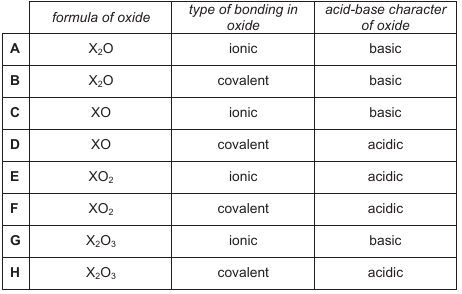
Which of the following options identifies the formula, the type of bonding and the acid-base character of the oxide of element X?
Which of the following options identifies the formula, the type of bonding and the acid-base character of the oxide of element X?
- A.formula of oxide: XO, type of bonding in oxide: ionic, acid-base character of oxide: basic
- B.formula of oxide: XO, type of bonding in oxide: covalent, acid-base character of oxide: basic
- C.formula of oxide: XO, type of bonding in oxide: ionic, acid-base character of oxide: basic
- D.formula of oxide: XO, type of bonding in oxide: covalent, acid-base character of oxide: acidic
- E.formula of oxide: XO, type of bonding in oxide: ionic, acid-base character of oxide: acidic
- F.formula of oxide: XO, type of bonding in oxide: covalent, acid-base character of oxide: acidic
- G.formula of oxide: XO, type of bonding in oxide: ionic, acid-base character of oxide: basic
- H.formula of oxide: XO, type of bonding in oxide: covalent, acid-base character of oxide: acidic
Answer: C
Question 43
Solid copper(II) chloride contains Cu ions and Cl ions only.
Solid lithium phosphate(V) contains Li ions and PO ions only.
Aqueous solutions of copper(II) chloride and lithium phosphate(V) are mixed to produce a precipitate of copper(II) phosphate(V) and an aqueous solution of lithium chloride.
Which of the following represents the balanced ionic equation for this process?
Solid lithium phosphate(V) contains Li ions and PO ions only.
Aqueous solutions of copper(II) chloride and lithium phosphate(V) are mixed to produce a precipitate of copper(II) phosphate(V) and an aqueous solution of lithium chloride.
Which of the following represents the balanced ionic equation for this process?
- A.
- B.
- C.
- D.
- E.
- F.
Answer: D
Question 44
Which of the following statements about the reaction of lithium with water are correct?
1 The reaction is a redox reaction.
2 7 g of lithium will react with excess water to produce 2 g of hydrogen gas.
3 The reaction produces a solution with a pH greater than that of water.
4 14 g of lithium will exactly react with 36 g of water.
(A values: H = 1; Li = 7; O = 16)
1 The reaction is a redox reaction.
2 7 g of lithium will react with excess water to produce 2 g of hydrogen gas.
3 The reaction produces a solution with a pH greater than that of water.
4 14 g of lithium will exactly react with 36 g of water.
(A values: H = 1; Li = 7; O = 16)
- A.1 and 2 only
- B.1 and 4 only
- C.1, 2 and 3 only
- D.1, 3 and 4 only
- E.2 and 3 only
- F.3 and 4 only
Answer: D
Question 45
Consider this electrochemical cell containing an aqueous copper(II) chloride electrolyte:
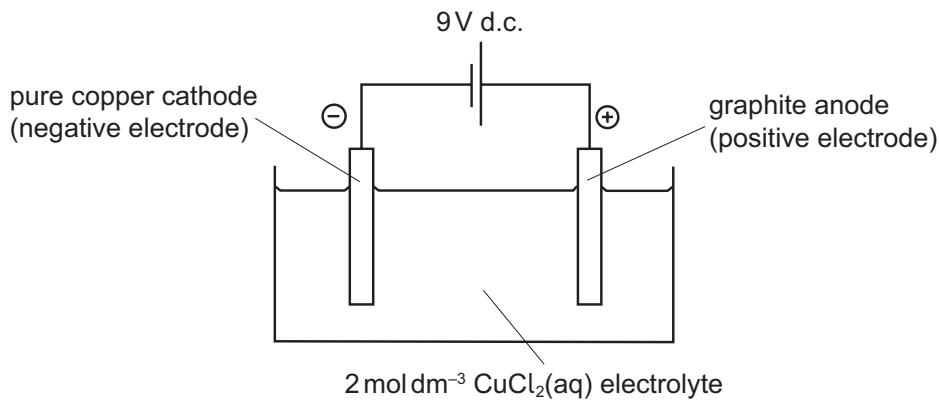
Which row in the following table identifies the reactions occurring at the electrodes?
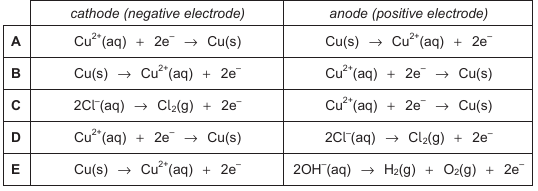
Which row in the following table identifies the reactions occurring at the electrodes?
- A.cathode (negative electrode): ; anode (positive electrode):
- B.cathode (negative electrode): ; anode (positive electrode):
- C.cathode (negative electrode): ; anode (positive electrode):
- D.cathode (negative electrode): ; anode (positive electrode):
- E.cathode (negative electrode): ; anode (positive electrode):
Answer: D
Question 46
A fluorocarbon has a relative molecular mass which is twice that of its empirical formula mass.
81 g of the compound contains 57 g of fluorine.
What is the molecular formula of the compound?
(A values: C=12; F=19)
81 g of the compound contains 57 g of fluorine.
What is the molecular formula of the compound?
(A values: C=12; F=19)
- A.CF
- B.CF
- C.CF
- D.CF
- E.CF
- F.CF
Answer: E
Question 47
In which of the following reactions is there a change in volume of 24 dm³, when measured at room temperature and pressure?
1 56 g of carbon monoxide completely reacts with an excess of oxygen
2 36 g of steam is fully decomposed
3 30 g of nitrogen monoxide completely reacts with an excess of oxygen
(A values: C = 12; O = 16; H = 1.0; N = 14. Assume that one mole of gas occupies a volume of 24 dm³ at room temperature and pressure.)
1 56 g of carbon monoxide completely reacts with an excess of oxygen
2 36 g of steam is fully decomposed
3 30 g of nitrogen monoxide completely reacts with an excess of oxygen
(A values: C = 12; O = 16; H = 1.0; N = 14. Assume that one mole of gas occupies a volume of 24 dm³ at room temperature and pressure.)
- A.none of them
- B.1 only
- C.2 only
- D.3 only
- E.1 and 2 only
- F.1 and 3 only
- G.2 and 3 only
- H.1, 2 and 3
Answer: E
Question 48
Magnesium reacts with sulfuric acid according to the following chemical equation:
Line P on each graph shows how the volume of hydrogen formed changes with time when 1.2 g of magnesium reacts with 40 cm³ of 1.0 mol dm⁻³ sulfuric acid at 20 °C.
(A value: Mg=24)
Two further experiments were carried out and the volumes of hydrogen formed were plotted.
Experiment Q: 1.2 g of magnesium + 40 cm³ of 2.0 mol dm⁻³ sulfuric acid at 20 °C
Experiment R: 1.2 g of magnesium + 40 cm³ of 0.5 mol dm⁻³ sulfuric acid at 20 °C
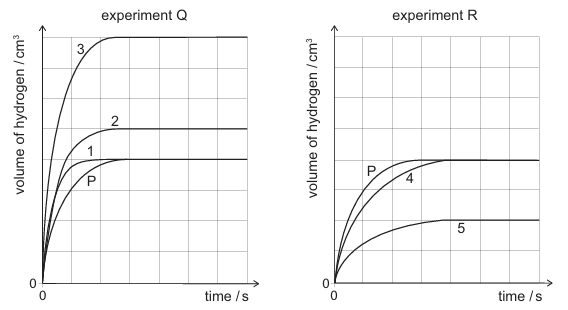
(Image shows two graphs. The left graph is 'experiment Q' and has curves P, 1, 2, 3. The right graph is 'experiment R' and has curves P, 4, 5. Both graphs plot volume of hydrogen vs time.)
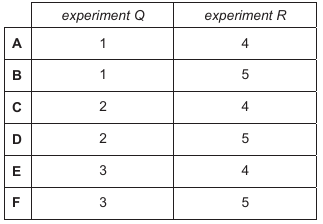
Which lines show how the volume of hydrogen formed will change with time in each experiment?
Line P on each graph shows how the volume of hydrogen formed changes with time when 1.2 g of magnesium reacts with 40 cm³ of 1.0 mol dm⁻³ sulfuric acid at 20 °C.
(A value: Mg=24)
Two further experiments were carried out and the volumes of hydrogen formed were plotted.
Experiment Q: 1.2 g of magnesium + 40 cm³ of 2.0 mol dm⁻³ sulfuric acid at 20 °C
Experiment R: 1.2 g of magnesium + 40 cm³ of 0.5 mol dm⁻³ sulfuric acid at 20 °C
(Image shows two graphs. The left graph is 'experiment Q' and has curves P, 1, 2, 3. The right graph is 'experiment R' and has curves P, 4, 5. Both graphs plot volume of hydrogen vs time.)
Which lines show how the volume of hydrogen formed will change with time in each experiment?
- A.experiment Q: 1, experiment R: 4
- B.experiment Q: 1, experiment R: 5
- C.experiment Q: 2, experiment R: 4
- D.experiment Q: 2, experiment R: 5
- E.experiment Q: 3, experiment R: 4
- F.experiment Q: 3, experiment R: 5
Answer: D
Question 49
Nitrogen and hydrogen react together to form ammonia as shown below:
The energy released by this reaction is 93 kJ mol⁻¹.
What is the bond energy in the nitrogen molecule?
(Bond energies: H-H = 436 kJ mol⁻¹; N-H = 391 kJ mol⁻¹)
The energy released by this reaction is 93 kJ mol⁻¹.
What is the bond energy in the nitrogen molecule?
(Bond energies: H-H = 436 kJ mol⁻¹; N-H = 391 kJ mol⁻¹)
- A.315 kJ mol⁻¹
- B.513 kJ mol⁻¹
- C.644 kJ mol⁻¹
- D.864 kJ mol⁻¹
- E.945 kJ mol⁻¹
- F.1131 kJ mol⁻¹
Answer: E
Question 50
Consider the following two electrolytic processes:
electrolysis of molten lead(II) chloride
electrolysis of brine (sodium chloride solution)
Which of the following statements is/are correct?
1 In both processes, reduction takes place at the negative electrode.
2 If 20.0 g of product is formed at the negative electrode in each process, then both processes produce the same volume of chlorine gas, measured at room temperature and pressure.
3 In both processes, a metal is produced at the negative electrode.
(A values: Cl=35.5; H = 1.00; Na = 23.0; Pb = 207. Assume that one mole of gas occupies 24.0 dm³ at room temperature and pressure.)
electrolysis of molten lead(II) chloride
electrolysis of brine (sodium chloride solution)
Which of the following statements is/are correct?
1 In both processes, reduction takes place at the negative electrode.
2 If 20.0 g of product is formed at the negative electrode in each process, then both processes produce the same volume of chlorine gas, measured at room temperature and pressure.
3 In both processes, a metal is produced at the negative electrode.
(A values: Cl=35.5; H = 1.00; Na = 23.0; Pb = 207. Assume that one mole of gas occupies 24.0 dm³ at room temperature and pressure.)
- A.none of them
- B.1 only
- C.2 only
- D.3 only
- E.1 and 2 only
- F.1 and 3 only
- G.2 and 3 only
- H.1, 2 and 3
Answer: B
Question 51
Silver nitrate solution reacts with zinc powder in an exothermic reaction:
The graph shows the maximum temperature rise as different masses of zinc react with separate 50.0 cm³ samples of 0.100 mol dm⁻³ silver nitrate solution.
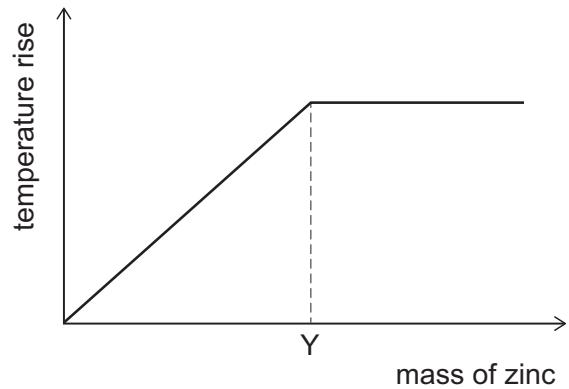
(Image of a graph plotting 'temperature rise' on the y-axis against 'mass of zinc' on the x-axis. The graph starts at the origin, rises linearly to a peak point labelled Y, and then becomes a horizontal line.)
What is the mass of zinc at the position labelled Y?
(A value: Zn = 65)
The graph shows the maximum temperature rise as different masses of zinc react with separate 50.0 cm³ samples of 0.100 mol dm⁻³ silver nitrate solution.
(Image of a graph plotting 'temperature rise' on the y-axis against 'mass of zinc' on the x-axis. The graph starts at the origin, rises linearly to a peak point labelled Y, and then becomes a horizontal line.)
What is the mass of zinc at the position labelled Y?
(A value: Zn = 65)
- A.0.163 g
- B.0.325 g
- C.0.650 g
- D.1.63 g
- E.3.25 g
- F.6.50 g
Answer: A
Question 52
Natural samples of copper contain two isotopes: which has a relative isotopic mass of 62.93, and which has a relative isotopic mass of 64.93.
The relative atomic mass of a sample of elemental copper is 63.55.
What is the percentage abundance of each of the two isotopes to the nearest whole number?
The relative atomic mass of a sample of elemental copper is 63.55.
What is the percentage abundance of each of the two isotopes to the nearest whole number?
- A.27% and 73%
- B.73% and 27%
- C.31% and 69%
- D.69% and 31%
- E.36% and 64%
- F.64% and 36%
Answer: D
Question 53
The reaction between calcium carbonate and hydrochloric acid was used to measure the effect of changing conditions on the mass of CO produced and the rate of CO production.
The experiment was carried out five times with different conditions at a constant temperature.
The following conditions were varied:
CaCO as chips or powder
mass of CaCO
volume of HCl
concentration of HCl
Which experiment (A-E) in the following table will produce 8.8 g of carbon dioxide in the shortest time?
(M values: CaCO = 100; CO=44)
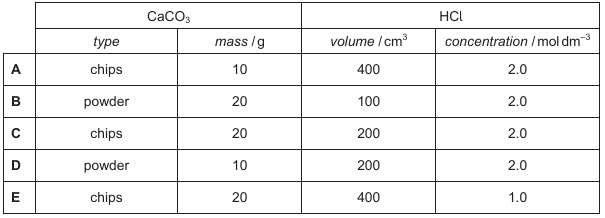
The experiment was carried out five times with different conditions at a constant temperature.
The following conditions were varied:
CaCO as chips or powder
mass of CaCO
volume of HCl
concentration of HCl
Which experiment (A-E) in the following table will produce 8.8 g of carbon dioxide in the shortest time?
(M values: CaCO = 100; CO=44)
- A.CaCO type: chips, mass/g: 10, HCl volume/cm³: 400, concentration/mol dm⁻³: 2.0
- B.CaCO type: powder, mass/g: 20, HCl volume/cm³: 100, concentration/mol dm⁻³: 2.0
- C.CaCO type: chips, mass/g: 20, HCl volume/cm³: 200, concentration/mol dm⁻³: 2.0
- D.CaCO type: powder, mass/g: 10, HCl volume/cm³: 200, concentration/mol dm⁻³: 2.0
- E.CaCO type: chips, mass/g: 20, HCl volume/cm³: 400, concentration/mol dm⁻³: 1.0
Answer: C
Question 54
An atom of has a radius of 0.05 nanometres.
The radius of the nucleus of this atom is approximately 50 000 times smaller.
What is the approximate radius of the nucleus in femtometres?
(1 femtometre = 10 m)
The radius of the nucleus of this atom is approximately 50 000 times smaller.
What is the approximate radius of the nucleus in femtometres?
(1 femtometre = 10 m)
- A.1000
- B.100
- C.10
- D.1
- E.0.1
- F.0.01
Answer: D