Mapped to the ESAT specification
NSAA 2017 Physics Part B
18 questions18 marksUpdated October 2025
Natural Sciences Admissions Assessment 2017 is one of the closest available past papers for the Engineering and Science Admissions Test. Below, all 18 questions are mapped to the ESAT topics they test, each with its answer. Sit it cold under exam timing, then work back through anything you missed using the solutions.
What this paper covers on the ESAT
Every question mapped to the Engineering and Science Admissions Test specification, so you know exactly which areas it tests.
Mathematics 1
- Geometry (1)
Questions and answers are free. Full step-by-step worked solutions unlock with a free account. Start practising.
Question 19
1 markA car is travelling along a horizontal road in a straight line.
The graph is a velocity-time graph for part of the car's journey.
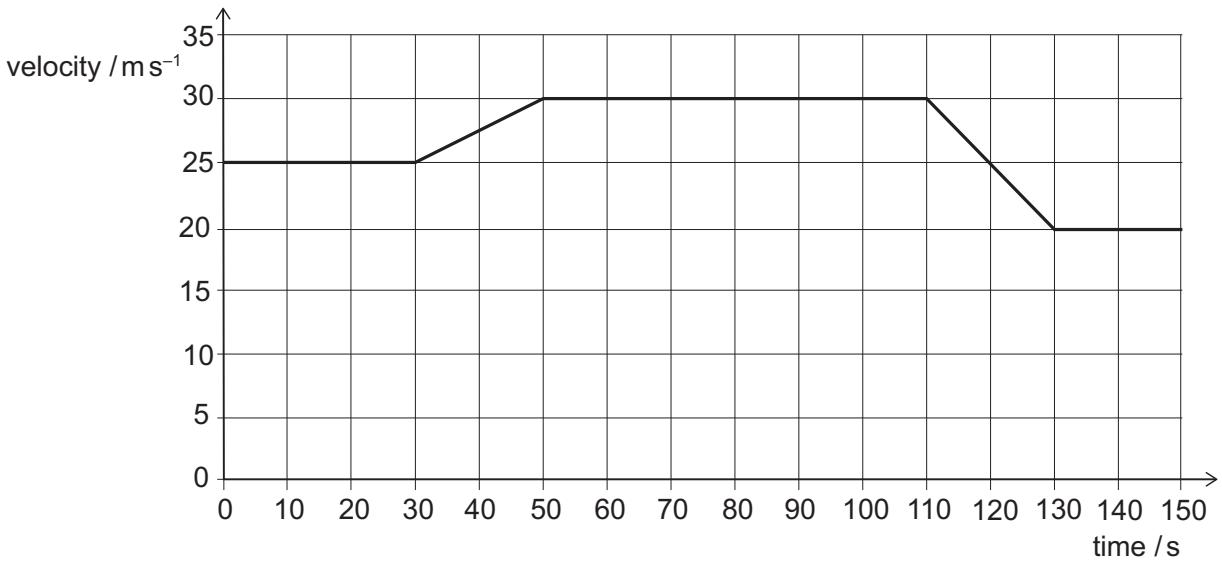
During this part of the journey, what is the total distance that the car travels while it is decelerating?
The graph is a velocity-time graph for part of the car's journey.
During this part of the journey, what is the total distance that the car travels while it is decelerating?
- A.400 m
- B.500 m
- C.550 m
- D.600 m
- E.750 m
- F.1400 m
- G.1800 m
- H.1900 m
Answer: B
Question 20
1 markWhen a saucepan of water is heated from below, convection currents form and transfer heat through the liquid.
Here are three statements about the water as it is heated:
1 The mass of a fixed volume of the water increases.
2 The density of a fixed mass of the water decreases.
3 The volume of a fixed mass of the water increases.
Which of these statements help(s) to explain how convection currents are formed?
Here are three statements about the water as it is heated:
1 The mass of a fixed volume of the water increases.
2 The density of a fixed mass of the water decreases.
3 The volume of a fixed mass of the water increases.
Which of these statements help(s) to explain how convection currents are formed?
- A.none of them
- B.1 only
- C.2 only
- D.3 only
- E.1 and 2 only
- F.1 and 3 only
- G.2 and 3 only
- H.1, 2 and 3
Answer: G
Question 21
1 markTable 1 gives the approximate frequency ranges of sections of the electromagnetic spectrum.

Table 2 gives information about two different types of wave in air.
Waves 1 to 3 are longitudinal waves formed by an object vibrating.
Waves 4 to 6 are electromagnetic waves.
The speed of sound in air is . The speed of light in air is .
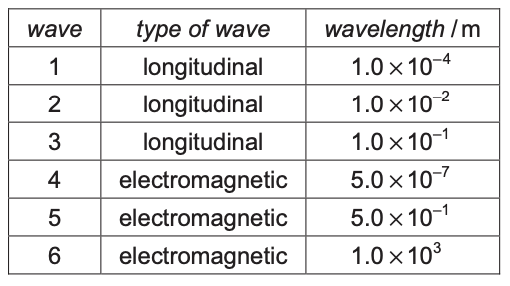
A person detects only two of these waves unaided, using just their eyes and ears.
Which two waves does the person detect?
Table 2 gives information about two different types of wave in air.
Waves 1 to 3 are longitudinal waves formed by an object vibrating.
Waves 4 to 6 are electromagnetic waves.
The speed of sound in air is . The speed of light in air is .
A person detects only two of these waves unaided, using just their eyes and ears.
Which two waves does the person detect?
- A.wave 1 and wave 4
- B.wave 1 and wave 5
- C.wave 2 and wave 5
- D.wave 2 and wave 6
- E.wave 3 and wave 4
- F.wave 3 and wave 6
Answer: E
Question 22
1 markA charge of 60 C passes through an electrical component when a steady voltage of 10 V is applied across it for 30 seconds. The resistance of the component remains constant throughout.
What is the resistance of the component?
What is the resistance of the component?
- A.
- B.
- C.
- D.
- E.
- F.
Answer: E
Question 23
1 markAn electric motor is used to pull a broken-down car slowly from the road up a ramp on to the back of a breakdown truck.
The car has a mass of 1200 kg and is lifted through a vertical height of 1.0 m.
The total input energy to the motor is 28 kJ and it is 75% efficient.
In the process of lifting the car, energy is lost to the surroundings from the motor and from other causes.
What is the total energy lost to the surroundings?
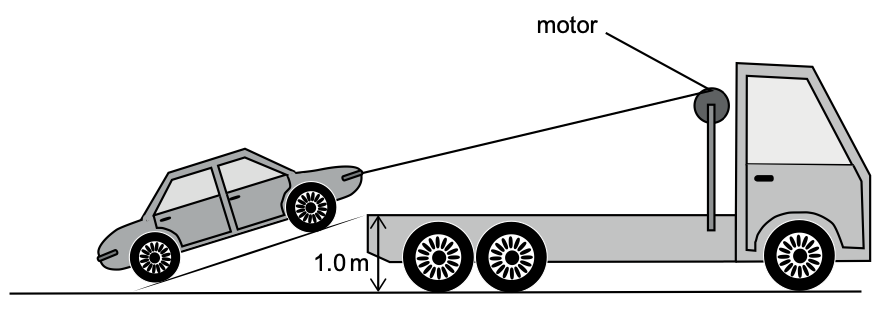
(gravitational field strength = )
The car has a mass of 1200 kg and is lifted through a vertical height of 1.0 m.
The total input energy to the motor is 28 kJ and it is 75% efficient.
In the process of lifting the car, energy is lost to the surroundings from the motor and from other causes.
What is the total energy lost to the surroundings?
(gravitational field strength = )
- A.7.0 kJ
- B.9.0 kJ
- C.12 kJ
- D.16 kJ
- E.21 kJ
- F.33 kJ
Answer: D
Question 24
1 markIn one type of medical scanner a source is placed inside a patient's body. This source causes pairs of gamma-rays to be emitted simultaneously in opposite directions.
Detectors on each side of the patient are used to detect the gamma-rays. The distance between the two detectors is 3.0 m. When the source is at Q, half-way between the detectors, the two gamma-rays arrive at the same time.
In a particular scan the gamma-rays arrive at the two detectors with a time difference of s.
Assume that, inside the patient, the gamma-rays travel at a speed of .
How far from Q, half-way between the detectors, is the gamma-ray source?
Detectors on each side of the patient are used to detect the gamma-rays. The distance between the two detectors is 3.0 m. When the source is at Q, half-way between the detectors, the two gamma-rays arrive at the same time.
In a particular scan the gamma-rays arrive at the two detectors with a time difference of s.
Assume that, inside the patient, the gamma-rays travel at a speed of .
How far from Q, half-way between the detectors, is the gamma-ray source?
- A.6.0 mm
- B.12 mm
- C.24 mm
- D.6.0 cm
- E.12 cm
- F.24 cm
Answer: D
Question 25
1 markWhen a plutonium-239 nucleus absorbs a neutron it undergoes nuclear fission. One particular fission reaction results in the creation of xenon and zirconium as daughter nuclei. The nuclear equation for this reaction is shown but with some non-zero integers replaced by the letters w, x, y and z.
Which equation is correct?
Which equation is correct?
- A.
- B.
- C.
- D.
- E.
- F.
Answer: B
Question 26
1 markAn electric motor is connected to a constant 12 V d.c. supply. The motor is used to lift a mass of 20 kg by means of a rope and pulley. The mass is lifted vertically through a height of 6.0 m in a time of 5.0 s. The complete lifting system (motor, rope and pulley) is 80% efficient.
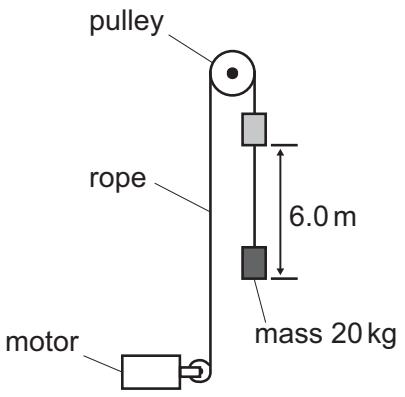
What is the current in the electric motor?
(gravitational field strength = )
What is the current in the electric motor?
(gravitational field strength = )
- A.1.6 A
- B.2.0 A
- C.2.5 A
- D.16 A
- E.20 A
- F.25 A
Answer: F
Question 27
1 markThe nuclide decays to the stable nuclide Y. During this process four particles are emitted: an -particle and three particles.
Which of the following is not a nuclide that could be formed at any stage during this process?
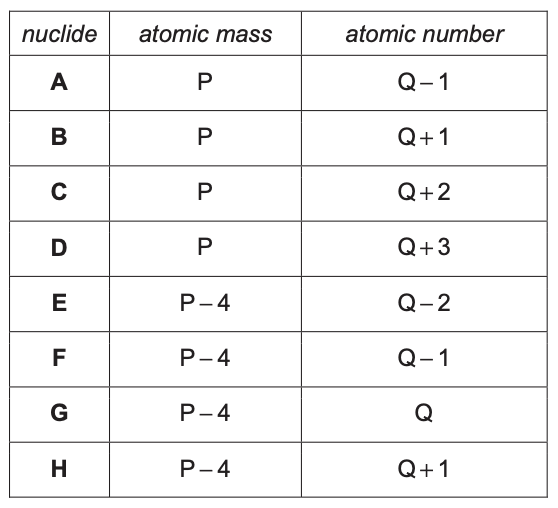
Which of the following is not a nuclide that could be formed at any stage during this process?
- A.P, Q-1
- B.P, Q+1
- C.P, Q+2
- D.P, Q+3
- E.P-4, Q-2
- F.P-4, Q-1
- G.P-4, Q
- H.P-4, Q+1
Answer: A
Question 28
1 markThe radius of an iron-56 atom is times greater than the radius of an iron-56 nucleus.
What is the value of ?
What is the value of ?
- A.
- B.
- C.
- D.
- E.
- F.
Answer: A
Question 29
1 markGraph 1 shows how the displacement of one of the particles of a medium varies with time in seconds as a wave travels through the medium.
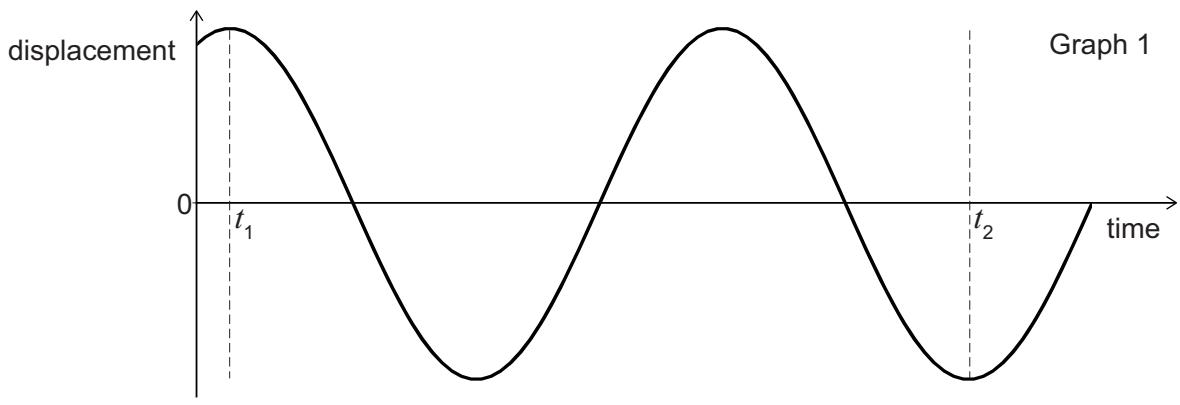
Graph 2 shows how the displacement varies with distance in metres at one time for the same wave.
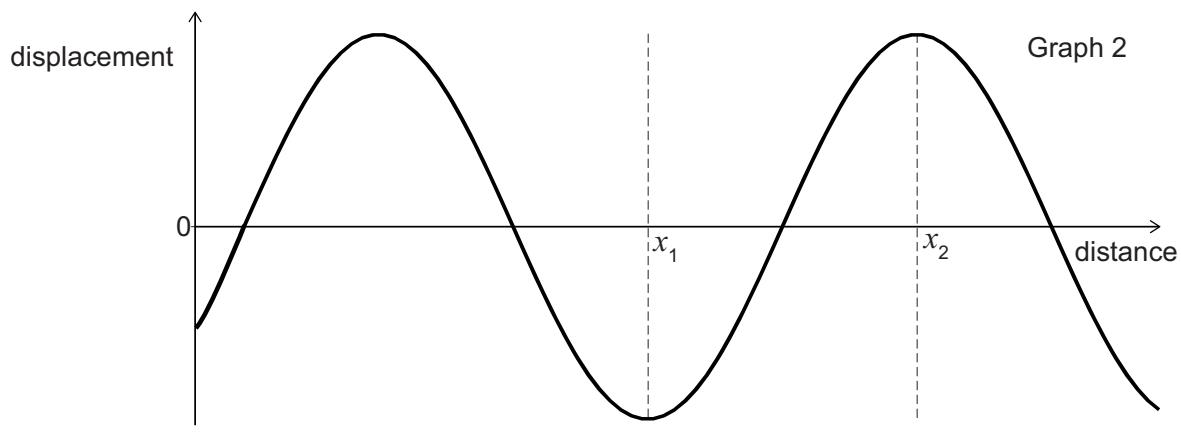
Which expression gives the speed in of the wave?
Graph 2 shows how the displacement varies with distance in metres at one time for the same wave.
Which expression gives the speed in of the wave?
- A.
- B.
- C.
- D.
- E.
- F.
Answer: E
Question 30
1 markA kettle is designed to work from a car's power socket. The kettle has a power rating of 150 W when a constant voltage of 12.0 V d.c. is applied across its element.
How much charge passes through the element of this kettle when the voltage of 12.0 V is applied across it for 20 minutes?
How much charge passes through the element of this kettle when the voltage of 12.0 V is applied across it for 20 minutes?
- A.96 C
- B.250 C
- C.15 000 C
- D.36 000 C
- E.900 000 C
- F.2 160 000 C
Answer: C
Question 31
1 markA freight train travelling on a straight horizontal track at collides with a passenger train travelling at in the opposite direction. Both trains immediately come to a complete stop on the track.
The freight train has three locomotives of 130 tonnes each and seven container wagons of 30 tonnes each. The passenger train has two locomotives of 70 tonnes each and a number of passenger carriages of 10 tonnes each.
How many passenger carriages does the passenger train have?
The freight train has three locomotives of 130 tonnes each and seven container wagons of 30 tonnes each. The passenger train has two locomotives of 70 tonnes each and a number of passenger carriages of 10 tonnes each.
How many passenger carriages does the passenger train have?
- A.7
- B.9
- C.10
- D.24
- E.46
Answer: C
Question 32
1 markConsider the following four calculations:
1
2
3
4
Which two calculations result in the answer 40 kg?
1
2
3
4
Which two calculations result in the answer 40 kg?
- A.1 and 2
- B.1 and 3
- C.1 and 4
- D.2 and 3
- E.2 and 4
- F.3 and 4
Answer: C
Question 33
1 markConsider the following three statements about a parachutist of mass 72 kg falling vertically at a constant velocity of after the parachute has opened:
1 The parachutist has a constant kinetic energy of 1800 J.
2 The parachutist is losing gravitational potential energy at a rate of .
3 Air resistance and the force of gravity acting on the parachutist are a Newton's third law pair of forces.
Which of the statements is/are correct?
(gravitational field strength = )
1 The parachutist has a constant kinetic energy of 1800 J.
2 The parachutist is losing gravitational potential energy at a rate of .
3 Air resistance and the force of gravity acting on the parachutist are a Newton's third law pair of forces.
Which of the statements is/are correct?
(gravitational field strength = )
- A.none of them
- B.1 only
- C.2 only
- D.3 only
- E.1 and 2 only
- F.1 and 3 only
- G.2 and 3 only
- H.1, 2 and 3
Answer: C
Question 34
1 markTwo radioactive sources X and Y have half-lives of 3.0 hours and 2.0 hours respectively. The product of the decay of both of the sources is a stable isotope of the element Z.
Six hours ago a mixture contained the same number of atoms of both X and Y, and no other atoms.
What fraction of the mixture is now made up of atoms of Z?
Six hours ago a mixture contained the same number of atoms of both X and Y, and no other atoms.
What fraction of the mixture is now made up of atoms of Z?
- A.
- B.
- C.
- D.
- E.
- F.
Answer: D
Question 35
1 markCar X passes car Y on a motorway.
Car X is travelling at 1.5 times the speed of car Y.
The mass of car X is of the mass of car Y.
How do the kinetic energies of the two cars compare?
Car X is travelling at 1.5 times the speed of car Y.
The mass of car X is of the mass of car Y.
How do the kinetic energies of the two cars compare?
- A.kinetic energy of car X = 0.90 × kinetic energy of car Y
- B.kinetic energy of car X = 0.96 × kinetic energy of car Y
- C.kinetic energy of car X = 1.20 × kinetic energy of car Y
- D.kinetic energy of car X = 1.44 × kinetic energy of car Y
- E.kinetic energy of car X = 1.80 × kinetic energy of car Y
Answer: E
Question 36
1 markIn the following circuit the ammeter shows a reading of 4.0 A.
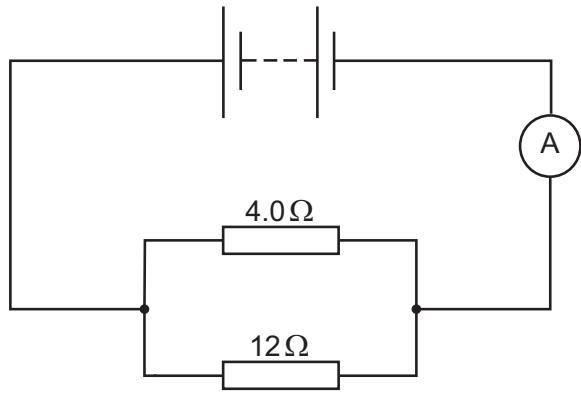
The power dissipated in the resistor is 12 W.
What is the power dissipated in the resistor?
The power dissipated in the resistor is 12 W.
What is the power dissipated in the resistor?
- A.3.0 W
- B.4.0 W
- C.12 W
- D.16 W
- E.36 W
Answer: E