NSAA 2018 Chemistry S1
16 questions16 marksUpdated June 2026
The NSAA 2018 Chemistry S1 paper in full: all 16 questions, each with its answer. NSAA is the Natural Sciences Admissions Assessment. Sit it cold under exam timing, mark it, then work back through anything you missed using the solutions below.
Download the original PDF →Questions and answers are free. Full step-by-step worked solutions unlock with a free account. Start practising.
Question 37
Which row in the following table gives the numbers of protons, neutrons and electrons in ?
| | number of protons | number of neutrons | number of electrons |
|---|---|---|---|
| A | 27 | 33 | 27 |
| B | 27 | 35 | 29 |
| C | 29 | 35 | 27 |
| D | 29 | 35 | 29 |
| E | 31 | 33 | 29 |
| F | 31 | 35 | 29 |
| | number of protons | number of neutrons | number of electrons |
|---|---|---|---|
| A | 27 | 33 | 27 |
| B | 27 | 35 | 29 |
| C | 29 | 35 | 27 |
| D | 29 | 35 | 29 |
| E | 31 | 33 | 29 |
| F | 31 | 35 | 29 |
- A.27 protons, 33 neutrons, 27 electrons
- B.27 protons, 35 neutrons, 29 electrons
- C.29 protons, 35 neutrons, 27 electrons
- D.29 protons, 35 neutrons, 29 electrons
- E.31 protons, 33 neutrons, 29 electrons
- F.31 protons, 35 neutrons, 29 electrons
Answer: C
Question 38
The following exothermic reaction reaches equilibrium at room temperature.
Which of the following changes, when applied independently, will alter the position of the equilibrium?
1 increasing the temperature by 25 °C
2 adding 20 cm³ of water to the equilibrium mixture
3 adding a catalyst
4 adding an extra 0.5 mol of ethanol ()
Which of the following changes, when applied independently, will alter the position of the equilibrium?
1 increasing the temperature by 25 °C
2 adding 20 cm³ of water to the equilibrium mixture
3 adding a catalyst
4 adding an extra 0.5 mol of ethanol ()
- A.1 only
- B.1 and 3 only
- C.1, 2 and 4 only
- D.2 and 4 only
- E.1, 2, 3 and 4
Answer: C
Question 39
What is the overall process that takes place at the cathode (negative electrode) in the electrolysis of dilute aqueous sodium sulfate?
- A.
- B.
- C.
- D.
- E.
Answer: A
Question 40
A mass spectrum of a sample of element X with atomic number 5 is shown. The graph shows percentage abundance on the y-axis against mass/charge on the x-axis. There are two peaks: one at mass/charge 10 with an abundance of approximately 25%, and one at mass/charge 11 with an abundance of 100%.
Using the data, which row in the following table best describes the position of X in the Periodic Table and the relative atomic mass of this sample of X?
| | Period | Group | relative atomic mass |
|---|---|---|---|
| A | 1 | 15 | 10.2 |
| B | 1 | 15 | 10.8 |
| C | 2 | 13 | 10.2 |
| D | 2 | 13 | 10.8 |
| E | 3 | 2 | 10.2 |
| F | 3 | 2 | 10.8 |
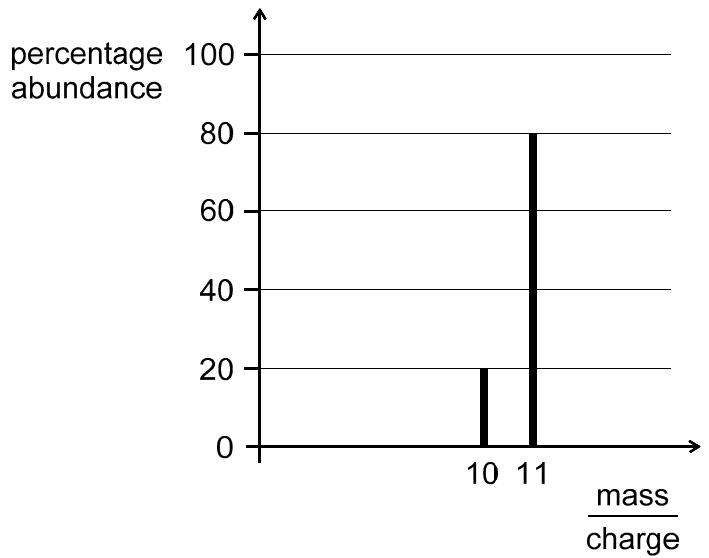
Using the data, which row in the following table best describes the position of X in the Periodic Table and the relative atomic mass of this sample of X?
| | Period | Group | relative atomic mass |
|---|---|---|---|
| A | 1 | 15 | 10.2 |
| B | 1 | 15 | 10.8 |
| C | 2 | 13 | 10.2 |
| D | 2 | 13 | 10.8 |
| E | 3 | 2 | 10.2 |
| F | 3 | 2 | 10.8 |
- A.Period 1, Group 15, relative atomic mass 10.2
- B.Period 1, Group 15, relative atomic mass 10.8
- C.Period 2, Group 13, relative atomic mass 10.2
- D.Period 2, Group 13, relative atomic mass 10.8
- E.Period 3, Group 2, relative atomic mass 10.2
- F.Period 3, Group 2, relative atomic mass 10.8
Answer: D
Question 41
The gases nitrogen, oxygen and argon can be separated from liquefied air by fractional distillation.
Given the data in the table, in which order would the gases be collected?
| | melting point / °C | boiling point / °C |
|---|---|---|
| nitrogen | -210 | -196 |
| oxygen | -218 | -183 |
| argon | -189 | -186 |
Given the data in the table, in which order would the gases be collected?
| | melting point / °C | boiling point / °C |
|---|---|---|
| nitrogen | -210 | -196 |
| oxygen | -218 | -183 |
| argon | -189 | -186 |
- A.nitrogen, oxygen, argon
- B.nitrogen, argon, oxygen
- C.oxygen, nitrogen, argon
- D.oxygen, argon, nitrogen
- E.argon, nitrogen, oxygen
- F.argon, oxygen, nitrogen
Answer: B
Question 42
Concentrated aqueous sodium chloride was electrolysed. After a few minutes, the remaining electrolyte solution was tested with a pH probe at 25 °C.
The gases produced at the electrodes were collected and tested with a colourless aqueous solution of sodium bromide.
Which row in the following table best describes the observations in these tests?
| | pH of the remaining solution | test of gas from anode (positive electrode) | test of gas from cathode (negative electrode) |
|---|---|---|---|
| A | 2 | no observable change | no observable change |
| B | 2 | no observable change | orange solution forms |
| C | 7 | orange solution forms | no observable change |
| D | 7 | orange solution forms | orange solution forms |
| E | 12 | orange solution forms | no observable change |
| F | 12 | no observable change | orange solution forms |
The gases produced at the electrodes were collected and tested with a colourless aqueous solution of sodium bromide.
Which row in the following table best describes the observations in these tests?
| | pH of the remaining solution | test of gas from anode (positive electrode) | test of gas from cathode (negative electrode) |
|---|---|---|---|
| A | 2 | no observable change | no observable change |
| B | 2 | no observable change | orange solution forms |
| C | 7 | orange solution forms | no observable change |
| D | 7 | orange solution forms | orange solution forms |
| E | 12 | orange solution forms | no observable change |
| F | 12 | no observable change | orange solution forms |
- A.pH 2, test of gas from anode: no observable change, test of gas from cathode: no observable change
- B.pH 2, test of gas from anode: no observable change, test of gas from cathode: orange solution forms
- C.pH 7, test of gas from anode: orange solution forms, test of gas from cathode: no observable change
- D.pH 7, test of gas from anode: orange solution forms, test of gas from cathode: orange solution forms
- E.pH 12, test of gas from anode: orange solution forms, test of gas from cathode: no observable change
- F.pH 12, test of gas from anode: no observable change, test of gas from cathode: orange solution forms
Answer: E
Question 43
The following equations show the main reactions that take place in a blast furnace during the extraction of iron and the removal of the impurities:
Which row in the following table correctly identifies whether the underlined substance is oxidised, or reduced, or neither? The underlined substances are in the second equation, in the fourth equation, and in the fifth equation.
| | | | |
|---|---|---|---|
| A | oxidised | reduced | neither |
| B | oxidised | neither | neither |
| C | oxidised | reduced | oxidised |
| D | oxidised | neither | oxidised |
| E | reduced | reduced | neither |
| F | reduced | neither | neither |
| G | reduced | reduced | oxidised |
| H | reduced | neither | oxidised |
Which row in the following table correctly identifies whether the underlined substance is oxidised, or reduced, or neither? The underlined substances are in the second equation, in the fourth equation, and in the fifth equation.
| | | | |
|---|---|---|---|
| A | oxidised | reduced | neither |
| B | oxidised | neither | neither |
| C | oxidised | reduced | oxidised |
| D | oxidised | neither | oxidised |
| E | reduced | reduced | neither |
| F | reduced | neither | neither |
| G | reduced | reduced | oxidised |
| H | reduced | neither | oxidised |
- A.: oxidised, : reduced, : neither
- B.: oxidised, : neither, : neither
- C.: oxidised, : reduced, : oxidised
- D.: oxidised, : neither, : oxidised
- E.: reduced, : reduced, : neither
- F.: reduced, : neither, : neither
- G.: reduced, : reduced, : oxidised
- H.: reduced, : neither, : oxidised
Answer: F
Question 44
X, Y and Z have the same electron configuration.
X is an atom, Y is a monatomic anion and Z is a monatomic cation.
Which of the following statements is always correct?
X is an atom, Y is a monatomic anion and Z is a monatomic cation.
Which of the following statements is always correct?
- A.Anion Y has fewer protons than atom X.
- B.Cation Z has more electrons than protons.
- C.X, Y and Z are in the same group of the Periodic Table.
- D.X, Y and Z have consecutive atomic numbers.
- E.X, Y and Z have the same mass number.
Answer: A
Question 45
In the Contact process, sulfur dioxide reacts with oxygen to make sulfur trioxide in a reversible reaction.
When 5.00 mol of and 11.0 mol of are allowed to reach equilibrium at 450 °C, 80.0% of the is converted to .
What is the volume of the resulting mixture?
(Assume that temperature and pressure are constant, and that at this temperature the volume of one mole of gas is 60.0 dm³.)
When 5.00 mol of and 11.0 mol of are allowed to reach equilibrium at 450 °C, 80.0% of the is converted to .
What is the volume of the resulting mixture?
(Assume that temperature and pressure are constant, and that at this temperature the volume of one mole of gas is 60.0 dm³.)
- A.240 dm³
- B.336 dm³
- C.600 dm³
- D.720 dm³
- E.840 dm³
- F.960 dm³
Answer: E
Question 46
The non-metallic element phosphorus forms two stable chlorides: (boiling point 76 °C) and (boiling point 161 °C).
Which of the following statements explain(s) the difference in boiling points?
1 There are more covalent bonds in so more energy is required to break them.
2 The forces between the molecules in liquid are stronger.
3 The covalent bonds in are weaker so less energy is required to break them.
Which of the following statements explain(s) the difference in boiling points?
1 There are more covalent bonds in so more energy is required to break them.
2 The forces between the molecules in liquid are stronger.
3 The covalent bonds in are weaker so less energy is required to break them.
- A.none of them
- B.1 only
- C.2 only
- D.3 only
- E.1 and 2 only
- F.1 and 3 only
- G.2 and 3 only
- H.1, 2 and 3
Answer: C
Question 47
A student calculated the mass of anhydrous copper(II) sulfate () required to make 250 cm³ of an aqueous solution of concentration 0.200 mol dm⁻³.
However, the student mistakenly made the solution using the same mass of hydrated copper(II) sulfate () instead.
What is the concentration, in mol dm⁻³, of the solution made with the hydrated copper(II) sulfate?
( values: Cu = 64; S = 32; O = 16; H = 1.0)
However, the student mistakenly made the solution using the same mass of hydrated copper(II) sulfate () instead.
What is the concentration, in mol dm⁻³, of the solution made with the hydrated copper(II) sulfate?
( values: Cu = 64; S = 32; O = 16; H = 1.0)
- A.0.128 mol dm⁻³
- B.0.160 mol dm⁻³
- C.0.180 mol dm⁻³
- D.0.200 mol dm⁻³
- E.0.223 mol dm⁻³
- F.0.313 mol dm⁻³
Answer: A
Question 48
Bromine is an element in Group 17 of the Periodic Table.
Which of the following statements is/are correct about the element bromine?
1 Bromine will oxidise chloride ions in aqueous solution to form chlorine.
2 Bromine has a lower boiling point than chlorine.
3 Bromine reacts with calcium (Group 2) to form a compound containing 80% bromine by mass.
( values: Cl = 35.5; Ca = 40; Br = 80)
Which of the following statements is/are correct about the element bromine?
1 Bromine will oxidise chloride ions in aqueous solution to form chlorine.
2 Bromine has a lower boiling point than chlorine.
3 Bromine reacts with calcium (Group 2) to form a compound containing 80% bromine by mass.
( values: Cl = 35.5; Ca = 40; Br = 80)
- A.none of them
- B.1 only
- C.2 only
- D.3 only
- E.1 and 2 only
- F.1 and 3 only
- G.2 and 3 only
- H.1, 2 and 3
Answer: D
Question 49
Paper chromatography was used to separate three mixtures of amino acids. The mixtures were labelled P, Q and R. The chromatogram is shown below.
Each mixture contains some of the five amino acids in the following table. The values were measured for each amino acid with the solvent used to produce the chromatogram.
| amino acid | value |
|---|---|
| asparagine | 0.50 |
| glutamic acid | 0.30 |
| glycine | 0.26 |
| leucine | 0.71 |
| valine | 0.61 |
Which of the following statements is/are correct?
1 Mixture P contains valine and glycine.
2 Leucine is found in all three mixtures.
3 Glutamic acid is the least mobile amino acid with this solvent.
4 Mixtures P and Q both contain asparagine.
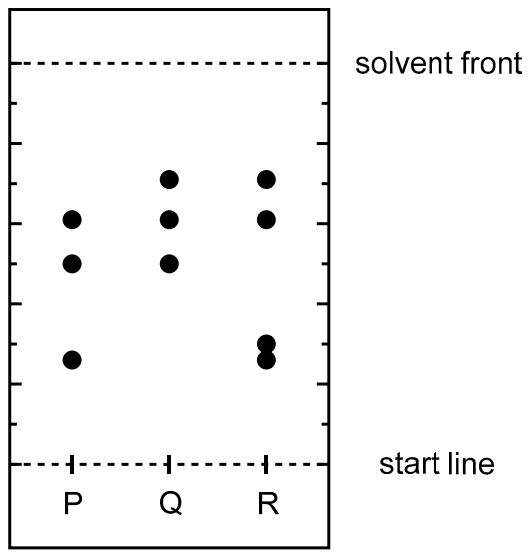
Each mixture contains some of the five amino acids in the following table. The values were measured for each amino acid with the solvent used to produce the chromatogram.
| amino acid | value |
|---|---|
| asparagine | 0.50 |
| glutamic acid | 0.30 |
| glycine | 0.26 |
| leucine | 0.71 |
| valine | 0.61 |
Which of the following statements is/are correct?
1 Mixture P contains valine and glycine.
2 Leucine is found in all three mixtures.
3 Glutamic acid is the least mobile amino acid with this solvent.
4 Mixtures P and Q both contain asparagine.
- A.1 and 2 only
- B.1 and 4 only
- C.2 and 3 only
- D.3 only
- E.4 only
Answer: B
Question 50
Dilute hydrochloric acid and magnesium were mixed and the total volume of gas released was measured over time. A graph of volume of gas (cm³) versus time (s) is shown. At time = 2 seconds, the volume of gas released is 24 cm³.
What is the average rate of reaction, in g s⁻¹, with respect to the magnesium over the first two seconds?
( value: Mg = 24. Assume that the volume of one mole of gas is 24 dm³.)
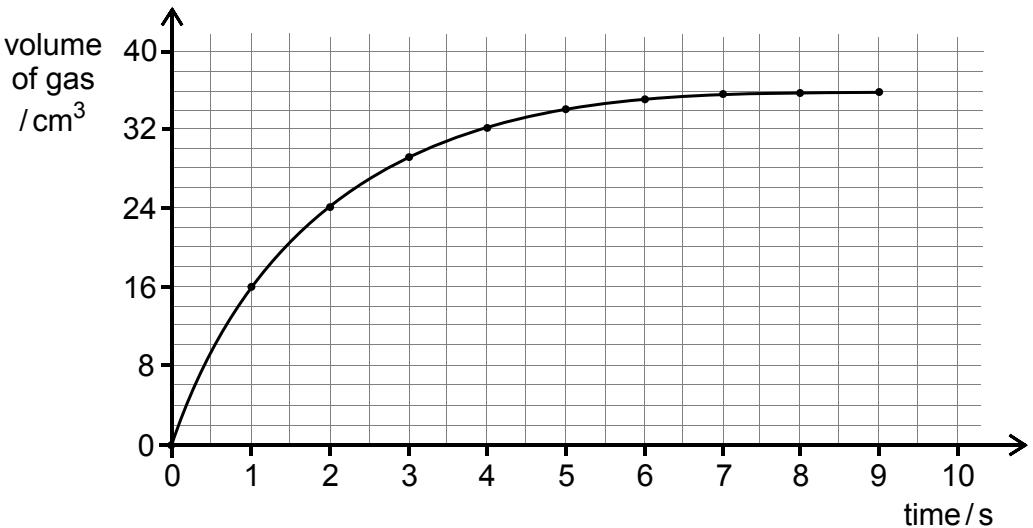
What is the average rate of reaction, in g s⁻¹, with respect to the magnesium over the first two seconds?
( value: Mg = 24. Assume that the volume of one mole of gas is 24 dm³.)
- A.0.012 g s⁻¹
- B.0.024 g s⁻¹
- C.0.048 g s⁻¹
- D.12 g s⁻¹
- E.24 g s⁻¹
- F.48 g s⁻¹
Answer: A
Question 51
Copper can react with concentrated nitric acid to form the gas nitrogen monoxide.
What is the value of a when the equation is balanced?
What is the value of a when the equation is balanced?
- A.6
- B.7
- C.8
- D.9
- E.10
- F.11
- G.12
Answer: C
Question 52
A small amount of a solid mixture, containing calcium carbonate and an inert substance, was added to 50.00 cm³ dilute hydrochloric acid of concentration 0.1000 mol dm⁻³.
After all of the calcium carbonate had reacted, the solution was heated to drive off the carbon dioxide.
The resulting solution was neutralised by 12.50 cm³ of 0.1000 mol dm⁻³ sodium hydroxide solution.
What was the mass of calcium carbonate in the mixture added to the hydrochloric acid?
( value: = 100.0)
After all of the calcium carbonate had reacted, the solution was heated to drive off the carbon dioxide.
The resulting solution was neutralised by 12.50 cm³ of 0.1000 mol dm⁻³ sodium hydroxide solution.
What was the mass of calcium carbonate in the mixture added to the hydrochloric acid?
( value: = 100.0)
- A.0.06250 g
- B.0.1250 g
- C.0.1875 g
- D.0.3750 g
- E.0.6250 g
- F.0.7500 g
Answer: C