Mapped to the ESAT specification
NSAA 2018 Physics Part B
18 questions18 marksUpdated June 2026
Natural Sciences Admissions Assessment 2018 is one of the closest available past papers for the Engineering and Science Admissions Test. Below, all 18 questions are mapped to the ESAT topics they test, each with its answer. Sit it cold under exam timing, then work back through anything you missed using the solutions.
What this paper covers on the ESAT
Every question mapped to the Engineering and Science Admissions Test specification, so you know exactly which areas it tests.
Mathematics 1
- Algebra (4)
- Geometry (1)
Physics
- Electricity (2)
Questions and answers are free. Full step-by-step worked solutions unlock with a free account. Start practising.
Question 19
1 markAn unstable nucleus X becomes a stable nucleus Y after a succession of decays, during which a total of 5 alpha particles and 2 beta () particles are emitted.
How many fewer protons does nucleus Y contain than nucleus X?
How many fewer protons does nucleus Y contain than nucleus X?
- A.6
- B.8
- C.10
- D.12
- E.14
- F.16
- G.18
- H.20
Answer: B
Question 20
1 markThe diagram shows three resistors , and connected in series with a battery of constant voltage. The resistance of each resistor and the corresponding current are also shown.
[Image of a series circuit with a battery, an ammeter showing 0.20 A, and three resistors: R1 = 12Ω, R2 = 15Ω, R3 = 3.0Ω]
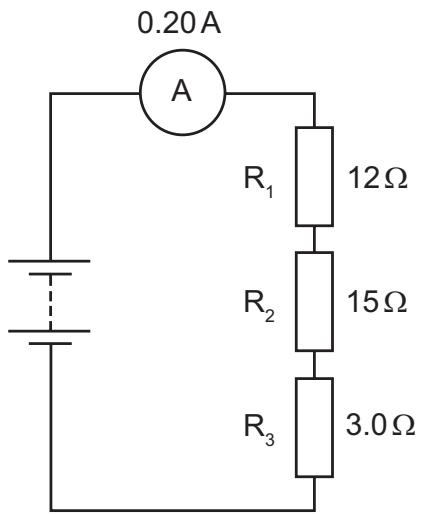
Resistor is now removed and the circuit is reconnected.
What is the new current in the circuit?
[Image of a series circuit with a battery, an ammeter showing 0.20 A, and three resistors: R1 = 12Ω, R2 = 15Ω, R3 = 3.0Ω]
Resistor is now removed and the circuit is reconnected.
What is the new current in the circuit?
- A.0.20 A
- B.0.22 A
- C.0.33 A
- D.0.40 A
- E.0.50 A
- F.2.0 A
- G.6.0 A
Answer: D
Question 21
1 markWhen travelling in a vacuum, visible light has a wavelength between 400 nm and 700 nm.
The speed of light in a vacuum is .
What can be concluded about ultraviolet radiation from this information?
The speed of light in a vacuum is .
What can be concluded about ultraviolet radiation from this information?
- A.It has a maximum frequency of Hz
- B.It has a maximum frequency of Hz
- C.It has a maximum frequency of Hz
- D.It has a maximum frequency of Hz
- E.It has a minimum frequency of Hz
- F.It has a minimum frequency of Hz
- G.It has a minimum frequency of Hz
- H.It has a minimum frequency of Hz
Answer: G
Question 22
1 markThe graph is the speed-time graph for a bus travelling in a straight line between two stops.
[Image of a speed-time graph with speed/ms⁻¹ on the y-axis and time/s on the x-axis. The graph shows acceleration from (0,0) to (20,12), constant speed from (20,12) to (80,12), and deceleration from (80,12) to (120,0).]
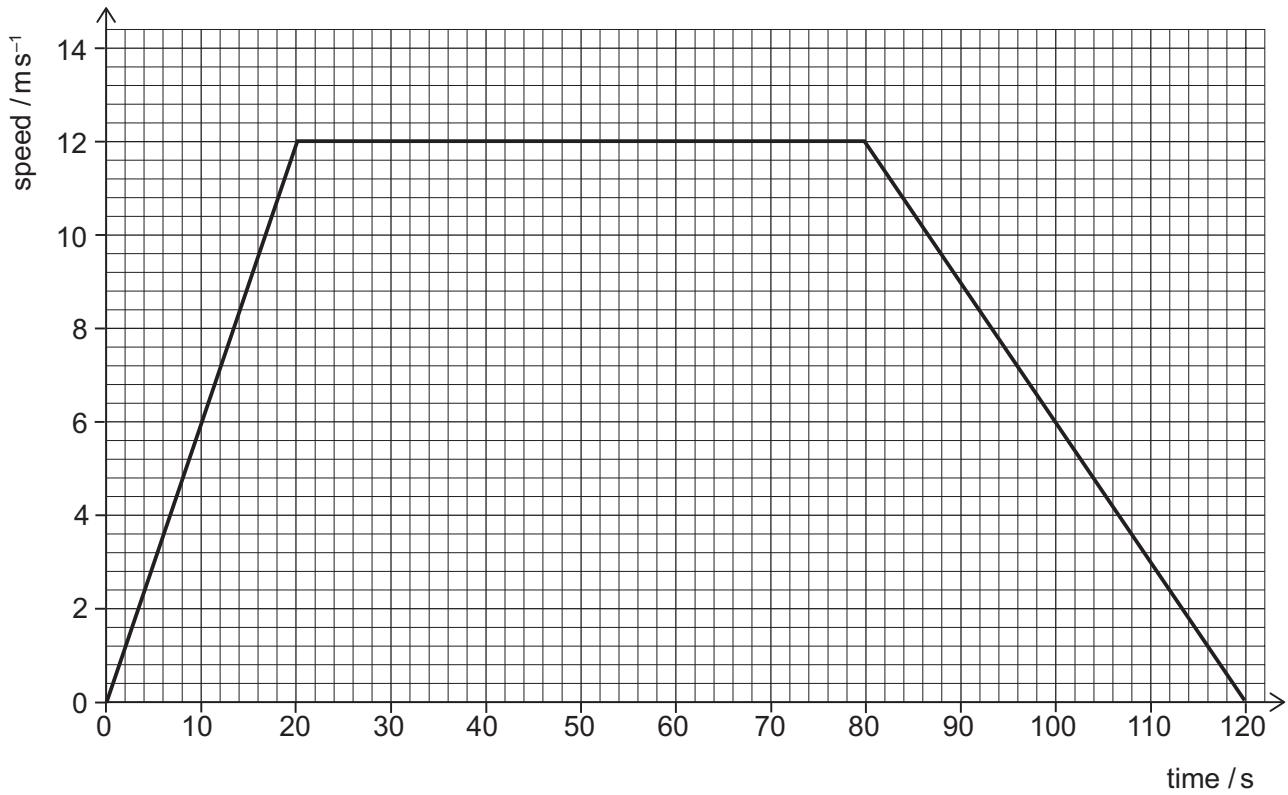
What is the average speed of the bus during this time?
[Image of a speed-time graph with speed/ms⁻¹ on the y-axis and time/s on the x-axis. The graph shows acceleration from (0,0) to (20,12), constant speed from (20,12) to (80,12), and deceleration from (80,12) to (120,0).]
What is the average speed of the bus during this time?
- A.
- B.
- C.
- D.
- E.
- F.
- G.
Answer: E
Question 23
1 markA filament lamp working at its operating voltage converts electrical energy at a rate of 100 W.
The lamp has an efficiency of 5.0%.
How much energy is wasted by the lamp in 10 minutes?
The lamp has an efficiency of 5.0%.
How much energy is wasted by the lamp in 10 minutes?
- A.50 J
- B.950 J
- C.1000 J
- D.3000 J
- E.57 000 J
- F.60 000 J
Answer: E
Question 24
1 markA student is investigating heat flow along a solid uniform metal bar.
The bar has length , cross-sectional area , and has its ends maintained at temperatures and (where ).
Which relationship represents the rate of heat flow along the bar?
(Assume that there is no heat transfer through the sides of the bar.)
The bar has length , cross-sectional area , and has its ends maintained at temperatures and (where ).
Which relationship represents the rate of heat flow along the bar?
(Assume that there is no heat transfer through the sides of the bar.)
- A.
- B.
- C.
- D.
- E.
- F.
- G.
- H.
Answer: C
Question 25
1 markThe potential difference across the motor in an electric car is 400 V and the current in the motor is 1250 A.
The car accelerates along a horizontal road from rest for 4.0 s.
The efficiency of the overall system is 45%.
What is the kinetic energy of the car at the end of the 4.0 s?
(Ignore energy losses due to air resistance and due to friction between the tyres and the road.)
The car accelerates along a horizontal road from rest for 4.0 s.
The efficiency of the overall system is 45%.
What is the kinetic energy of the car at the end of the 4.0 s?
(Ignore energy losses due to air resistance and due to friction between the tyres and the road.)
- A.225 000 J
- B.500 000 J
- C.900 000 J
- D.1 250 000 J
- E.2 000 000 J
Answer: C
Question 26
1 markThe momentum of a small object moving in a straight line is and its kinetic energy is 96 J.
What is the mass of the object?
What is the mass of the object?
- A.3.0 kg
- B.4.0 kg
- C.6.0 kg
- D.8.0 kg
- E.12 kg
Answer: A
Question 27
1 markA radioactive isotope decays in a single step to a stable isotope.
A radiation detector is placed very near to a sample of the radioactive isotope in a laboratory. The count rate on the detector changes as time elapses. The graph shows how the measured count rate changes with time.
[Image of a decay graph showing count rate vs. time. The count rate starts at 120 counts per minute at time 0 and exponentially decays, asymptotically approaching 20 counts per minute.]
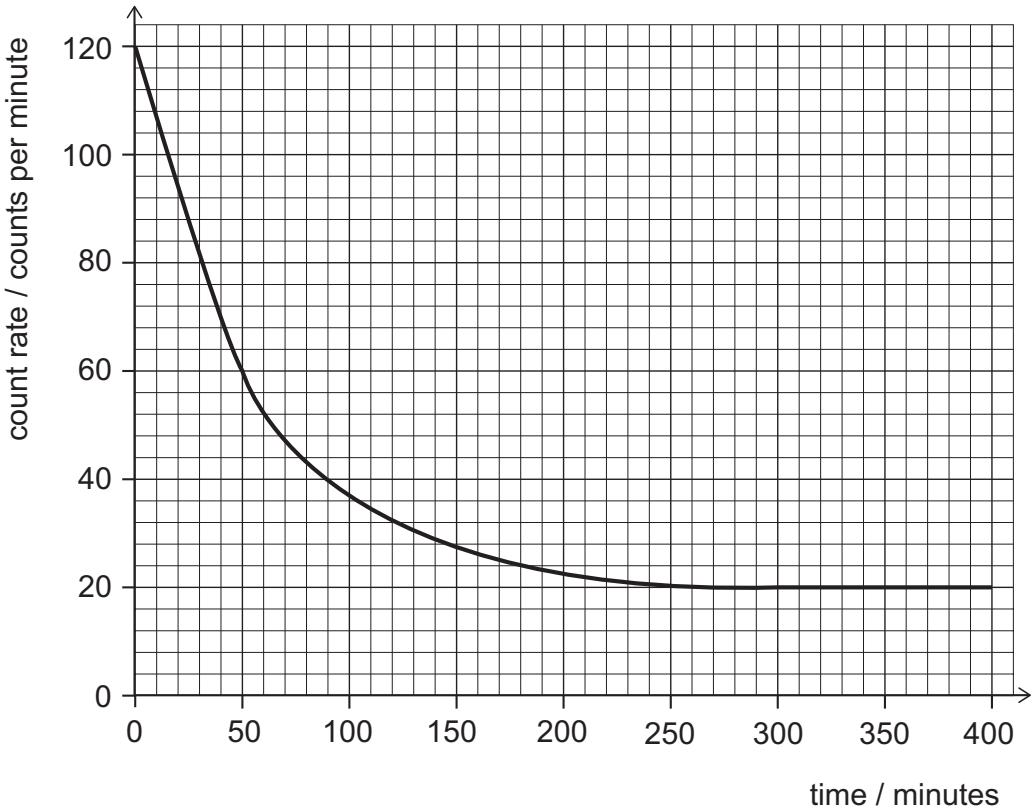
What is the background count rate and what is the half-life of the isotope?
A radiation detector is placed very near to a sample of the radioactive isotope in a laboratory. The count rate on the detector changes as time elapses. The graph shows how the measured count rate changes with time.
[Image of a decay graph showing count rate vs. time. The count rate starts at 120 counts per minute at time 0 and exponentially decays, asymptotically approaching 20 counts per minute.]
What is the background count rate and what is the half-life of the isotope?
- A.background count rate / counts per minute: 20, half-life of isotope / minutes: 40
- B.background count rate / counts per minute: 20, half-life of isotope / minutes: 50
- C.background count rate / counts per minute: 20, half-life of isotope / minutes: 60
- D.background count rate / counts per minute: 20, half-life of isotope / minutes: 65
- E.background count rate / counts per minute: 120, half-life of isotope / minutes: 40
- F.background count rate / counts per minute: 120, half-life of isotope / minutes: 50
- G.background count rate / counts per minute: 120, half-life of isotope / minutes: 60
- H.background count rate / counts per minute: 120, half-life of isotope / minutes: 65
Answer: A
Question 28
1 markA rock falling vertically experiences an air resistance force of 12 N at an instant when its acceleration is downwards.
What is the mass of the rock?
(gravitational field strength = )
What is the mass of the rock?
(gravitational field strength = )
- A.1.0 kg
- B.1.2 kg
- C.1.5 kg
- D.6.0 kg
- E.10 kg
- F.12 kg
- G.15 kg
- H.60 kg
Answer: C
Question 29
1 markA transverse wave with an amplitude of 4.0 cm and a frequency of 10 Hz travels along a rope at a speed of .
What is the total distance travelled by a particle in the rope in a time of 20 s?
What is the total distance travelled by a particle in the rope in a time of 20 s?
- A.2.4 m
- B.4.8 m
- C.8.0 m
- D.16 m
- E.32 m
- F.48 m
Answer: E
Question 30
1 markA student places a measuring cylinder on a balance. She pours a volume V of water into the measuring cylinder, and finds that the mass of the measuring cylinder and water together is 290 g.
She then empties the measuring cylinder and dries it before putting it back on the balance.
She now pours the same volume V of olive oil into the measuring cylinder, and finds that the mass of the measuring cylinder and olive oil together is 270 g.
What is the mass of the measuring cylinder?
(densities: olive oil = ; water = )
She then empties the measuring cylinder and dries it before putting it back on the balance.
She now pours the same volume V of olive oil into the measuring cylinder, and finds that the mass of the measuring cylinder and olive oil together is 270 g.
What is the mass of the measuring cylinder?
(densities: olive oil = ; water = )
- A.18 g
- B.20 g
- C.90 g
- D.180 g
- E.200 g
Answer: C
Question 31
1 markA skydiver of weight 1000 N falls vertically.
The distance-time graph for the skydiver is shown below.
[Image of a distance-time graph where the slope gradually increases and then becomes constant, indicating terminal velocity.]
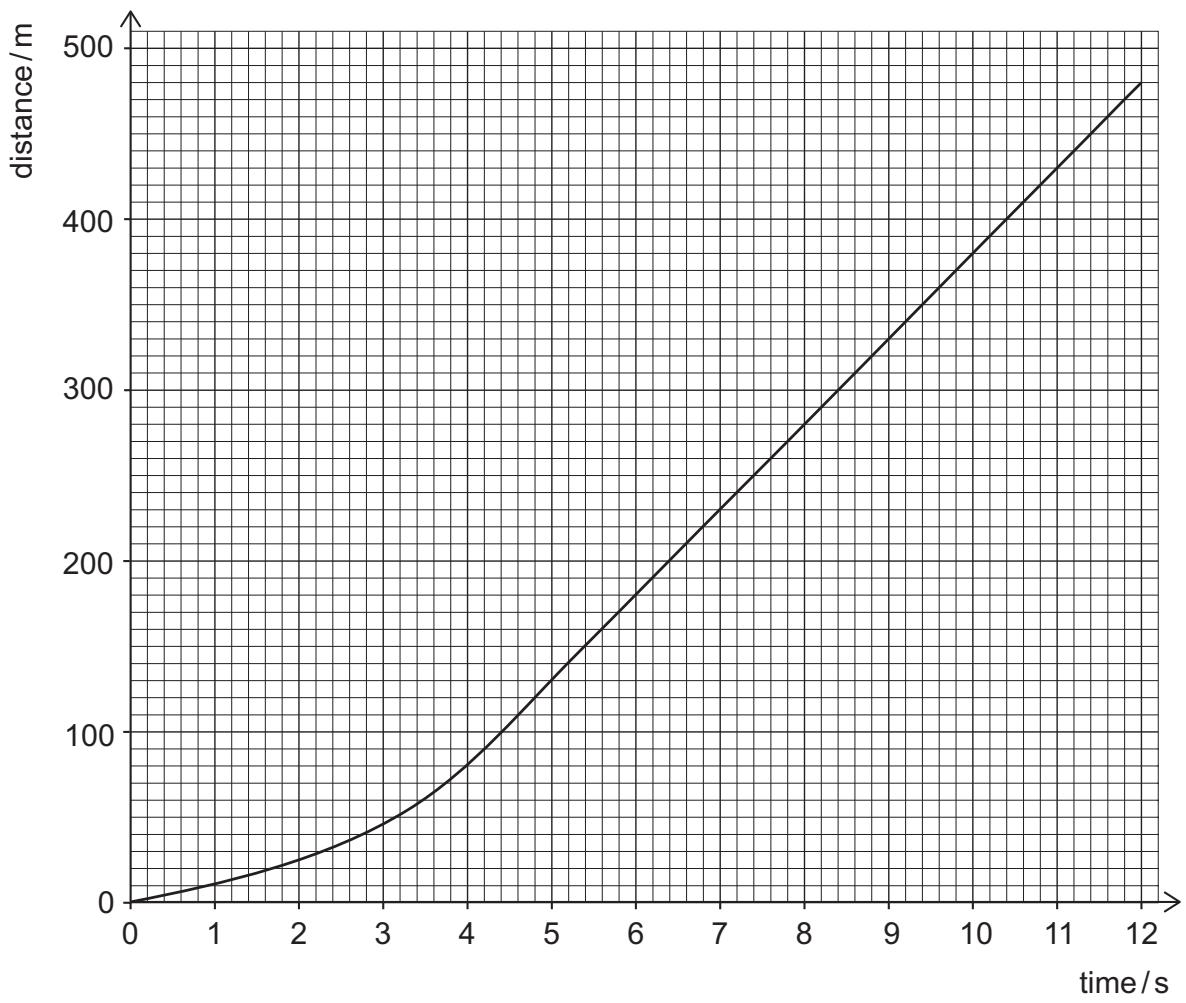
The air resistance (in N) acting on the skydiver travelling at velocity (in ) is given by the equation
where (in ) is a constant.
What is the numerical value of for the skydiver?
The distance-time graph for the skydiver is shown below.
[Image of a distance-time graph where the slope gradually increases and then becomes constant, indicating terminal velocity.]
The air resistance (in N) acting on the skydiver travelling at velocity (in ) is given by the equation
where (in ) is a constant.
What is the numerical value of for the skydiver?
- A.0.050
- B.0.40
- C.0.63
- D.2.5
- E.20
Answer: B
Question 32
1 markA source generates water waves of fixed frequency that have a wavelength of 1.5 cm.
As they cross a boundary into shallower water their frequency does not change, but their speed is reduced by .
The new wavelength is 1.2 cm.
What is the speed of the waves in the shallower water?
As they cross a boundary into shallower water their frequency does not change, but their speed is reduced by .
The new wavelength is 1.2 cm.
What is the speed of the waves in the shallower water?
- A.
- B.
- C.
- D.
- E.
- F.
Answer: E
Question 33
1 markA neutron is absorbed by a uranium-235 () nuclide.
The resulting nuclide undergoes fission to produce a bromine-88 () nuclide, a lanthanum-145 nuclide and some neutrons.
The lanthanum-145 nuclide is radioactive and emits a beta () particle.
How many neutrons are emitted in the fission reaction and how many protons are there in the nuclide formed by the decay of lanthanum-145?
The resulting nuclide undergoes fission to produce a bromine-88 () nuclide, a lanthanum-145 nuclide and some neutrons.
The lanthanum-145 nuclide is radioactive and emits a beta () particle.
How many neutrons are emitted in the fission reaction and how many protons are there in the nuclide formed by the decay of lanthanum-145?
- A.neutrons: 2, protons: 55
- B.neutrons: 2, protons: 56
- C.neutrons: 2, protons: 57
- D.neutrons: 2, protons: 58
- E.neutrons: 3, protons: 55
- F.neutrons: 3, protons: 56
- G.neutrons: 3, protons: 57
- H.neutrons: 3, protons: 58
Answer: H
Question 34
1 markThe diagram shows a circuit containing a battery and three identical resistors X, Y and Z.
[Image of a circuit diagram where resistor Z is in series with a parallel combination of resistors X and Y, all connected to a battery.]
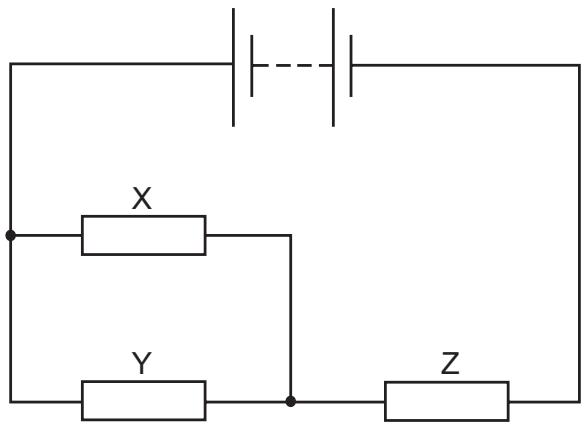
The total power supplied by the battery is 18 W.
What is the power dissipated as heat in resistor X?
[Image of a circuit diagram where resistor Z is in series with a parallel combination of resistors X and Y, all connected to a battery.]
The total power supplied by the battery is 18 W.
What is the power dissipated as heat in resistor X?
- A.1.5 W
- B.2.0 W
- C.3.0 W
- D.4.5 W
- E.6.0 W
- F.8.0 W
- G.12 W
Answer: C
Question 35
1 markA filament lamp and a 0-10Ω variable resistor are connected in series with a power supply of constant voltage.
The graph shows the voltage-current (V-I) characteristic of the filament lamp.
[Image of a non-linear V-I graph for a filament lamp, with Voltage (V) on the y-axis and Current (A) on the x-axis. The curve starts at the origin and curves upwards.]
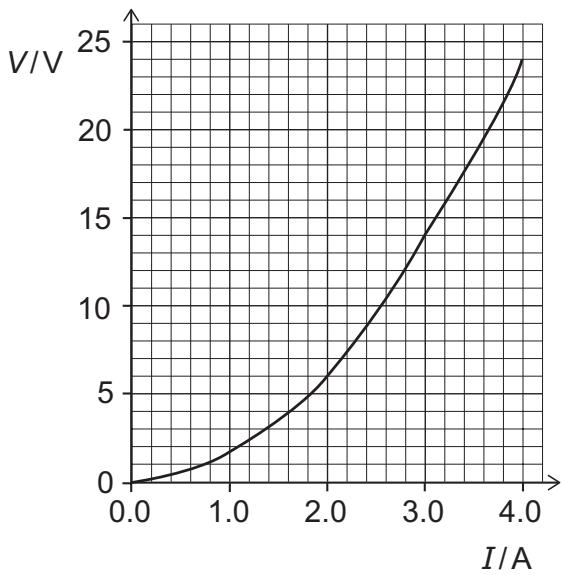
When the resistance of the variable resistor is 4.0Ω, the current in the lamp is 2.0 A.
What is the power dissipated in the lamp when the resistance of the variable resistor is zero?
The graph shows the voltage-current (V-I) characteristic of the filament lamp.
[Image of a non-linear V-I graph for a filament lamp, with Voltage (V) on the y-axis and Current (A) on the x-axis. The curve starts at the origin and curves upwards.]
When the resistance of the variable resistor is 4.0Ω, the current in the lamp is 2.0 A.
What is the power dissipated in the lamp when the resistance of the variable resistor is zero?
- A.12 W
- B.14 W
- C.16 W
- D.28 W
- E.42 W
- F.96 W
Answer: E
Question 36
1 markThree detectors X, Y and Z are separated by large distances.
Each of the detectors records a seismic wave from the same earthquake whose epicentre (source) is very close to the surface of the Earth.
The wave travels out from the epicentre at .
Detectors X and Y start to detect the wave at the same time, but detector Z starts to detect it one minute later.
Which of the following statements must be correct?
1 The epicentre is at the midpoint of the line XY.
2 Z is equidistant from X and Y.
3 Z is no more than 240 km away from X and from Y.
Each of the detectors records a seismic wave from the same earthquake whose epicentre (source) is very close to the surface of the Earth.
The wave travels out from the epicentre at .
Detectors X and Y start to detect the wave at the same time, but detector Z starts to detect it one minute later.
Which of the following statements must be correct?
1 The epicentre is at the midpoint of the line XY.
2 Z is equidistant from X and Y.
3 Z is no more than 240 km away from X and from Y.
- A.none of them
- B.1 only
- C.2 only
- D.3 only
- E.1 and 2 only
- F.1 and 3 only
- G.2 and 3 only
- H.1, 2 and 3
Answer: A