Mapped to the ESAT specification
NSAA 2019 Advanced Mathematics And Advanced Physics Part E
10 questions10 marksUpdated October 2025
Natural Sciences Admissions Assessment 2019 is one of the closest available past papers for the Engineering and Science Admissions Test. Below, all 10 questions are mapped to the ESAT topics they test, each with its answer. Sit it cold under exam timing, then work back through anything you missed using the solutions.
What this paper covers on the ESAT
Every question mapped to the Engineering and Science Admissions Test specification, so you know exactly which areas it tests.
Mathematics 1
- Geometry (2)
Questions and answers are free. Full step-by-step worked solutions unlock with a free account. Start practising.
Question 73
1 markFind the area of the shape bounded by the four lines:
- A.4
- B.12
- C.21
- D.25
- E.27
- F.30
Answer: C
Question 74
1 markA hydroelectric power station uses the water in a reservoir to power the generators. The water falls through a vertical height of 150 m to the turbines which power the generators.
The efficiency of the power station is 90% and the output power of the power station is 1800 MW.
The gravitational field strength is and the density of water is .
What volume of water passes through the turbines in one minute?
The efficiency of the power station is 90% and the output power of the power station is 1800 MW.
The gravitational field strength is and the density of water is .
What volume of water passes through the turbines in one minute?
- A.
- B.
- C.
- D.
- E.
- F.
Answer: C
Question 75
1 markThe curve
has a local maximum when and a local minimum when
What is the value of ?
has a local maximum when and a local minimum when
What is the value of ?
- A.-9
- B.-3
- C.-1
- D.1
- E.3
- F.9
Answer: B
Question 76
1 markA car P of mass 1000 kg is travelling north at along a straight, horizontal road when it hits another car Q which is directly ahead of P and travelling in the same direction. Car Q has a mass of 500 kg and is travelling at .
The collision lasts for 0.20 s and immediately after the collision car Q is moving north at .
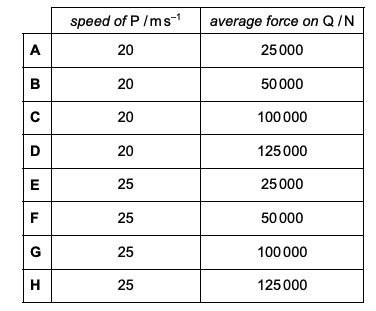
What is the speed of P immediately after the collision and what is the size of the average resultant force that acts on Q during the collision?
(Assume that no external forces act on the cars during the collision.)
The collision lasts for 0.20 s and immediately after the collision car Q is moving north at .
What is the speed of P immediately after the collision and what is the size of the average resultant force that acts on Q during the collision?
(Assume that no external forces act on the cars during the collision.)
- A.speed of P: , average force on Q:
- B.speed of P: , average force on Q:
- C.speed of P: , average force on Q:
- D.speed of P: , average force on Q:
- E.speed of P: , average force on Q:
- F.speed of P: , average force on Q:
- G.speed of P: , average force on Q:
- H.speed of P: , average force on Q:
Answer: E
Question 77
1 markIt is given that
where
What are the possible values of ?
where
What are the possible values of ?
- A. or
- B. or
- C. or
- D. or
- E.3 or 2
Answer: D
Question 78
1 markA metal wire of length 0.50 m has a uniform cross-sectional area of .
There is a current of 4.0 A in the wire.
What is the potential difference across the ends of the wire?
(resistivity of the metal = )
There is a current of 4.0 A in the wire.
What is the potential difference across the ends of the wire?
(resistivity of the metal = )
- A.0.05 V
- B.0.20 V
- C.0.80 V
- D.3.2 V
- E.5.0 V
- F.20 V
Answer: C
Question 79
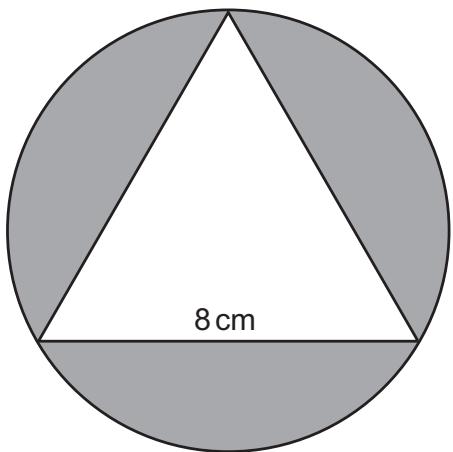
1 markAn equilateral triangle of side 8 cm is drawn so that its vertices lie on the circumference of a circle, as shown in the diagram.
[Image of a circle with an inscribed equilateral triangle. The side length of the triangle is labeled '8 cm'. The three segments of the circle that are outside the triangle are shaded.]
What is the total of the three areas shaded in the diagram, in ?
[Image of a circle with an inscribed equilateral triangle. The side length of the triangle is labeled '8 cm'. The three segments of the circle that are outside the triangle are shaded.]
What is the total of the three areas shaded in the diagram, in ?
- A.
- B.
- C.
- D.
- E.
Answer: E
Question 80
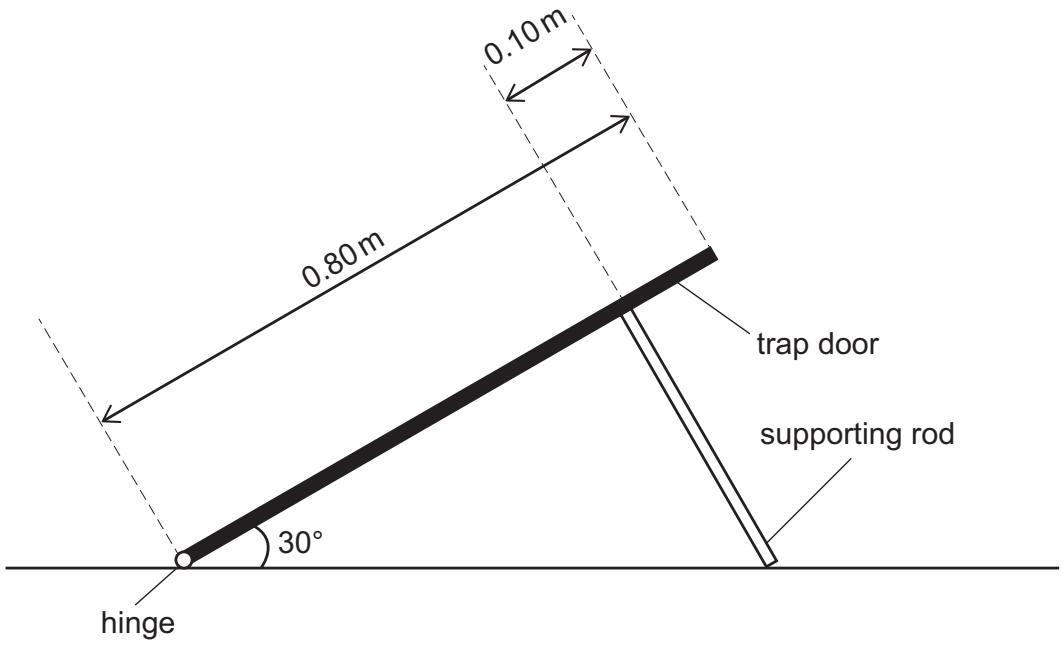
1 markA uniform square trap door of side 0.80 m and mass 14 kg has a smooth hinge at one edge and is held open at an angle of to the horizontal. It is supported by a single rigid rod placed so that it meets the surface of the trap door at at a distance 0.10 m from the top edge of the trap door, as shown.
[Image showing a trap door hinged at the bottom left, held open at an angle of 30 degrees to the horizontal. The door is a square of side 0.80 m. A supporting rod is placed perpendicular to the trap door, meeting it at a point 0.10 m from the top edge.]
What is the normal contact force exerted on the trap door by the rod?
(gravitational field strength = )
[Image showing a trap door hinged at the bottom left, held open at an angle of 30 degrees to the horizontal. The door is a square of side 0.80 m. A supporting rod is placed perpendicular to the trap door, meeting it at a point 0.10 m from the top edge.]
What is the normal contact force exerted on the trap door by the rod?
(gravitational field strength = )
- A.40 N
- B.
- C.
- D.80 N
- E.
- F.
Answer: D
Question 81
1 markWhich one of the following is the real solution of the equation
- A.
- B.
- C.
- D.
- E.
- F.
Answer: B
Question 82
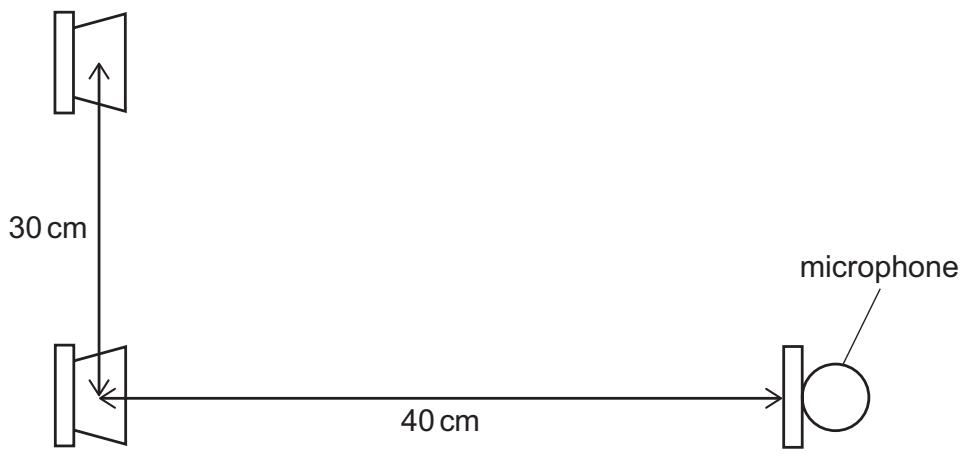
1 markTwo small loudspeakers are placed side by side 30 cm apart.
They are connected to the same signal generator so that they emit sound of frequency 400 Hz in phase with one another.
The sounds both reach a microphone placed 40 cm directly in front of one of the two loudspeakers as shown.
[Image showing two loudspeakers, one above the other, separated by a vertical distance of 30 cm. A microphone is positioned 40 cm horizontally from the lower loudspeaker, such that the line connecting the microphone and the lower loudspeaker is perpendicular to the line connecting the two loudspeakers.]
What is the phase difference between waves from the loudspeakers as they arrive at the microphone?
(speed of sound = )
They are connected to the same signal generator so that they emit sound of frequency 400 Hz in phase with one another.
The sounds both reach a microphone placed 40 cm directly in front of one of the two loudspeakers as shown.
[Image showing two loudspeakers, one above the other, separated by a vertical distance of 30 cm. A microphone is positioned 40 cm horizontally from the lower loudspeaker, such that the line connecting the microphone and the lower loudspeaker is perpendicular to the line connecting the two loudspeakers.]
What is the phase difference between waves from the loudspeakers as they arrive at the microphone?
(speed of sound = )
- A.
- B.
- C.
- D.
- E.
- F.
- G.
Answer: C