NSAA 2019 Biology S1
18 questions18 marksUpdated October 2025
The NSAA 2019 Biology S1 paper in full: all 18 questions, each with its answer. NSAA is the Natural Sciences Admissions Assessment. Sit it cold under exam timing, mark it, then work back through anything you missed using the solutions below.
Download the original PDF →Questions and answers are free. Full step-by-step worked solutions unlock with a free account. Start practising.
Question 55
Which of the following statements is/are correct for both bacterial cells and sperm cells?
1 The cell can divide.
2 The cell contains DNA.
3 The cell has a cell wall.
4 The cell has a nucleus.
5 The cell can carry out respiration.
1 The cell can divide.
2 The cell contains DNA.
3 The cell has a cell wall.
4 The cell has a nucleus.
5 The cell can carry out respiration.
- A.2 only
- B.4 only
- C.1 and 2 only
- D.2 and 5 only
- E.3 and 4 only
- F.3 and 5 only
- G.1, 2 and 5 only
- H.1, 3 and 4 only
Answer: D
Question 56
Which one of the following statements about cells or tissues is correct?
- A.Any adult stem cells can naturally give rise to all tissue.
- B.Endocrine glands secrete enzymes into the bloodstream.
- C.Embryonic stem cells divide by meiosis to form all cell types.
- D.Receptor cells send chemical impulses along neurones.
- E.The stomach wall contains a tissue that enables movement of food.
Answer: E
Question 57
The diagram represents a section of DNA.
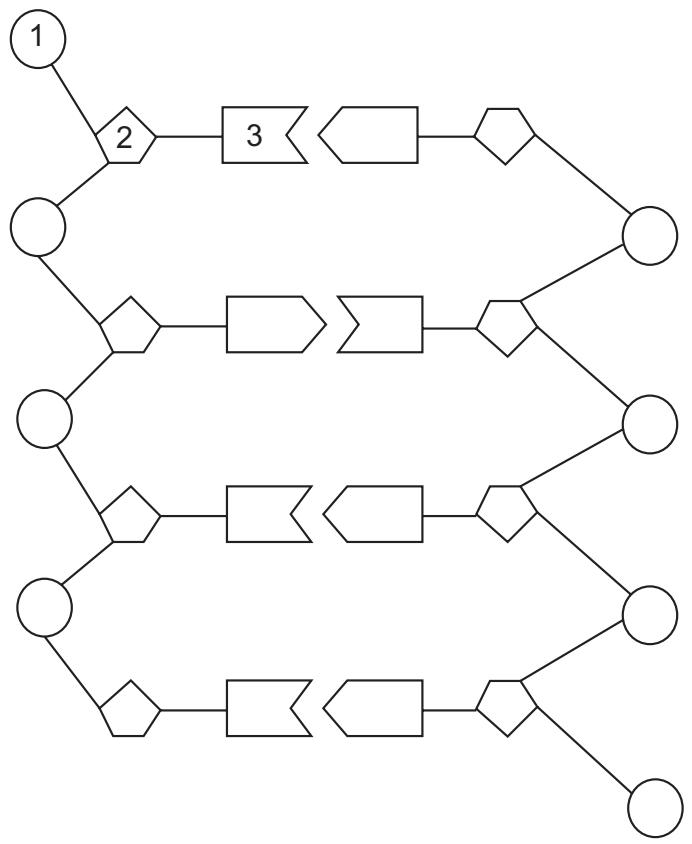
What do the parts labelled 1, 2 and 3 represent?
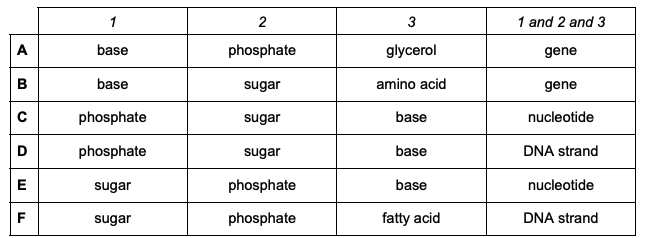
What do the parts labelled 1, 2 and 3 represent?
- A.1: base, 2: phosphate, 3: glycerol, 1 and 2 and 3: gene
- B.1: base, 2: sugar, 3: amino acid, 1 and 2 and 3: gene
- C.1: phosphate, 2: sugar, 3: base, 1 and 2 and 3: nucleotide
- D.1: phosphate, 2: sugar, 3: base, 1 and 2 and 3: DNA strand
- E.1: sugar, 2: phosphate, 3: base, 1 and 2 and 3: nucleotide
- F.1: sugar, 2: phosphate, 3: fatty acid, 1 and 2 and 3: DNA strand
Answer: C
Question 58
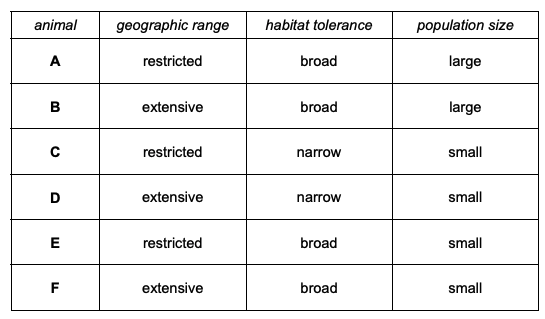
Using the information in the table, which animal (A-F) is most at risk of extinction?
- A.A
- B.B
- C.C
- D.D
- E.E
- F.F
Answer: C
Question 59
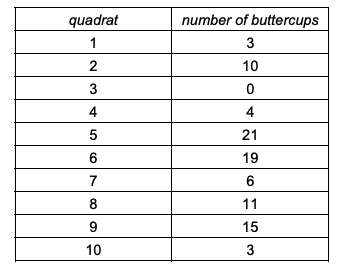
An ecologist used a 50 cm × 50 cm square quadrat to estimate the number of meadow buttercups present in a field with an area of 50 m². The quadrat was distributed randomly on ten occasions in the field and the number of buttercups counted in each quadrat
- A.368
- B.460
- C.920
- D.1840
- E.4600
- F.18400
- G.45000
Answer: D
Question 60
The photomicrograph shows a section through the wall of a human bronchus, one of the tubes which carries air towards the lungs.
A student studying this structure annotated the photomicrograph by describing the cells found in two different layers in the wall of the bronchus.
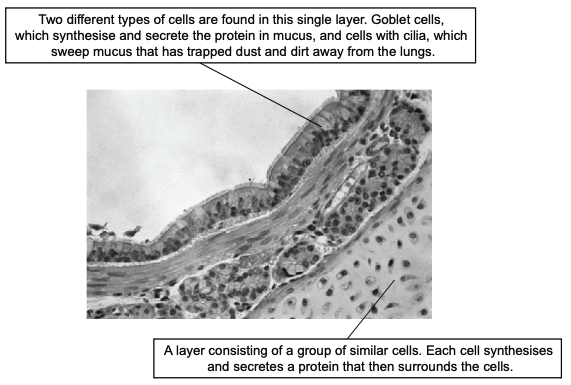
The student used these observations to write some conclusions.
Which of the following conclusions is/are correct?
1 The two different layers are both tissues.
2 The bronchus can be described as an organ.
3 Amino acids are found in the cytoplasm of cells in each layer.
A student studying this structure annotated the photomicrograph by describing the cells found in two different layers in the wall of the bronchus.
The student used these observations to write some conclusions.
Which of the following conclusions is/are correct?
1 The two different layers are both tissues.
2 The bronchus can be described as an organ.
3 Amino acids are found in the cytoplasm of cells in each layer.
- A.none of them
- B.1 only
- C.2 only
- D.3 only
- E.1 and 2 only
- F.1 and 3 only
- G.1, 2 and 3
Answer: G
Question 61
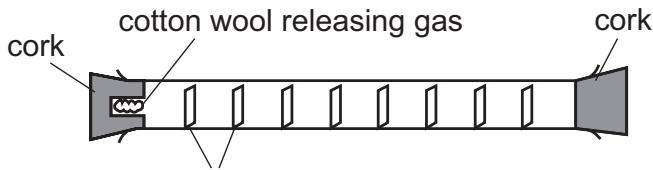
A student carried out an investigation using the diffusion of a gas along a tube to model movement of gases in the air space of a leaf. An alkaline gas was released from a solution that evaporated from the cotton wool.
As the gas diffused, it caused damp litmus paper to change colour.
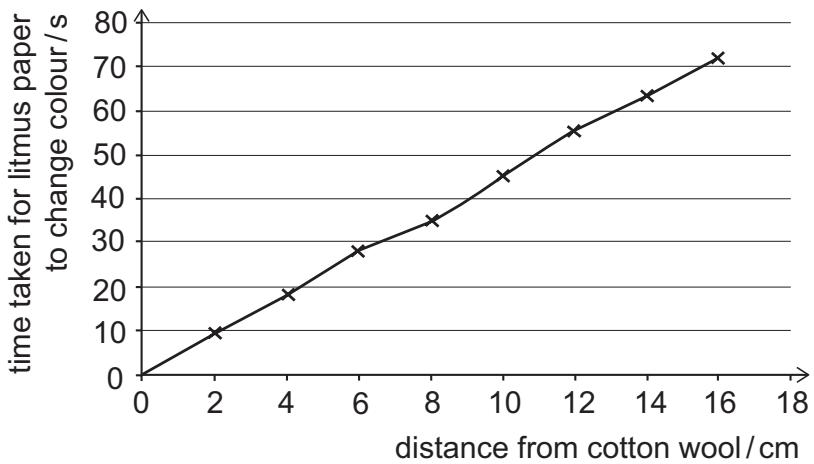
The time was recorded when each piece of litmus paper changed colour.
The apparatus and a graph of the results are shown below.
Which of the following statements about the investigation is/are correct?
1 The dependent variable has been plotted on the x-axis.
2 If diffusion of the gas was slower, the graph line would become steeper.
3 If a more concentrated solution was used in an identical set of apparatus, the data collected would result in a line on the graph below the points plotted for the original gas.
As the gas diffused, it caused damp litmus paper to change colour.
The time was recorded when each piece of litmus paper changed colour.
The apparatus and a graph of the results are shown below.
Which of the following statements about the investigation is/are correct?
1 The dependent variable has been plotted on the x-axis.
2 If diffusion of the gas was slower, the graph line would become steeper.
3 If a more concentrated solution was used in an identical set of apparatus, the data collected would result in a line on the graph below the points plotted for the original gas.
- A.none of them
- B.1 only
- C.2 only
- D.3 only
- E.1 and 2 only
- F.1 and 3 only
- G.2 and 3 only
Answer: G
Question 62
A bacterium was genetically modified by inserting a human gene into a plasmid. A plasmid is a small circle of DNA that can be used to transfer genes into bacterial cells. These modified bacteria then secrete the protein that the human gene codes for. The gene contains a sequence of bases that is not repeated anywhere else in its DNA and is not found in the DNA of other organisms. This sequence of bases is found in every allele of this gene.
Assuming that no mutations occur, how many copies of this base sequence would you expect to find at each of the stages X, Y and Z?
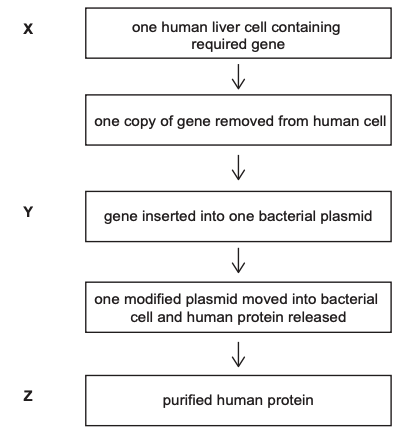
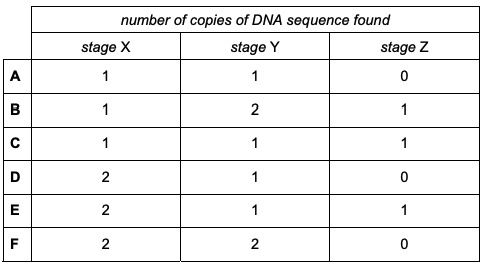
Assuming that no mutations occur, how many copies of this base sequence would you expect to find at each of the stages X, Y and Z?
- A.stage X: 1, stage Y: 1, stage Z: 0
- B.stage X: 1, stage Y: 2, stage Z: 1
- C.stage X: 1, stage Y: 1, stage Z: 1
- D.stage X: 2, stage Y: 1, stage Z: 0
- E.stage X: 2, stage Y: 1, stage Z: 1
- F.stage X: 2, stage Y: 2, stage Z: 0
Answer: D
Question 63
A student set up an experiment to measure the rate of photosynthesis, as shown in the diagram.
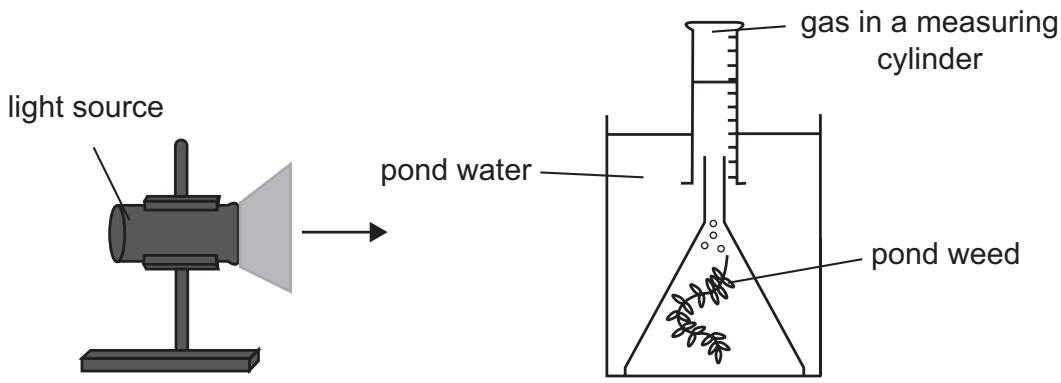
Data was collected and plotted on a graph.
If plotted, which of the following variables would give a gradient that is directly proportional to the rate of photosynthesis?
(All other variables were kept constant.)
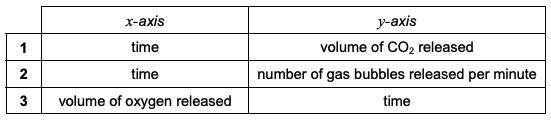
Data was collected and plotted on a graph.
If plotted, which of the following variables would give a gradient that is directly proportional to the rate of photosynthesis?
(All other variables were kept constant.)
- A.none of them
- B.1 only
- C.2 only
- D.3 only
- E.1 and 2 only
- F.1 and 3 only
- G.2 and 3 only
- H.1, 2 and 3
Answer: A
Question 64
Bacteria reproduce asexually by dividing into two by binary fission.
Which of the following statements is/are correct about binary fission in bacteria?
1 As it is a form of asexual reproduction, there cannot be any variation in the offspring.
2 It can lead to a repeated doubling in population size if there are no limiting factors.
3 If binary fission occurs every 20 minutes, one bacterium would become bacteria in 24 hours.
Which of the following statements is/are correct about binary fission in bacteria?
1 As it is a form of asexual reproduction, there cannot be any variation in the offspring.
2 It can lead to a repeated doubling in population size if there are no limiting factors.
3 If binary fission occurs every 20 minutes, one bacterium would become bacteria in 24 hours.
- A.none of them
- B.1 only
- C.2 only
- D.3 only
- E.1 and 2 only
- F.1 and 3 only
- G.2 and 3 only
- H.1, 2 and 3
Answer: C
Question 65
Which of the following may stay the same when a mutation occurs in a human gene that codes for a protein?
1 the genotype of the organism's offspring
2 the phenotype of the organism
3 the sequence of amino acids in the protein
1 the genotype of the organism's offspring
2 the phenotype of the organism
3 the sequence of amino acids in the protein
- A.none of them
- B.1 only
- C.2 only
- D.3 only
- E.1 and 2 only
- F.1 and 3 only
- G.2 and 3 only
- H.1, 2 and 3
Answer: H
Question 66
A child is affected by a dominant genetic condition. All of his cells have the same genotype. The allele associated with this condition is not present in either of his parents.
Which of the following statements could explain this?
1 A mutation occurred during meiosis in his father.
2 A random mutation occurred in his DNA after he was born.
3 Both of his grandmothers had the condition.
Which of the following statements could explain this?
1 A mutation occurred during meiosis in his father.
2 A random mutation occurred in his DNA after he was born.
3 Both of his grandmothers had the condition.
- A.none of them
- B.1 only
- C.2 only
- D.3 only
- E.1 and 2 only
- F.1 and 3 only
- G.2 and 3 only
- H.1, 2 and 3
Answer: B
Question 67
Phosphatase enzymes break the bond between a phosphate group and the rest of a molecule.
Phenolphthalein phosphate (PPP) is colourless and is a substrate for phosphatase enzymes.
• The phosphate group of PPP can be removed by the phosphatase enzyme to produce the indicator phenolphthalein.
• Phenolphthalein goes pink in alkaline conditions.
Five tubes were set up with equal concentrations of PPP and a plant phosphatase enzyme.
Each tube was at a different pH. The tubes were incubated at the same temperature. After 10 minutes Na₂CO₃ was then added to each tube until a pH of 9.5 was reached. The colour was observed immediately and then again after another 5 minutes.
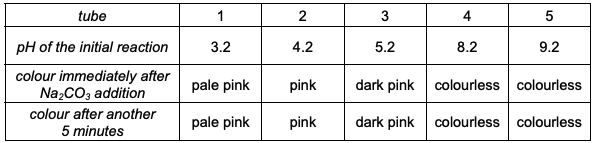
Which of the following statements is/are correct?
1 Na₂CO₃ solution inhibited the activity of the phosphatase enzyme.
2 More substrate was produced in conditions of high acidity compared to low acidity.
3 The optimum pH for this plant phosphatase must be 5.2.
Phenolphthalein phosphate (PPP) is colourless and is a substrate for phosphatase enzymes.
• The phosphate group of PPP can be removed by the phosphatase enzyme to produce the indicator phenolphthalein.
• Phenolphthalein goes pink in alkaline conditions.
Five tubes were set up with equal concentrations of PPP and a plant phosphatase enzyme.
Each tube was at a different pH. The tubes were incubated at the same temperature. After 10 minutes Na₂CO₃ was then added to each tube until a pH of 9.5 was reached. The colour was observed immediately and then again after another 5 minutes.
Which of the following statements is/are correct?
1 Na₂CO₃ solution inhibited the activity of the phosphatase enzyme.
2 More substrate was produced in conditions of high acidity compared to low acidity.
3 The optimum pH for this plant phosphatase must be 5.2.
- A.none of them
- B.1 only
- C.2 only
- D.3 only
- E.1 and 2 only
- F.1 and 3 only
- G.2 and 3 only
- H.1, 2 and 3
Answer: B
Question 68
A gene found on the X chromosome in humans has two alleles, dominant and recessive. Individuals who have only recessive alleles have a condition that affects their eyesight.
The inheritance of the condition in one family is shown in the family tree.
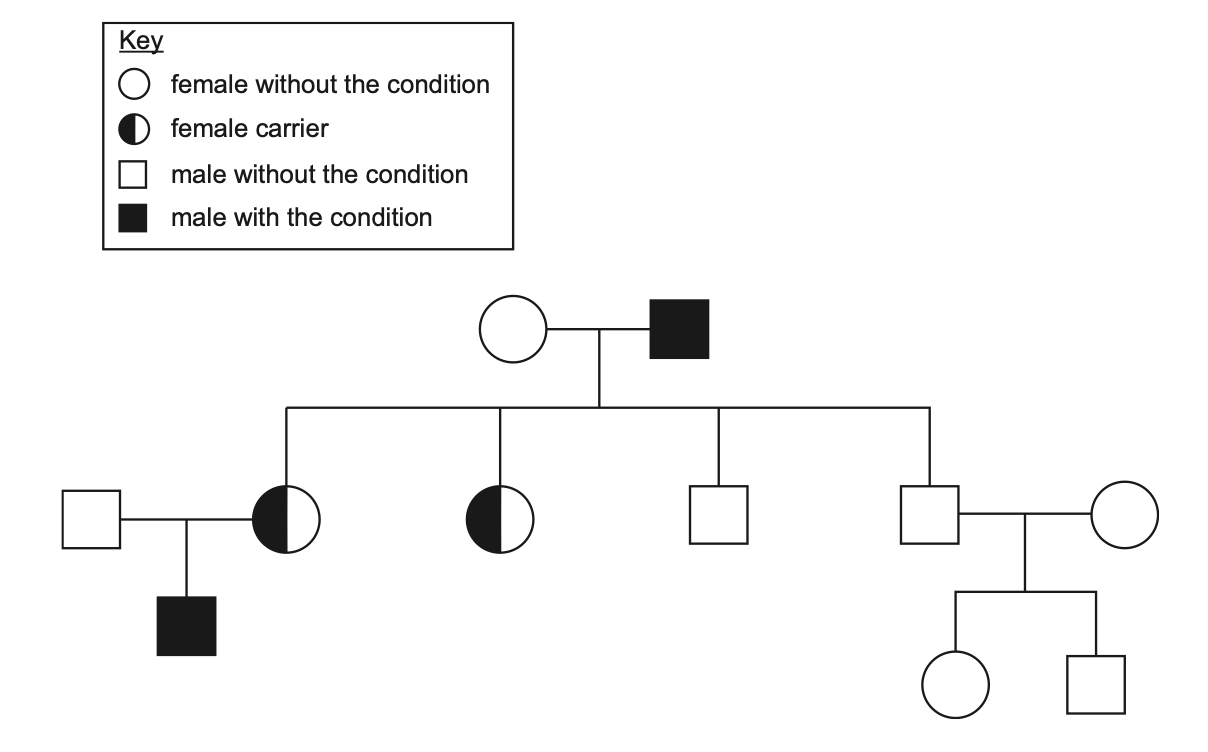
If one living skin cell from each member of this family were analysed, how many of the following alleles would be found?
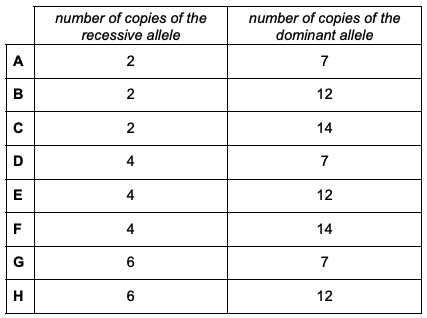
The table shows the options, with a different number of recessive and dominant alleles for each option A-H.
The inheritance of the condition in one family is shown in the family tree.
If one living skin cell from each member of this family were analysed, how many of the following alleles would be found?
The table shows the options, with a different number of recessive and dominant alleles for each option A-H.
- A.number of copies of the recessive allele: 2, number of copies of the dominant allele: 7
- B.number of copies of the recessive allele: 2, number of copies of the dominant allele: 12
- C.number of copies of the recessive allele: 2, number of copies of the dominant allele: 14
- D.number of copies of the recessive allele: 4, number of copies of the dominant allele: 7
- E.number of copies of the recessive allele: 4, number of copies of the dominant allele: 12
- F.number of copies of the recessive allele: 4, number of copies of the dominant allele: 14
- G.number of copies of the recessive allele: 6, number of copies of the dominant allele: 7
- H.number of copies of the recessive allele: 6, number of copies of the dominant allele: 12
Answer: E
Question 69
The graphs below show the oxygen uptake before, during and after a period of strenuous physical exercise.
Which shaded area correctly represents the additional oxygen taken in to repay the oxygen debt acquired through anaerobic respiration?
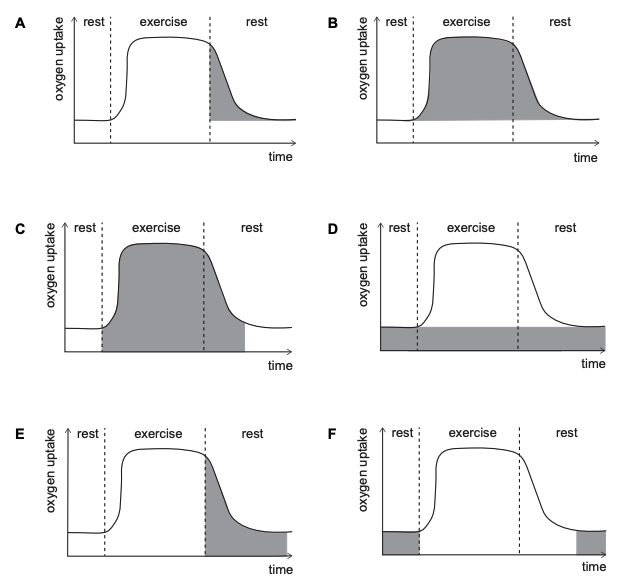
Which shaded area correctly represents the additional oxygen taken in to repay the oxygen debt acquired through anaerobic respiration?
- A.Graph A
- B.Graph B
- C.Graph C
- D.Graph D
- E.Graph E
- F.Graph F
Answer: A
Question 70
An investigation was carried out using clones of one plant.
Twenty plants of the same initial height were selected and divided into four equal groups. Each group was grown for six months and their environments were controlled as follows:
• kept at a different temperature to each other
• grown in a pot with an equal mass of soil with the same nutrients
• watered with an equal volume of water
• kept in the same light intensity
After six months, the height of the plants was measured. The mean height of the plants in each pot was calculated. The results are shown in the chart.
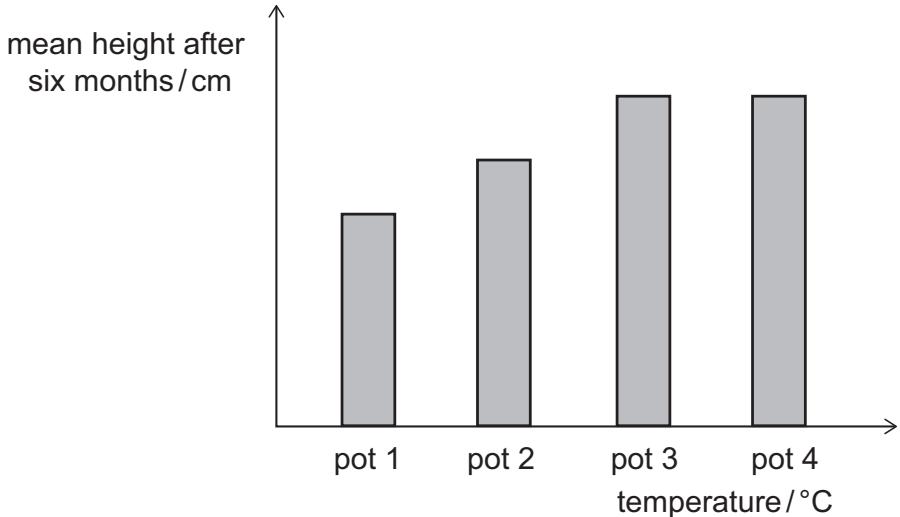
Which of the following statements could explain the results?
1 The difference in mean height between plants in pot 1 and plants in pot 2 could be due to the environment.
2 The mean height of plants in pot 4 equals that of plants in pot 3 because of another environmental factor in addition to temperature.
3 The mean height of plants in pot 3 equals that of plants in pot 4 because of the genotype of the plants.
Twenty plants of the same initial height were selected and divided into four equal groups. Each group was grown for six months and their environments were controlled as follows:
• kept at a different temperature to each other
• grown in a pot with an equal mass of soil with the same nutrients
• watered with an equal volume of water
• kept in the same light intensity
After six months, the height of the plants was measured. The mean height of the plants in each pot was calculated. The results are shown in the chart.
Which of the following statements could explain the results?
1 The difference in mean height between plants in pot 1 and plants in pot 2 could be due to the environment.
2 The mean height of plants in pot 4 equals that of plants in pot 3 because of another environmental factor in addition to temperature.
3 The mean height of plants in pot 3 equals that of plants in pot 4 because of the genotype of the plants.
- A.none of them
- B.1 only
- C.2 only
- D.3 only
- E.1 and 2 only
- F.1 and 3 only
- G.2 and 3 only
- H.1, 2 and 3
Answer: H
Question 71
An investigation was carried out on the effect of substrate concentration on an enzyme-controlled reaction.
Four different concentrations of substrate were tested. In each case, the concentration of product was measured at regular intervals following the introduction of the substrate.
All the other variables were kept constant.
The results obtained are shown on the graph.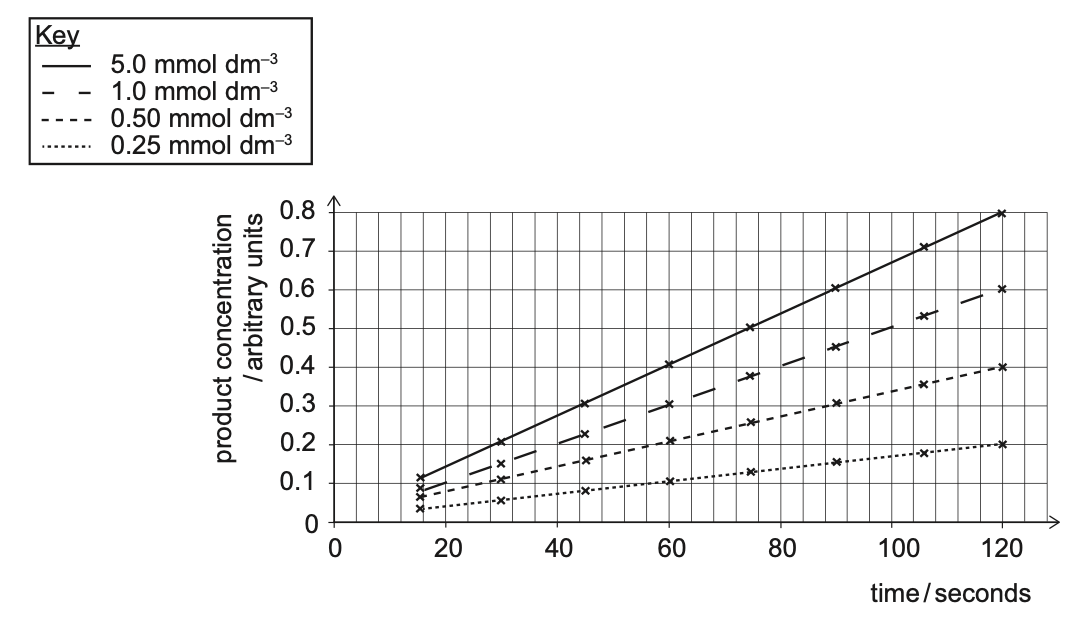
Which of the following statements is/are correct?
1 As substrate concentration increases, the time taken to produce 0.2 arbitrary units of product increases.
2 Doubling the substrate concentration always doubles the rate of the reaction.
3 The average rate of reaction for a substrate concentration of 1.0 mmol dm⁻³ is 0.005 arbitrary units per second.
Four different concentrations of substrate were tested. In each case, the concentration of product was measured at regular intervals following the introduction of the substrate.
All the other variables were kept constant.
The results obtained are shown on the graph.
Which of the following statements is/are correct?
1 As substrate concentration increases, the time taken to produce 0.2 arbitrary units of product increases.
2 Doubling the substrate concentration always doubles the rate of the reaction.
3 The average rate of reaction for a substrate concentration of 1.0 mmol dm⁻³ is 0.005 arbitrary units per second.
- A.none of them
- B.1 only
- C.2 only
- D.3 only
- E.1 and 2 only
- F.1 and 3 only
- G.2 and 3 only
- H.1, 2 and 3
Answer: D
Question 72
The sequence of a coding section of DNA is shown below.
CTAGTCTGGTGGCTACGTCCTCCTCTACTATGGCTAGTCGTCTGGTGGCTA
The number of each type of amino acid coded for by this sequence of DNA bases is shown in the table.
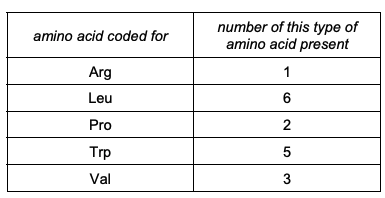
What is the correct sequence of amino acids coded for by this sequence of DNA?
CTAGTCTGGTGGCTACGTCCTCCTCTACTATGGCTAGTCGTCTGGTGGCTA
The number of each type of amino acid coded for by this sequence of DNA bases is shown in the table.
What is the correct sequence of amino acids coded for by this sequence of DNA?
- A.Leu-Trp-Trp-Leu-Arg-Pro-Pro-Leu-Leu-Val-Leu-Val-Val-Trp-Trp-Trp
- B.Leu-Trp-Trp-Leu-Arg-Pro-Pro-Leu-Leu-Trp-Leu-Trp-Val-Val-Val-Val
- C.Leu-Val-Trp-Trp-Leu-Arg-Pro-Pro-Leu-Leu-Trp-Leu-Val-Val-Trp-Trp
- D.Leu-Trp-Trp-Leu-Arg-Pro-Pro-Leu-Leu-Val-Leu-Val-Val-Trp-Trp-Trp-Leu
- E.Leu-Trp-Trp-Leu-Arg-Pro-Pro-Leu-Leu-Trp-Leu-Trp-Val-Val-Val-Val-Leu
- F.Leu-Leu-Trp-Trp-Leu-Arg-Pro-Pro-Leu-Leu-Trp-Leu-Val-Val-Trp-Trp-Val
- G.Leu-Val-Trp-Trp-Leu-Leu-Pro-Pro-Leu-Leu-Trp-Leu-Val-Val-Trp-Trp-Leu
- H.Leu-Val-Trp-Trp-Leu-Arg-Pro-Pro-Leu-Leu-Trp-Leu-Val-Val-Trp-Trp-Leu
Answer: H