NSAA 2019 Chemistry S1
16 questions16 marksUpdated June 2026
The NSAA 2019 Chemistry S1 paper in full: all 16 questions, each with its answer. NSAA is the Natural Sciences Admissions Assessment. Sit it cold under exam timing, mark it, then work back through anything you missed using the solutions below.
Download the original PDF →Questions and answers are free. Full step-by-step worked solutions unlock with a free account. Start practising.
Question 39
Four samples, labelled W, X, Y and Z, were investigated using paper chromatography with a solvent that caused any mixtures present to be fully separated. The results are shown in the chromatogram.
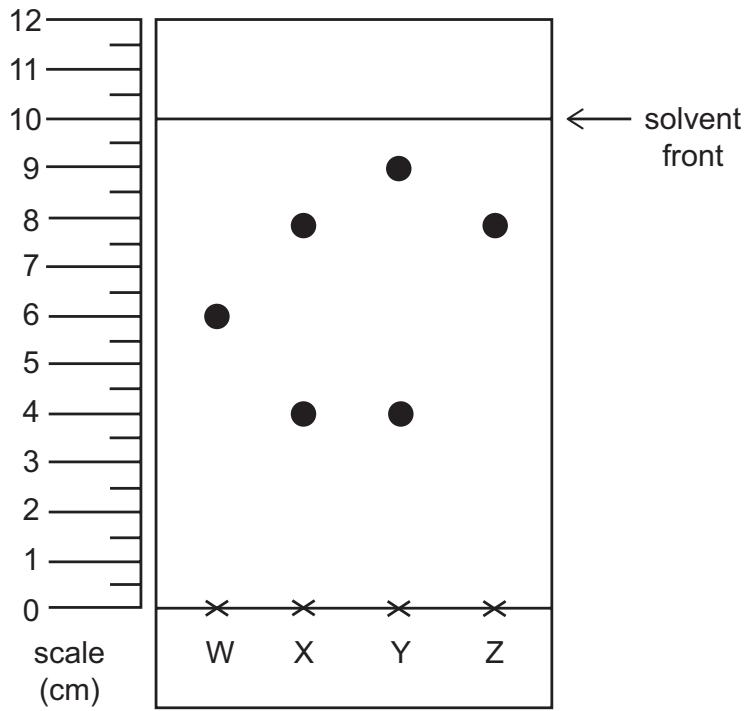
What is the value of the spot with the strongest attraction to the mobile phase relative to the stationary phase and that is from a sample containing only one substance?
What is the value of the spot with the strongest attraction to the mobile phase relative to the stationary phase and that is from a sample containing only one substance?
- A.0.50
- B.0.60
- C.0.67
- D.0.75
- E.0.80
- F.0.90
Answer: E
Question 40
A mass spectrometer is a device that can measure the mass of isotopes. It shows this data as a spectrum, giving both the relative mass and the percentage abundance of each isotope.
The charts indicate the relative mass and percentage abundance for lithium atoms, carbon atoms and oxygen atoms found in a sample taken from a nuclear reactor.
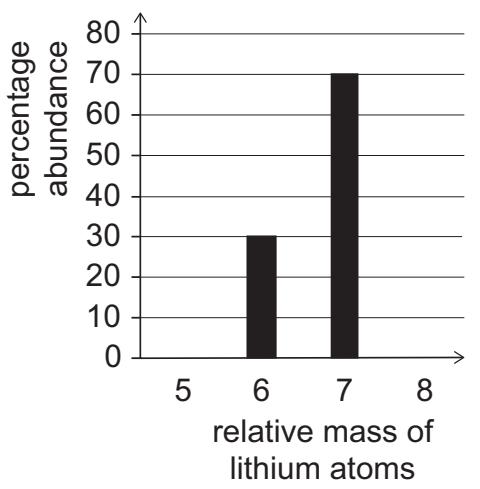
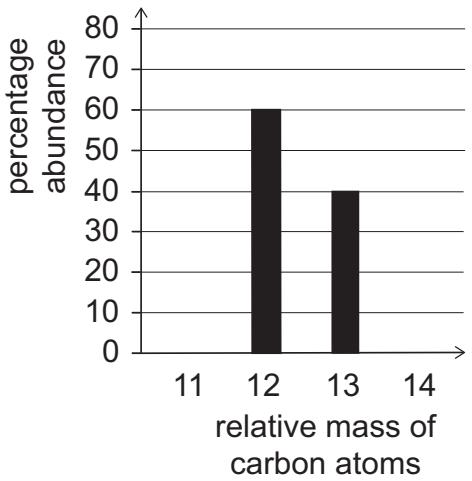
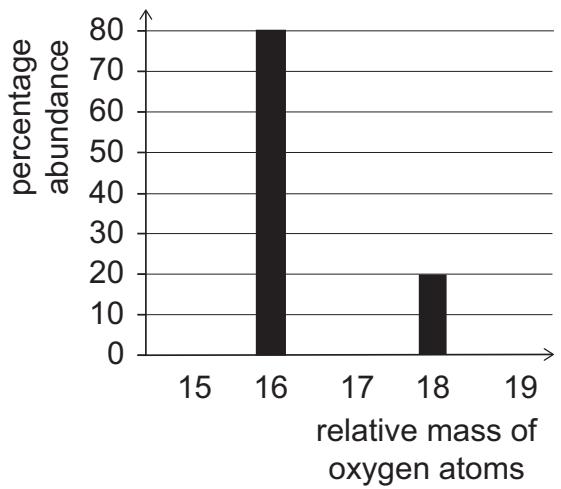
Using this data, what is the largest possible relative molar mass of lithium carbonate?
The charts indicate the relative mass and percentage abundance for lithium atoms, carbon atoms and oxygen atoms found in a sample taken from a nuclear reactor.
Using this data, what is the largest possible relative molar mass of lithium carbonate?
- A.35
- B.38
- C.45
- D.67
- E.74
- F.75
- G.81
Answer: G
Question 41
The following information about metals labelled P, Q, R and S is given.
* Metals P and S can be extracted by electrolysis, but not by reaction with carbon.
* Metals Q and R can be extracted by reaction with carbon.
* Metal S forms positive ions more readily than metal P.
* Metal R reacts with the oxide of metal Q.
What is the order of reactivity of these four metals, starting with the most reactive?
* Metals P and S can be extracted by electrolysis, but not by reaction with carbon.
* Metals Q and R can be extracted by reaction with carbon.
* Metal S forms positive ions more readily than metal P.
* Metal R reacts with the oxide of metal Q.
What is the order of reactivity of these four metals, starting with the most reactive?
- A.P, S, Q, R
- B.P, S, R, Q
- C.Q, R, P, S
- D.Q, R, S, P
- E.R, Q, P, S
- F.R, Q, S, P
- G.S, P, Q, R
- H.S, P, R, Q
Answer: H
Question 42
A simple ion of an element with atomic number has a mass number of .
The ion has a charge of -2.
How many protons, neutrons and electrons are present in this ion?
| | protons | neutrons | electrons |
|---|---|---|---|
| A | | | |
| B | | | |
| C | | | |
| D | | | |
| E | | | |
| F | | | |
The ion has a charge of -2.
How many protons, neutrons and electrons are present in this ion?
| | protons | neutrons | electrons |
|---|---|---|---|
| A | | | |
| B | | | |
| C | | | |
| D | | | |
| E | | | |
| F | | | |
- A. protons, neutrons, electrons
- B. protons, neutrons, electrons
- C. protons, neutrons, electrons
- D. protons, neutrons, electrons
- E. protons, neutrons, electrons
- F. protons, neutrons, electrons
Answer: F
Question 43
A 116 g sample of an oxide of iron contains 84 g of iron.
Which of the following is the empirical formula of this oxide of iron?
( values: O = 16; Fe = 56)
Which of the following is the empirical formula of this oxide of iron?
( values: O = 16; Fe = 56)
- A.FeO
- B.
- C.
- D.
- E.
Answer: E
Question 44
Which of the following chemical equations represent(s) a redox reaction?
1.
2.
3.
1.
2.
3.
- A.none of them
- B.1 only
- C.2 only
- D.3 only
- E.1 and 2 only
- F.1 and 3 only
- G.2 and 3 only
- H.1, 2 and 3
Answer: B
Question 45
X is an anhydrous salt of iron containing one type of cation and one type of anion.
An aqueous solution of X gives a white precipitate when aqueous barium chloride is added in the presence of hydrochloric acid.
On adding aqueous sodium hydroxide to an aqueous solution of X, a brown precipitate formed immediately.
The relative atomic mass of iron is 56, and its atomic number is 26.
What is the relative molar mass of X?
( values: C = 12; N = 14; O = 16; S = 32; Cl = 35.5; Br = 80)
An aqueous solution of X gives a white precipitate when aqueous barium chloride is added in the presence of hydrochloric acid.
On adding aqueous sodium hydroxide to an aqueous solution of X, a brown precipitate formed immediately.
The relative atomic mass of iron is 56, and its atomic number is 26.
What is the relative molar mass of X?
( values: C = 12; N = 14; O = 16; S = 32; Cl = 35.5; Br = 80)
- A.127
- B.152
- C.162.5
- D.208
- E.264
- F.272
- G.360
- H.400
Answer: H
Question 46
In the electrolysis of dilute sulfuric acid, hydrogen gas is formed at the negative electrode (cathode) and oxygen gas is formed at the positive electrode (anode).
If 100 g of hydrogen gas is formed in the electrolysis of dilute sulfuric acid, what mass of oxygen gas is also formed?
( values: H = 1; O = 16)
If 100 g of hydrogen gas is formed in the electrolysis of dilute sulfuric acid, what mass of oxygen gas is also formed?
( values: H = 1; O = 16)
- A.50 g
- B.100 g
- C.200 g
- D.800 g
- E.1600 g
Answer: D
Question 47
0.005 mol of a chloride of element X was dissolved in water and then reacted with excess silver nitrate solution to form a precipitate of silver chloride, AgCl. This precipitate is the only product of this reaction that contains chlorine.
After filtering, washing and drying, the mass of the precipitate was recorded to be 1.435 g.
Which of the following could be the formula of the chloride of X?
( value: AgCl = 143.5)
After filtering, washing and drying, the mass of the precipitate was recorded to be 1.435 g.
Which of the following could be the formula of the chloride of X?
( value: AgCl = 143.5)
- A.
- B.
- C.XCl
- D.
- E.
Answer: D
Question 48
A chemical equation that represents the reaction of phosphorus with concentrated nitric acid is:
What is the value of the sum ?
What is the value of the sum ?
- A.24
- B.28
- C.30
- D.32
- E.36
Answer: A
Question 49
A 2.40 g lump of magnesium was added to 500 cm³ of a 2.00 mol dm⁻³ solution of HCl in a conical flask that was on an electronic balance. The neck of the flask was plugged with cotton wool, and the decrease in mass of the flask and its contents was recorded at regular intervals.
The mass of the hydrogen released (equal to the mass loss recorded) was plotted against time. The result is line 1 on the graph.
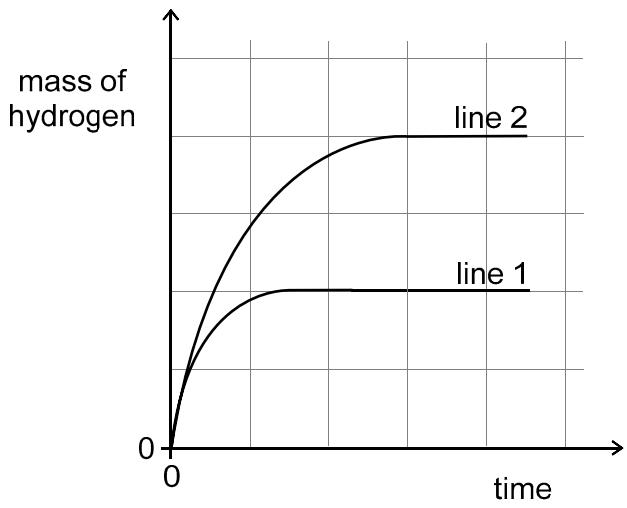
Which of the following experiments performed under the same conditions would give line 2?
( value: Mg = 24.0)
The mass of the hydrogen released (equal to the mass loss recorded) was plotted against time. The result is line 1 on the graph.
Which of the following experiments performed under the same conditions would give line 2?
( value: Mg = 24.0)
- A.a 2.40 g lump of magnesium added to 500 cm³ of 2.00 mol dm⁻³
- B.2.40 g of magnesium powder added to 500 cm³ of 2.00 mol dm⁻³ HCl
- C.a 2.40 g lump of magnesium added to 1000 cm³ of 2.00 mol dm⁻³ HCl
- D.a 4.80 g lump of magnesium added to 500 cm³ of 2.00 mol dm⁻³ HCl
- E.4.80 g of magnesium powder added to 500 cm³ of 2.00 mol dm⁻³ HCl
Answer: D
Question 50
A technician needs to separate three liquids (X, Y and Z) which have been accidentally mixed together. None of the liquids react with each other.
| liquid | X | Y | Z |
|---|---|---|---|
| boiling point / °C | 65 | 51 | 100 |
| density / g cm⁻³ | 0.79 | 0.68 | 1.00 |
X and Z are miscible, but Y is immiscible with both X and Z.
The technician uses a separating funnel to separate the upper and lower layers of the mixture.
What should the technician do next to maximise separation of the three liquids?
| liquid | X | Y | Z |
|---|---|---|---|
| boiling point / °C | 65 | 51 | 100 |
| density / g cm⁻³ | 0.79 | 0.68 | 1.00 |
X and Z are miscible, but Y is immiscible with both X and Z.
The technician uses a separating funnel to separate the upper and lower layers of the mixture.
What should the technician do next to maximise separation of the three liquids?
- A.distil the lower layer at 51 °C
- B.distil the lower layer at 65 °C
- C.distil the lower layer at 100 °C
- D.distil the upper layer at 51 °C
- E.distil the upper layer at 65 °C
- F.distil the upper layer at 100 °C
Answer: B
Question 51
In each of the following procedures an excess of the metal is added to 1.0 dm³ of a 1.0 mol dm⁻³ solution of the acid.
* copper added to sulfuric acid
* iron added to hydrochloric acid
* magnesium added to sulfuric acid
* zinc added to hydrochloric acid
Which row in the following table identifies combinations of metal and acid that will react and produce the largest, and the smallest, theoretical mass of anhydrous salt?
( values: = 160; = 127; = 120; = 136)
| | reaction that produces the largest mass of salt | reaction that produces the smallest mass of salt |
|---|---|---|
| A | Cu and | Fe and HCl |
| B | Cu and | Mg and |
| C | Fe and HCl | Zn and HCl |
| D | Mg and | Fe and HCl |
| E | Mg and | Zn and HCl |
| F | Zn and HCl | Mg and |
* copper added to sulfuric acid
* iron added to hydrochloric acid
* magnesium added to sulfuric acid
* zinc added to hydrochloric acid
Which row in the following table identifies combinations of metal and acid that will react and produce the largest, and the smallest, theoretical mass of anhydrous salt?
( values: = 160; = 127; = 120; = 136)
| | reaction that produces the largest mass of salt | reaction that produces the smallest mass of salt |
|---|---|---|
| A | Cu and | Fe and HCl |
| B | Cu and | Mg and |
| C | Fe and HCl | Zn and HCl |
| D | Mg and | Fe and HCl |
| E | Mg and | Zn and HCl |
| F | Zn and HCl | Mg and |
- A.Largest: Cu and , Smallest: Fe and HCl
- B.Largest: Cu and , Smallest: Mg and
- C.Largest: Fe and HCl, Smallest: Zn and HCl
- D.Largest: Mg and , Smallest: Fe and HCl
- E.Largest: Mg and , Smallest: Zn and HCl
- F.Largest: Zn and HCl, Smallest: Mg and
Answer: D
Question 52
3.4 g of an impure sample of silicon tetrachloride is reacted with water. The mixture is then filtered and the resulting solution made up to 250 cm³.
12.5 cm³ of this solution is neutralised exactly by 20.0 cm³ of 0.100 mol dm⁻³ sodium hydroxide.
What is the percentage purity of the silicon tetrachloride?
( value: = 170. Assume that the impurity does not react.)
12.5 cm³ of this solution is neutralised exactly by 20.0 cm³ of 0.100 mol dm⁻³ sodium hydroxide.
What is the percentage purity of the silicon tetrachloride?
( value: = 170. Assume that the impurity does not react.)
- A.1.7%
- B.2.5%
- C.10%
- D.32%
- E.50%
Answer: E
Question 53
The Haber process is represented by the following chemical equation:
What is the overall enthalpy change for the reaction?
(Bond enthalpies: = 945 kJ mol⁻¹; H-H = 435 kJ mol⁻¹; N-H = 390 kJ mol⁻¹)
What is the overall enthalpy change for the reaction?
(Bond enthalpies: = 945 kJ mol⁻¹; H-H = 435 kJ mol⁻¹; N-H = 390 kJ mol⁻¹)
- A.+90 kJ mol⁻¹
- B.-90 kJ mol⁻¹
- C.+990 kJ mol⁻¹
- D.-990 kJ mol⁻¹
- E.+1080 kJ mol⁻¹
- F.-1080 kJ mol⁻¹
Answer: B
Question 54
The diagram shows the electrolysis of molten lead(II) bromide, , using graphite electrodes to separate the compound into its elements.
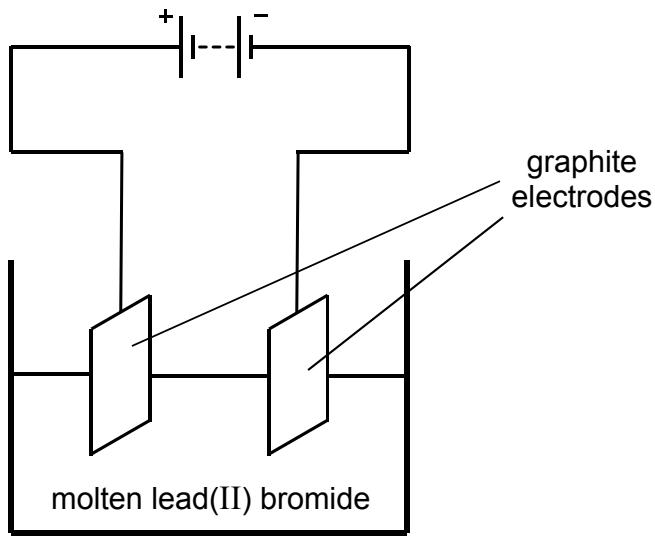
Which of the following statements about this electrolysis is/are correct?
1. Lead is formed at the negative electrode.
2. Electrons flow through the external circuit away from the positive electrode towards the negative electrode.
3. Bromine molecules and lead are produced in a 2:1 molar ratio.
Which of the following statements about this electrolysis is/are correct?
1. Lead is formed at the negative electrode.
2. Electrons flow through the external circuit away from the positive electrode towards the negative electrode.
3. Bromine molecules and lead are produced in a 2:1 molar ratio.
- A.none of them
- B.1 only
- C.2 only
- D.3 only
- E.1 and 2 only
- F.1 and 3 only
- G.2 and 3 only
- H.1, 2 and 3
Answer: E