NSAA 2019 Physics S1
17 questions17 marksUpdated June 2026
The NSAA 2019 Physics S1 paper in full: all 17 questions, each with its answer. NSAA is the Natural Sciences Admissions Assessment. Sit it cold under exam timing, mark it, then work back through anything you missed using the solutions below.
Download the original PDF →Questions and answers are free. Full step-by-step worked solutions unlock with a free account. Start practising.
Question 20
A builder lifts bags of cement onto the back of a lorry. Each bag has a mass of 25 kg. It takes the builder 2.5 minutes to load ten bags.
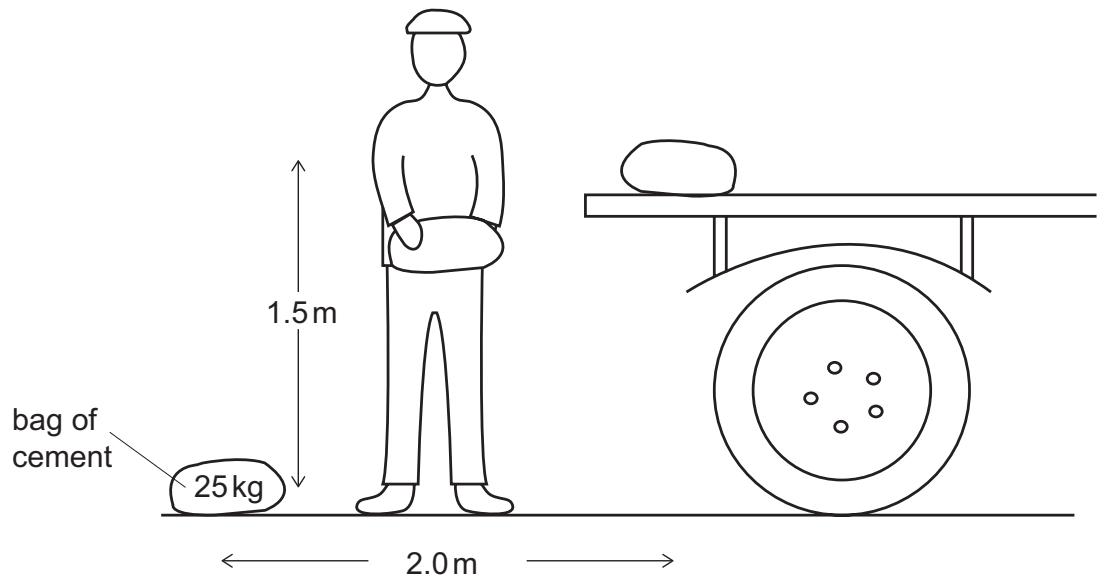
[diagram not to scale]
What are the total work done, T, on the ten bags and the average power required for T?
(gravitational field strength = )
[diagram not to scale]
What are the total work done, T, on the ten bags and the average power required for T?
(gravitational field strength = )
- A.total work done T/J: 375, average power / W: 2.5
- B.total work done T/J: 375, average power / W: 150
- C.total work done T/J: 625, average power / W: 4.2
- D.total work done T/J: 625, average power / W: 250
- E.total work done T/J: 3750, average power / W: 25
- F.total work done T/J: 3750, average power / W: 1500
- G.total work done T/J: 6250, average power / W: 42
- H.total work done T/J: 6250, average power / W: 2500
Answer: E
Question 21
The current-voltage graph for a diode is shown.
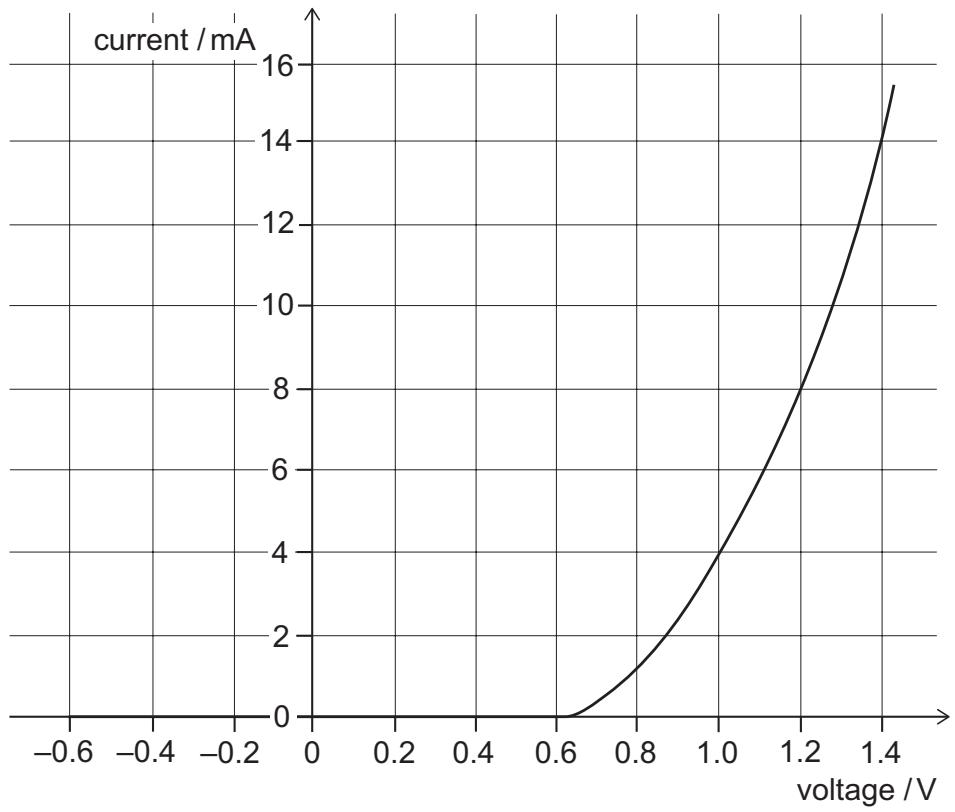
The diode is connected in series with a resistor and a 6.0 V battery. The current in the circuit is 8.0 mA.
What is the resistance of the resistor?
(Assume that the battery has negligible resistance.)
The diode is connected in series with a resistor and a 6.0 V battery. The current in the circuit is 8.0 mA.
What is the resistance of the resistor?
(Assume that the battery has negligible resistance.)
- A.
- B.
- C.
- D.
- E.
- F.
- G.
Answer: F
Question 22
Two electromagnetic waves P and Q travel in a vacuum and the ratio of their wavelengths is:
Which row in the table shows the ratio of their speeds, the ratio of their frequencies, and identifies the possible natures of P and Q?
Which row in the table shows the ratio of their speeds, the ratio of their frequencies, and identifies the possible natures of P and Q?
- A.speed of P / speed of Q: 1.0, frequency of P / frequency of Q: , nature of P: microwave, nature of Q: X-ray
- B.speed of P / speed of Q: 1.0, frequency of P / frequency of Q: , nature of P: microwave, nature of Q: radio wave
- C.speed of P / speed of Q: 1.0, frequency of P / frequency of Q: , nature of P: infrared, nature of Q: ultraviolet
- D.speed of P / speed of Q: 1.0, frequency of P / frequency of Q: , nature of P: visible light, nature of Q: infrared
- E.speed of P / speed of Q: , frequency of P / frequency of Q: 1.0, nature of P: gamma, nature of Q: X-ray
- F.speed of P / speed of Q: , frequency of P / frequency of Q: 1.0, nature of P: gamma, nature of Q: infrared
- G.speed of P / speed of Q: , frequency of P / frequency of Q: , nature of P: infrared, nature of Q: radio wave
- H.speed of P / speed of Q: , frequency of P / frequency of Q: , nature of P: visible light, nature of Q: ultraviolet
Answer: A
Question 23
A block of aluminium of mass 0.80 kg, initially at a temperature of , is supplied with 54 000 J of thermal energy.
The specific heat capacity of aluminium is .
What is the final temperature of the block?
(Assume that there is no other transfer of energy between the block and the surroundings.)
The specific heat capacity of aluminium is .
What is the final temperature of the block?
(Assume that there is no other transfer of energy between the block and the surroundings.)
- A.
- B.
- C.
- D.
- E.
Answer: C
Question 24
A light spring is used to support a range of loads.
The spring obeys Hooke's law. The system is in equilibrium.
Which of the following statements is/are correct?
1 The tension in the spring is directly proportional to the length of the spring.
2 The tension in the spring and the weight of the load it supports are a Newton's third law pair of forces.
3 When the extension of the spring is doubled, the energy stored in the spring increases by a factor of four.
The spring obeys Hooke's law. The system is in equilibrium.
Which of the following statements is/are correct?
1 The tension in the spring is directly proportional to the length of the spring.
2 The tension in the spring and the weight of the load it supports are a Newton's third law pair of forces.
3 When the extension of the spring is doubled, the energy stored in the spring increases by a factor of four.
- A.none of them
- B.1 only
- C.2 only
- D.3 only
- E.1 and 2 only
- F.1 and 3 only
- G.2 and 3 only
- H.1, 2 and 3
Answer: D
Question 25
A water-tight cylinder with a thin, freely moving piston contains of trapped air at atmospheric pressure of .
When the cylinder is submerged in water of constant density , the volume of air in the cylinder decreases to .
The piston is at a depth h below the surface of the water and the water surface is open to the atmosphere.
What is the depth h?
(gravitational field strength = ; assume that the temperature of the air remains constant and that air is an ideal gas)
When the cylinder is submerged in water of constant density , the volume of air in the cylinder decreases to .
The piston is at a depth h below the surface of the water and the water surface is open to the atmosphere.
What is the depth h?
(gravitational field strength = ; assume that the temperature of the air remains constant and that air is an ideal gas)
- A.40 m
- B.50 m
- C.60 m
- D.400 m
- E.500 m
- F.600 m
Answer: A
Question 26
The secondary coil of an ideal, 100% efficient transformer is connected to a resistor by cables of total resistance . The current in the primary coil is 4.0 A. There are 240 turns in the primary coil and 4800 turns in the secondary coil.
What is the power produced as heat in the cables?
What is the power produced as heat in the cables?
- A.60 W
- B.300 W
- C.6000 W
- D.24000 W
- E.120000 W
- F.9600000 W
Answer: A
Question 27
Heat is supplied to an initially solid substance at a rate of 60 W.
The graph shows the variation of the temperature of the substance with time.
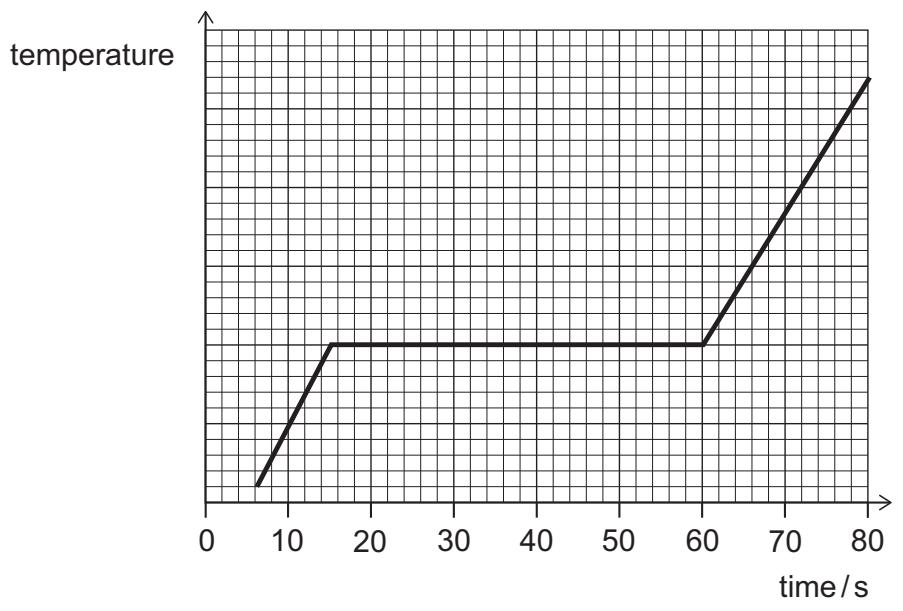
What is the mass of the substance?
(specific latent heat of fusion of substance = ; assume that there is no heat transferred to the surroundings)
The graph shows the variation of the temperature of the substance with time.
What is the mass of the substance?
(specific latent heat of fusion of substance = ; assume that there is no heat transferred to the surroundings)
- A.0.013 g
- B.0.60 g
- C.3.0 g
- D.9.0 g
- E.27 g
- F.36 g
Answer: E
Question 28
Two tanks of water are connected by a solid cylindrical copper bar of length l and diameter d.
The bar is insulated.
One tank contains water at and the other tank contains water at temperature .
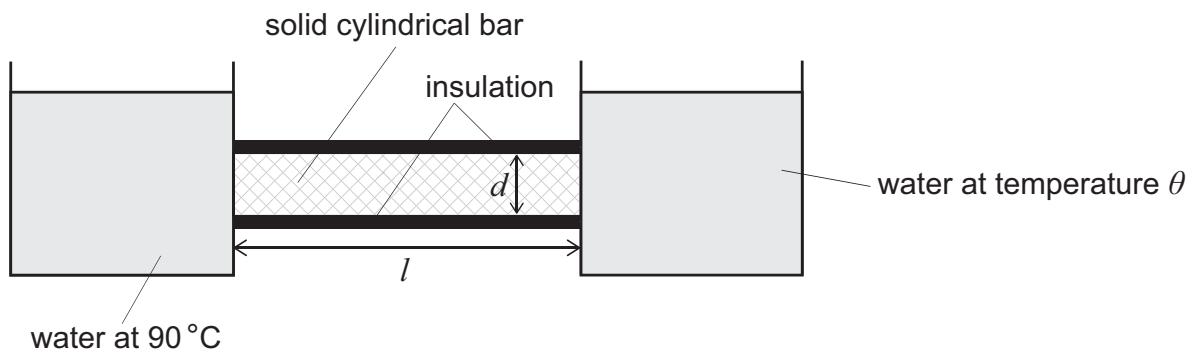
For which of the following conditions is thermal energy conducted along the bar at the lowest rate?
The bar is insulated.
One tank contains water at and the other tank contains water at temperature .
For which of the following conditions is thermal energy conducted along the bar at the lowest rate?
- A.l/m: 0.40, d/cm: 4.0, /°C: 20
- B.l/m: 0.40, d/cm: 4.0, /°C: 40
- C.l/m: 0.40, d/cm: 8.0, /°C: 20
- D.l/m: 0.40, d/cm: 8.0, /°C: 40
- E.l/m: 0.80, d/cm: 4.0, /°C: 20
- F.l/m: 0.80, d/cm: 4.0, /°C: 40
- G.l/m: 0.80, d/cm: 8.0, /°C: 20
- H.l/m: 0.80, d/cm: 8.0, /°C: 40
Answer: F
Question 29
A U-shaped permanent magnet rests on a balance.
A straight, horizontal wire of length 5.0 cm is fixed in position between the poles of the magnet, perpendicular to the horizontal magnetic field.
There is a current of 2.0 A in the wire and the reading on the balance is 202 g.
When the direction of the 2.0 A current is reversed, the reading changes to 198 g.
What is the strength of the magnetic field?
(gravitational field strength = )
A straight, horizontal wire of length 5.0 cm is fixed in position between the poles of the magnet, perpendicular to the horizontal magnetic field.
There is a current of 2.0 A in the wire and the reading on the balance is 202 g.
When the direction of the 2.0 A current is reversed, the reading changes to 198 g.
What is the strength of the magnetic field?
(gravitational field strength = )
- A.0.020 T
- B.0.040 T
- C.0.20 T
- D.0.40 T
- E.200 T
- F.400 T
Answer: C
Question 30
The radioactive isotope X becomes the stable isotope Y after a succession of decays involving only the emission of alpha and beta () particles.
During the decay of one nucleus from X to Y, a total of seven particles are emitted. It is known that more of these particles are alpha particles than beta particles.
The atomic number of X is Z and the mass number of X is A.
Which row in the table could give the atomic number and the mass number of Y?
During the decay of one nucleus from X to Y, a total of seven particles are emitted. It is known that more of these particles are alpha particles than beta particles.
The atomic number of X is Z and the mass number of X is A.
Which row in the table could give the atomic number and the mass number of Y?
- A.atomic number of Y: Z - 2, mass number of Y: A - 12
- B.atomic number of Y: Z - 5, mass number of Y: A - 8
- C.atomic number of Y: Z - 8, mass number of Y: A - 20
- D.atomic number of Y: Z - 10, mass number of Y: A - 24
- E.atomic number of Y: Z - 11, mass number of Y: A - 16
Answer: C
Question 31
The kinetic energy of an object of mass 4.0 kg, travelling in a straight line, increases from 32 J to 200 J in 3.0 seconds due to a constant resultant force.
What is the value of this resultant force?
What is the value of this resultant force?
- A.2.0 N
- B.4.0 N
- C.8.0 N
- D.24 N
- E.28 N
- F.56 N
Answer: C
Question 32
In the following circuit, all five resistors have the same resistance.
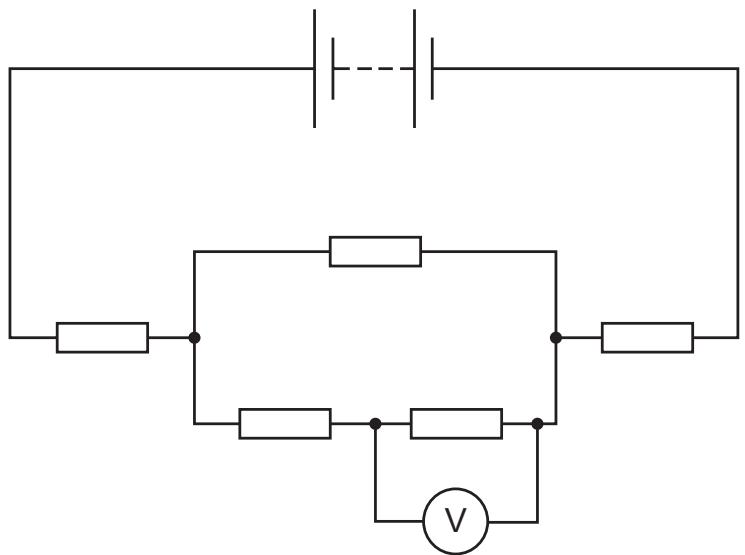
The reading on the voltmeter is 1.0 V.
What is the voltage across the battery?
The reading on the voltmeter is 1.0 V.
What is the voltage across the battery?
- A.4.0 V
- B.5.0 V
- C.6.0 V
- D.7.0 V
- E.8.0 V
- F.9.0 V
- G.10 V
Answer: E
Question 33
Two hovercraft travel horizontally in opposite directions along the same straight line. The mass and speed of each hovercraft are shown in the diagram. Horizontal resistive forces acting on each hovercraft are negligible.
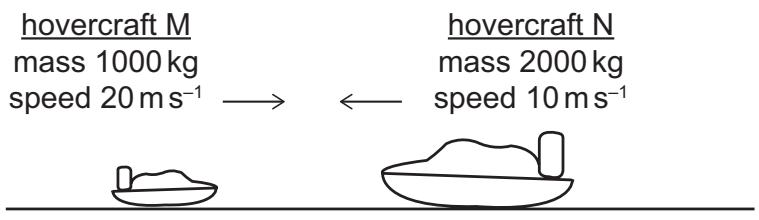
The hovercraft collide and stick together. The collision lasts for 0.10 s.
Just before the collision, what is the total kinetic energy and the magnitude of the total momentum of the two hovercraft, and what is the magnitude of the average force acting horizontally on each hovercraft during the collision?
The hovercraft collide and stick together. The collision lasts for 0.10 s.
Just before the collision, what is the total kinetic energy and the magnitude of the total momentum of the two hovercraft, and what is the magnitude of the average force acting horizontally on each hovercraft during the collision?
- A.total initial kinetic energy/kJ: 100, total initial momentum /kgms⁻¹: 0, average force on each hovercraft /kN: 2.0
- B.total initial kinetic energy/kJ: 100, total initial momentum /kgms⁻¹: 0, average force on each hovercraft /kN: 200
- C.total initial kinetic energy/kJ: 100, total initial momentum /kgms⁻¹: , average force on each hovercraft /kN: 2.0
- D.total initial kinetic energy/kJ: 100, total initial momentum /kgms⁻¹: , average force on each hovercraft /kN: 200
- E.total initial kinetic energy/kJ: 300, total initial momentum /kgms⁻¹: 0, average force on each hovercraft /kN: 2.0
- F.total initial kinetic energy/kJ: 300, total initial momentum /kgms⁻¹: 0, average force on each hovercraft /kN: 200
- G.total initial kinetic energy/kJ: 300, total initial momentum /kgms⁻¹: , average force on each hovercraft /kN: 2.0
- H.total initial kinetic energy/kJ: 300, total initial momentum /kgms⁻¹: , average force on each hovercraft /kN: 200
Answer: F
Question 34
The graph shows how a car's velocity changes in 85 seconds.
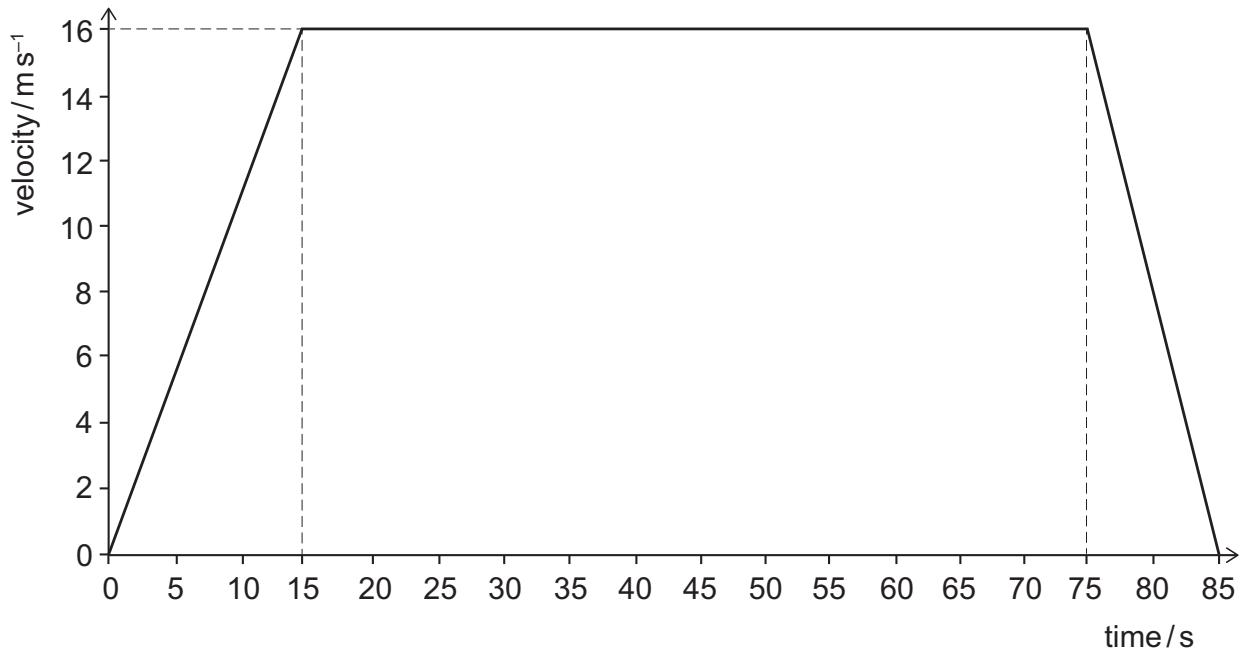
What proportion of the total distance is travelled at constant velocity?
What proportion of the total distance is travelled at constant velocity?
- A.
- B.
- C.
- D.
- E.
- F.
Answer: D
Question 35
A block is designed with a cylindrical channel to accommodate a hot-water pipe. The block is 100 cm long and it has a square cross-section of side 22.0 cm with a cylindrical hole in the middle, as shown in the diagram:
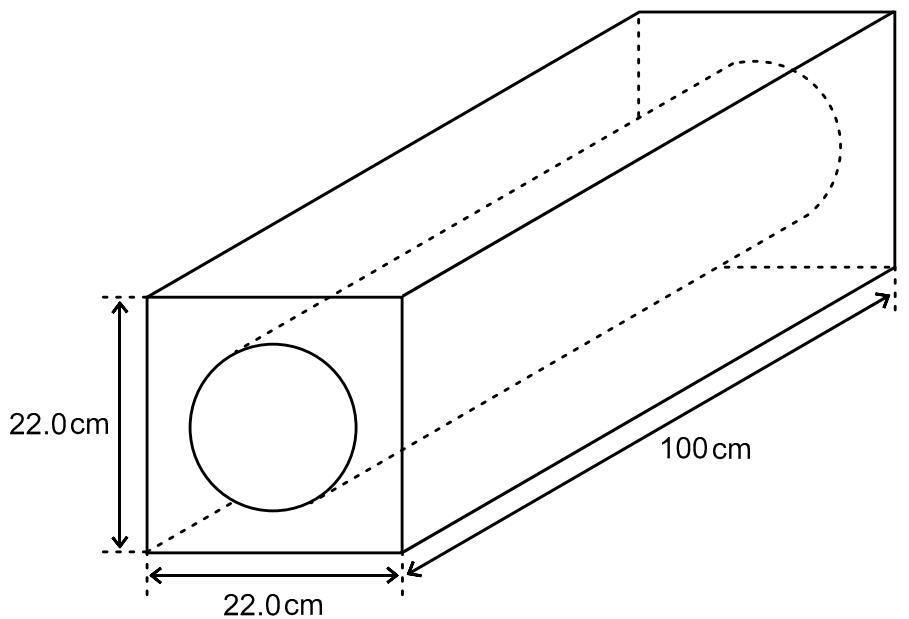
[diagram not to scale]
The diameter of the cylindrical hole is 14.0 cm and the density of the material from which the block is made is .
What is the mass of the block?
(take to be )
[diagram not to scale]
The diameter of the cylindrical hole is 14.0 cm and the density of the material from which the block is made is .
What is the mass of the block?
(take to be )
- A.1.32 kg
- B.3.30 kg
- C.13.2 kg
- D.33.0 kg
- E.132 kg
- F.330 kg
- G.1320 kg
- H.3300 kg
Answer: B
Question 36
A sample initially contains equal numbers of atoms of a radioactive isotope X and a stable isotope Y.
Isotope X has a half-life of 3 years and decays in a single stage to the stable isotope Y.
What is the ratio
number of atoms of X : number of atoms of Y
in the sample 6 years later?
Isotope X has a half-life of 3 years and decays in a single stage to the stable isotope Y.
What is the ratio
number of atoms of X : number of atoms of Y
in the sample 6 years later?
- A.The sample contains only isotope Y.
- B.1:7
- C.1:4
- D.1:3
- E.7:4
Answer: B