Mapped to the ESAT specification
NSAA 2020 Chemistry Part C
20 questions20 marksUpdated October 2025
Natural Sciences Admissions Assessment 2020 is one of the closest available past papers for the Engineering and Science Admissions Test. Below, all 20 questions are mapped to the ESAT topics they test, each with its answer. Sit it cold under exam timing, then work back through anything you missed using the solutions.
What this paper covers on the ESAT
Every question mapped to the Engineering and Science Admissions Test specification, so you know exactly which areas it tests.
Mathematics 1
- Algebra (1)
Chemistry
- Quantitative chemistry (17)
- Electrolysis (5)
- Oxidation, reduction and redox (5)
- The Periodic Table (IUPAC conventions, Groups are labelled as 1-18) (5)
- Acids, bases and salts (4)
- Atomic structure (4)
- Group chemistry (4)
- Chemical reactions, formulae and equations (3)
- Chemical tests (3)
- Separation techniques (3)
- Carbon/Organic chemistry (2)
- Chemical bonding, structure and properties (2)
- Energetics (2)
- Rates of reaction (2)
- Air and water (1)
- Kinetic/Particle theory (1)
Questions and answers are free. Full step-by-step worked solutions unlock with a free account. Start practising.
Question 41
1 markUse the following data table to answer the question.
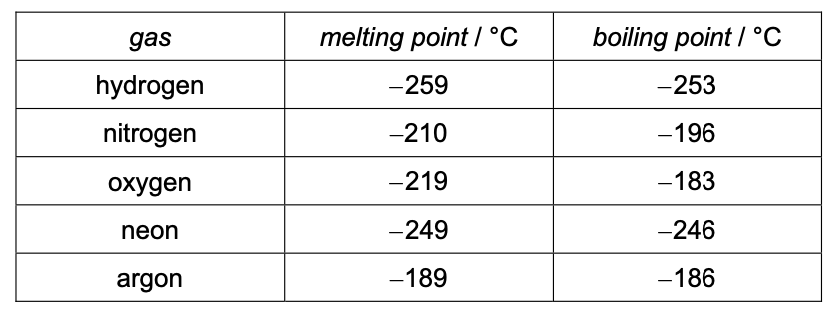
Water and carbon dioxide were removed from a sample of air and the remaining mixture was cooled to -260 °C.
The three most abundant remaining elements are to be separated by fractional distillation.
In which order would these three elements be collected?
Water and carbon dioxide were removed from a sample of air and the remaining mixture was cooled to -260 °C.
The three most abundant remaining elements are to be separated by fractional distillation.
In which order would these three elements be collected?
- A.hydrogen, neon, nitrogen
- B.hydrogen, neon, oxygen
- C.neon, nitrogen, argon
- D.neon, nitrogen, oxygen
- E.nitrogen, argon, oxygen
- F.nitrogen, oxygen, argon
- G.oxygen, nitrogen, argon
- H.oxygen, argon, nitrogen
Answer: E
Question 42
1 markConsider **only** the first three metals in Group 1 (Li, Na, K) and **only** the first three elements in Group 17 (F, Cl, Br).
Which of the following statements is/are correct for the compound lithium bromide?
1 It is formed from the least reactive of the three Group 17 elements.
2 It is formed from the least reactive of the three Group 1 elements and the Group 17 element (of the three) with the lowest boiling point.
3 It is formed from the Group 1 element (of the three) with the highest melting point.
Which of the following statements is/are correct for the compound lithium bromide?
1 It is formed from the least reactive of the three Group 17 elements.
2 It is formed from the least reactive of the three Group 1 elements and the Group 17 element (of the three) with the lowest boiling point.
3 It is formed from the Group 1 element (of the three) with the highest melting point.
- A.none of them
- B.1 only
- C.2 only
- D.3 only
- E.1 and 2 only
- F.1 and 3 only
- G.2 and 3 only
- H.1, 2 and 3
Answer: F
Question 43
1 markWhich of the following tests could be used, on its own, to distinguish between all three of the following white solids: potassium carbonate, calcium chloride and sodium sulfate?
1 Add a small amount of each solid separately to a platinum wire and hold in a colourless flame.
2 Dissolve a small amount of each solid separately in deionised water and add a few drops of sodium hydroxide solution.
3 Dissolve a small amount of each solid separately in deionised water and add a few drops of hydrochloric acid, followed by barium chloride solution.
1 Add a small amount of each solid separately to a platinum wire and hold in a colourless flame.
2 Dissolve a small amount of each solid separately in deionised water and add a few drops of sodium hydroxide solution.
3 Dissolve a small amount of each solid separately in deionised water and add a few drops of hydrochloric acid, followed by barium chloride solution.
- A.none of them
- B.1 only
- C.2 only
- D.3 only
- E.1 and 2 only
- F.1 and 3 only
- G.2 and 3 only
- H.1, 2 and 3
Answer: F
Question 44
1 markMolecule J is a straight-chain hydrocarbon containing one carbon-carbon double bond.
The relative atomic mass () of hydrogen is 1 and carbon is 12.
What is the **minimum** additional information that is needed in order to determine the molecular formula of molecule J?
1 The percentage by mass of carbon in the molecule.
2 The percentage by mass of hydrogen in the molecule.
3 The relative molar mass () of the molecule.
The relative atomic mass () of hydrogen is 1 and carbon is 12.
What is the **minimum** additional information that is needed in order to determine the molecular formula of molecule J?
1 The percentage by mass of carbon in the molecule.
2 The percentage by mass of hydrogen in the molecule.
3 The relative molar mass () of the molecule.
- A.1 only
- B.3 only
- C.1 and 2 only
- D.1 and 3 only
- E.1, 2 and 3
Answer: B
Question 45
1 markIodic acid, , can be made from iodine in the following reaction:
What is the value of x when the equation is balanced?
What is the value of x when the equation is balanced?
- A.1
- B.2
- C.3
- D.4
- E.5
- F.6
Answer: E
Question 46
1 markWhich one of the following formulae is correct for the compound given?
- A.aluminium sulfate,
- B.ammonium carbonate,
- C.calcium hydroxide,
- D.magnesium nitrate,
- E.potassium bromide,
Answer: B
Question 47
1 markWhich of the following statements about elements in the Periodic Table is/are correct?
1 When the element in Period 5, Group 2 reacts with the element that is in Period 3, Group 17, a redox reaction occurs.
2 In each Group, the elements from Period 2 are more reactive than the elements from Period 5.
3 The compound formed between the element in Period 2, Group 14 and the element in Period 3, Group 17 will have a simple molecular structure.
1 When the element in Period 5, Group 2 reacts with the element that is in Period 3, Group 17, a redox reaction occurs.
2 In each Group, the elements from Period 2 are more reactive than the elements from Period 5.
3 The compound formed between the element in Period 2, Group 14 and the element in Period 3, Group 17 will have a simple molecular structure.
- A.none of them
- B.1 only
- C.2 only
- D.3 only
- E.1 and 2 only
- F.1 and 3 only
- G.2 and 3 only
- H.1, 2 and 3
Answer: F
Question 48
1 markSome dilute aqueous solutions were electrolysed using graphite electrodes.
Which of the rows in the table show(s) the correct products of electrolysis?
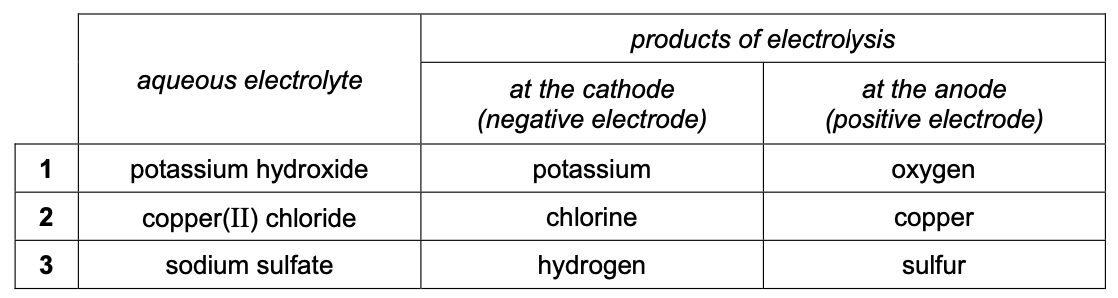
Which of the rows in the table show(s) the correct products of electrolysis?
- A.none of them
- B.1 only
- C.2 only
- D.3 only
- E.1 and 2 only
- F.1 and 3 only
- G.2 and 3 only
- H.1, 2 and 3
Answer: A
Question 49
1 markA paper chromatogram is set up with an orange food colouring spotted on the baseline.
Ten minutes after the start, the solvent front has moved 15.0 cm up the paper from the baseline and a yellow spot is 12.0 cm above the baseline.
Five minutes later, the solvent front has moved up a further 10.0 cm.
How far from the baseline will the yellow spot be 15 minutes after the start?
Ten minutes after the start, the solvent front has moved 15.0 cm up the paper from the baseline and a yellow spot is 12.0 cm above the baseline.
Five minutes later, the solvent front has moved up a further 10.0 cm.
How far from the baseline will the yellow spot be 15 minutes after the start?
- A.8.0 cm
- B.12.0 cm
- C.15.0 cm
- D.20.0 cm
- E.22.0 cm
- F.25.0 cm
- G.31.3 cm
Answer: D
Question 50
1 markWhich of the following equations represent(s) a redox reaction?
1
2
3
1
2
3
- A.none of them
- B.1 only
- C.2 only
- D.3 only
- E.1 and 2 only
- F.1 and 3 only
- G.2 and 3 only
- H.1, 2 and 3
Answer: C
Question 51
1 mark100 cm³ of ethane is mixed with 1400 cm³ of oxygen and the mixture is ignited.
All volumes are measured at atmospheric pressure and a temperature of 150 °C.
What will be the total volume of gas after the complete combustion?
(Assume that equal amounts of any gas at the same temperature and pressure occupy the same volume.)
All volumes are measured at atmospheric pressure and a temperature of 150 °C.
What will be the total volume of gas after the complete combustion?
(Assume that equal amounts of any gas at the same temperature and pressure occupy the same volume.)
- A.500 cm³
- B.1250 cm³
- C.1500 cm³
- D.1550 cm³
- E.1700 cm³
- F.2000 cm³
Answer: D
Question 52
1 mark10 g of a mixture of solid magnesium hydroxide, , and solid sodium hydroxide, NaOH, is added to an excess of water and stirred.
One of the components of the mixture dissolves. Assume that the other is completely insoluble.
The mixture is filtered to remove the insoluble component of the mixture.
50 cm³ of 1.0 mol dm⁻³ sulfuric acid exactly neutralises the remaining solution.
What is the mass of magnesium hydroxide in the original mixture?
( values: ; )
One of the components of the mixture dissolves. Assume that the other is completely insoluble.
The mixture is filtered to remove the insoluble component of the mixture.
50 cm³ of 1.0 mol dm⁻³ sulfuric acid exactly neutralises the remaining solution.
What is the mass of magnesium hydroxide in the original mixture?
( values: ; )
- A.2.0 g
- B.2.9 g
- C.4.0 g
- D.5.8 g
- E.6.0 g
- F.8.0 g
Answer: D
Question 53
1 markCalcium carbonate reacts with hydrochloric acid according to the following chemical equation:
Line P on the graph shows how the volume of carbon dioxide formed changes with time when 4.0 g of calcium carbonate reacts with 50 cm³ of 1.0 mol dm⁻³ hydrochloric acid at 20 °C.
A second reaction was carried out under identical conditions with the same mass of calcium carbonate but using 50 cm³ of 2.0 mol dm⁻³ hydrochloric acid.
Which line (A-F) best represents how the volume of carbon dioxide formed changes with time in the second reaction?
( value: )
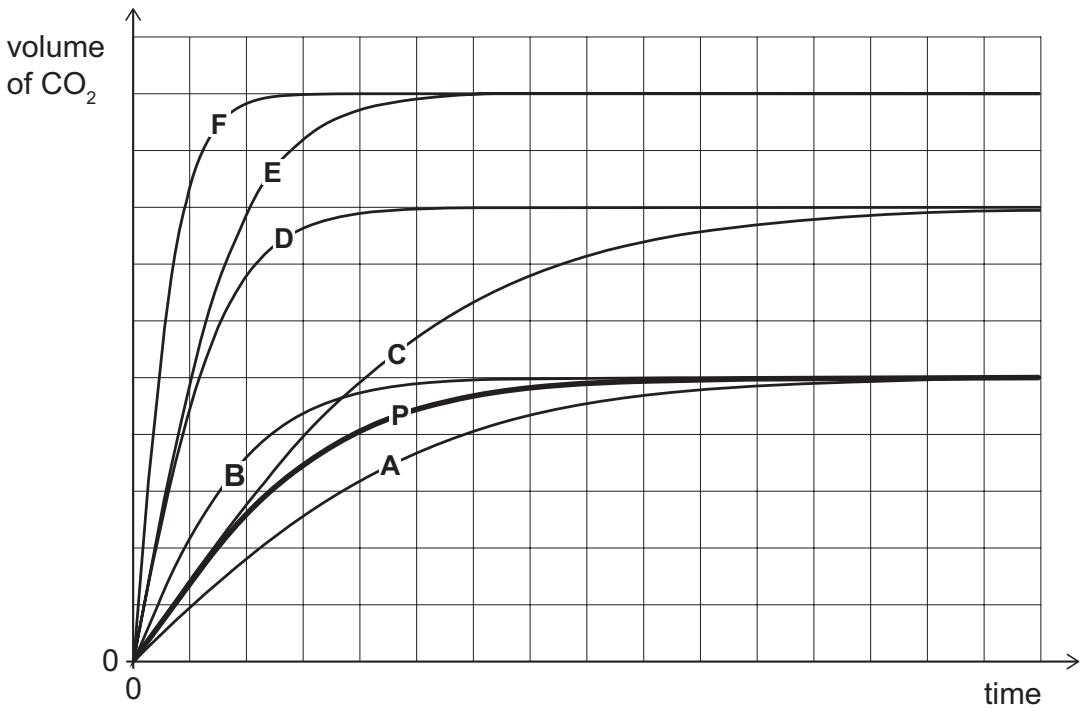
Line P on the graph shows how the volume of carbon dioxide formed changes with time when 4.0 g of calcium carbonate reacts with 50 cm³ of 1.0 mol dm⁻³ hydrochloric acid at 20 °C.
A second reaction was carried out under identical conditions with the same mass of calcium carbonate but using 50 cm³ of 2.0 mol dm⁻³ hydrochloric acid.
Which line (A-F) best represents how the volume of carbon dioxide formed changes with time in the second reaction?
( value: )
- A.A
- B.B
- C.C
- D.D
- E.E
- F.F
Answer: D
Question 54
1 markHydrochloric acid, sulfuric acid and phosphoric(V) acid are inorganic acids.
Phosphoric(V) acid, , ionises in water in the following series of reactions:
0.1 mol dm⁻³ hydrochloric acid has a pH of 1.0 at room temperature.
Which of the following statements about these acids is/are correct?
1 The pH of 0.1 mol dm⁻³ sulfuric acid is greater than 1.0 at room temperature.
2 can act as an acid or as a base.
3 30 cm³ of calcium hydroxide solution exactly neutralises 20 cm³ phosphoric(V) acid solution when both solutions are the same concentration.
Phosphoric(V) acid, , ionises in water in the following series of reactions:
0.1 mol dm⁻³ hydrochloric acid has a pH of 1.0 at room temperature.
Which of the following statements about these acids is/are correct?
1 The pH of 0.1 mol dm⁻³ sulfuric acid is greater than 1.0 at room temperature.
2 can act as an acid or as a base.
3 30 cm³ of calcium hydroxide solution exactly neutralises 20 cm³ phosphoric(V) acid solution when both solutions are the same concentration.
- A.none of them
- B.1 only
- C.2 only
- D.3 only
- E.1 and 2 only
- F.1 and 3 only
- G.2 and 3 only
- H.1, 2 and 3
Answer: G
Question 55
1 markComplete combustion of 1 mol of hydrocarbon X requires exactly 8.5 mol of oxygen.
Incomplete combustion of 1 mol of hydrocarbon X, to form carbon monoxide and water only, requires exactly 5.5 mol of oxygen.
How many hydrogen atoms are there in one molecule of hydrocarbon X?
Incomplete combustion of 1 mol of hydrocarbon X, to form carbon monoxide and water only, requires exactly 5.5 mol of oxygen.
How many hydrogen atoms are there in one molecule of hydrocarbon X?
- A.6
- B.8
- C.10
- D.12
- E.14
Answer: C
Question 56
1 markAn element Z forms an ionic compound which has
The ion of Z in has 10 electrons.
Element Z has three isotopes, labelled L, M and N, which contain the following numbers of neutrons.

The percentage abundances of isotopes M and N are the same.
What is the percentage abundance of the isotope L in the element Z in ?
( value: )
The ion of Z in has 10 electrons.
Element Z has three isotopes, labelled L, M and N, which contain the following numbers of neutrons.
The percentage abundances of isotopes M and N are the same.
What is the percentage abundance of the isotope L in the element Z in ?
( value: )
- A.4.10%
- B.10.0%
- C.13.4%
- D.43.3%
- E.80.0%
- F.91.8%
Answer: E
Question 57
1 markAn experiment is carried out using the first three metals in Group 1: lithium, sodium and potassium.
The initial masses of three open beakers each containing 100 g samples of an alcohol are recorded.
In three separate experiments, equal small masses of lithium, sodium and potassium are added to the three beakers, which are on electronic balances.
Each metal reacts in a similar way and after the reaction is complete, the final mass of each beaker and its contents is recorded.
In each case, the final mass of the beaker and its contents is compared to the recorded initial mass before the alkali metal was added.
Which of the following statements is correct?
The initial masses of three open beakers each containing 100 g samples of an alcohol are recorded.
In three separate experiments, equal small masses of lithium, sodium and potassium are added to the three beakers, which are on electronic balances.
Each metal reacts in a similar way and after the reaction is complete, the final mass of each beaker and its contents is recorded.
In each case, the final mass of the beaker and its contents is compared to the recorded initial mass before the alkali metal was added.
Which of the following statements is correct?
- A.The beaker with lithium added would decrease in mass the most.
- B.The beaker with sodium added would decrease in mass the most.
- C.The beaker with potassium added would decrease in mass the most.
- D.All three beakers would show the same decrease in mass.
- E.The beaker with lithium added would increase in mass the most.
- F.The beaker with sodium added would increase in mass the most.
- G.The beaker with potassium added would increase in mass the most.
- H.All three beakers would show the same increase in mass.
Answer: G
Question 58
1 markFour separate experiments were carried out using different quantities of 2 mol dm⁻³ hydrochloric acid and 2 mol dm⁻³ sodium hydroxide in insulated polystyrene cups.
After stirring, the maximum temperature was recorded and the results plotted on a graph as shown.
The temperatures of the acid and alkali on their own were also plotted on the graph. Two straight lines were drawn and extrapolated as shown.
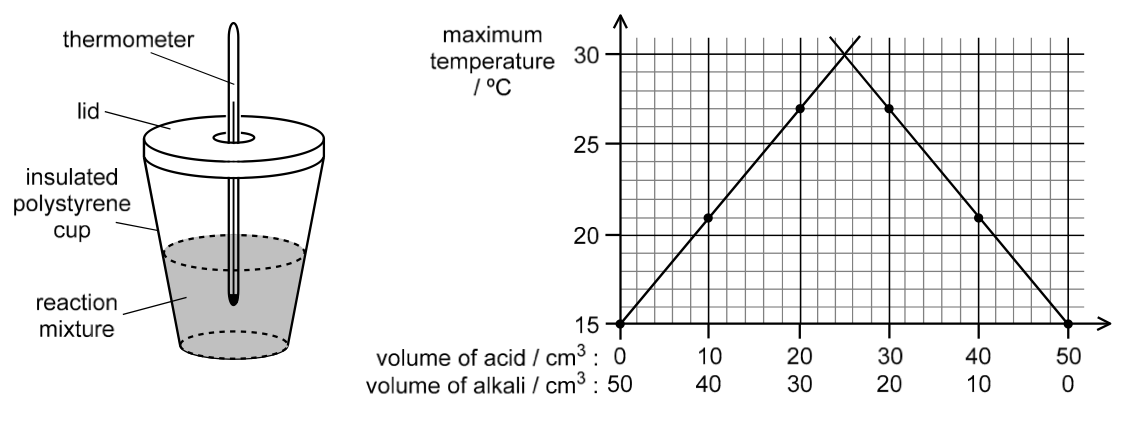
What is the molar enthalpy change for the neutralisation reaction, in kJ mol⁻¹?
(Assume that the specific heat capacity of the solutions is 4 J g⁻¹ °C⁻¹, the density of dilute solutions is 1 g cm⁻³, and all heat is transferred to the solution.)
After stirring, the maximum temperature was recorded and the results plotted on a graph as shown.
The temperatures of the acid and alkali on their own were also plotted on the graph. Two straight lines were drawn and extrapolated as shown.
What is the molar enthalpy change for the neutralisation reaction, in kJ mol⁻¹?
(Assume that the specific heat capacity of the solutions is 4 J g⁻¹ °C⁻¹, the density of dilute solutions is 1 g cm⁻³, and all heat is transferred to the solution.)
- A.3 kJ mol⁻¹
- B.6 kJ mol⁻¹
- C.30 kJ mol⁻¹
- D.60 kJ mol⁻¹
- E.120 kJ mol⁻¹
- F.3000 kJ mol⁻¹
Answer: D
Question 59
1 markAn electric current is the flow of charged particles.
In an electrolysis of aluminium oxide using inert electrodes, the current flows at moles of electrons per second.
Assume that only aluminium oxide is present and the aluminium is a single isotope .
What mass of aluminium is produced in 48 seconds?
In an electrolysis of aluminium oxide using inert electrodes, the current flows at moles of electrons per second.
Assume that only aluminium oxide is present and the aluminium is a single isotope .
What mass of aluminium is produced in 48 seconds?
- A.0.04 mg
- B.0.09 mg
- C.0.52 mg
- D.1.04 mg
- E.1.08 mg
- F.2.16 mg
- G.3.12 mg
- H.6.48 mg
Answer: F
Question 60
1 markX is a solution of sulfuric acid.
20.0 cm³ of X is diluted by adding distilled water to produce 500 cm³ of solution Y.
10.0 cm³ of Y is exactly neutralised by 40.0 cm³ of 0.0500 mol dm⁻³ aqueous potassium hydroxide.
What is the concentration of sulfuric acid in X?
20.0 cm³ of X is diluted by adding distilled water to produce 500 cm³ of solution Y.
10.0 cm³ of Y is exactly neutralised by 40.0 cm³ of 0.0500 mol dm⁻³ aqueous potassium hydroxide.
What is the concentration of sulfuric acid in X?
- A.0.00100 mol dm⁻³
- B.0.100 mol dm⁻³
- C.0.200 mol dm⁻³
- D.0.400 mol dm⁻³
- E.1.25 mol dm⁻³
- F.2.50 mol dm⁻³
- G.5.00 mol dm⁻³
- H.10.0 mol dm⁻³
Answer: F