Mapped to the ESAT specification
NSAA 2020 Physics Part X
20 questions20 marksUpdated October 2025
Natural Sciences Admissions Assessment 2020 is one of the closest available past papers for the Engineering and Science Admissions Test. Below, all 20 questions are mapped to the ESAT topics they test, each with its answer. Sit it cold under exam timing, then work back through anything you missed using the solutions.
What this paper covers on the ESAT
Every question mapped to the Engineering and Science Admissions Test specification, so you know exactly which areas it tests.
Mathematics 1
- Algebra (2)
Physics
- Waves (10)
- Electricity (8)
Questions and answers are free. Full step-by-step worked solutions unlock with a free account. Start practising.
Question 1
1 markSpring P has spring constant and spring Q has spring constant .
The two springs are connected in series.
The springs are stretched by 6.0 cm in total.
What is the extension of spring P?
(The springs have negligible mass and obey Hooke's law.)
The two springs are connected in series.
The springs are stretched by 6.0 cm in total.
What is the extension of spring P?
(The springs have negligible mass and obey Hooke's law.)
- A.1.5 cm
- B.2.0 cm
- C.3.0 cm
- D.4.0 cm
- E.4.5 cm
Answer: E
Question 2
1 markA single strand of wire has a radius of and length 15 m. The resistivity of the material from which the wire is made is .
Twelve strands of this wire are connected in parallel to make a cable.
What is the resistance of the cable?
Twelve strands of this wire are connected in parallel to make a cable.
What is the resistance of the cable?
- A.
- B.
- C.
- D.
- E.
- F.
Answer: D
Question 3
1 markA ray of light is directed into a semicircular transparent block, entering at P. The direction of the ray is adjusted until it strikes the centre of the flat face XY of the block at the critical angle and reflects to Q as shown.
The length of XY is L.
The speed of light in air is c.
What is the time taken by the light to travel from P to Q in the block?
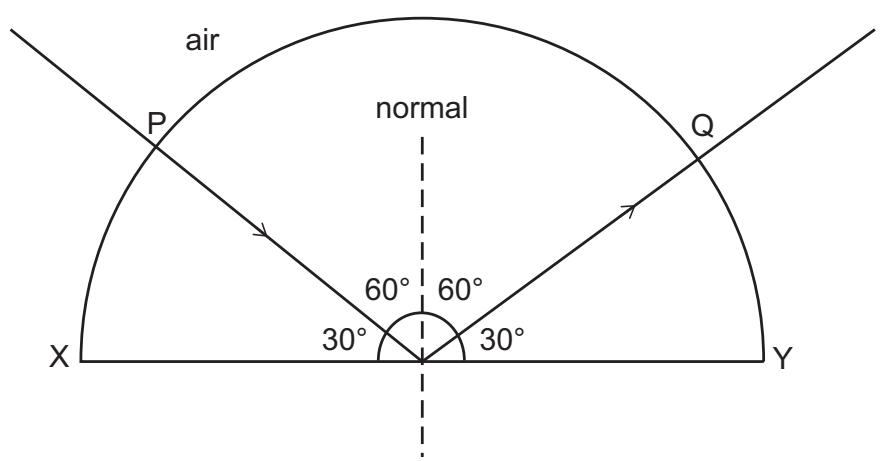
The length of XY is L.
The speed of light in air is c.
What is the time taken by the light to travel from P to Q in the block?
- A.
- B.
- C.
- D.
- E.
- F.
Answer: C
Question 4
1 markA solid cube with sides of length 20 cm is made from material with density . The cube is suspended, in equilibrium, from an initially unstretched spring, and this results in the spring gaining strain energy of 3.2 J.
What is the spring constant of the spring?
(gravitational field strength = ; the spring obeys Hooke's law)
What is the spring constant of the spring?
(gravitational field strength = ; the spring obeys Hooke's law)
- A.
- B.
- C.
- D.
- E.
- F.
Answer: E
Question 5
1 markA projectile is fired upwards from the ground at an angle of to the vertical at a speed of .
It travels a horizontal distance d and lands with a downwards vertical component of velocity of on ground that is height h above the starting point of the projectile.
What are d and h?
(gravitational field strength = ; assume that air resistance is negligible)
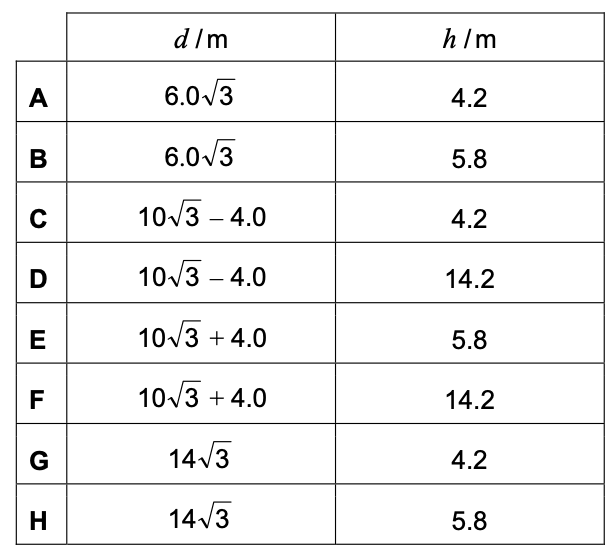
It travels a horizontal distance d and lands with a downwards vertical component of velocity of on ground that is height h above the starting point of the projectile.
What are d and h?
(gravitational field strength = ; assume that air resistance is negligible)
- A.d/m = , h/m = 4.2
- B.d/m = , h/m = 5.8
- C.d/m = , h/m = 4.2
- D.d/m = , h/m = 14.2
- E.d/m = , h/m = 5.8
- F.d/m = , h/m = 14.2
- G.d/m = , h/m = 4.2
- H.d/m = , h/m = 5.8
Answer: G
Question 6
1 markDiagram 1 shows the positions of nine equally spaced particles in a medium.
Diagram 2 shows the positions of the same nine particles, at a particular time, while a longitudinal wave is travelling through the medium.
What is the amplitude of the wave?


Diagram 2 shows the positions of the same nine particles, at a particular time, while a longitudinal wave is travelling through the medium.
What is the amplitude of the wave?
- A.0.4 m
- B.0.5 m
- C.0.6 m
- D.0.7 m
- E.2.0 m
- F.4.0 m
- G.6.0 m
- H.8.0 m
Answer: D
Question 7
1 markA spaceship with mass travels at constant velocity and has of kinetic energy.
An external impulse of , lasting for 2.0 s, is applied to the spaceship acting in the opposite direction to the motion of the spaceship.
What is the average rate of loss of kinetic energy of the spaceship during the application of the impulse?
An external impulse of , lasting for 2.0 s, is applied to the spaceship acting in the opposite direction to the motion of the spaceship.
What is the average rate of loss of kinetic energy of the spaceship during the application of the impulse?
- A.
- B.
- C.
- D.
- E.
- F.
Answer: B
Question 8
1 markThe diagram shows a solid triangular prism.
The sides of the triangular cross section of the prism are of length x.
The height of the prism is 3x.
The uniform density of the prism is .
The gravitational field strength is g.
What is the minimum pressure the prism can exert when it rests on level ground?
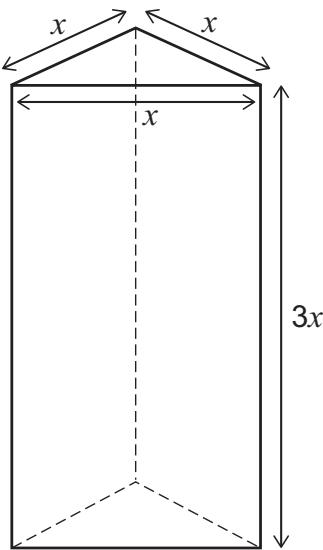
The sides of the triangular cross section of the prism are of length x.
The height of the prism is 3x.
The uniform density of the prism is .
The gravitational field strength is g.
What is the minimum pressure the prism can exert when it rests on level ground?
- A.
- B.
- C.
- D.
- E.
- F.
Answer: F
Question 9
1 markAn apple of mass is placed on a uniform metre rule with the centre of gravity of the apple at the 10 cm mark. The rule is balanced on a pivot placed at the 35 cm mark.
The apple is replaced with an orange of mass . The rule now balances with the pivot at the 40 cm mark.
What is the ratio ?
The apple is replaced with an orange of mass . The rule now balances with the pivot at the 40 cm mark.
What is the ratio ?
- A.
- B.
- C.
- D.
- E.
- F.
Answer: F
Question 10
1 markA cyclist travels at a constant speed of on level ground. During this time the power needed to maintain a constant speed is 900 W. The total weight of the cyclist and bicycle is 850 N.
The cyclist now cycles up a slope at the same constant speed. The slope is at an angle of to the horizontal.
What is the driving force on the bicycle as it travels up the slope?
(Assume that the magnitude of the resistive forces is constant.)
The cyclist now cycles up a slope at the same constant speed. The slope is at an angle of to the horizontal.
What is the driving force on the bicycle as it travels up the slope?
(Assume that the magnitude of the resistive forces is constant.)
- A.75 N
- B.350 N
- C.500 N
- D.() N
- E.775 N
- F.() N
- G.925 N
Answer: C
Question 11
1 markThree identical resistors can be combined in four different arrangements.
One of the arrangements has a resistance of 18Ω.
A different arrangement has a resistance of 8.0Ω.
What are the resistances of the other two arrangements?
(All three resistors contribute to the total resistance in all arrangements.)
One of the arrangements has a resistance of 18Ω.
A different arrangement has a resistance of 8.0Ω.
What are the resistances of the other two arrangements?
(All three resistors contribute to the total resistance in all arrangements.)
- A.2.0Ω and 4.0Ω
- B.2.0Ω and 9.0Ω
- C.4.0Ω and 12Ω
- D.4.0Ω and 36Ω
- E.36Ω and 162Ω
- F.81Ω and 162Ω
Answer: D
Question 12
1 markA fixed resistor is connected in series with a light dependent resistor (LDR) across a 100 V dc power supply.
The current in the LDR is 5.0 mA.
The intensity of light falling on the LDR now decreases and the voltage across the fixed resistor changes by 50%.
What is the change in the resistance of the LDR as a result of the change in intensity?
The current in the LDR is 5.0 mA.
The intensity of light falling on the LDR now decreases and the voltage across the fixed resistor changes by 50%.
What is the change in the resistance of the LDR as a result of the change in intensity?
- A.
- B.
- C.
- D.
- E.
- F.
Answer: D
Question 13
1 markAn elastic cord with spring constant k is fixed to two points P and Q on the diameter of a ring so that the cord is taut but unstretched. The radius of the ring is r.
The midpoint of the cord is then pulled and fixed to a point on the ring halfway between P and Q.
What is the energy stored in the elastic cord?
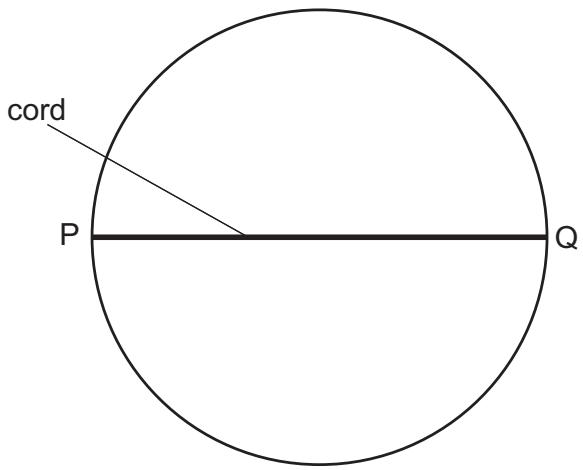
The midpoint of the cord is then pulled and fixed to a point on the ring halfway between P and Q.
What is the energy stored in the elastic cord?
- A.
- B.
- C.
- D.
- E.
- F.
Answer: F
Question 14
1 markAn object of mass M experiences a resultant force of magnitude F. The force acts in a single horizontal direction with a magnitude that varies with time t according to
where X and Y are constants.
The object is at rest at t = 0.
What is the magnitude of the momentum of the object at time t = T?
where X and Y are constants.
The object is at rest at t = 0.
What is the magnitude of the momentum of the object at time t = T?
- A.
- B.
- C.
- D.
- E.
- F.
Answer: A
Question 15
1 markA trolley of mass 3.0 kg is moving horizontally along a smooth track. Its displacement x from a point at time t is given by the equation:
where x is in metres and t is in seconds.
How much work is done on the trolley between times t = 0 and t = 5.0 s?
where x is in metres and t is in seconds.
How much work is done on the trolley between times t = 0 and t = 5.0 s?
- A.12 J
- B.24 J
- C.78 J
- D.270 J
- E.840 J
- F.864 J
- G.936 J
Answer: E
Question 16
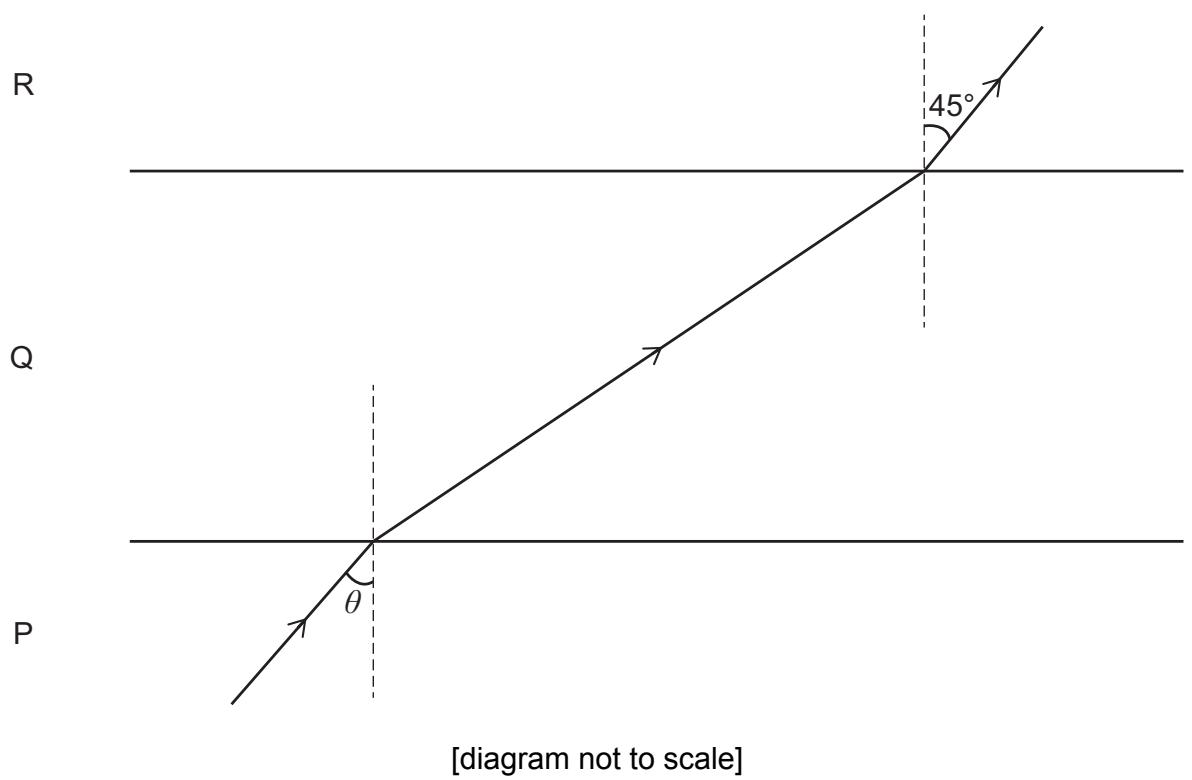
1 markThe diagram shows a ray of light passing through three mediums, P, Q and R. The boundaries between the three mediums are parallel.
[diagram not to scale]
The ratio of the speed of light in medium P to the speed of light in medium Q is
The ratio of the speed of light in medium Q to the speed of light in medium R is
What is the value of ?
[diagram not to scale]
The ratio of the speed of light in medium P to the speed of light in medium Q is
The ratio of the speed of light in medium Q to the speed of light in medium R is
What is the value of ?
- A.
- B.
- C.
- D.
- E.
- F.
Answer: E
Question 17
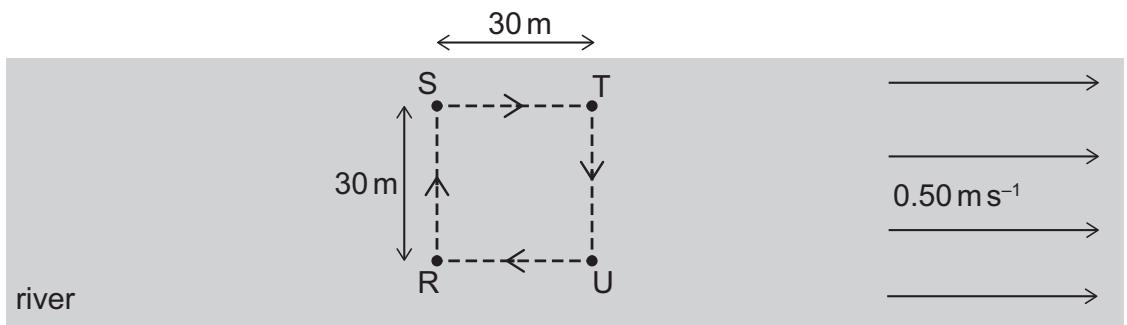
1 markWater in a wide river flows at a constant speed of . A swimmer swims around a square path of side 30 m marked out by 4 posts R, S, T and U which are fixed to the river bed, as shown.
The swimmer has a constant speed of relative to the water.
How long does it take for the swimmer to swim around the square path once?
The swimmer has a constant speed of relative to the water.
How long does it take for the swimmer to swim around the square path once?
- A.() s
- B.() s
- C.() s
- D.() s
- E.120 s
- F.140 s
Answer: D
Question 18
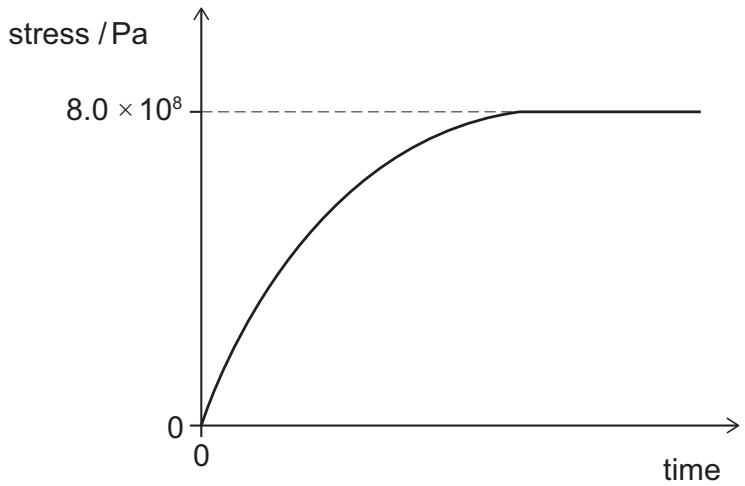
1 markThe stress in a steel cable increases with time and is then maintained at a constant value, as shown. The wire does not reach its limit of proportionality.
The table shows properties of the steel used in the cable and the dimensions of the cable.

How much work was done to stretch the cable?
The table shows properties of the steel used in the cable and the dimensions of the cable.
How much work was done to stretch the cable?
- A.320 J
- B.1.28 kJ
- C.2.56 kJ
- D.320 kJ
- E.640 kJ
- F.1.60 MJ
- G.6.40 MJ
Answer: B
Question 19
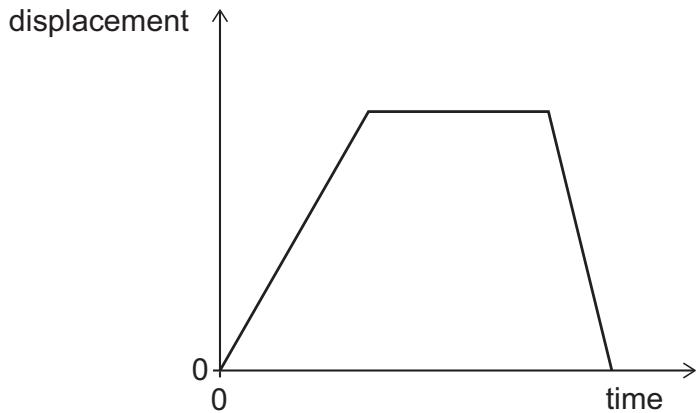
1 markThe following graph shows how the displacement of an object travelling along a straight, horizontal track varies with time.
Which graph shows the velocity of this object against displacement?
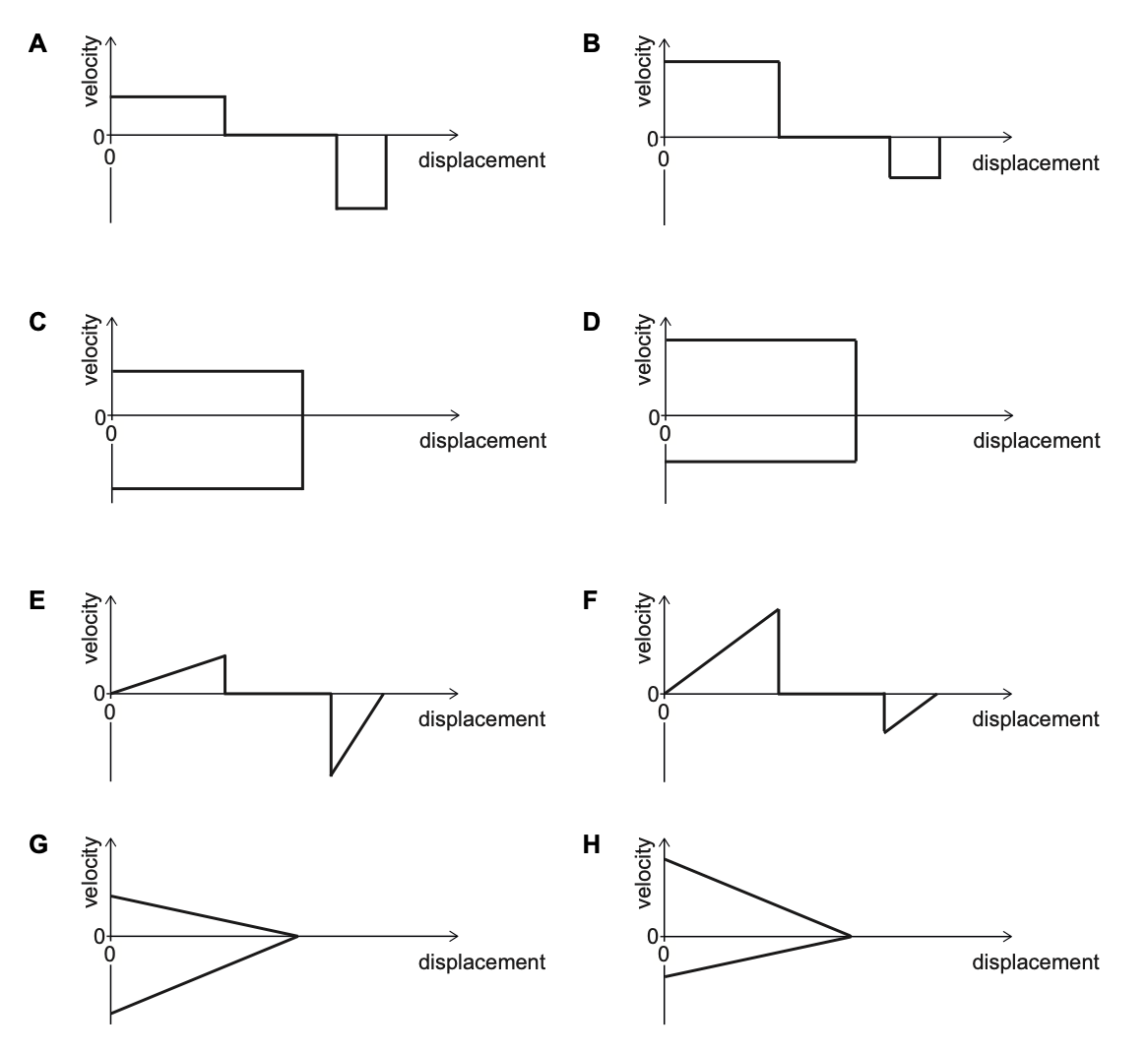
Which graph shows the velocity of this object against displacement?
- A.Graph A showing a plot of velocity against displacement.
- B.Graph B showing a plot of velocity against displacement.
- C.Graph C showing a plot of velocity against displacement.
- D.Graph D showing a plot of velocity against displacement.
- E.Graph E showing a plot of velocity against displacement.
- F.Graph F showing a plot of velocity against displacement.
- G.Graph G showing a plot of velocity against displacement.
- H.Graph H showing a plot of velocity against displacement.
Answer: C
Question 20
1 markA cell has emf E and internal resistance r that varies with current I according to:
where k is a constant.
A variable resistor is connected to the terminals of the cell. The resistance of the variable resistor is adjusted.
Which expression gives the resistance of the variable resistor, in terms of k and E, that causes maximum power dissipation in it?
where k is a constant.
A variable resistor is connected to the terminals of the cell. The resistance of the variable resistor is adjusted.
Which expression gives the resistance of the variable resistor, in terms of k and E, that causes maximum power dissipation in it?
- A.
- B.
- C.
- D.
- E.
- F.
- G.
- H.
Answer: D