Mapped to the ESAT specification
NSAA 2021 Chemistry Part Y
20 questions20 marksUpdated June 2026
Natural Sciences Admissions Assessment 2021 is one of the closest available past papers for the Engineering and Science Admissions Test. Below, all 20 questions are mapped to the ESAT topics they test, each with its answer. Sit it cold under exam timing, then work back through anything you missed using the solutions.
What this paper covers on the ESAT
Every question mapped to the Engineering and Science Admissions Test specification, so you know exactly which areas it tests.
Mathematics 1
- Geometry (1)
Chemistry
- Quantitative chemistry (29)
- Carbon/Organic chemistry (10)
- Acids, bases and salts (5)
- Chemical reactions, formulae and equations (4)
- Chemical bonding, structure and properties (3)
- Energetics (3)
- Oxidation, reduction and redox (3)
- Atomic structure (2)
- Chemical tests (2)
- Group chemistry (1)
- Rates of reaction (1)
Questions and answers are free. Full step-by-step worked solutions unlock with a free account. Start practising.
Question 21
1 markA Group 1 metal hydrogencarbonate contains the ion and decomposes at .
When dilute hydrochloric acid is added to the residue from the thermal decomposition of this metal hydrogencarbonate, a gas is released that turns limewater cloudy. The residue also gives a yellow-orange colour in a flame test.
8.4 g of this metal hydrogencarbonate is heated to constant mass at .
How much mass is lost in this reaction?
( values: H = 1; C = 12; O = 16; Li = 7; Na = 23; K = 39)
When dilute hydrochloric acid is added to the residue from the thermal decomposition of this metal hydrogencarbonate, a gas is released that turns limewater cloudy. The residue also gives a yellow-orange colour in a flame test.
8.4 g of this metal hydrogencarbonate is heated to constant mass at .
How much mass is lost in this reaction?
( values: H = 1; C = 12; O = 16; Li = 7; Na = 23; K = 39)
- A.2.2 g
- B.2.6 g
- C.3.1 g
- D.4.0 g
- E.4.4 g
- F.5.3 g
- G.6.2 g
Answer: C
Question 22
1 markWhich of the following statements is correct for the bond angle () in gaseous germanium(II) chloride, , molecules as predicted by the VSEPR model?
- A.
- B.
- C.
- D.
- E.
Answer: B
Question 23
1 markPropanal can be reduced to propan-1-ol with hydrogen gas at high pressure and a platinum catalyst.
Radioactive propan-1-ol can be made if the hydrogen gas is replaced by pure tritium gas. Tritium, , is the radioactive isotope of hydrogen.
All of the atoms other than in the radioactive propan-1-ol are the most abundant isotope for the element. The most abundant isotopes of carbon, hydrogen and oxygen are , and .
How many neutrons are there in one molecule of this radioactive propan-1-ol?
Radioactive propan-1-ol can be made if the hydrogen gas is replaced by pure tritium gas. Tritium, , is the radioactive isotope of hydrogen.
All of the atoms other than in the radioactive propan-1-ol are the most abundant isotope for the element. The most abundant isotopes of carbon, hydrogen and oxygen are , and .
How many neutrons are there in one molecule of this radioactive propan-1-ol?
- A.26
- B.28
- C.30
- D.32
- E.34
- F.40
- G.42
Answer: C
Question 24
1 markA sample of hydrated cobalt(II) sulfate, , with a mass of 5.62 g, was heated to convert the sample completely to 3.10 g of anhydrous cobalt(II) sulfate.
What is the value of x?
( values: H = 1.0; O = 16.0; S = 32.1; Co = 58.9)
What is the value of x?
( values: H = 1.0; O = 16.0; S = 32.1; Co = 58.9)
- A.2
- B.3
- C.4
- D.5
- E.6
- F.7
- G.8
- H.9
Answer: F
Question 25
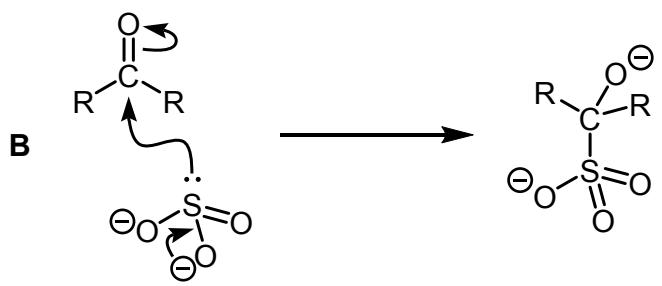
1 markWhich of the following does not give the species shown?
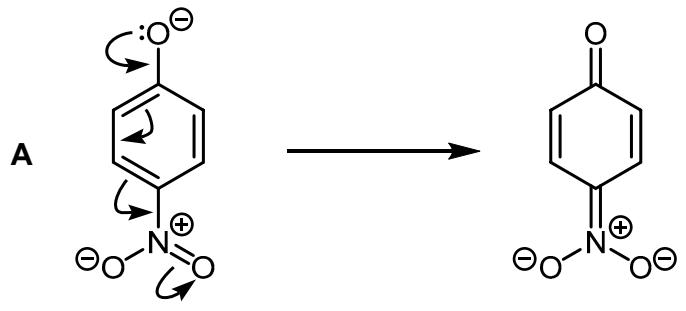



- A.[Image of a reaction showing a para-nitrophenoxide ion rearranging to form a quinone-like structure]
- B.[Image of a reaction showing an intramolecular reaction between a carboxylate and a sulfonyl group]
- C.[Image of a reaction showing the decarboxylation of a beta-keto acid via a cyclic transition state to form an enol and carbon dioxide]
- D.[Image of a reaction showing the protonation of an azo compound]
- E.[Image of a reaction showing the decarboxylation of a beta-keto carboxylate to form an enolate and carbon dioxide]
Answer: D
Question 26
1 mark0.4 mol of a halogenoalkane reacted completely with hot, ethanolic potassium hydroxide to give 28 g of a single organic product X in 100% yield.
What percentage of all of the structural isomers with both the same functional group and molecular formula as X would show geometric (E/Z) isomerism?
( values: H = 1; C = 12)
What percentage of all of the structural isomers with both the same functional group and molecular formula as X would show geometric (E/Z) isomerism?
( values: H = 1; C = 12)
- A.17%
- B.20%
- C.25%
- D.33%
- E.40%
- F.50%
Answer: B
Question 27
1 mark of sodium hydroxide solution is placed in a polystyrene cup with a thermometer.
hydrochloric acid is added from a burette to the stirred solution of sodium hydroxide.
Both solutions are at the same temperature before mixing.
The temperature is recorded each time a measured amount of hydrochloric acid is added, and the data is plotted on a graph.
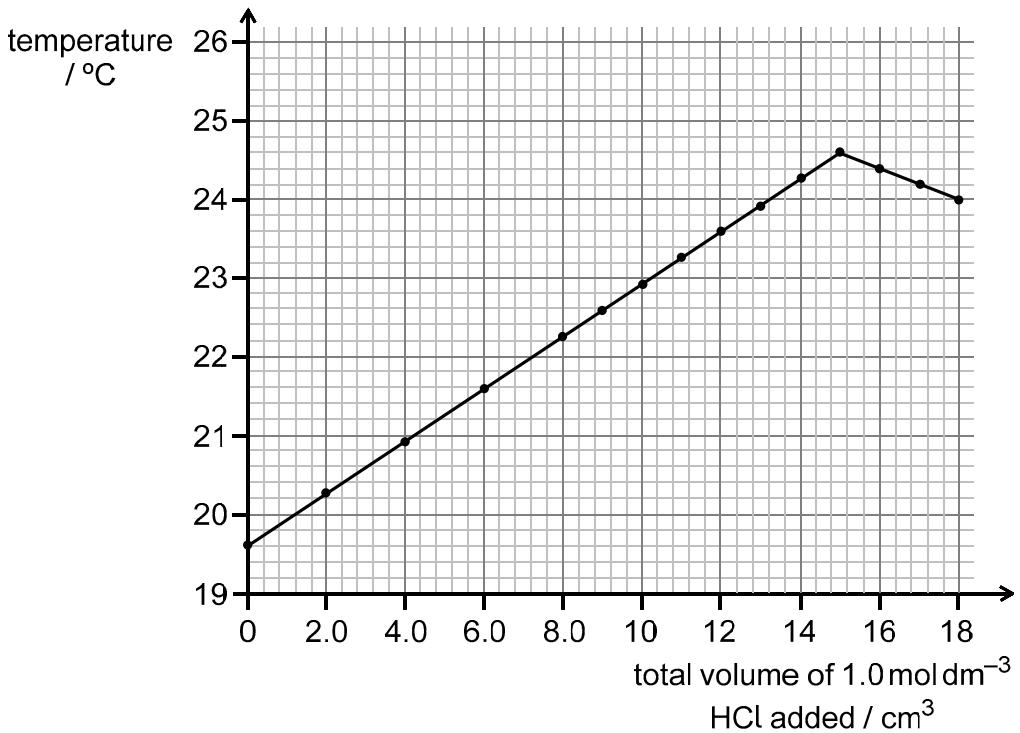
Assuming that no heat is lost from the cup, what is the enthalpy change of reaction when one mole of aqueous sodium hydroxide is neutralised?
(Assume that all solutions have density and specific heat capacity 4.2\,J\,g^{-1}\{°C}^{-1}.)
hydrochloric acid is added from a burette to the stirred solution of sodium hydroxide.
Both solutions are at the same temperature before mixing.
The temperature is recorded each time a measured amount of hydrochloric acid is added, and the data is plotted on a graph.
Assuming that no heat is lost from the cup, what is the enthalpy change of reaction when one mole of aqueous sodium hydroxide is neutralised?
(Assume that all solutions have density and specific heat capacity 4.2\,J\,g^{-1}\{°C}^{-1}.)
- A.-56.0 kJ
- B.-49.3 kJ
- C.-35.0 kJ
- D.-33.6 kJ
- E.-21.0 kJ
Answer: A
Question 28
1 markConsider the distribution of a solute X between two immiscible solvents: water and ether.
The equilibrium constant, , is 0.15 at .
of a solution of X in ether at contains 21.5 g of X. of water is added, shaken with the ether solution and allowed to reach equilibrium at .
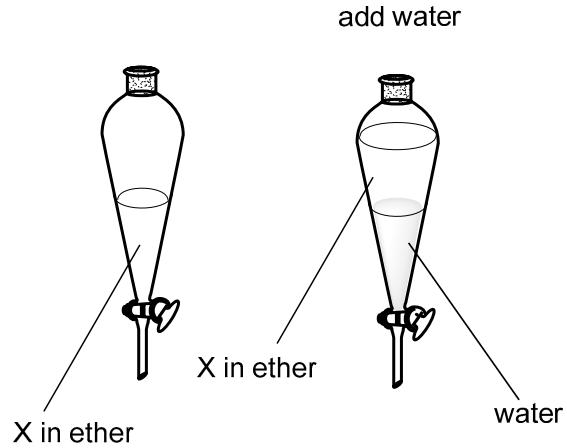
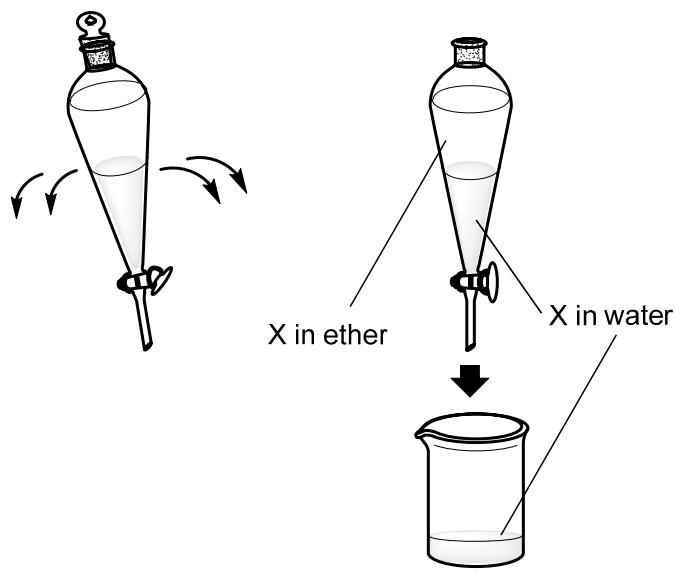
What is the maximum mass of X that can be transferred into the aqueous layer?
The equilibrium constant, , is 0.15 at .
of a solution of X in ether at contains 21.5 g of X. of water is added, shaken with the ether solution and allowed to reach equilibrium at .
What is the maximum mass of X that can be transferred into the aqueous layer?
- A.4.96 g
- B.14.3 g
- C.18.7 g
- D.20.0 g
- E.20.5 g
Answer: D
Question 29
1 mark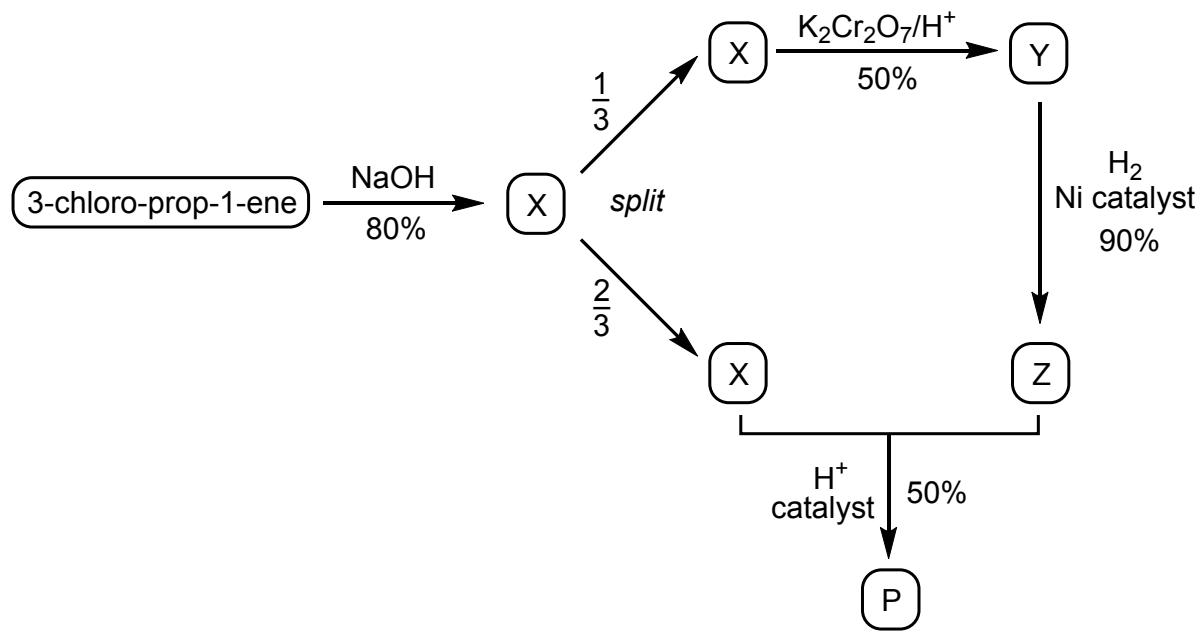
5.0 mol of 3-chloro-prop-1-ene ( = 76.5) was reacted with excess sodium hydroxide to form a single product X in 80% yield.
One third of compound X was heated with excess acidified potassium dichromate(VI) under reflux to form a single product Y in 50% yield.
All of compound Y was reacted with hydrogen gas at high temperature in the presence of nickel to form a single product Z in 90% yield.
The remaining quantity of compound X was reacted with all of compound Z in the presence of an acid catalyst to form product P in 50% yield.
What is the maximum mass of product P that could be produced from this synthesis?
( values: H = 1; C = 12; O = 16; Cl = 35.5)
- A.2.74 g
- B.5.48 g
- C.23.0 g
- D.34.2 g
- E.114 g
- F.123 g
- G.152 g
Answer: D
Question 30
1 markIron(II) sulfate is used as a moss treatment on lawns and sports pitches. The recommended amount of iron is per .
Analysis of a particular sports pitch showed it to contain of iron per .
A pitch care company supplies three hydrated formulations:
• which contains 20% of iron by mass
• which contains 25% of iron by mass
• which contains 33% of iron by mass
A 25 kg sack of one of the iron(II) sulfate formulations is to be used on the sports pitch but unfortunately it has lost its label. A small sample was heated to constant mass to form a white solid, and the mass of the sample decreased by more than 40% in this process.
The sports pitch is 90 m long and 60 m wide.
What mass of the iron(II) sulfate formulation (in kg) should be added to ensure that the iron content is at the recommended level?
( values: = 152; = 18)
Analysis of a particular sports pitch showed it to contain of iron per .
A pitch care company supplies three hydrated formulations:
• which contains 20% of iron by mass
• which contains 25% of iron by mass
• which contains 33% of iron by mass
A 25 kg sack of one of the iron(II) sulfate formulations is to be used on the sports pitch but unfortunately it has lost its label. A small sample was heated to constant mass to form a white solid, and the mass of the sample decreased by more than 40% in this process.
The sports pitch is 90 m long and 60 m wide.
What mass of the iron(II) sulfate formulation (in kg) should be added to ensure that the iron content is at the recommended level?
( values: = 152; = 18)
- A.1.08 kg
- B.1.35 kg
- C.3.60 kg
- D.4.32 kg
- E.5.40 kg
- F.6.75 kg
Answer: E
Question 31
1 markA compound contains potassium cations, and anions that contain only boron and fluorine. Each anion contains one boron atom.
0.630 g of this compound contains 0.195 g of potassium and 0.055 g of boron.
What is the shape of the anions in this compound?
( values: B = 11; F = 19; K = 39)
0.630 g of this compound contains 0.195 g of potassium and 0.055 g of boron.
What is the shape of the anions in this compound?
( values: B = 11; F = 19; K = 39)
- A.linear
- B.bent (V-shaped)
- C.trigonal planar
- D.trigonal pyramidal
- E.tetrahedral
- F.square planar
Answer: E
Question 32
1 markThe first ionisation energy of five elements is measured.
Which row matches the five elements to their first ionisation energy?
[Table header: first ionisation energy / with columns for 577, 736, 1000, 1060, 1680]
Which row matches the five elements to their first ionisation energy?
[Table header: first ionisation energy / with columns for 577, 736, 1000, 1060, 1680]
- A.577: F, 736: Mg, 1000: Al, 1060: P, 1680: S
- B.577: F, 736: P, 1000: S, 1060: Mg, 1680: Al
- C.577: F, 736: P, 1000: S, 1060: Al, 1680: Mg
- D.577: Mg, 736: Al, 1000: S, 1060: P, 1680: F
- E.577: Mg, 736: Al, 1000: P, 1060: S, 1680: F
- F.577: Al, 736: Mg, 1000: P, 1060: S, 1680: F
- G.577: Al, 736: Mg, 1000: S, 1060: P, 1680: F
- H.577: S, 736: P, 1000: Al, 1060: Mg, 1680: F
Answer: G
Question 33
1 markA yellow precipitate is formed when alkaline aqueous iodine reacts with alcohols that have the structure R-CH(OH)CH₃, where R is a carbon chain or H.
There are a number of structural isomers with the molecular formula that are alcohols.
Of these structural isomeric alcohols:
(i) how many will form a yellow precipitate when reacted with alkaline aqueous iodine;
(ii) how many, following mild oxidation and immediate distillation, will produce a silver mirror with Tollens' reagent?
[A table is provided for the options with columns '(i) forms yellow precipitate' and '(ii) produces silver mirror']
There are a number of structural isomers with the molecular formula that are alcohols.
Of these structural isomeric alcohols:
(i) how many will form a yellow precipitate when reacted with alkaline aqueous iodine;
(ii) how many, following mild oxidation and immediate distillation, will produce a silver mirror with Tollens' reagent?
[A table is provided for the options with columns '(i) forms yellow precipitate' and '(ii) produces silver mirror']
- A.(i) 1, (ii) 1
- B.(i) 2, (ii) 3
- C.(i) 2, (ii) 4
- D.(i) 2, (ii) 7
- E.(i) 3, (ii) 3
- F.(i) 3, (ii) 4
- G.(i) 3, (ii) 7
- H.(i) 4, (ii) 4
Answer: C
Question 34
1 markThe standard enthalpy change of formation of hydrogen iodide is .
For the reaction of gaseous iodine with hydrogen
the enthalpy change of reaction can be calculated using bond enthalpy values.
The bond enthalpies are:
| bond | bond enthalpy / |
| :--- | :--- |
| H-H | 436 |
| I-I | 151 |
| H-I | 299 |
The sublimation of iodine is represented by:
Using the data provided, what is the enthalpy change for the sublimation of iodine?
(All data is given at room temperature and pressure.)
For the reaction of gaseous iodine with hydrogen
the enthalpy change of reaction can be calculated using bond enthalpy values.
The bond enthalpies are:
| bond | bond enthalpy / |
| :--- | :--- |
| H-H | 436 |
| I-I | 151 |
| H-I | 299 |
The sublimation of iodine is represented by:
Using the data provided, what is the enthalpy change for the sublimation of iodine?
(All data is given at room temperature and pressure.)
- A.-262 kJ mol⁻¹
- B.-236 kJ mol⁻¹
- C.-41 kJ mol⁻¹
- D.+37 kJ mol⁻¹
- E.+41 kJ mol⁻¹
- F.+63 kJ mol⁻¹
- G.+236 kJ mol⁻¹
Answer: F
Question 35
1 markSodium hydrogencarbonate, , and sodium carbonate are both used as antacids. They react with hydrochloric acid in the stomach to form the same products.
The contents of a person's stomach has a pH of 1.0, which is a concentration of HCl. The stomach contained of aqueous solution when the pH was measured.
Which of the following amounts of sodium hydrogencarbonate would bring the stomach contents into the normal range of pH 2.0-3.0?
( values: H = 1; C = 12; O = 16; Na = 23)
The contents of a person's stomach has a pH of 1.0, which is a concentration of HCl. The stomach contained of aqueous solution when the pH was measured.
Which of the following amounts of sodium hydrogencarbonate would bring the stomach contents into the normal range of pH 2.0-3.0?
( values: H = 1; C = 12; O = 16; Na = 23)
- A.0.0038 mol
- B.0.0075 mol
- C.0.0080 mol
- D.0.016 mol
- E.0.095 mol
Answer: B
Question 36
1 markX is a dicarboxylic acid. When in aqueous solution, 2.36 g of X reacts with excess sodium carbonate to produce of carbon dioxide, measured at room temperature and pressure. Assume that no gas dissolves in the water present.
Y is a liquid organic compound containing only one functional group. 1 mol of Y reacts exactly with 1 mol of sodium, giving off a gas that pops with a lighted splint. Aqueous Y does not change the colour of blue or red litmus papers.
When of gaseous Y is combusted in excess oxygen, of carbon dioxide and of water vapour are the only products formed. All volumes are measured at the same temperature and pressure.
When heated in the presence of concentrated sulfuric acid, 1 mol of X reacts completely with 2 mol of Y to give 1 mol of organic product Z. Water is also produced in the reaction.
What is the relative molar mass of Z?
( values: H = 1; C = 12; O = 16. Assume that one mole of gas occupies at room temperature and pressure.)
Y is a liquid organic compound containing only one functional group. 1 mol of Y reacts exactly with 1 mol of sodium, giving off a gas that pops with a lighted splint. Aqueous Y does not change the colour of blue or red litmus papers.
When of gaseous Y is combusted in excess oxygen, of carbon dioxide and of water vapour are the only products formed. All volumes are measured at the same temperature and pressure.
When heated in the presence of concentrated sulfuric acid, 1 mol of X reacts completely with 2 mol of Y to give 1 mol of organic product Z. Water is also produced in the reaction.
What is the relative molar mass of Z?
( values: H = 1; C = 12; O = 16. Assume that one mole of gas occupies at room temperature and pressure.)
- A.101
- B.160
- C.166
- D.170
- E.202
- F.220
Answer: E
Question 37
1 markCats are unable to synthesise the amino acid taurine in their bodies, so they must obtain it from their food. It is often added to cat food as an additive.
Taurine is a monoprotic acid with the following molecular structure:
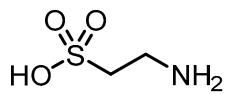
Dietary studies suggest that a cat should consume 10 mg of taurine per kilogram of body mass per day.
Brand X cat food contains taurine at a level of 0.008% by mass, but this level is too low for a cat to acquire a sufficient amount from a healthy amount of food.
Magnesium taurate is an ionic salt which liberates taurine in the body. of a aqueous solution of magnesium taurate was added to a 10 kg bag of brand X cat food and thoroughly mixed.
A particular cat bowl can hold a 50 g serving of cat food. A particular cat of mass 4000 g always eats a full serving.
What is the minimum number of bowls of cat food that this cat must eat to ensure that it has consumed its daily requirement of taurine?
(Assume that the addition of the solution does not significantly alter the total mass of the bag of cat food.)
Taurine is a monoprotic acid with the following molecular structure:
Dietary studies suggest that a cat should consume 10 mg of taurine per kilogram of body mass per day.
Brand X cat food contains taurine at a level of 0.008% by mass, but this level is too low for a cat to acquire a sufficient amount from a healthy amount of food.
Magnesium taurate is an ionic salt which liberates taurine in the body. of a aqueous solution of magnesium taurate was added to a 10 kg bag of brand X cat food and thoroughly mixed.
A particular cat bowl can hold a 50 g serving of cat food. A particular cat of mass 4000 g always eats a full serving.
What is the minimum number of bowls of cat food that this cat must eat to ensure that it has consumed its daily requirement of taurine?
(Assume that the addition of the solution does not significantly alter the total mass of the bag of cat food.)
- A.2
- B.3
- C.4
- D.5
- E.6
- F.7
- G.8
Answer: D
Question 38
1 markAnalysis of hydrocarbon P showed it to contain 0.60 g of carbon and 0.10 g of hydrogen, and to have a relative molecular mass of 70.
P reacts with hydrogen bromide to form a mixture of Q and R. However, the main product was Q.
Q reacts with warm, aqueous sodium hydroxide to form S.
S reacts with warm, acidified potassium dichromate(VI) to form T. T does not produce a silver mirror with Tollens' reagent and does not produce bubbles when sodium carbonate is added.
S undergoes dehydration on reaction with hot, concentrated sulfuric acid to form the original hydrocarbon P and a new compound U. Both P and U do not have stereoisomers.
What is the structure of compound U?
( values: H = 1; C = 12)
P reacts with hydrogen bromide to form a mixture of Q and R. However, the main product was Q.
Q reacts with warm, aqueous sodium hydroxide to form S.
S reacts with warm, acidified potassium dichromate(VI) to form T. T does not produce a silver mirror with Tollens' reagent and does not produce bubbles when sodium carbonate is added.
S undergoes dehydration on reaction with hot, concentrated sulfuric acid to form the original hydrocarbon P and a new compound U. Both P and U do not have stereoisomers.
What is the structure of compound U?
( values: H = 1; C = 12)
- A.[Image of the skeletal structure of pent-1-ene]
- B.[Image of the skeletal structure of pent-2-ene]
- C.[Image of the skeletal structure of 2-methylbut-1-ene]
- D.[Image of the skeletal structure of 3-methylbut-1-ene]
- E.[Image of the skeletal structure of 2-methylbut-2-ene]
- F.[Image of the skeletal structure of 2,3-dimethylbut-1-ene]
- G.[Image of the skeletal structure of 2,3-dimethylbut-2-ene]
- H.[Image of the skeletal structure of 4-methylpent-2-ene]
Answer: H
Question 39
1 markLanthanum iodate(V), , decomposes when heated to to give a product that contains the ion Q.
An unbalanced ionic equation for the reaction is:
Ion Q contains only iodine in the +7 oxidation state and oxygen in the -2 oxidation state.
The oxidation state of the lanthanum does not change in the reaction.
0.005 mol of is fully decomposed by heating. The iodine produced is titrated against a solution of sodium thiosulfate (). of the sodium thiosulfate solution is needed to reach the end-point. The equation for the reaction between iodine and sodium thiosulfate is:
What is the formula of the product that contains ion Q?
An unbalanced ionic equation for the reaction is:
Ion Q contains only iodine in the +7 oxidation state and oxygen in the -2 oxidation state.
The oxidation state of the lanthanum does not change in the reaction.
0.005 mol of is fully decomposed by heating. The iodine produced is titrated against a solution of sodium thiosulfate (). of the sodium thiosulfate solution is needed to reach the end-point. The equation for the reaction between iodine and sodium thiosulfate is:
What is the formula of the product that contains ion Q?
- A.
- B.
- C.
- D.
- E.
- F.
Answer: F
Question 40
1 markConsider the following chemical equation:
where Q is a binary compound.
The molecules of Q are hexatomic and contain phosphorus in the +2 oxidation state.
Using the lowest integer values for all the coefficients v, w, x, y and z, what is the value of w when the equation is balanced?
where Q is a binary compound.
The molecules of Q are hexatomic and contain phosphorus in the +2 oxidation state.
Using the lowest integer values for all the coefficients v, w, x, y and z, what is the value of w when the equation is balanced?
- A.1
- B.2
- C.13
- D.16
- E.24
- F.26
Answer: C