NSAA 2021 Chemistry S1
20 questions20 marksUpdated October 2025
The NSAA 2021 Chemistry S1 paper in full: all 20 questions, each with its answer. NSAA is the Natural Sciences Admissions Assessment. Sit it cold under exam timing, mark it, then work back through anything you missed using the solutions below.
Download the original PDF →Questions and answers are free. Full step-by-step worked solutions unlock with a free account. Start practising.
Question 41
The following equations represent the reactions of four metals M, Q, R and T:
M(s) + HCl(aq) → no reaction
Which option lists the order of reactivity of the four metals, from the most to the least reactive?
M(s) + HCl(aq) → no reaction
Which option lists the order of reactivity of the four metals, from the most to the least reactive?
- A.M, Q, R, T
- B.M, R, T, Q
- C.Q, M, T, R
- D.Q, R, T, M
- E.R, M, T, Q
- F.R, T, M, Q
- G.T, M, R, Q
- H.T, R, Q, M
Answer: F
Question 42
Consider the following three ions of calcium observed in mass spectrometry:
Which of the following statements is/are correct?
1 All three ions have the electron configuration 2,8,8
2 has more neutrons than
3 has more protons than
Which of the following statements is/are correct?
1 All three ions have the electron configuration 2,8,8
2 has more neutrons than
3 has more protons than
- A.none of them
- B.1 only
- C.2 only
- D.3 only
- E.1 and 2 only
- F.1 and 3 only
- G.2 and 3 only
- H.1, 2 and 3
Answer: C
Question 43
The relative isotopic abundances of a sample of magnesium are shown in the table.
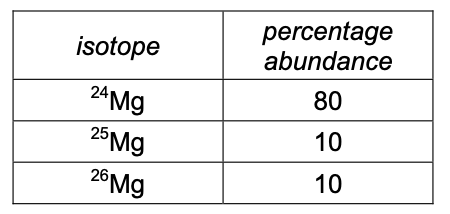
What is the relative atomic mass () of the magnesium?
What is the relative atomic mass () of the magnesium?
- A.24.0
- B.24.3
- C.24.5
- D.24.8
- E.25.0
Answer: B
Question 44
A portion of the Periodic Table is given:
Which one of these trends is correct?
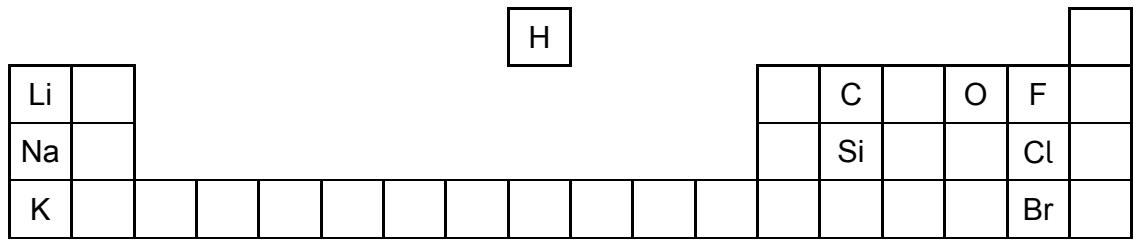
Which one of these trends is correct?
- A.Boiling point: K > Na > Li
- B.Electrical conductivity: NaCl(l) > NaCl(s) > Na(s)
- C.Reactivity:
- D.Melting point:
- E.Number of double bonds per molecule:
Answer: E
Question 45
hydrochloric acid was slowly added from a burette into an insulated flask containing of aqueous sodium hydroxide. The flask was gently swirled and the temperature of the resulting solution measured continuously.
The two solutions had the same initial temperature and a graph was drawn of the temperature of the resulting solution against the volume of hydrochloric acid added.
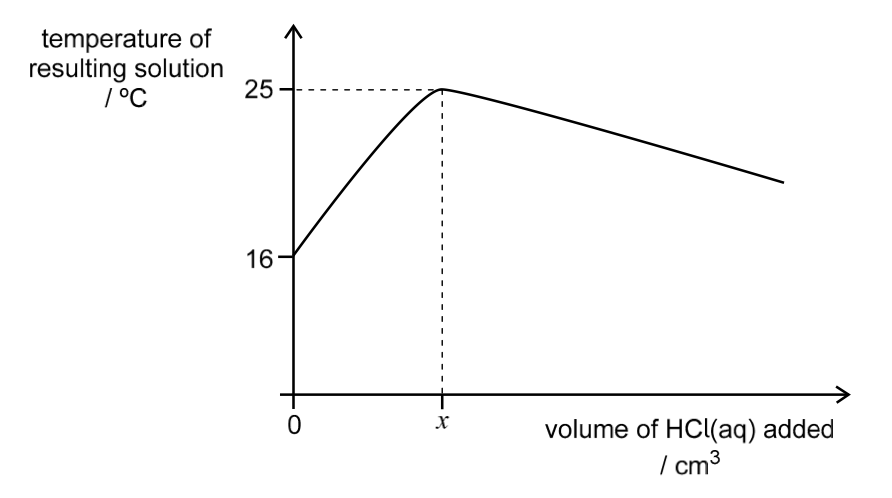
Which of the following statements explains the shape of the graph?
The two solutions had the same initial temperature and a graph was drawn of the temperature of the resulting solution against the volume of hydrochloric acid added.
Which of the following statements explains the shape of the graph?
- A.The reaction has reached a state of equilibrium.
- B.An endothermic reaction occurs after of hydrochloric acid is added.
- C.The reaction rate decreases as the acid is used up.
- D.The sodium hydroxide has been neutralised by hydrochloric acid.
- E.The sodium hydroxide becomes a weaker base as the volume of the resulting solution increases.
Answer: D
Question 46
Which one of the following represents the repeating unit of poly(pent-2-ene)?
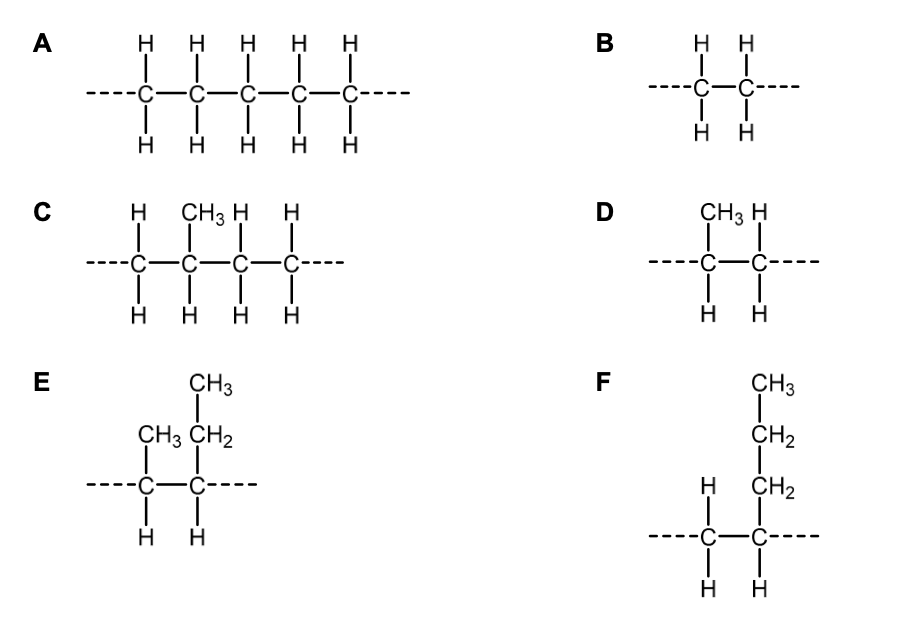
- A.Represents a segment of a 5-carbon alkane chain.
- B.Represents the repeating unit of polyethylene, .
- C.Represents a 4-carbon chain with side groups.
- D.Represents the repeating unit of polypropylene, .
- E.Represents the repeating unit of poly(pent-2-ene), .
- F.Represents the repeating unit of poly(but-1-ene), .
Answer: E
Question 47
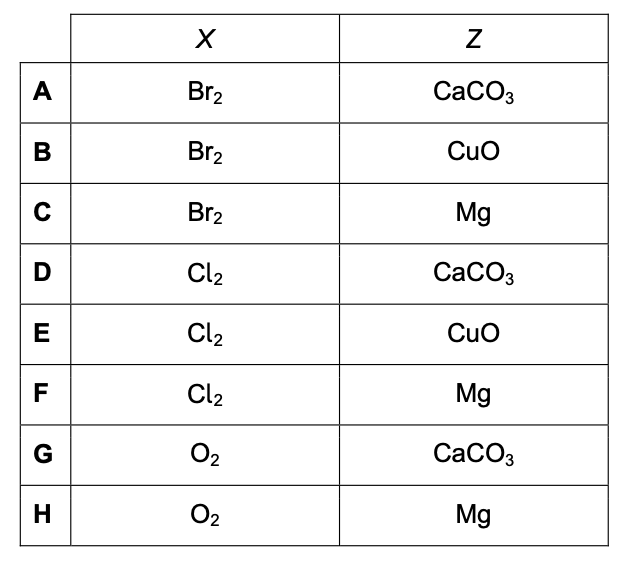
X is a gaseous element. X can react explosively with hydrogen to produce a single product. When dissolved in water, this product forms an acidic aqueous solution Y. When aqueous silver nitrate is added to solution Y, a white precipitate forms.
Solution Y reacts with substance Z to form two products only. One of these products forms a white precipitate when aqueous sodium hydroxide is added to it.
Which of the following could be X and Z?
Solution Y reacts with substance Z to form two products only. One of these products forms a white precipitate when aqueous sodium hydroxide is added to it.
Which of the following could be X and Z?
- A.,
- B.,
- C.,
- D.,
- E.,
- F.,
- G.,
- H.,
Answer: F
Question 48
Some students were trying to assign oxidation numbers to each of the four sulfur atoms in the tetrathionate ion, .
Which of the following lists gives the possible oxidation states of the four sulfur atoms present?
Which of the following lists gives the possible oxidation states of the four sulfur atoms present?
- A.0, 0, +6, +6
- B.+3, +3, +3, +3
- C.0, +2, +6, +6
- D.0, 0, +5, +5
- E.-2, -2, +7, +7
Answer: D
Question 49
The table shows the reagents in three organic reactions.
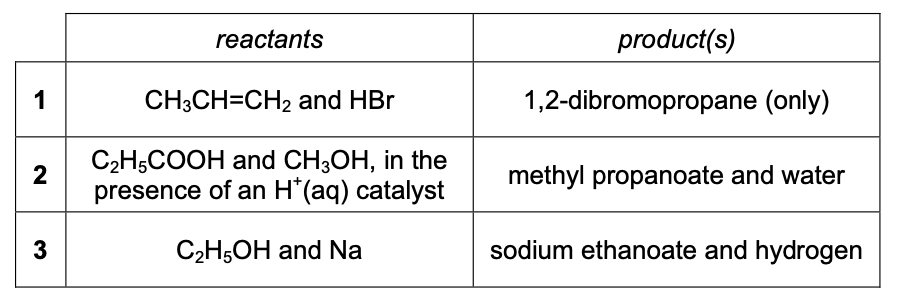
Which of the rows correctly show(s) the product(s) obtained from the specified reactants?
Which of the rows correctly show(s) the product(s) obtained from the specified reactants?
- A.none of them
- B.1 only
- C.2 only
- D.3 only
- E.1 and 2 only
- F.1 and 3 only
- G.2 and 3 only
- H.1, 2 and 3
Answer: C
Question 50
Chlorine gas reacts with hot concentrated aqueous sodium hydroxide to form sodium chloride, sodium chlorate(V) and water.
The unbalanced ionic equation for this reaction is:
What is the simplest ratio of in the balanced equation?
The unbalanced ionic equation for this reaction is:
What is the simplest ratio of in the balanced equation?
- A.1:1
- B.1:2
- C.2:1
- D.1:5
- E.5:1
- F.1:7
- G.7:1
Answer: E
Question 51
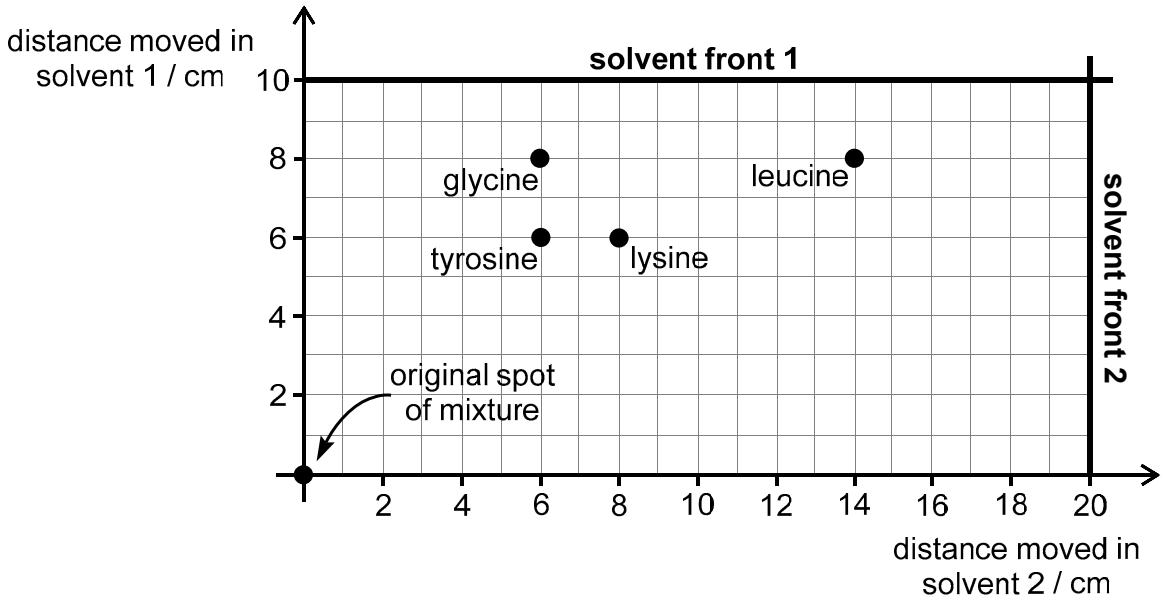
An experiment was carried out to separate the four amino acids present in a mixture of amino acids.
A spot of this mixture was placed on chromatography paper. The bottom of the paper was placed in solvent 1 and left until the solvent nearly reached the top of the paper.
The paper was then thoroughly dried and turned by 90°. The procedure was then repeated with solvent 2.
The amino acids were then identified with reference to known values in the respective solvents.
The final positions of the amino acids on the chromatograph are shown on the following diagram.
[Image of a 2D chromatogram. Y-axis: 'distance moved in solvent 1 / cm' from 0 to 10. X-axis: 'distance moved in solvent 2 / cm' from 0 to 20. The solvent front for solvent 1 is at 10 cm. The original spot is at (0,0). The final spots are at approximate coordinates (distance in solvent 2, distance in solvent 1): glycine (6, 8), leucine (14, 8), tyrosine (6, 6), lysine (8, 6).]
Which of the following statements is correct?
A spot of this mixture was placed on chromatography paper. The bottom of the paper was placed in solvent 1 and left until the solvent nearly reached the top of the paper.
The paper was then thoroughly dried and turned by 90°. The procedure was then repeated with solvent 2.
The amino acids were then identified with reference to known values in the respective solvents.
The final positions of the amino acids on the chromatograph are shown on the following diagram.
[Image of a 2D chromatogram. Y-axis: 'distance moved in solvent 1 / cm' from 0 to 10. X-axis: 'distance moved in solvent 2 / cm' from 0 to 20. The solvent front for solvent 1 is at 10 cm. The original spot is at (0,0). The final spots are at approximate coordinates (distance in solvent 2, distance in solvent 1): glycine (6, 8), leucine (14, 8), tyrosine (6, 6), lysine (8, 6).]
Which of the following statements is correct?
- A.Leucine travels further relative to the solvent front in solvent 2 than in solvent 1.
- B.Lysine has a greater value in solvent 1 than it has in solvent 2.
- C.Solvent 1 alone could be used to separate all four amino acids.
- D.Solvent 2 alone could be used to separate all four amino acids.
- E.The value of tyrosine in solvent 1 is 0.6 and in solvent 2 is 0.7.
Answer: B
Question 52
A reaction between copper and nitric acid produces a blue solution of copper(II) nitrate, water and substance X only.
Substance X does not contain copper or hydrogen.
The balanced equation for the reaction shows that 1 mole of copper reacts to produce 2 moles of water.
What is the identity of substance X?
Substance X does not contain copper or hydrogen.
The balanced equation for the reaction shows that 1 mole of copper reacts to produce 2 moles of water.
What is the identity of substance X?
- A.
- B.NO
- C.
- D.
- E.
Answer: C
Question 53
Ethanedioic acid, , is a weak diprotic acid.
What is the minimum volume of a solution of ethanedioic acid required to neutralise of sodium hydroxide solution?
What is the minimum volume of a solution of ethanedioic acid required to neutralise of sodium hydroxide solution?
- A.
- B.
- C.
- D.
- E.
Answer: A
Question 54
Propene burns in air. For each mole of propene burned, 2000 kJ of heat is released.
2.10 g of propene is burned to heat a 1000 g sample of olive oil.
The olive oil has an initial temperature of 23.0 °C. It takes 2.00 J to heat one gram of olive oil by 1.0°C.
Assume that all heat is transferred to the olive oil and none is lost to the surroundings.
What is the maximum temperature reached by the oil?
( value: )
2.10 g of propene is burned to heat a 1000 g sample of olive oil.
The olive oil has an initial temperature of 23.0 °C. It takes 2.00 J to heat one gram of olive oil by 1.0°C.
Assume that all heat is transferred to the olive oil and none is lost to the surroundings.
What is the maximum temperature reached by the oil?
( value: )
- A.20.0°C
- B.43.0°C
- C.48.0°C
- D.50.0°C
- E.73.0°C
- F.100°C
- G.200 °C
- H.223°C
Answer: E
Question 55
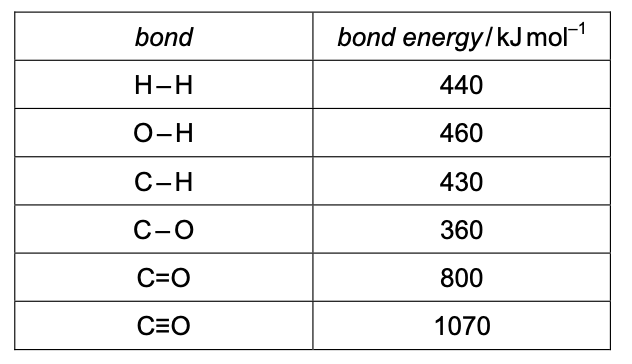
What is the calculated energy change for the following reaction using appropriate values from the data provided?
- A.+200 kJ mol⁻¹
- B.-200 kJ mol⁻¹
- C.+720 kJ mol⁻¹
- D.-720 kJ mol⁻¹
- E.+1080 kJ mol⁻¹
- F.-1080 kJ mol⁻¹
Answer: A
Question 56
The balanced equation for an oxidation of ammonia is:
of ammonia and of oxygen, both at 850 °C and 1 atmosphere pressure, are mixed and allowed to react to form the products shown in the equation. No other reactions occur.
What is the maximum total volume of gases (at 850 °C and 1 atmosphere pressure) after the reaction?
(Assume that all gases have the same volume at the given temperature and pressure.)
of ammonia and of oxygen, both at 850 °C and 1 atmosphere pressure, are mixed and allowed to react to form the products shown in the equation. No other reactions occur.
What is the maximum total volume of gases (at 850 °C and 1 atmosphere pressure) after the reaction?
(Assume that all gases have the same volume at the given temperature and pressure.)
- A.
- B.
- C.
- D.
- E.
Answer: B
Question 57
The electrolysis of molten potassium chloride in an inert atmosphere produces potassium at the negative electrode and chlorine at the positive electrode.
The electrolysis of aqueous copper(II) sulfate solution deposits copper on the negative electrode.
The masses of potassium, chlorine and copper produced or deposited in these experiments were recorded.
Assume that the same number of electrons is transferred during the electrolysis of molten potassium chloride and aqueous copper(II) sulfate solution.
Which of the following gives the elements arranged in order of the mass produced/deposited during these electrolysis experiments, from lowest mass to highest mass?
( values: Cl = 35.5; K = 39.0; Cu = 63.5)
The electrolysis of aqueous copper(II) sulfate solution deposits copper on the negative electrode.
The masses of potassium, chlorine and copper produced or deposited in these experiments were recorded.
Assume that the same number of electrons is transferred during the electrolysis of molten potassium chloride and aqueous copper(II) sulfate solution.
Which of the following gives the elements arranged in order of the mass produced/deposited during these electrolysis experiments, from lowest mass to highest mass?
( values: Cl = 35.5; K = 39.0; Cu = 63.5)
- A.chlorine, copper, potassium
- B.chlorine, potassium, copper
- C.copper, chlorine, potassium
- D.copper, potassium, chlorine
- E.potassium, chlorine, copper
- F.potassium, copper, chlorine
Answer: C
Question 58
0.500 g of magnesium (an excess) was added to dilute hydrochloric acid.
The following graph shows the total volume of the gas released over time as the reaction progresses. All volumes were measured in at room temperature and pressure.
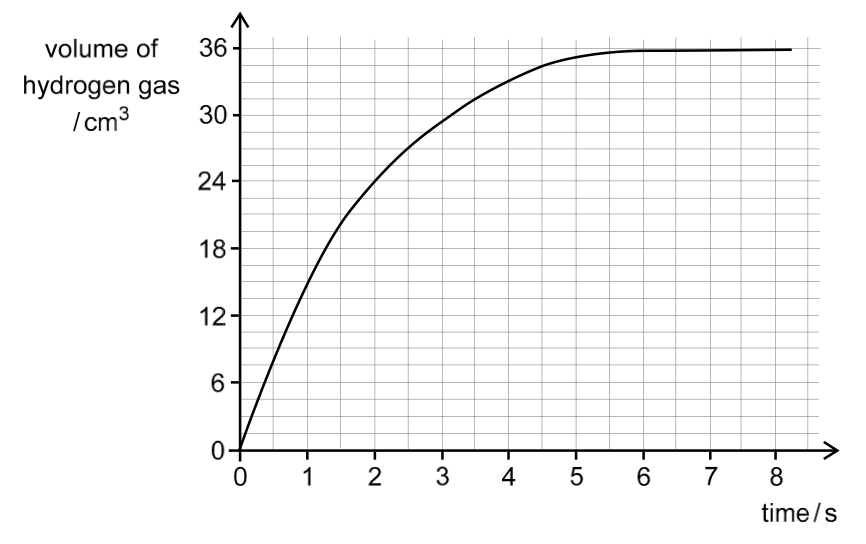
What is the mass of magnesium remaining after two seconds?
( value: Mg = 24. Assume that the volume of one mole of gas at room temperature and pressure is .)
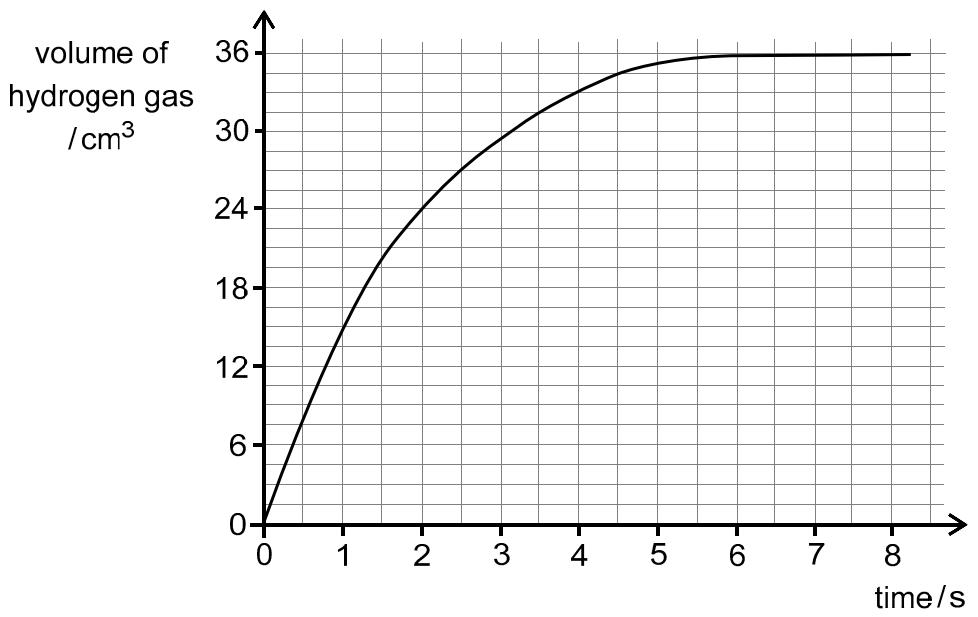
The following graph shows the total volume of the gas released over time as the reaction progresses. All volumes were measured in at room temperature and pressure.
What is the mass of magnesium remaining after two seconds?
( value: Mg = 24. Assume that the volume of one mole of gas at room temperature and pressure is .)
- A.0.024 g
- B.0.036 g
- C.0.048 g
- D.0.452 g
- E.0.464 g
- F.0.476 g
Answer: F
Question 59
A mixture of both sodium nitrate and barium bromide solids, with a combined mass of 6.36 g, was stirred into water and completely dissolved.
An excess of aqueous silver nitrate was added and a precipitate formed. The precipitate was filtered and dried. The mass of dry precipitate was 3.76 g.
What was the mass of sodium nitrate in the original mixture?
( values: ; ; )
An excess of aqueous silver nitrate was added and a precipitate formed. The precipitate was filtered and dried. The mass of dry precipitate was 3.76 g.
What was the mass of sodium nitrate in the original mixture?
( values: ; ; )
- A.0.42 g
- B.0.85 g
- C.1.70 g
- D.2.97 g
- E.3.39 g
- F.5.94 g
Answer: E
Question 60
A spoonful of magnesium carbonate powder was added to excess hydrochloric acid in an open conical flask on an electronic balance.
The mass of the flask and its contents was measured initially and at 1-minute intervals. The total mass of gas produced was then calculated.
The reaction stopped at 5 minutes.
Which row in the following table could represent the total mass of gas calculated after each measurement?
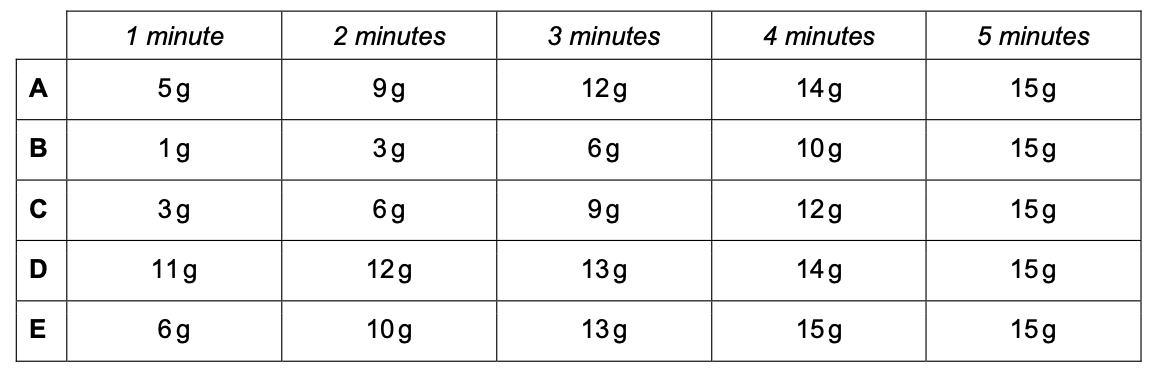
The mass of the flask and its contents was measured initially and at 1-minute intervals. The total mass of gas produced was then calculated.
The reaction stopped at 5 minutes.
Which row in the following table could represent the total mass of gas calculated after each measurement?
- A.Row A
- B.Row B
- C.Row C
- D.Row D
- E.Row E
Answer: A