NSAA 2021 Physics S1
20 questions20 marksUpdated October 2025
The NSAA 2021 Physics S1 paper in full: all 20 questions, each with its answer. NSAA is the Natural Sciences Admissions Assessment. Sit it cold under exam timing, mark it, then work back through anything you missed using the solutions below.
Download the original PDF →Questions and answers are free. Full step-by-step worked solutions unlock with a free account. Start practising.
Question 21
A resistor has a constant voltage of 9.00 V across it.
A total charge of 180 C passes through the resistor in 4.00 minutes.
What is the power dissipated in the resistor?
A total charge of 180 C passes through the resistor in 4.00 minutes.
What is the power dissipated in the resistor?
- A.0.750 W
- B.6.75 W
- C.12.0 W
- D.81.0 W
- E.108 W
- F.405 W
- G.1620 W
- H.6480 W
Answer: B
Question 22
Air is trapped in a cylinder by a piston. The density of the air in the cylinder is .
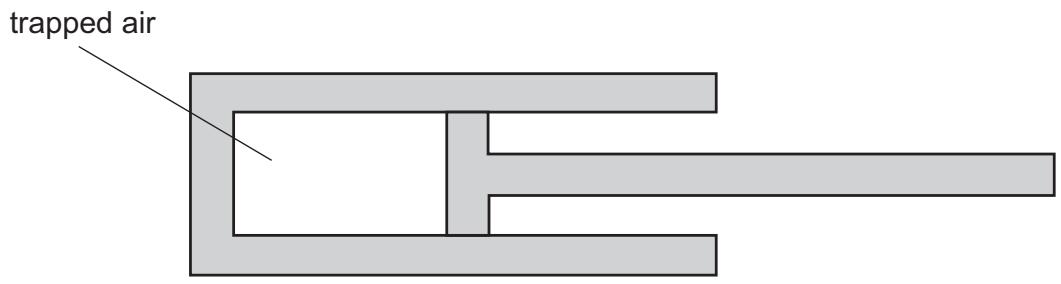
The piston is moved so that the pressure of the trapped air increases by 20%. The temperature of the trapped air does not change.
What is the new density of the trapped air?
(Assume that air is an ideal gas.)
The piston is moved so that the pressure of the trapped air increases by 20%. The temperature of the trapped air does not change.
What is the new density of the trapped air?
(Assume that air is an ideal gas.)
- A.
- B.
- C.
- D.
- E.
- F.
Answer: E
Question 23
A non-ideal transformer has 100 turns on the primary coil and 25 turns on the secondary coil.
It is provided with 3.0 kW of electrical power at a current of 12.5 A.
The voltage output is the same as for an ideal transformer, but the current in the output coil is 40 A.
What is the efficiency of the transformer?
It is provided with 3.0 kW of electrical power at a current of 12.5 A.
The voltage output is the same as for an ideal transformer, but the current in the output coil is 40 A.
What is the efficiency of the transformer?
- A.20%
- B.25%
- C.31%
- D.69%
- E.75%
- F.80%
- G.91%
- H.100%
Answer: F
Question 24
A car of mass 1400 kg is towing a caravan of mass 1000 kg along a straight horizontal section of road at a constant speed.
The driving force from the engine is increased by 3000 N, causing the car and caravan to accelerate.
At one moment during this acceleration, the resistive force on the car has increased by 200 N and the resistive force on the caravan has increased by 400 N.
What is the acceleration of the car and caravan at this moment?
The driving force from the engine is increased by 3000 N, causing the car and caravan to accelerate.
At one moment during this acceleration, the resistive force on the car has increased by 200 N and the resistive force on the caravan has increased by 400 N.
What is the acceleration of the car and caravan at this moment?
- A.
- B.
- C.
- D.
- E.
Answer: A
Question 25
A star is moving away from a space telescope positioned above the Earth. The star emits light of frequency and wavelength at the speed of light .
This light travels towards the space telescope through the vacuum of space until it is detected on the space telescope.
The frequency, the wavelength and the speed of the light measured at the telescope are , and respectively.
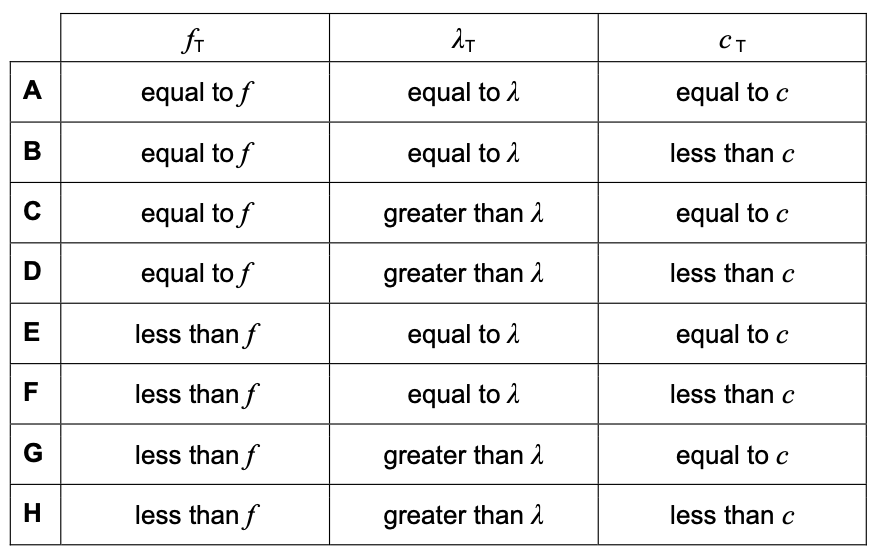
How do , and compare with , and ?
This light travels towards the space telescope through the vacuum of space until it is detected on the space telescope.
The frequency, the wavelength and the speed of the light measured at the telescope are , and respectively.
How do , and compare with , and ?
- A. equal to , equal to , equal to
- B. equal to , equal to , less than
- C. equal to , greater than , equal to
- D. equal to , greater than , less than
- E. less than , equal to , equal to
- F. less than , equal to , less than
- G. less than , greater than , equal to
- H. less than , greater than , less than
Answer: G
Question 26
Q is an element with several isotopes.
The nuclide contains 6 neutrons more than the nuclide .
Another isotope of Q is the nuclide .
How many neutrons does the nuclide contain?
The nuclide contains 6 neutrons more than the nuclide .
Another isotope of Q is the nuclide .
How many neutrons does the nuclide contain?
- A.9
- B.16
- C.19
- D.21
- E.25
- F.33
- G.49
Answer: F
Question 27
A light spring has an uncompressed length of 0.10 m. When an object of mass 0.5 kg rests in equilibrium on top of the spring, the length of the spring reduces to 0.08 m as shown.
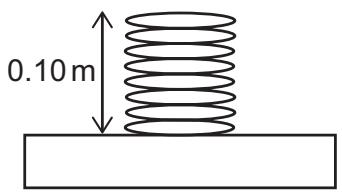
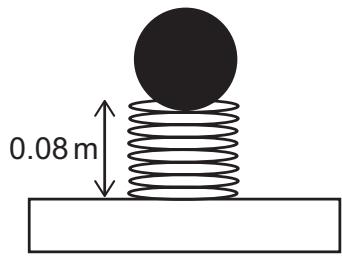
What is the energy stored in the spring due to the compression?
(gravitational field strength = ; the spring obeys Hooke's law)
What is the energy stored in the spring due to the compression?
(gravitational field strength = ; the spring obeys Hooke's law)
- A.0.005 J
- B.0.02 J
- C.0.05 J
- D.0.1 J
- E.0.2 J
- F.0.4 J
Answer: C
Question 28
A set of decorative lights consists of 20 lamps connected in series to a dc supply of constant voltage.
The total power transferred by all the lamps is .
The set is designed so that if one of the lamps fails, that lamp becomes short-circuited and it then has zero resistance. The remaining lamps are still lit.
If this happens, with the set connected to the same supply, what is the new total power transferred by the remaining 19 lamps?
(Assume that the resistance of each functioning lamp remains constant.)
The total power transferred by all the lamps is .
The set is designed so that if one of the lamps fails, that lamp becomes short-circuited and it then has zero resistance. The remaining lamps are still lit.
If this happens, with the set connected to the same supply, what is the new total power transferred by the remaining 19 lamps?
(Assume that the resistance of each functioning lamp remains constant.)
- A.
- B.
- C.
- D.
- E.
Answer: D
Question 29
A train accelerates from rest along a straight, horizontal section of track.
The force exerted on the train due to its motors is constant and there is a constant friction force of N.
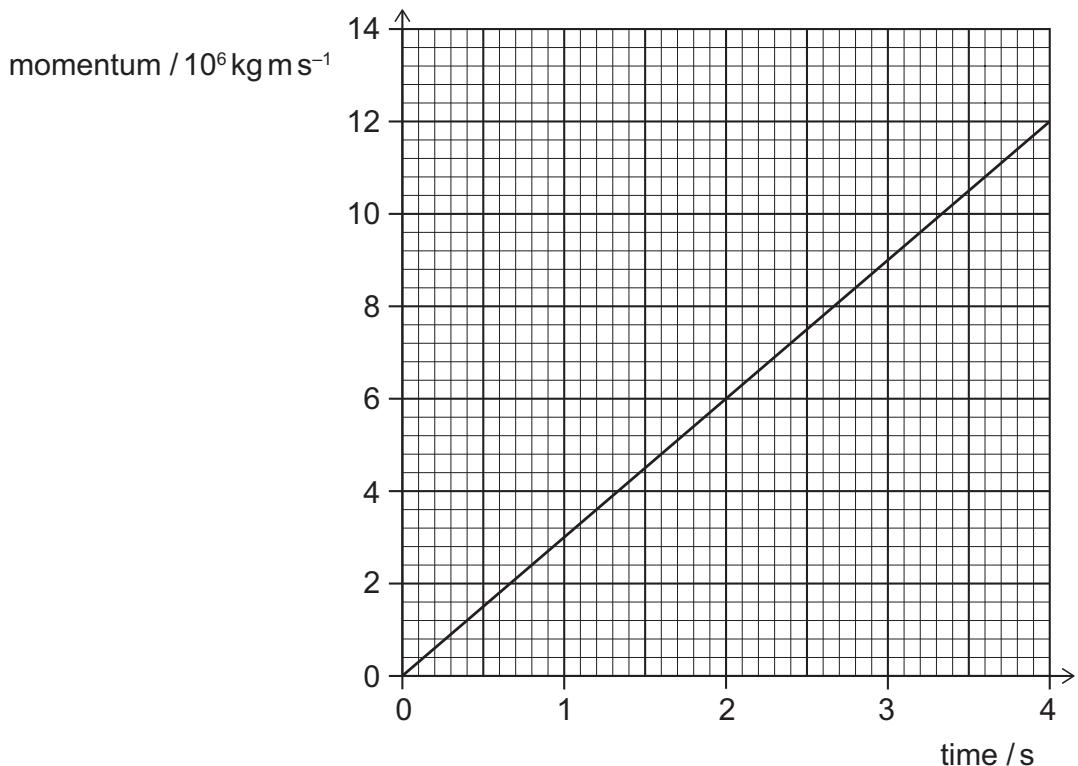
The graph shows how the momentum of the train changes with time.
What is the force exerted on the train due to its motors?
The force exerted on the train due to its motors is constant and there is a constant friction force of N.
The graph shows how the momentum of the train changes with time.
What is the force exerted on the train due to its motors?
- A. N
- B. N
- C. N
- D. N
- E. N
- F. N
- G. N
- H. N
Answer: E
Question 30
A ship travels into a wave that is travelling in the opposite direction to the ship.
The ship has a horizontal speed of . The speed of the wave is .
The front of the ship rises and falls with a time period of 8.0 s.
What is the wavelength of the wave?
The ship has a horizontal speed of . The speed of the wave is .
The front of the ship rises and falls with a time period of 8.0 s.
What is the wavelength of the wave?
- A. m
- B. m
- C.1.0 m
- D. m
- E.24 m
- F.40 m
- G.64 m
- H.88 m
Answer: H
Question 31
A 6.0 V battery is connected to an 8.0 resistor and a filament lamp as shown in the circuit diagram.
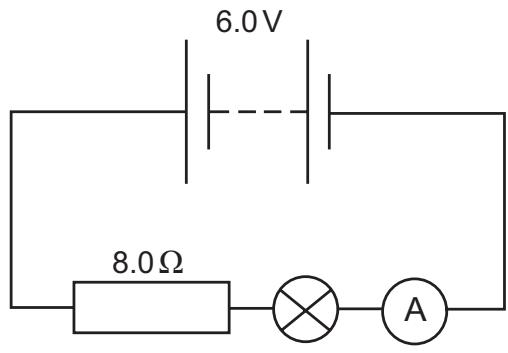
The reading on the ammeter is 0.25 A.
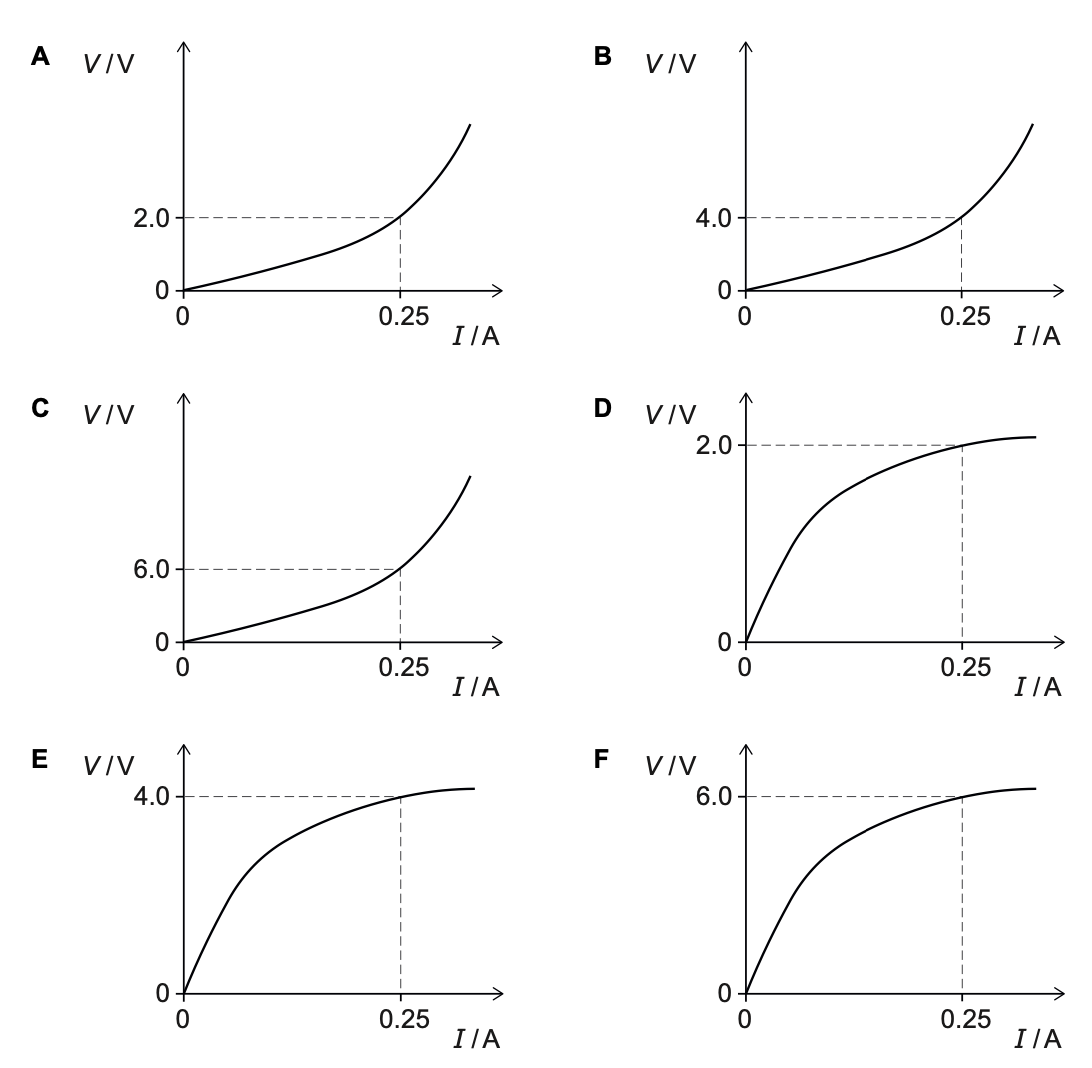
Which graph is a possible V-I graph for the filament lamp?
The reading on the ammeter is 0.25 A.
Which graph is a possible V-I graph for the filament lamp?
- A.Graph A
- B.Graph B
- C.Graph C
- D.Graph D
- E.Graph E
- F.Graph F
Answer: B
Question 32
A uniform, horizontal magnetic field has magnetic field strength 0.60 T and a direction from west to east.
A horizontal wire is placed in a north-south direction, so that it is at to the magnetic field.
The wire carries a constant current.
The wire has length 0.40 m and mass 0.018 kg.
The resultant force acting vertically on the wire is zero.
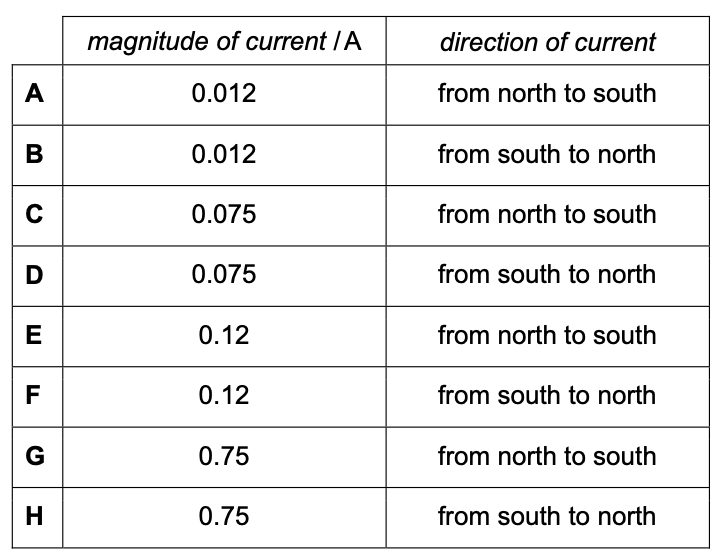
What are the magnitude and direction of the current in the wire?
(gravitational field strength = )
A horizontal wire is placed in a north-south direction, so that it is at to the magnetic field.
The wire carries a constant current.
The wire has length 0.40 m and mass 0.018 kg.
The resultant force acting vertically on the wire is zero.
What are the magnitude and direction of the current in the wire?
(gravitational field strength = )
- A.magnitude of current / A: 0.012, direction of current: from north to south
- B.magnitude of current / A: 0.012, direction of current: from south to north
- C.magnitude of current / A: 0.075, direction of current: from north to south
- D.magnitude of current / A: 0.075, direction of current: from south to north
- E.magnitude of current / A: 0.12, direction of current: from north to south
- F.magnitude of current / A: 0.12, direction of current: from south to north
- G.magnitude of current / A: 0.75, direction of current: from north to south
- H.magnitude of current / A: 0.75, direction of current: from south to north
Answer: G
Question 33
The wavelength range of visible light is 400-700 nm.
Light with a frequency of Hz is green.
Microwaves used in cooking have a wavelength of 12 cm.
Which of the following statements is/are correct?
1 Light with a frequency of Hz is red.
2 Microwaves used in cooking have a frequency of Hz.
3 Electromagnetic radiation with a frequency of Hz can be used in thermal imaging of a building.
(speed of light = )
Light with a frequency of Hz is green.
Microwaves used in cooking have a wavelength of 12 cm.
Which of the following statements is/are correct?
1 Light with a frequency of Hz is red.
2 Microwaves used in cooking have a frequency of Hz.
3 Electromagnetic radiation with a frequency of Hz can be used in thermal imaging of a building.
(speed of light = )
- A.none of them
- B.1 only
- C.2 only
- D.3 only
- E.1 and 2 only
- F.1 and 3 only
- G.2 and 3 only
- H.1, 2 and 3
Answer: C
Question 34
There is a high-speed straight railway line between two cities that are 60 km apart. The train stops at both cities.
The train accelerates at a uniform rate of to a maximum speed of .
When braking, it decelerates at a uniform rate of .
What is the minimum time taken by the train to travel from one city to the other?
The train accelerates at a uniform rate of to a maximum speed of .
When braking, it decelerates at a uniform rate of .
What is the minimum time taken by the train to travel from one city to the other?
- A.140 s
- B.355 s
- C.430 s
- D.500 s
- E.570 s
- F.860 s
- G.1000 s
Answer: E
Question 35
A metal block has mass .
Heat is transferred to the block at a constant rate .
The graph shows how the change in temperature of the block from its initial temperature varies with time .
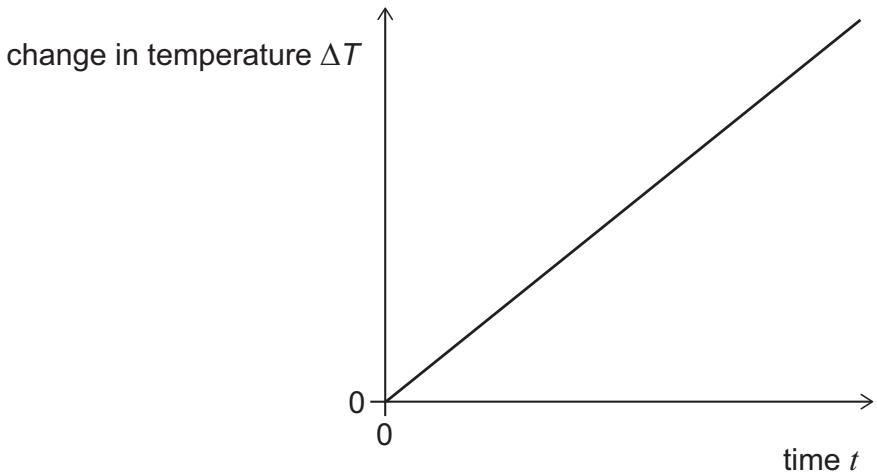
The gradient of the line is .
Which expression gives the specific heat capacity of the metal from which the block is made?
(Assume that no heat is transferred out of the block during the time interval shown by the graph.)
Heat is transferred to the block at a constant rate .
The graph shows how the change in temperature of the block from its initial temperature varies with time .
The gradient of the line is .
Which expression gives the specific heat capacity of the metal from which the block is made?
(Assume that no heat is transferred out of the block during the time interval shown by the graph.)
- A.
- B.
- C.
- D.
- E.
- F.
- G.
- H.
Answer: D
Question 36
A skydiver of mass 80 kg is accelerating vertically downwards through the air. At one instant in time the skydiver has a speed of . After travelling a further distance of 20 m downwards the skydiver's speed has increased to .
What is the average force of air resistance acting on the skydiver over the 20 m?
(gravitational field strength = )
What is the average force of air resistance acting on the skydiver over the 20 m?
(gravitational field strength = )
- A.600 N
- B.650 N
- C.750 N
- D.790 N
- E.950 N
Answer: B
Question 37
A radioactive nuclide X decays in a single stage to a stable nuclide R.
A radioactive nuclide Y decays in a single stage to a stable nuclide S.
When a rock formed it contained equal numbers of atoms of all four nuclides X, Y, R and S.
The half-life of X is years and the half-life of Y is years.
What is the value of at a time years after the rock has formed?
(Assume that no other processes add or remove X, Y, R or S from the rock during this time.)
A radioactive nuclide Y decays in a single stage to a stable nuclide S.
When a rock formed it contained equal numbers of atoms of all four nuclides X, Y, R and S.
The half-life of X is years and the half-life of Y is years.
What is the value of at a time years after the rock has formed?
(Assume that no other processes add or remove X, Y, R or S from the rock during this time.)
- A.
- B.
- C.
- D.
- E.
- F.2
Answer: C
Question 38
A beaker containing 180 g of water at C has a 20 g ice cube at C added to it.
No heat is transferred between the water and the surroundings (including the beaker).
What is the final temperature of all the water in the beaker after all the ice has melted?
(Take the specific heat capacity of water to be and the specific latent heat of fusion of water to be .)
No heat is transferred between the water and the surroundings (including the beaker).
What is the final temperature of all the water in the beaker after all the ice has melted?
(Take the specific heat capacity of water to be and the specific latent heat of fusion of water to be .)
- A.C
- B.C
- C.C
- D.C
- E.C
- F.C
Answer: D
Question 39
Liquid X has density and liquid Y has density .
of liquid X and of liquid Y are poured into a cylindrical container and allowed to settle. The two liquids do not mix or react.
The internal cross-sectional area of the container is . The base of the container rests on a horizontal surface.
What is the pressure due to the liquids at a height of 4.0 cm above the interior of the base of the container?
(gravitational field strength = )
of liquid X and of liquid Y are poured into a cylindrical container and allowed to settle. The two liquids do not mix or react.
The internal cross-sectional area of the container is . The base of the container rests on a horizontal surface.
What is the pressure due to the liquids at a height of 4.0 cm above the interior of the base of the container?
(gravitational field strength = )
- A.10 Pa
- B.40 Pa
- C.42 Pa
- D.50 Pa
- E.100 Pa
- F.400 Pa
- G.420 Pa
- H.500 Pa
Answer: G
Question 40
A pulse of ultrasound travels from one end of a solid uniform rod of length , starting at time .
The pulse is partially reflected by a crack in the rod and partially by the far end of the rod.
These two reflected pulses travel back along the rod, arriving at the end from which they started at times and , where .
What is the distance between the crack and the far end of the rod?
The pulse is partially reflected by a crack in the rod and partially by the far end of the rod.
These two reflected pulses travel back along the rod, arriving at the end from which they started at times and , where .
What is the distance between the crack and the far end of the rod?
- A.
- B.
- C.
- D.
- E.
- F.
Answer: E