Mapped to the ESAT specification
NSAA 2022 Biology Part D
20 questions20 marksUpdated June 2026
Natural Sciences Admissions Assessment 2022 is one of the closest available past papers for the Engineering and Science Admissions Test. Below, all 20 questions are mapped to the ESAT topics they test, each with its answer. Sit it cold under exam timing, then work back through anything you missed using the solutions.
What this paper covers on the ESAT
Every question mapped to the Engineering and Science Admissions Test specification, so you know exactly which areas it tests.
Biology
- Animal physiology (7)
- Cell division and sex determination (5)
- Plant physiology (4)
- Enzymes (3)
- DNA (2)
- Ecosystems (2)
- Inheritance (2)
- Movement across membranes (2)
- Variation (2)
- Cells (1)
Questions and answers are free. Full step-by-step worked solutions unlock with a free account. Start practising.
Question 61
1 markWhich of the following is/are correct when a healthy human breathes in?
1 The ribcage moves up and out because air enters the lungs.
2 The volume of the thorax decreases and the thoracic pressure increases.
3 Energy is required to contract the intercostal muscles but not the diaphragm.
1 The ribcage moves up and out because air enters the lungs.
2 The volume of the thorax decreases and the thoracic pressure increases.
3 Energy is required to contract the intercostal muscles but not the diaphragm.
- A.none of them
- B.1 only
- C.2 only
- D.3 only
- E.1 and 2 only
- F.1 and 3 only
- G.2 and 3 only
- H.1, 2 and 3
Answer: A
Question 62
1 markWhich of the following statements about the cardiovascular system in a healthy individual is/are correct?
1 When blood flow in the capillaries is restricted, the rate of oxygen exchanged with the tissues is reduced.
2 Oxygen exchange from the blood in the arteries into the tissues is fast due to the high pressure of blood.
3 Capillary walls contain a small amount of smooth muscle to constrict the vessels.
1 When blood flow in the capillaries is restricted, the rate of oxygen exchanged with the tissues is reduced.
2 Oxygen exchange from the blood in the arteries into the tissues is fast due to the high pressure of blood.
3 Capillary walls contain a small amount of smooth muscle to constrict the vessels.
- A.none of them
- B.1 only
- C.2 only
- D.3 only
- E.1 and 2 only
- F.1 and 3 only
- G.2 and 3 only
- H.1, 2 and 3
Answer: B
Question 63
1 markThe arrow in the diagram shows the net movement of molecule X out of a healthy mammalian cell.
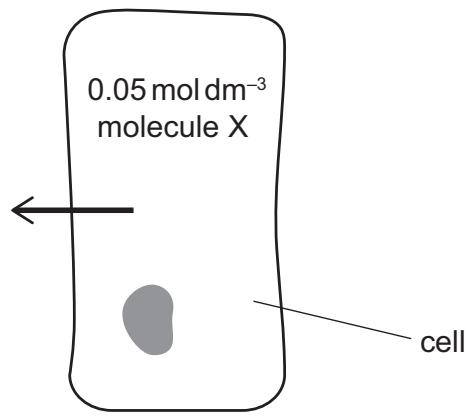
The maximum cell width is . The cell membrane accounts for 0.2% of this width.
What is the width of a single cell membrane, in nm, and which process is represented by the arrow in the diagram?
The maximum cell width is . The cell membrane accounts for 0.2% of this width.
What is the width of a single cell membrane, in nm, and which process is represented by the arrow in the diagram?
- A.width of a single cell membrane / nm: 0.01, process represented by the arrow in the diagram: diffusion
- B.width of a single cell membrane / nm: 0.01, process represented by the arrow in the diagram: active transport
- C.width of a single cell membrane / nm: 0.02, process represented by the arrow in the diagram: diffusion
- D.width of a single cell membrane / nm: 0.02, process represented by the arrow in the diagram: active transport
- E.width of a single cell membrane / nm: 10, process represented by the arrow in the diagram: diffusion
- F.width of a single cell membrane / nm: 10, process represented by the arrow in the diagram: active transport
- G.width of a single cell membrane / nm: 20, process represented by the arrow in the diagram: diffusion
- H.width of a single cell membrane / nm: 20, process represented by the arrow in the diagram: active transport
Answer: F
Question 64
1 markWhich one of the following comparisons is correct?
- A.alveoli | bronchi | both are tissues that are specialised for gas exchange
- B.pancreas | ovary | both are organs that function as endocrine glands
- C.phloem | xylem | both are organs that transport liquids from leaves to roots in plants
- D.sensory neurone | motor neurone | both are tissues that are stimulated by a relay neurone
- E.small intestine | trachea | both are organs that have tissues with cilia
Answer: B
Question 65
1 markThe graph shows the cumulative frequency for the heights of a group of 15-year-old students.
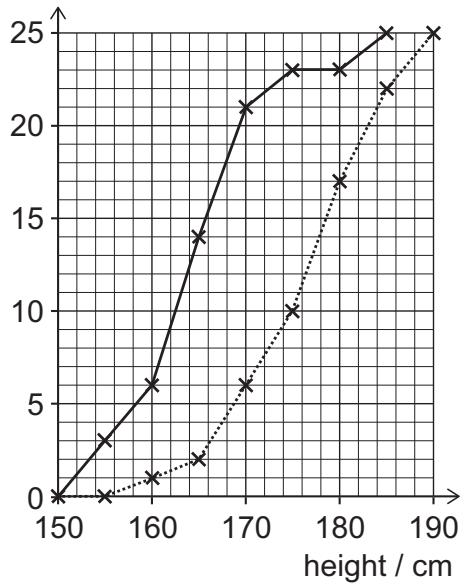
Which of the following statements is/are correct?
1 The difference between the mean heights of male and female students can be found by reading the difference in heights at a cumulative frequency of 12.5.
2 The difference in height between different males is explained by environmental factors alone.
3 The difference in the cumulative frequency graphs for males and females could be explained by a gene on the Y chromosome.
Which of the following statements is/are correct?
1 The difference between the mean heights of male and female students can be found by reading the difference in heights at a cumulative frequency of 12.5.
2 The difference in height between different males is explained by environmental factors alone.
3 The difference in the cumulative frequency graphs for males and females could be explained by a gene on the Y chromosome.
- A.none of them
- B.1 only
- C.2 only
- D.3 only
- E.1 and 2 only
- F.1 and 3 only
- G.2 and 3 only
- H.1, 2 and 3
Answer: D
Question 66
1 markWhen a person touches a hot object, they rapidly pull their hand away as a result of a reflex arc.
The diagram shows a student's drawing of part of this reflex arc.
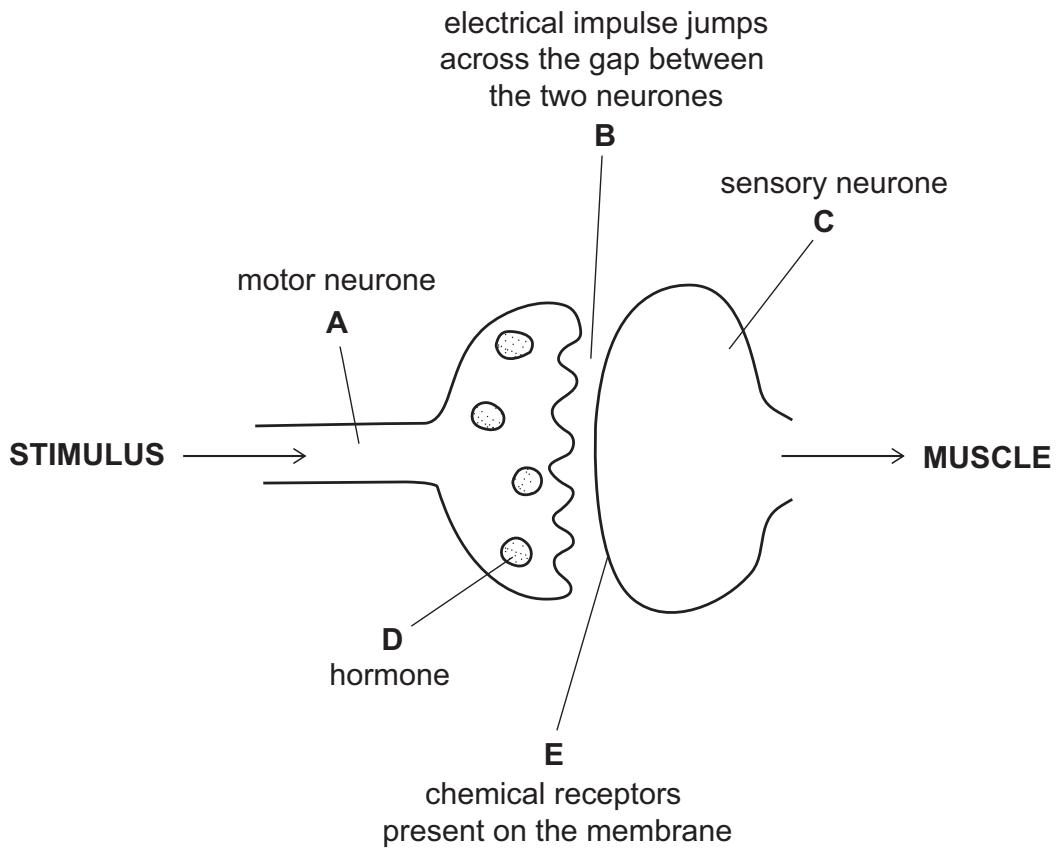
Which label (A-E) is correct?
The diagram shows a student's drawing of part of this reflex arc.
Which label (A-E) is correct?
Answer: E
Question 67
1 markA cell from a healthy animal was removed. This cell contained four times the mass of DNA when compared to a single gamete from the same animal.
Which of the following statements could be correct?
1 The cell was just about to start meiosis.
2 The cell was just about to start mitosis.
3 The cell had just started meiosis.
4 The cell had just started mitosis.
Which of the following statements could be correct?
1 The cell was just about to start meiosis.
2 The cell was just about to start mitosis.
3 The cell had just started meiosis.
4 The cell had just started mitosis.
- A.1 only
- B.2 only
- C.1 and 2 only
- D.1 and 3 only
- E.2 and 3 only
- F.2 and 4 only
- G.1, 2, 3 and 4
Answer: G
Question 68
1 markMany different species of cichlid fish have evolved from a common ancestor. The drawing shows some of the species that have evolved in Lake Victoria in Africa.
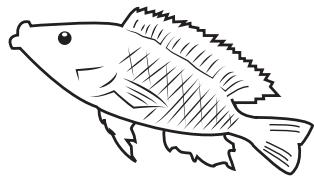
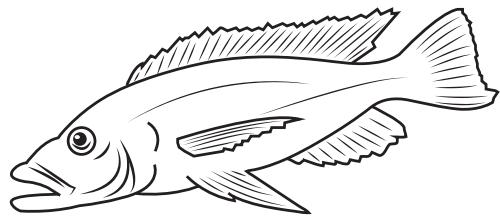
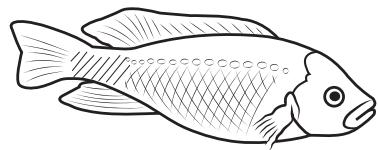
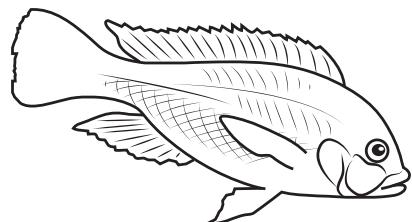
Which of the following statements about evolution of the cichlid fish is/are correct?
1 Different food types being available caused mutations in the DNA of the ancestral population of fish.
2 Natural selection was possible because there were multiple alleles of the genes affecting the traits shown in the diagram.
3 Natural selection of individuals with phenotypes best suited to different parts of the environment took place.
Which of the following statements about evolution of the cichlid fish is/are correct?
1 Different food types being available caused mutations in the DNA of the ancestral population of fish.
2 Natural selection was possible because there were multiple alleles of the genes affecting the traits shown in the diagram.
3 Natural selection of individuals with phenotypes best suited to different parts of the environment took place.
- A.none of them
- B.1 only
- C.2 only
- D.3 only
- E.1 and 2 only
- F.1 and 3 only
- G.2 and 3 only
- H.1, 2 and 3
Answer: G
Question 69
1 markThe graph shows the number of live bacteria growing in a nutrient broth at C over 60 hours.
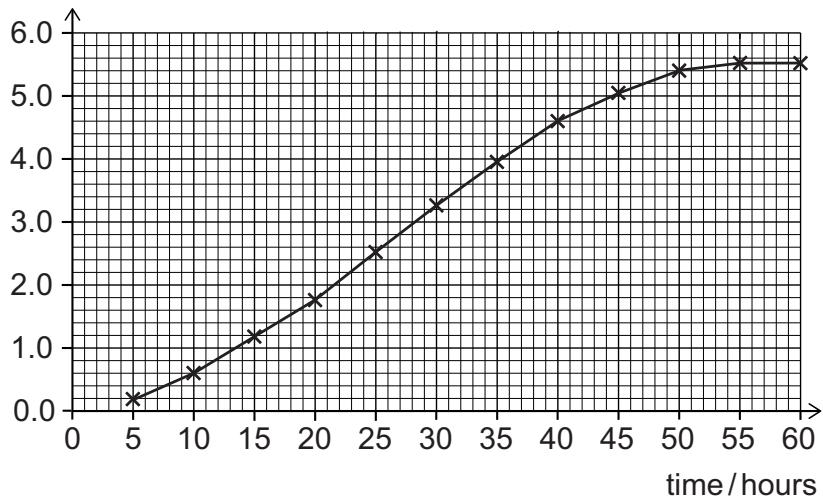
Which statement is correct?
Which statement is correct?
- A.If there were no limiting factors, the number of live bacteria in the population would be directly proportional to time.
- B.At 40 hours, there are on average 4.6 live bacteria per mm³.
- C.At 60 hours, the number of bacteria dying is greater than the number being produced.
- D.Some of the live bacteria in the population at 60 hours could be genetically different to the bacteria in the population at 5 hours.
- E.There is no limiting factor affecting the population of live bacteria over the 60 hour period.
Answer: D
Question 70
1 markSome students collected data using a belt transect on a beach and recorded the results in a kite diagram.
The shading represents the number of individuals present at each point along the belt transect. The wider the shading in the vertical direction, the larger the number of individuals present. The vertical scale is the same for all species. The six species shown were the only ones present.
Data was recorded every 5 m along the belt transect.
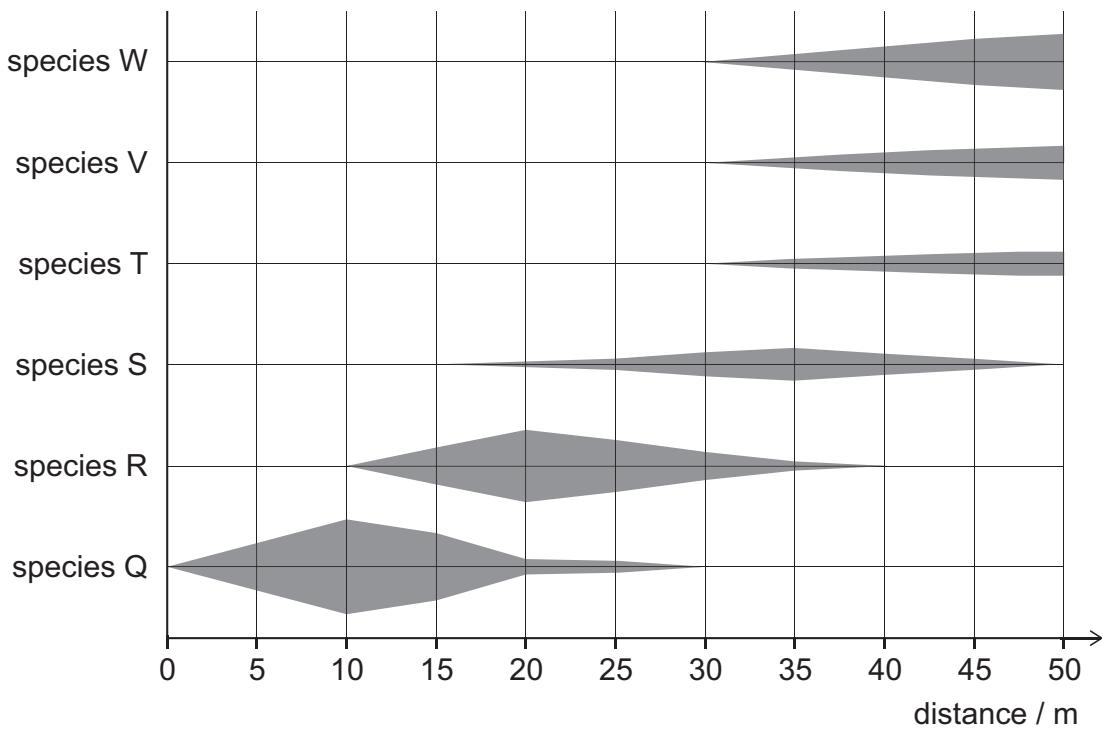
Which of the following statements is/are correct?
1 The sampling site with the highest number of different species is at 35m.
2 The abundance of species T, V and W is the same.
3 At a distance of 5m, species Q is the only species present.
The shading represents the number of individuals present at each point along the belt transect. The wider the shading in the vertical direction, the larger the number of individuals present. The vertical scale is the same for all species. The six species shown were the only ones present.
Data was recorded every 5 m along the belt transect.
Which of the following statements is/are correct?
1 The sampling site with the highest number of different species is at 35m.
2 The abundance of species T, V and W is the same.
3 At a distance of 5m, species Q is the only species present.
- A.none of them
- B.1 only
- C.2 only
- D.3 only
- E.1 and 2 only
- F.1 and 3 only
- G.2 and 3 only
- H.1, 2 and 3
Answer: F
Question 71
1 markThe effect of pH on the breakdown of starch by pancreatic amylase was investigated.
Starch and pancreatic amylase solution were mixed in test tubes, each at a different pH. The percentage of starch remaining after 5 minutes was recorded on the graph.
All other variables were kept constant.
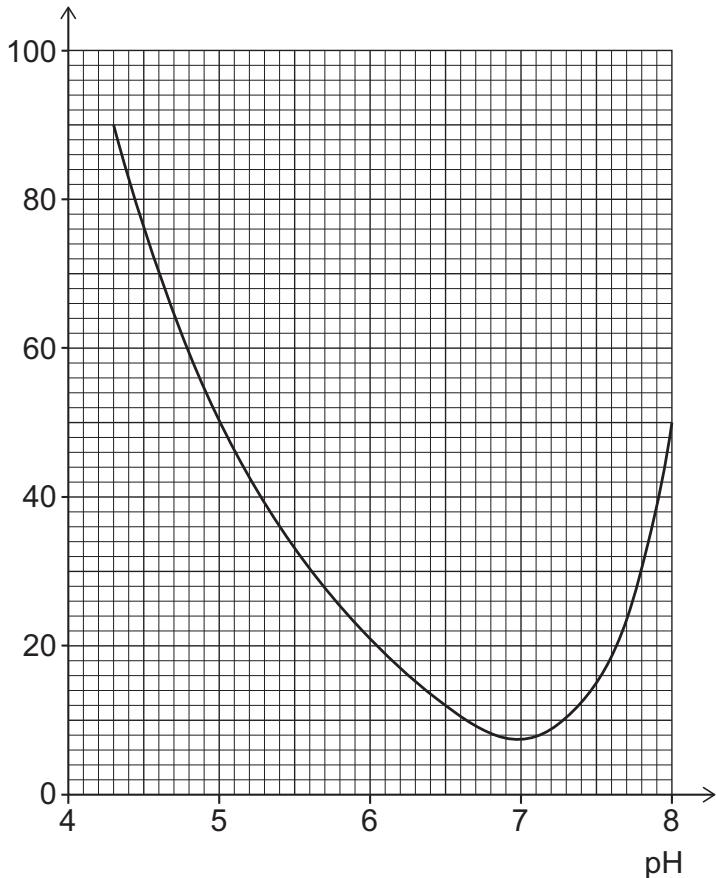
Using these results, which of the following conclusions could be correct?
1 During the 5 minutes, there are more enzyme-product complexes formed at pH 4.5 than at pH 6.
2 The shape of the enzyme is different at pH 5 compared to the shape at pH 7.
3 The optimum pH for this enzyme is approximately pH 7 under the conditions of this experiment.
Starch and pancreatic amylase solution were mixed in test tubes, each at a different pH. The percentage of starch remaining after 5 minutes was recorded on the graph.
All other variables were kept constant.
Using these results, which of the following conclusions could be correct?
1 During the 5 minutes, there are more enzyme-product complexes formed at pH 4.5 than at pH 6.
2 The shape of the enzyme is different at pH 5 compared to the shape at pH 7.
3 The optimum pH for this enzyme is approximately pH 7 under the conditions of this experiment.
- A.none of them
- B.1 only
- C.2 only
- D.3 only
- E.1 and 2 only
- F.1 and 3 only
- G.2 and 3 only
- H.1, 2 and 3
Answer: G
Question 72
1 markThe diagram summarises the homeostatic control of blood glucose concentration.
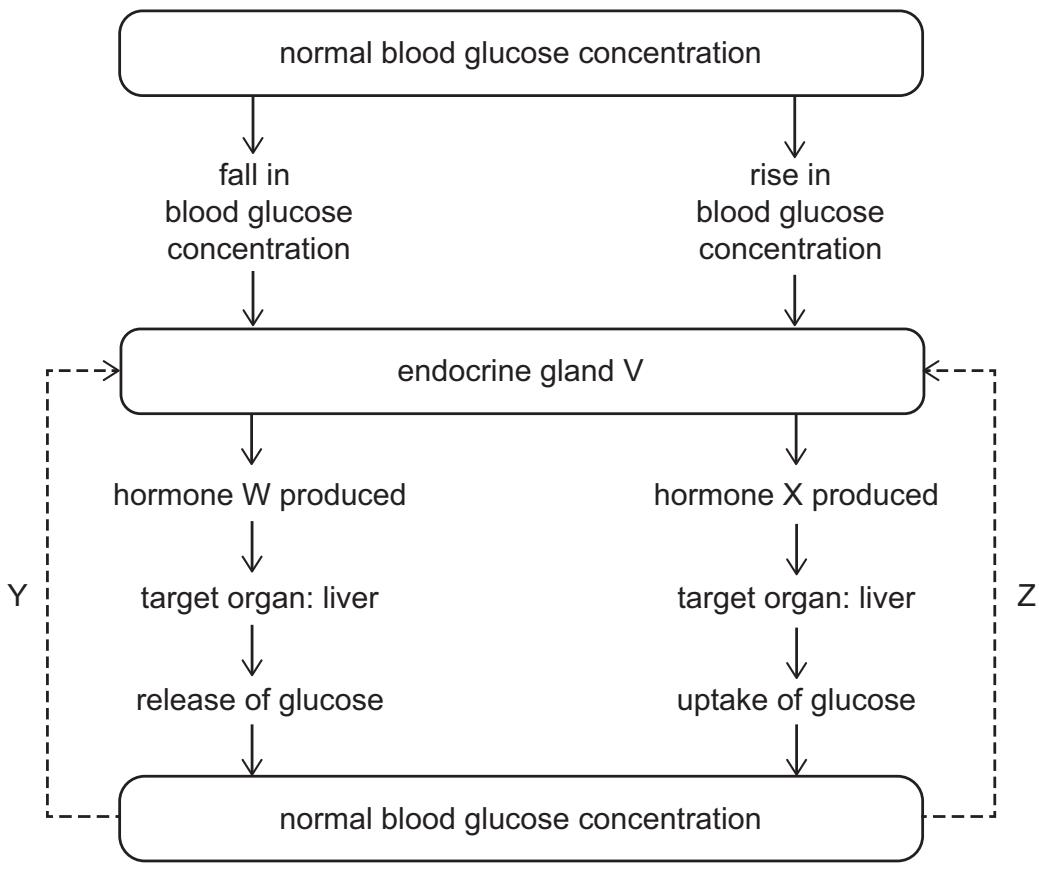
Which row is correct?
Which row is correct?
- A.gland V: pancreas, hormone W: adrenaline, hormone X: insulin, process Y: nervous response, process Z: nervous response
- B.gland V: pancreas, hormone W: glucagon, hormone X: insulin, process Y: negative feedback, process Z: negative feedback
- C.gland V: pancreas, hormone W: insulin, hormone X: glucagon, process Y: negative feedback, process Z: negative feedback
- D.gland V: pancreas, hormone W: insulin, hormone X: glucagon, process Y: nervous response, process Z: negative feedback
- E.gland V: pituitary, hormone W: adrenaline, hormone X: ADH, process Y: negative feedback, process Z: nervous response
- F.gland V: pituitary, hormone W: ADH, hormone X: glucagon, process Y: nervous response, process Z: negative feedback
- G.gland V: pituitary, hormone W: ADH, hormone X: insulin, process Y: nervous response, process Z: nervous response
- H.gland V: pituitary, hormone W: glucagon, hormone X: insulin, process Y: negative feedback, process Z: nervous response
Answer: B
Question 73
1 markThe graph shows the rate of transpiration at different temperatures for a plant in its natural environment.
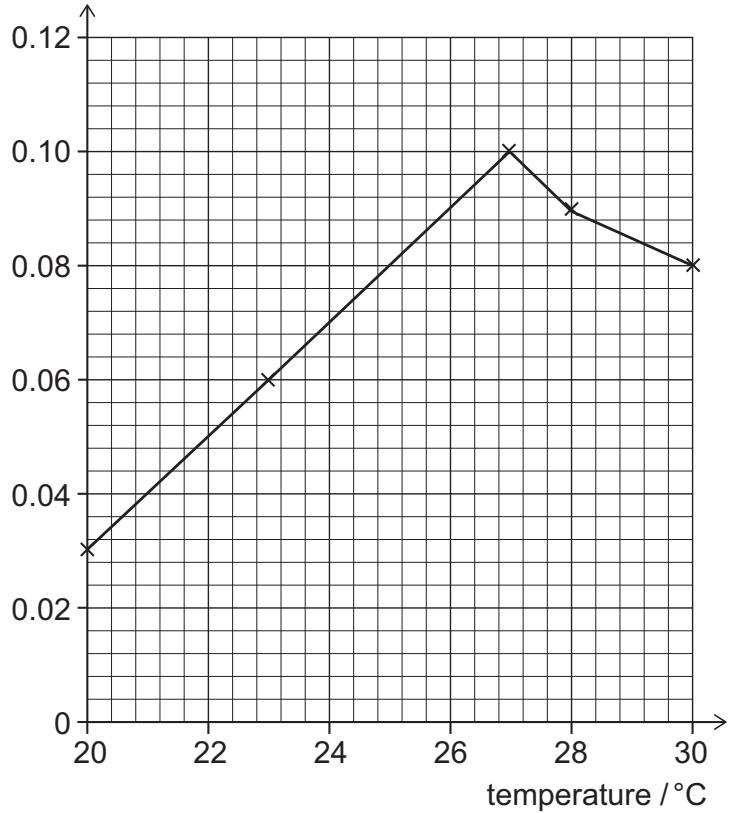
Which of the following statements is/are correct?
1 Stomata open when the guard cells lose water and become flaccid.
2 Between 20 °C and 27 °C, the humidity around the leaves must have decreased.
3 The air speed around the leaves could be higher at 23°C than at 30°C.
Which of the following statements is/are correct?
1 Stomata open when the guard cells lose water and become flaccid.
2 Between 20 °C and 27 °C, the humidity around the leaves must have decreased.
3 The air speed around the leaves could be higher at 23°C than at 30°C.
- A.none of them
- B.1 only
- C.2 only
- D.3 only
- E.1 and 2 only
- F.1 and 3 only
- G.2 and 3 only
- H.1, 2 and 3
Answer: D
Question 74
1 markAn investigation was carried out to study the effect of protease concentration on the rate of breakdown of a protein into amino acids.
A protease solution of known concentration was diluted and used in each experiment, and all other variables were kept constant. The table shows the results.
[Table with two rows. Row 1: 'percentage concentration of protease' with values 10, 20, 30, 40, 50, 60, 70. Row 2: 'rate of reaction / arbitrary units' with values 1.8, 3.5, 5.3, 6.0, 6.3, 6.3, 6.3.]
Which of the following statements is/are correct about this investigation?
1 Between concentrations of 10% and 40%, the rate of reaction has increased as more active sites are available.
2 Between concentrations of 50% and 70%, the enzyme concentration is the limiting factor.
3 At a protease concentration of 60%, the rate of reaction will be faster if substrate concentration is increased.
A protease solution of known concentration was diluted and used in each experiment, and all other variables were kept constant. The table shows the results.
[Table with two rows. Row 1: 'percentage concentration of protease' with values 10, 20, 30, 40, 50, 60, 70. Row 2: 'rate of reaction / arbitrary units' with values 1.8, 3.5, 5.3, 6.0, 6.3, 6.3, 6.3.]
Which of the following statements is/are correct about this investigation?
1 Between concentrations of 10% and 40%, the rate of reaction has increased as more active sites are available.
2 Between concentrations of 50% and 70%, the enzyme concentration is the limiting factor.
3 At a protease concentration of 60%, the rate of reaction will be faster if substrate concentration is increased.
- A.none of them
- B.1 only
- C.2 only
- D.3 only
- E.1 and 2 only
- F.1 and 3 only
- G.2 and 3 only
- H.1, 2 and 3
Answer: F
Question 75
1 markDifferent samples of the same pond plant were kept underwater and exposed to five different colours of light at the same light intensity.
All other variables were kept constant.
The time taken for the plant to release 20 bubbles was recorded. The results are shown in the chart.
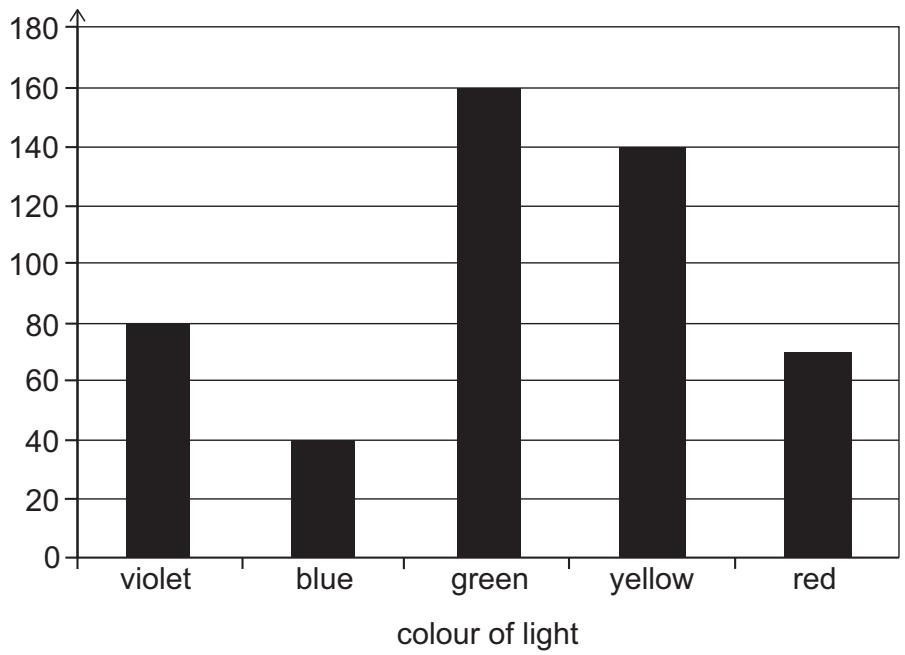
Which of the following conclusions is/are correct?
1 This pond plant photosynthesises fastest when exposed to green light.
2 When exposed to any of these colours of light, this pond plant would release only oxygen.
3 When exposed to blue light, this pond plant produces 30 bubbles per minute.
All other variables were kept constant.
The time taken for the plant to release 20 bubbles was recorded. The results are shown in the chart.
Which of the following conclusions is/are correct?
1 This pond plant photosynthesises fastest when exposed to green light.
2 When exposed to any of these colours of light, this pond plant would release only oxygen.
3 When exposed to blue light, this pond plant produces 30 bubbles per minute.
- A.1 only
- B.2 only
- C.3 only
- D.1 and 2 only
- E.1 and 3 only
- F.2 and 3 only
- G.1, 2 and 3
Answer: C
Question 76
1 markThe diagram shows two sets of apparatus, P and Q, at the beginning of an investigation.
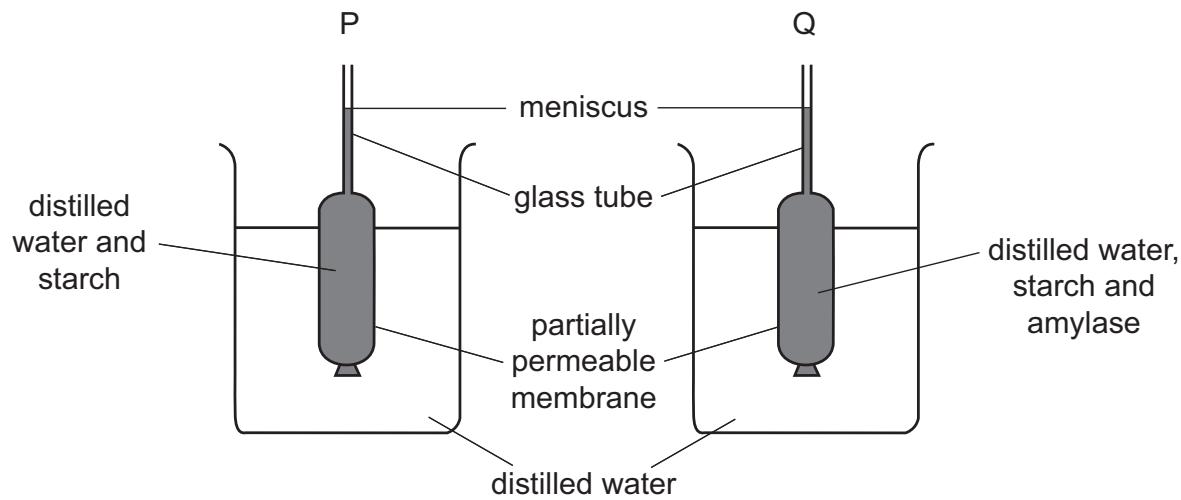
The only difference between P and Q was the contents of the partially permeable membrane.
The membrane is not permeable to starch or amylase but is permeable to smaller molecules.
After 10 minutes:
• the position of the meniscus in P had moved up the tube,
• the position of the meniscus in Q had moved down the tube.
Which of the following statements correctly explain(s) these observations?
1 Water moved by osmosis in P and Q.
2 Amylase was a substrate for starch.
3 Maltose was diffusing across the partially permeable membrane in Q, but not in P.
The only difference between P and Q was the contents of the partially permeable membrane.
The membrane is not permeable to starch or amylase but is permeable to smaller molecules.
After 10 minutes:
• the position of the meniscus in P had moved up the tube,
• the position of the meniscus in Q had moved down the tube.
Which of the following statements correctly explain(s) these observations?
1 Water moved by osmosis in P and Q.
2 Amylase was a substrate for starch.
3 Maltose was diffusing across the partially permeable membrane in Q, but not in P.
- A.none of them
- B.1 only
- C.2 only
- D.3 only
- E.1 and 2 only
- F.1 and 3 only
- G.2 and 3 only
- H.1, 2 and 3
Answer: F
Question 77
1 markTwo flies, which were both heterozygous for a trait, mated and all their eggs were collected. The resulting offspring grew into young adult flies.
The trait is controlled by a single gene with one dominant allele and one recessive allele.
Which of the following statements, taken independently, could be correct for the young adult fly population?
1 If the presence of two dominant alleles for this trait stops eggs with this genotype from hatching, the genotypic ratio within the young adult fly population would be 1:1.
2 If the presence of two recessive alleles for this trait produces sterile individuals, all of the young adult fly population will have the same phenotype.
3 If the population of young adult flies is small, the phenotypic ratio would be 1:2:1.
The trait is controlled by a single gene with one dominant allele and one recessive allele.
Which of the following statements, taken independently, could be correct for the young adult fly population?
1 If the presence of two dominant alleles for this trait stops eggs with this genotype from hatching, the genotypic ratio within the young adult fly population would be 1:1.
2 If the presence of two recessive alleles for this trait produces sterile individuals, all of the young adult fly population will have the same phenotype.
3 If the population of young adult flies is small, the phenotypic ratio would be 1:2:1.
- A.none of them
- B.1 only
- C.2 only
- D.3 only
- E.1 and 2 only
- F.1 and 3 only
- G.2 and 3 only
- H.1, 2 and 3
Answer: A
Question 78
1 markThe diagram shows part of the process of sperm production in a healthy human male. Only one pair of the 23 pairs of homologous chromosomes is shown.
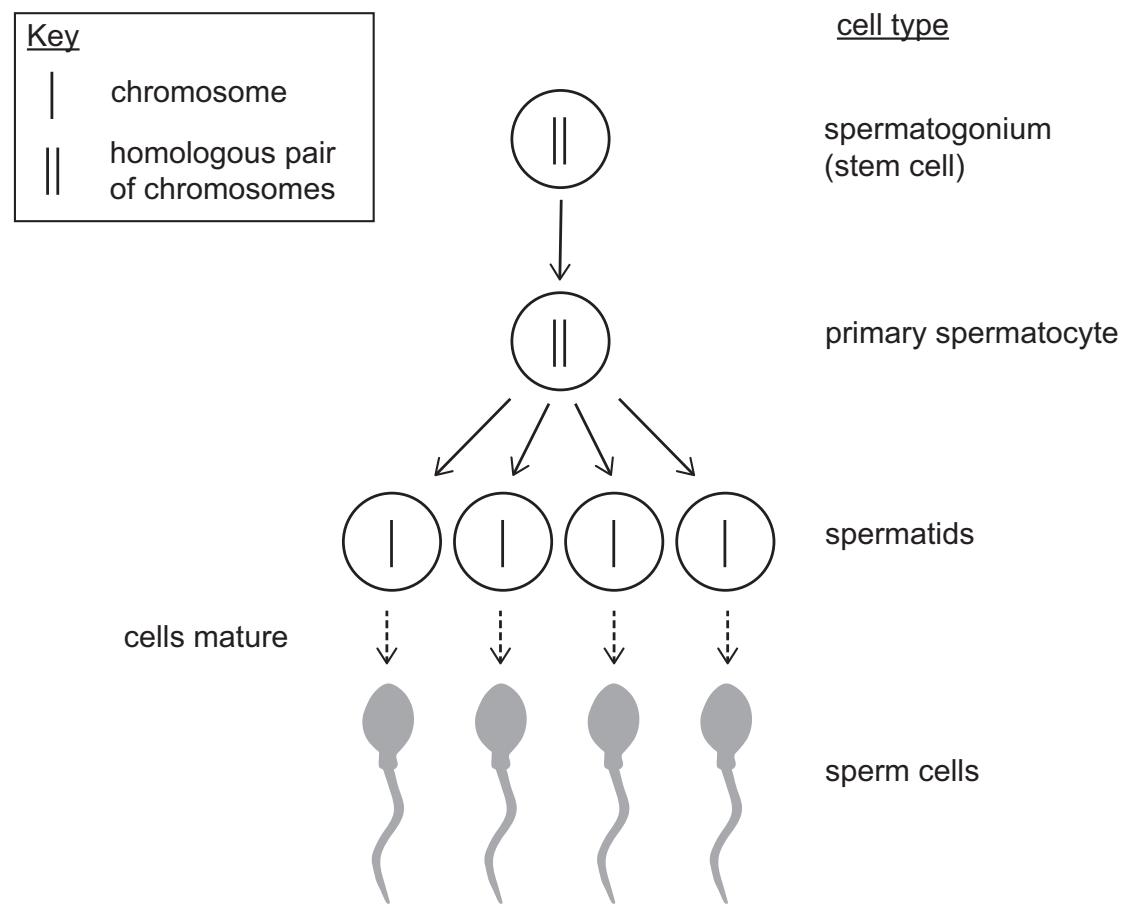
Which of the following statements is/are correct?
1 Gametes are produced from haploid stem cells.
2 Upon fertilisation, it is the male gamete that would determine the sex of the offspring.
3 DNA in the primary spermatocyte is copied before the spermatids are made.
Which of the following statements is/are correct?
1 Gametes are produced from haploid stem cells.
2 Upon fertilisation, it is the male gamete that would determine the sex of the offspring.
3 DNA in the primary spermatocyte is copied before the spermatids are made.
- A.none of them
- B.1 only
- C.2 only
- D.3 only
- E.1 and 2 only
- F.1 and 3 only
- G.2 and 3 only
- H.1, 2 and 3
Answer: G
Question 79
1 markThe graph shows the effect of increasing light intensity on the net rate at which a plant releases oxygen into the atmosphere.
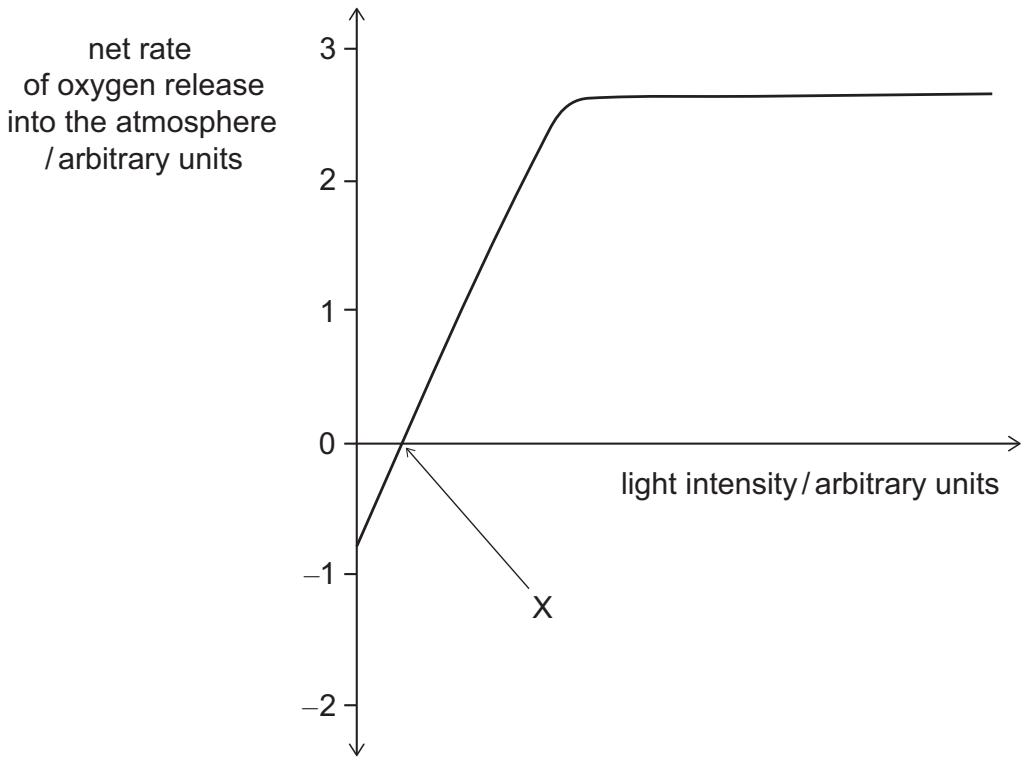
Which of the following could explain why the net rate of oxygen release at point X is zero?
1 The light intensity is too low to produce oxygen through photosynthesis.
2 All of the stomata will be closed at this light intensity, preventing the release of oxygen.
3 The rate of oxygen release from photosynthesis is equal to the rate of oxygen use in respiration.
Which of the following could explain why the net rate of oxygen release at point X is zero?
1 The light intensity is too low to produce oxygen through photosynthesis.
2 All of the stomata will be closed at this light intensity, preventing the release of oxygen.
3 The rate of oxygen release from photosynthesis is equal to the rate of oxygen use in respiration.
- A.none of them
- B.1 only
- C.2 only
- D.3 only
- E.1 and 2 only
- F.1 and 3 only
- G.2 and 3 only
- H.1, 2 and 3
Answer: D
Question 80
1 markTwo parents are heterozygous for a recessive condition that is controlled by a single autosomal gene with one dominant and one recessive allele. They have a daughter who does not display the condition.
This daughter has a child with a heterozygous man.
What is the probability that this child displays the condition?
(Assume no mutations.)
This daughter has a child with a heterozygous man.
What is the probability that this child displays the condition?
(Assume no mutations.)
- A.
- B.
- C.
- D.
- E.
Answer: C