Mapped to the ESAT specification
NSAA 2022 Chemistry Part Y
20 questions20 marksUpdated June 2026
Natural Sciences Admissions Assessment 2022 is one of the closest available past papers for the Engineering and Science Admissions Test. Below, all 20 questions are mapped to the ESAT topics they test, each with its answer. Sit it cold under exam timing, then work back through anything you missed using the solutions.
What this paper covers on the ESAT
Every question mapped to the Engineering and Science Admissions Test specification, so you know exactly which areas it tests.
Mathematics 1
- Algebra (1)
Chemistry
- Quantitative chemistry (12)
- Air and water (2)
- Chemical reactions, formulae and equations (2)
- Energetics (2)
- Metals (2)
- Oxidation, reduction and redox (2)
- Atomic structure (1)
- Kinetic/Particle theory (1)
Questions and answers are free. Full step-by-step worked solutions unlock with a free account. Start practising.
Question 21
1 markIn this question, consider only the elements potassium, rubidium, calcium, strontium, bromine and iodine. Assume that there are similar trends in physical properties in Periods 4 and 5 as there are in Periods 2 and 3.
Consider the enthalpy change for the process:
The element for which this process is most exothermic reacts with the metal with the highest first ionisation energy.
What is the relative molar mass () of the product from this reaction?
( values: K = 39; Rb = 86; Ca = 40; Sr = 88; Br = 80; I = 127)
Consider the enthalpy change for the process:
The element for which this process is most exothermic reacts with the metal with the highest first ionisation energy.
What is the relative molar mass () of the product from this reaction?
( values: K = 39; Rb = 86; Ca = 40; Sr = 88; Br = 80; I = 127)
- A.119
- B.120
- C.166
- D.200
- E.213
- F.248
- G.294
- H.342
Answer: D
Question 22
1 markThe following diagram gives the mass spectra of samples of the elements gallium (Ga) and chlorine (Cl).
The mass spectrum for Gallium (Ga) shows two peaks: one at with 60% abundance and one at with 40% abundance. The mass spectrum for Chlorine (Cl) shows two peaks: one at with 75% abundance and one at with 25% abundance.
Gaseous gallium chloride has a formula of .
The mass spectrum of gallium chloride shows peaks at different mass-to-charge ratio ( value).
What is the abundance ratio of the molecular ion with the largest value to the smallest value?
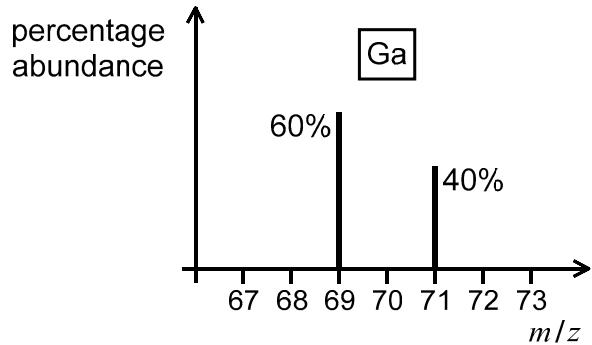
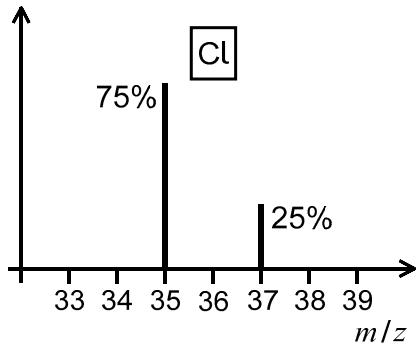
The mass spectrum for Gallium (Ga) shows two peaks: one at with 60% abundance and one at with 40% abundance. The mass spectrum for Chlorine (Cl) shows two peaks: one at with 75% abundance and one at with 25% abundance.
Gaseous gallium chloride has a formula of .
The mass spectrum of gallium chloride shows peaks at different mass-to-charge ratio ( value).
What is the abundance ratio of the molecular ion with the largest value to the smallest value?
- A.2:9
- B.2:16
- C.2:36
- D.2:54
- E.2:81
Answer: E
Question 23
1 mark4.00 g of bromine reacts with excess fluorine at temperatures over to form 8.75 g of compound X only. The molecular formula of X is the same as the empirical formula.
Using the VSEPR model, what is the smallest bond angle in compound X?
( values: Br = 80; F = 19)
Using the VSEPR model, what is the smallest bond angle in compound X?
( values: Br = 80; F = 19)
- A.
- B.in the range
- C.
- D.in the range
- E.
- F.in the range
Answer: F
Question 24
1 markAn aqueous solution of NaCl is added to an aqueous solution containing the complex ion and an equilibrium is established:
The concentration of in the equilibrium mixture is .
The numerical value of the equilibrium constant, , is 0.05.
The expression for does not include the solvent.
What is the ratio of the concentrations in the equilibrium mixture?
(All concentrations are in .)
The concentration of in the equilibrium mixture is .
The numerical value of the equilibrium constant, , is 0.05.
The expression for does not include the solvent.
What is the ratio of the concentrations in the equilibrium mixture?
(All concentrations are in .)
- A.4:5
- B.5:4
- C.1:10
- D.10:1
- E.1:320
- F.320:1
Answer: A
Question 25
1 markWhen organic compounds are treated with an alkaline aqueous solution of iodine, a yellow precipitate is formed by those compounds that contain either of these structural fragments:
or
There are 8 structurally isomeric alcohols with the molecular formula .
Each of these alcohols was heated under reflux with excess acidified potassium dichromate(VI).
How many of these alcohols gave a product that would form a yellow precipitate with an alkaline aqueous solution of iodine?
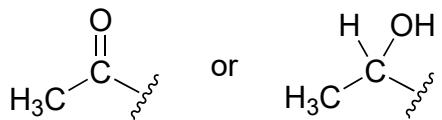
or
There are 8 structurally isomeric alcohols with the molecular formula .
Each of these alcohols was heated under reflux with excess acidified potassium dichromate(VI).
How many of these alcohols gave a product that would form a yellow precipitate with an alkaline aqueous solution of iodine?
- A.1
- B.2
- C.3
- D.4
- E.5
- F.6
- G.7
Answer: B
Question 26
1 markCalcium cyanamide is a compound containing calcium, carbon and nitrogen only. It contains 50% calcium by mass, and reacts with water to form ammonia and one other product that does not contain nitrogen or hydrogen.
One mole of calcium cyanamide contains one mole of calcium.
What volume of water, in , is required to react exactly with 8.0 g of calcium cyanamide?
( values: H = 1; C = 12; N = 14; O = 16; Ca = 40. Density of water is .)
One mole of calcium cyanamide contains one mole of calcium.
What volume of water, in , is required to react exactly with 8.0 g of calcium cyanamide?
( values: H = 1; C = 12; N = 14; O = 16; Ca = 40. Density of water is .)
- A.
- B.
- C.
- D.
- E.
- F.
- G.
- H.
Answer: D
Question 27
1 mark (Gibbs free energy change), (enthalpy change) and (entropy change) are thermodynamic quantities for a reaction linked by the equation
where T = temperature measured in kelvin (K).
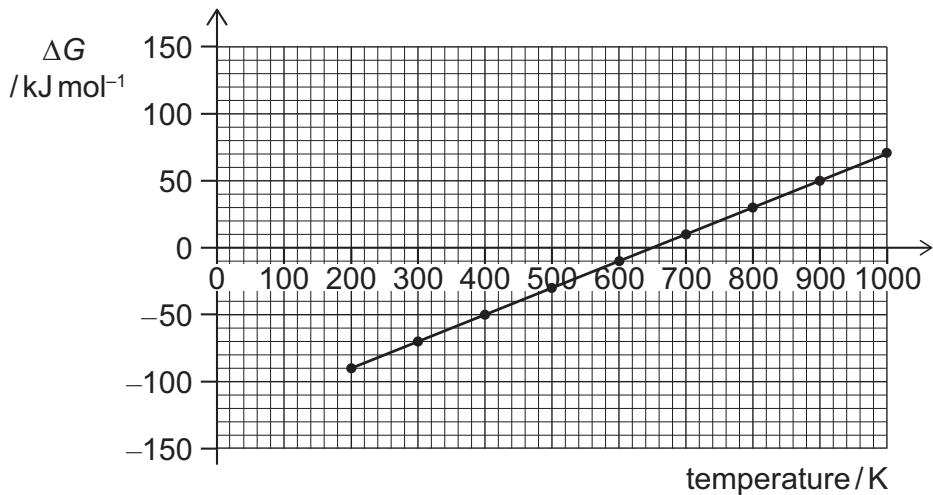
The graph shows how , in , varies with temperature, in K, for a reaction at constant pressure. The graph is a straight line with a negative gradient. The y-intercept (at T=0K) is approximately +150 . The x-intercept (where ) is approximately 750 K.
Is the reaction endothermic or exothermic, and what is the value of , in ?
(Assume that and do not vary with temperature over this range.)
where T = temperature measured in kelvin (K).
The graph shows how , in , varies with temperature, in K, for a reaction at constant pressure. The graph is a straight line with a negative gradient. The y-intercept (at T=0K) is approximately +150 . The x-intercept (where ) is approximately 750 K.
Is the reaction endothermic or exothermic, and what is the value of , in ?
(Assume that and do not vary with temperature over this range.)
- A.the reaction is endothermic, is -0.20
- B.the reaction is endothermic, is +0.20
- C.the reaction is endothermic, is -200
- D.the reaction is endothermic, is +200
- E.the reaction is exothermic, is -0.20
- F.the reaction is exothermic, is +0.20
- G.the reaction is exothermic, is -200
- H.the reaction is exothermic, is +200
Answer: G
Question 28
1 markThe table gives information relating to the enthalpy change of formation of calcium chloride.
| Process | enthalpy change / |
|---------------------------------------|-------------------------------------|
| | +190 |
| | +590 |
| | +1150 |
| | +240 |
| | -360 |
| | +2240 |
Using the data provided, what is the enthalpy change of formation of calcium chloride?
| Process | enthalpy change / |
|---------------------------------------|-------------------------------------|
| | +190 |
| | +590 |
| | +1150 |
| | +240 |
| | -360 |
| | +2240 |
Using the data provided, what is the enthalpy change of formation of calcium chloride?
- A.
- B.
- C.
- D.
- E.
- F.
- G.
- H.
Answer: C
Question 29
1 markCopper metal reacts with aqueous iron(III) ions to form aqueous iron(II) ions and aqueous copper(II) ions.
Which of the following statements can be deduced about this reaction?
Which of the following statements can be deduced about this reaction?
- A.Copper(II) ions are a stronger reducing agent than iron(II) ions.
- B.Copper(II) ions are a stronger oxidising agent than iron(III) ions.
- C.Iron(II) ions are a stronger reducing agent than copper metal.
- D.Copper metal is a stronger oxidising agent than iron(II) ions.
- E.Iron(III) ions are a stronger oxidising agent than copper(II) ions.
Answer: E
Question 30
1 markHeat loss is a problem in calorimetry experiments and can lead to inaccurate results. One way to address this problem is to carry out an experiment to find the heat capacity of the calorimeter (for example, 100 g of water in a copper can) using a reaction where the molar enthalpy change is known.
A student burned grams of ethanol (relative molar mass = ) in a burner and the temperature of the water in the calorimeter rose by in . The molar enthalpy of combustion of ethanol is .
The student then burned grams of propanol (relative molar mass = ) in the burner using the same calorimeter and the temperature of the water rose by in .
Which expression gives the molar enthalpy of combustion of propanol ?
(All other conditions for these experiments were identical.)
A student burned grams of ethanol (relative molar mass = ) in a burner and the temperature of the water in the calorimeter rose by in . The molar enthalpy of combustion of ethanol is .
The student then burned grams of propanol (relative molar mass = ) in the burner using the same calorimeter and the temperature of the water rose by in .
Which expression gives the molar enthalpy of combustion of propanol ?
(All other conditions for these experiments were identical.)
- A.
- B.
- C.
- D.
- E.
- F.
Answer: F
Question 31
1 markIn an experiment to investigate diffusion, four separate identical flasks containing one of hydrogen, helium, nitrogen or neon are placed in a large cubic box filled with argon, each in a different corner. All gases, including the argon, are at atmospheric pressure.
The temperature of the box is uniform and remains constant throughout the experiment. Temperature is directly proportional to the average kinetic energy of the particles in a gas.
The stoppers of the flasks are removed simultaneously and the time is recorded when a fixed proportion of each gas reaches a detector at the centre of the box.
A second experiment is carried out under the same conditions but at a higher temperature.
( values: H = 1.0; He = 4.0; N = 14; Ne = 20)
Which statement is correct?
The temperature of the box is uniform and remains constant throughout the experiment. Temperature is directly proportional to the average kinetic energy of the particles in a gas.
The stoppers of the flasks are removed simultaneously and the time is recorded when a fixed proportion of each gas reaches a detector at the centre of the box.
A second experiment is carried out under the same conditions but at a higher temperature.
( values: H = 1.0; He = 4.0; N = 14; Ne = 20)
Which statement is correct?
- A.If hydrogen is detected in minutes, then helium will be detected in minutes.
- B.The kinetic energy of every gas particle in the box will be the same at the same room temperature.
- C.The order in which the gases are detected at both temperatures is hydrogen, then helium, then nitrogen, and lastly neon.
- D.The average speed at which a helium particle travels is 5 times the speed at which an average neon particle travels.
- E.When the temperature of the box is increased, the average kinetic energy of the gases will decrease.
Answer: A
Question 32
1 markA high temperature reaction vessel requires a steady supply of an atmosphere free of oxygen, carbon monoxide and gases.
In order to achieve this, methane was burned in air to give a mixture of carbon dioxide, water vapour and nitrogen only.
A diagram shows 'methane + air' entering a 'burner', which outputs into a 'reactor vessel', with an 'exhaust' leaving the reactor vessel.
Assume that air is composed of 20% oxygen and 80% nitrogen only by volume.
What mass ratio of air to methane should be supplied to the burner?
( values: H = 1; C = 12; N = 14; O = 16. Assume that one mole of any gas occupies the same volume at a given temperature and pressure.)
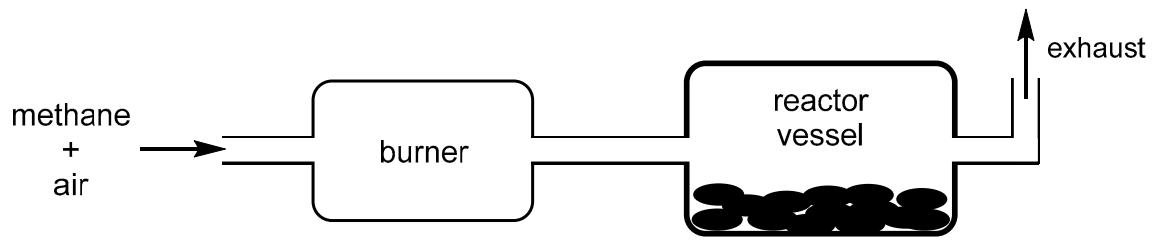
In order to achieve this, methane was burned in air to give a mixture of carbon dioxide, water vapour and nitrogen only.
A diagram shows 'methane + air' entering a 'burner', which outputs into a 'reactor vessel', with an 'exhaust' leaving the reactor vessel.
Assume that air is composed of 20% oxygen and 80% nitrogen only by volume.
What mass ratio of air to methane should be supplied to the burner?
( values: H = 1; C = 12; N = 14; O = 16. Assume that one mole of any gas occupies the same volume at a given temperature and pressure.)
- A.2:1
- B.2.5:1
- C.4.5:1
- D.5:1
- E.9:1
- F.18:1
- G.20:1
Answer: F
Question 33
1 markIn preparation for the disposal of of hydrochloric acid with a pH value of -0.6 (minus 0.6) into a drain, the following steps were taken:
step 1 The acid was diluted with water.
step 2 90 g of calcium carbonate powder was added which completely reacted.
step 3 The resulting solution was diluted with water to give a final volume of .
What is the final pH value of the solution?
( value: = 100. All pH values were measured at the same temperature.)
step 1 The acid was diluted with water.
step 2 90 g of calcium carbonate powder was added which completely reacted.
step 3 The resulting solution was diluted with water to give a final volume of .
What is the final pH value of the solution?
( value: = 100. All pH values were measured at the same temperature.)
- A.2.9
- B.3.4
- C.3.6
- D.4.4
- E.4.6
- F.5.4
- G.6.0
- H.7.0
Answer: B
Question 34
1 markLutetium (Lu) is a metallic element which forms compounds in which lutetium always has the same oxidation state.
When 3.50 g of lutetium is heated and burned in excess oxygen, of oxygen, measured at room temperature and pressure, is needed for complete reaction to form lutetium oxide.
When 3.50 g of lutetium reacts completely with dilute sulfuric acid, hydrogen and aqueous lutetium sulfate are produced. The salt is extracted from solution and allowed to crystallise into a white solid.
The solid is a hydrated salt with a 1:1 molar ratio of water to salt.
What is the maximum mass of hydrated salt that could be made from 3.50 g of lutetium?
( values: Lu = 175; S = 32; O = 16; H = 1. Assume that one mole of any gas occupies at room temperature and pressure.)
When 3.50 g of lutetium is heated and burned in excess oxygen, of oxygen, measured at room temperature and pressure, is needed for complete reaction to form lutetium oxide.
When 3.50 g of lutetium reacts completely with dilute sulfuric acid, hydrogen and aqueous lutetium sulfate are produced. The salt is extracted from solution and allowed to crystallise into a white solid.
The solid is a hydrated salt with a 1:1 molar ratio of water to salt.
What is the maximum mass of hydrated salt that could be made from 3.50 g of lutetium?
( values: Lu = 175; S = 32; O = 16; H = 1. Assume that one mole of any gas occupies at room temperature and pressure.)
- A.5.42 g
- B.5.78 g
- C.6.38 g
- D.6.56 g
- E.9.26 g
- F.9.62 g
- G.12.76 g
- H.13.12 g
Answer: D
Question 35
1 markSodium feredetate trihydrate and iron(II) sulfate can both be used to treat iron deficiency.
The formula for sodium feredetate trihydrate is shown in a diagram as a complex of and with an EDTA-like ligand, along with three water molecules ().
Sodium feredetate trihydrate is used as a solution. of this solution contains 210.5 mg of sodium feredetate trihydrate.
Iron(II) sulfate is used in tablet form. One iron tablet contains 63.0 mg of iron(II) ions.
What volume of sodium feredetate trihydrate solution would give the same mass of iron as one iron(II) sulfate tablet?
( values: H = 1.0; C = 12; N = 14; O = 16; Na = 23; Fe = 56)
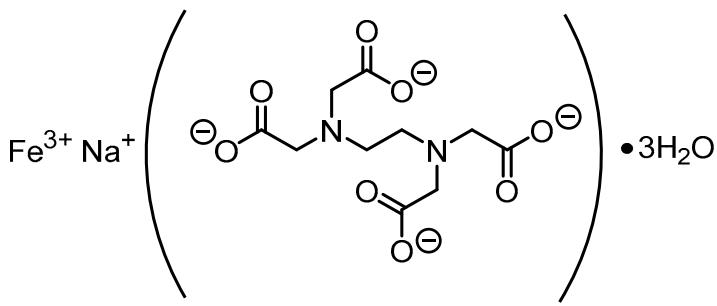
The formula for sodium feredetate trihydrate is shown in a diagram as a complex of and with an EDTA-like ligand, along with three water molecules ().
Sodium feredetate trihydrate is used as a solution. of this solution contains 210.5 mg of sodium feredetate trihydrate.
Iron(II) sulfate is used in tablet form. One iron tablet contains 63.0 mg of iron(II) ions.
What volume of sodium feredetate trihydrate solution would give the same mass of iron as one iron(II) sulfate tablet?
( values: H = 1.0; C = 12; N = 14; O = 16; Na = 23; Fe = 56)
- A.
- B.
- C.
- D.
- E.
- F.
Answer: F
Question 36
1 markThree half-equations involved in the oxidation of ethanol to ethanoic acid are:
A flask contains 0.345 g of ethanol. An excess of dilute sulfuric acid is added to the flask.
A separate flask contains aqueous dichromate ions, .
What volume of aqueous dichromate is needed to exactly convert all the ethanol to ethanoic acid?
( value: = 46)
A flask contains 0.345 g of ethanol. An excess of dilute sulfuric acid is added to the flask.
A separate flask contains aqueous dichromate ions, .
What volume of aqueous dichromate is needed to exactly convert all the ethanol to ethanoic acid?
( value: = 46)
- A.
- B.
- C.
- D.
- E.
- F.
- G.
Answer: D
Question 37
1 markV is a compound with empirical formula . It undergoes an addition reaction with hydrogen bromide, producing compound W.
W reacts with potassium cyanide to produce organic compound X which contains approximately by mass of nitrogen.
W also reacts with warm aqueous sodium hydroxide to give organic compound Y.
Y reacts with hot acidified potassium dichromate(VI) to produce organic compound Z.
Z does not react with aqueous sodium carbonate, nor does it react with Tollens' reagent.
Which of the following is a possible identity for W?
( values: H = 1; C = 12; N = 14)
W reacts with potassium cyanide to produce organic compound X which contains approximately by mass of nitrogen.
W also reacts with warm aqueous sodium hydroxide to give organic compound Y.
Y reacts with hot acidified potassium dichromate(VI) to produce organic compound Z.
Z does not react with aqueous sodium carbonate, nor does it react with Tollens' reagent.
Which of the following is a possible identity for W?
( values: H = 1; C = 12; N = 14)
- A.1-bromobutane
- B.1-bromopentane
- C.1-bromopropane
- D.2-bromo-2-methylpropane
- E.2-bromobutane
- F.2-bromo-2-methylbutane
- G.2-bromopropane
- H.3-bromopentane
Answer: E
Question 38
1 markA student is planning an experiment to determine the percentage of iron in a 3 g sample of the iron ore haematite, which contains as the only iron-containing species and other material which will not react in this experiment. The sample contains approximately 50% iron by mass.
The student's plan is:
step 1 Make a solution of ions by reacting iron(III) oxide with concentrated acid.
step 2 Reduce the ions to ions using a solution of tin(II) chloride.
step 3 Make up the solution containing to by adding water.
step 4 Titrate portions using potassium dichromate(VI) solution, .
The equations for the reactions occurring are:
In order to obtain titre values of between and , what concentration of potassium dichromate(VI), in , should the student use?
( value: Fe = 56)
The student's plan is:
step 1 Make a solution of ions by reacting iron(III) oxide with concentrated acid.
step 2 Reduce the ions to ions using a solution of tin(II) chloride.
step 3 Make up the solution containing to by adding water.
step 4 Titrate portions using potassium dichromate(VI) solution, .
The equations for the reactions occurring are:
In order to obtain titre values of between and , what concentration of potassium dichromate(VI), in , should the student use?
( value: Fe = 56)
- A.
- B.
- C.
- D.
- E.
- F.
Answer: A
Question 39
1 mark0.92 g of gaseous dinitrogen tetroxide, , is placed in a syringe with a free moving piston at and atmospheric pressure.
At , gaseous dinitrogen tetroxide dissociates and forms an equilibrium mixture with gaseous nitrogen dioxide, , only.
At equilibrium, the total volume of gas in the syringe is .
What percentage of the dinitrogen tetroxide has dissociated?
( values: N = 14; O = 16. Assume that, for all of the gases, one mole of gas occupies a volume of at and atmospheric pressure.)
At , gaseous dinitrogen tetroxide dissociates and forms an equilibrium mixture with gaseous nitrogen dioxide, , only.
At equilibrium, the total volume of gas in the syringe is .
What percentage of the dinitrogen tetroxide has dissociated?
( values: N = 14; O = 16. Assume that, for all of the gases, one mole of gas occupies a volume of at and atmospheric pressure.)
- A.10%
- B.20%
- C.30%
- D.40%
- E.50%
- F.60%
- G.70%
- H.80%
Answer: B
Question 40
1 markFluoride ions can be added to drinking water to improve dental health.
The recommended concentration of fluoride ions in drinking water for observable health benefits is between 1.0 and 1.5 ppm by mass.
The concentration of fluoride ions in a full 10 million litre water storage reservoir is 0.5 ppm.
The following three compounds can be used to supply fluoride ions to water:
sodium fluoride (NaF, = 42)
hexafluorosilicic acid (, = 144)
sodium fluorosilicate (, = 188)
Assume that all the fluorine present in the compounds ionises in water to form fluoride ions.
Which of the following treatments can be added to increase the fluoride ion concentration to within the recommended range?
( value: F = 19. Density of water is . 1 ppm = 1 part per million = 0.0001%.)
The recommended concentration of fluoride ions in drinking water for observable health benefits is between 1.0 and 1.5 ppm by mass.
The concentration of fluoride ions in a full 10 million litre water storage reservoir is 0.5 ppm.
The following three compounds can be used to supply fluoride ions to water:
sodium fluoride (NaF, = 42)
hexafluorosilicic acid (, = 144)
sodium fluorosilicate (, = 188)
Assume that all the fluorine present in the compounds ionises in water to form fluoride ions.
Which of the following treatments can be added to increase the fluoride ion concentration to within the recommended range?
( value: F = 19. Density of water is . 1 ppm = 1 part per million = 0.0001%.)
- A.6.30 kg of sodium fluoride (NaF)
- B.7200 g of hexafluorosilicic acid ()
- C.14400 g of hexafluorosilicic acid ()
- D.18.8 g of sodium fluorosilicate ()
- E.37.6 kg of sodium fluorosilicate ()
Answer: B