NSAA 2022 Chemistry S1
20 questions20 marksUpdated June 2026
The NSAA 2022 Chemistry S1 paper in full: all 20 questions, each with its answer. NSAA is the Natural Sciences Admissions Assessment. Sit it cold under exam timing, mark it, then work back through anything you missed using the solutions below.
Download the original PDF →Questions and answers are free. Full step-by-step worked solutions unlock with a free account. Start practising.
Question 41
The following pairs of 0.1 mol dm⁻³ solutions are mixed separately in test tubes.
1 AgNO₃(aq) with NaI(aq)
2 Cl₂(aq) with NaI(aq)
3 HCl(aq) with NaOH(aq)
4 MgCl₂(aq) with NaBr(aq)
Which pair(s) of solutions, when mixed, would produce a visible chemical change?
1 AgNO₃(aq) with NaI(aq)
2 Cl₂(aq) with NaI(aq)
3 HCl(aq) with NaOH(aq)
4 MgCl₂(aq) with NaBr(aq)
Which pair(s) of solutions, when mixed, would produce a visible chemical change?
- A.1 only
- B.2 only
- C.3 only
- D.4 only
- E.1 and 2 only
- F.1 and 3 only
- G.2 and 4 only
- H.3 and 4 only
Answer: E
Question 42
Some reactions of metal M and its compounds are shown in the following diagram.
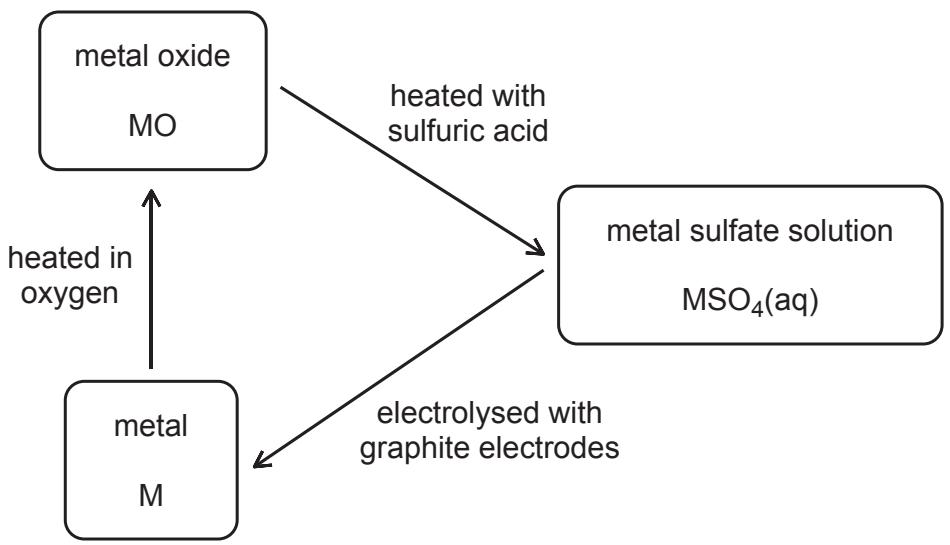
Which one of the following could be the identity of metal M?
Which one of the following could be the identity of metal M?
- A.aluminium
- B.copper
- C.magnesium
- D.potassium
- E.silver
Answer: B
Question 43
Consider the following properties of compound X:
| Property | Value |
|--------------------------------|------------|
| melting point | -114°C |
| boiling point | -85°C |
| conductivity as a solid | poor |
| conductivity as a liquid | poor |
| conductivity in aqueous solution | good |
Which one of the following could be the identity of compound X?
| Property | Value |
|--------------------------------|------------|
| melting point | -114°C |
| boiling point | -85°C |
| conductivity as a solid | poor |
| conductivity as a liquid | poor |
| conductivity in aqueous solution | good |
Which one of the following could be the identity of compound X?
- A.ammonium chloride, NH₄Cl
- B.barium chloride, BaCl₂
- C.hydrogen chloride, HCl
- D.potassium chloride, KCl
- E.tetrachloromethane, CCl₄
Answer: C
Question 44
Which of the following statements about losing electrons is/are correct?
1 During the electrolysis of a molten binary compound the ions attracted to the cathode (negative electrode) lose electrons at that electrode.
2 Descending Group 1 of the Periodic Table from lithium to caesium, the atoms of the elements lose electrons more easily.
3 When a substance is acting as a reducing agent it loses electrons.
1 During the electrolysis of a molten binary compound the ions attracted to the cathode (negative electrode) lose electrons at that electrode.
2 Descending Group 1 of the Periodic Table from lithium to caesium, the atoms of the elements lose electrons more easily.
3 When a substance is acting as a reducing agent it loses electrons.
- A.none of them
- B.1 only
- C.2 only
- D.3 only
- E.1 and 2 only
- F.1 and 3 only
- G.2 and 3 only
- H.1, 2 and 3
Answer: G
Question 45
Which of the following chemical reactions is/are redox reactions?
1
2
3
1
2
3
- A.none of them
- B.1 only
- C.2 only
- D.3 only
- E.1 and 2 only
- F.1 and 3 only
- G.2 and 3 only
- H.1, 2 and 3
Answer: D
Question 46
Three samples of calcium of different masses were added separately to excess dilute hydrochloric acid and the volume of gas released, measured at room temperature and pressure, was monitored.
One sample was powdered calcium, one was granules of calcium, and one was a solid piece of calcium.
The results are shown on the graph.
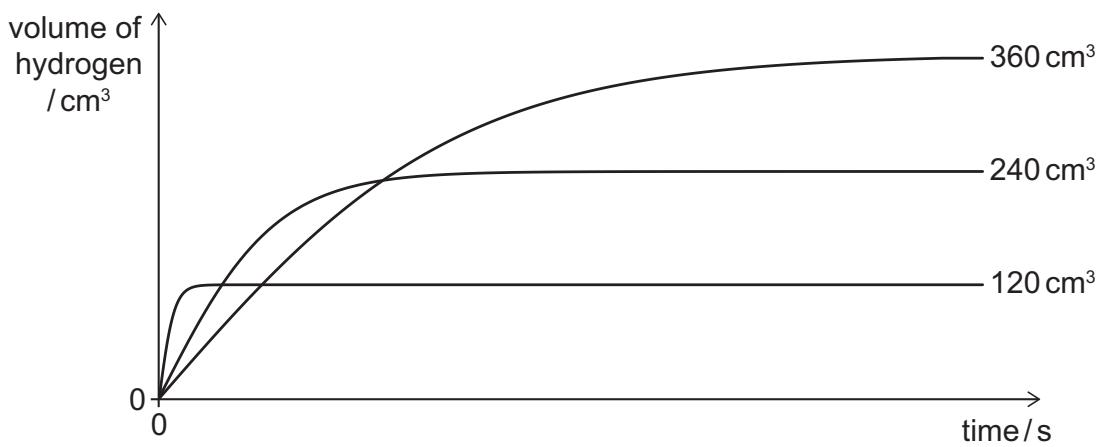
What is the mass of powdered calcium used in this experiment?
( value: Ca = 40. Assume that one mole of gas occupies a volume of 24 dm³ at room temperature and pressure.)
One sample was powdered calcium, one was granules of calcium, and one was a solid piece of calcium.
The results are shown on the graph.
What is the mass of powdered calcium used in this experiment?
( value: Ca = 40. Assume that one mole of gas occupies a volume of 24 dm³ at room temperature and pressure.)
- A.0.200 g
- B.0.400 g
- C.0.600 g
- D.1.20 g
- E.8.00 g
- F.16.0 g
- G.24.0 g
Answer: A
Question 47
Concentrated aqueous solutions of three compounds are electrolysed with inert electrodes.
The constituent elements of which of the following compounds may be collected using this process?
1 copper(II) bromide
2 hydrogen chloride
3 potassium chloride
The constituent elements of which of the following compounds may be collected using this process?
1 copper(II) bromide
2 hydrogen chloride
3 potassium chloride
- A.none of them
- B.1 only
- C.2 only
- D.3 only
- E.1 and 2 only
- F.1 and 3 only
- G.2 and 3 only
- H.1, 2 and 3
Answer: E
Question 48
of hydrochloric acid has a pH of 1.0.
What is the pH of the mixture formed when of calcium hydroxide solution is added?
What is the pH of the mixture formed when of calcium hydroxide solution is added?
- A.pH = 1.0
- B.1.0 < pH < 2.0
- C.pH = 2.0
- D.2.0 < pH < 7.0
- E.pH = 7.0
- F.pH > 7.0
Answer: F
Question 49
Carboxylic acid X reacts with propanol in the presence of an acid catalyst to form compound Y.
Compound Y has a relative molar mass of 116.
What is the relative molar mass () of X?
( values: C = 12; H = 1; O = 16)
Compound Y has a relative molar mass of 116.
What is the relative molar mass () of X?
( values: C = 12; H = 1; O = 16)
- A.45
- B.46
- C.55
- D.56
- E.59
- F.60
- G.73
- H.74
Answer: H
Question 50
Element Z is in Group 1 of the Periodic Table.
A pure sample of element Z consists of two isotopes with mass numbers 85 and 87, and has a relative atomic mass of 85.5.
Which of the following statements is/are correct about element Z in this sample?
1 Element Z reacts with bromine to form an ionic compound with formula .
2 Element Z forms a basic oxide.
3 More than 70% of the atoms of element Z have mass number 85.
A pure sample of element Z consists of two isotopes with mass numbers 85 and 87, and has a relative atomic mass of 85.5.
Which of the following statements is/are correct about element Z in this sample?
1 Element Z reacts with bromine to form an ionic compound with formula .
2 Element Z forms a basic oxide.
3 More than 70% of the atoms of element Z have mass number 85.
- A.none of them
- B.1 only
- C.2 only
- D.3 only
- E.1 and 2 only
- F.1 and 3 only
- G.2 and 3 only
- H.1, 2 and 3
Answer: G
Question 51
Three mixtures (P, Q and R) of amino acids were separated using paper chromatography.
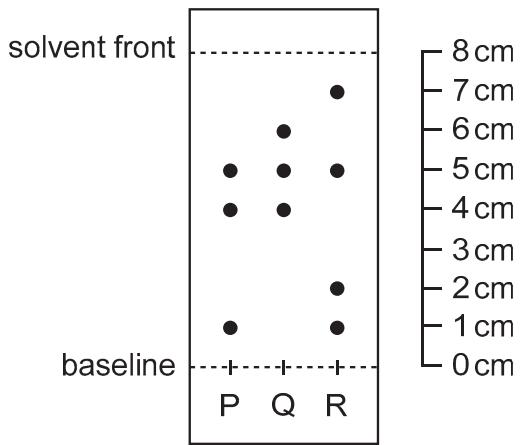
The test was repeated with the same mixtures, paper and solvent but this time the distance travelled by the common component of the mixtures was 7.5 cm.
How far did the most mobile component of mixture Q travel in the second test?
The test was repeated with the same mixtures, paper and solvent but this time the distance travelled by the common component of the mixtures was 7.5 cm.
How far did the most mobile component of mixture Q travel in the second test?
- A.6.0 cm
- B.8.5 cm
- C.9.0 cm
- D.9.6 cm
- E.10.5 cm
- F.12.0 cm
Answer: C
Question 52
A typical sample of dry air is at room temperature and pressure. There is a total of 25.0 mol of gas in this sample.
One of the gases in the sample, X, contributes separate particles to the mixture.
A second gas in the sample, Y, would, if alone, occupy a volume of at room temperature and pressure.
What are the identities of gases X and Y, and what would be the total amount of all of the remaining gases in the sample?
(Take Avogadro's number as . Assume that one mole of any gas occupies a volume of at room temperature and pressure.)
One of the gases in the sample, X, contributes separate particles to the mixture.
A second gas in the sample, Y, would, if alone, occupy a volume of at room temperature and pressure.
What are the identities of gases X and Y, and what would be the total amount of all of the remaining gases in the sample?
(Take Avogadro's number as . Assume that one mole of any gas occupies a volume of at room temperature and pressure.)
- A.identity of gas X: Ar, identity of gas Y: , total amount of all of the remaining gases in the sample in moles: 5.250 mol
- B.identity of gas X: , identity of gas Y: , total amount of all of the remaining gases in the sample in moles: 5.250 mol
- C.identity of gas X: , identity of gas Y: Ar, total amount of all of the remaining gases in the sample in moles: 5.250 mol
- D.identity of gas X: Ar, identity of gas Y: , total amount of all of the remaining gases in the sample in moles: 5.375 mol
- E.identity of gas X: Ar, identity of gas Y: , total amount of all of the remaining gases in the sample in moles: 5.375 mol
- F.identity of gas X: , identity of gas Y: , total amount of all of the remaining gases in the sample in moles: 5.375 mol
Answer: A
Question 53
The atomic number of fluorine is 9.
An element X forms a fluoride with the formula . Each molecule of has 32 electrons in total.
Element X has two isotopes. One isotope has the same number of neutrons as protons and the other isotope has a number of neutrons one greater than the number of protons.
The relative abundance of the heavier isotope is 0.80 (80%).
What is the relative atomic mass of element X?
An element X forms a fluoride with the formula . Each molecule of has 32 electrons in total.
Element X has two isotopes. One isotope has the same number of neutrons as protons and the other isotope has a number of neutrons one greater than the number of protons.
The relative abundance of the heavier isotope is 0.80 (80%).
What is the relative atomic mass of element X?
- A.5.2
- B.5.8
- C.10.2
- D.10.8
- E.14.2
- F.14.8
- G.16.2
- H.16.8
Answer: D
Question 54
1 mol of compound X undergoes complete combustion to produce of carbon dioxide (measured at room temperature and pressure).
1 mol of X can also undergo an addition reaction with 1 mol of hydrogen to form a saturated compound that has one branch.
X undergoes addition polymerisation. A section of the addition polymer containing three repeating units has an value greater than 200 but less than 300.
Which one of the following structural formulae could be that of compound X?
( values: C = 12; H = 1; F = 19. Assume that one mole of any gas occupies a volume of at room temperature and pressure.)
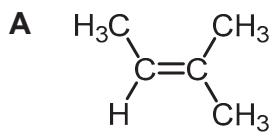
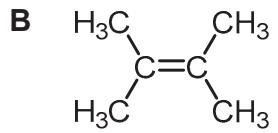
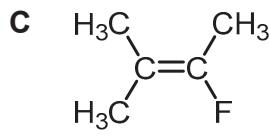
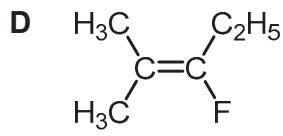
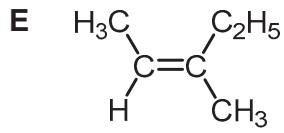
1 mol of X can also undergo an addition reaction with 1 mol of hydrogen to form a saturated compound that has one branch.
X undergoes addition polymerisation. A section of the addition polymer containing three repeating units has an value greater than 200 but less than 300.
Which one of the following structural formulae could be that of compound X?
( values: C = 12; H = 1; F = 19. Assume that one mole of any gas occupies a volume of at room temperature and pressure.)
- A.(CH₃)₂C=CHCH₃
- B.(CH₃)₂C=C(CH₃)₂
- C.(CH₃)₂C=CFCH₃
- D.(CH₃)(C₂H₅)C=CFCH₃
- E.(CH₃)(C₂H₅)C=CHCH₃
Answer: E
Question 55
The equation shows the complete combustion of an alkane.
alkane +
of a gaseous alkane requires of oxygen for complete combustion. The volumes of both gases were measured at the same temperature and pressure.
What is the value of ?
alkane +
of a gaseous alkane requires of oxygen for complete combustion. The volumes of both gases were measured at the same temperature and pressure.
What is the value of ?
- A.10.5
- B.12
- C.14
- D.15.5
- E.17.5
- F.19
Answer: D
Question 56
A sample of magnesium carbonate, , was reacted completely with of hydrochloric acid, which is an excess.
The remaining hydrochloric acid was titrated with sodium hydroxide solution. of sodium hydroxide was required for complete neutralisation.
What was the original mass of magnesium carbonate used, in mg?
( value: = 84)
The remaining hydrochloric acid was titrated with sodium hydroxide solution. of sodium hydroxide was required for complete neutralisation.
What was the original mass of magnesium carbonate used, in mg?
( value: = 84)
- A.42 mg
- B.84 mg
- C.168 mg
- D.210 mg
- E.336 mg
- F.420 mg
Answer: C
Question 57
A student mixed together of hydrochloric acid and of aqueous ammonia in an insulated container.
The initial temperatures of both solutions were .
The maximum temperature observed was .
Assume that the specific heat capacity of any aqueous solution is and that the density of the reaction mixture is .
Using this information, what is the molar enthalpy change, in , for the reaction of hydrochloric acid and aqueous ammonia?
The initial temperatures of both solutions were .
The maximum temperature observed was .
Assume that the specific heat capacity of any aqueous solution is and that the density of the reaction mixture is .
Using this information, what is the molar enthalpy change, in , for the reaction of hydrochloric acid and aqueous ammonia?
- A.
- B.
- C.
- D.
- E.
- F.
- G.
- H.
Answer: F
Question 58
An oxide of nitrogen can be prepared by the reaction of copper with hot nitric acid.
The other products of the reaction are copper(II) nitrate and water.
0.060 mol of copper reacted exactly with of nitric acid.
What is the empirical formula of the oxide of nitrogen produced in the reaction?
The other products of the reaction are copper(II) nitrate and water.
0.060 mol of copper reacted exactly with of nitric acid.
What is the empirical formula of the oxide of nitrogen produced in the reaction?
- A.NO
- B.
- C.
- D.
- E.
- F.
Answer: A
Question 59
One mole of an unsaturated hydrocarbon reacts with exactly one mole of bromine to form a compound that contains carbon, hydrogen and bromine by mass.
What is the relative molar mass () of this product?
( values: C = 12; H = 1; Br = 80)
What is the relative molar mass () of this product?
( values: C = 12; H = 1; Br = 80)
- A.150
- B.210
- C.220
- D.290
- E.300
- F.420
- G.440
- H.713
Answer: E
Question 60
Airbags in cars contain sodium azide () as a primary reagent, and potassium nitrate () as a secondary reagent.
The sodium azide decomposes according to the following equation to form nitrogen gas, which rapidly fills the airbag:
The sodium by-product of this first reaction then reacts with excess potassium nitrate according to this second equation:
Assume that both reactions go to completion.
An airbag contains 130 g of sodium azide.
What is the total volume of nitrogen gas formed in this airbag, measured at room temperature and pressure?
( values: N = 14.0; Na = 23.0. Assume that one mole of gas occupies at room temperature and pressure.)
The sodium azide decomposes according to the following equation to form nitrogen gas, which rapidly fills the airbag:
The sodium by-product of this first reaction then reacts with excess potassium nitrate according to this second equation:
Assume that both reactions go to completion.
An airbag contains 130 g of sodium azide.
What is the total volume of nitrogen gas formed in this airbag, measured at room temperature and pressure?
( values: N = 14.0; Na = 23.0. Assume that one mole of gas occupies at room temperature and pressure.)
- A.
- B.
- C.
- D.
- E.
- F.
- G.
- H.
Answer: B