Mapped to the ESAT specification
NSAA 2022 Physics Part B
20 questions20 marksUpdated October 2025
Natural Sciences Admissions Assessment 2022 is one of the closest available past papers for the Engineering and Science Admissions Test. Below, all 20 questions are mapped to the ESAT topics they test, each with its answer. Sit it cold under exam timing, then work back through anything you missed using the solutions.
What this paper covers on the ESAT
Every question mapped to the Engineering and Science Admissions Test specification, so you know exactly which areas it tests.
Mathematics 1
- Algebra (2)
- Geometry (1)
Physics
- Electricity (4)
Questions and answers are free. Full step-by-step worked solutions unlock with a free account. Start practising.
Question 21
1 markThere is a constant current in a conducting wire. A charge of 20 C passes through the wire in 1.5 minutes.
An 18 cm straight section of this wire lies in a uniform magnetic field. This section of wire is perpendicular to the direction of the field. The magnetic field strength is 0.15 T.
What is the magnitude of the magnetic force on this section of wire?
An 18 cm straight section of this wire lies in a uniform magnetic field. This section of wire is perpendicular to the direction of the field. The magnetic field strength is 0.15 T.
What is the magnitude of the magnetic force on this section of wire?
- A.0.0060 N
- B.0.36 N
- C.0.60 N
- D.0.81 N
- E.36 N
- F.49 N
- G.81 N
- H.4900 N
Answer: A
Question 22
1 markA rider on a rollercoaster moves very quickly towards a solid wall. While moving, the rider shouts, and hears an echo of the shout from the wall. The echo is quieter than the original shout.
How do the amplitude and frequency of the echo heard by the rider compare to the amplitude and frequency of the original shout?
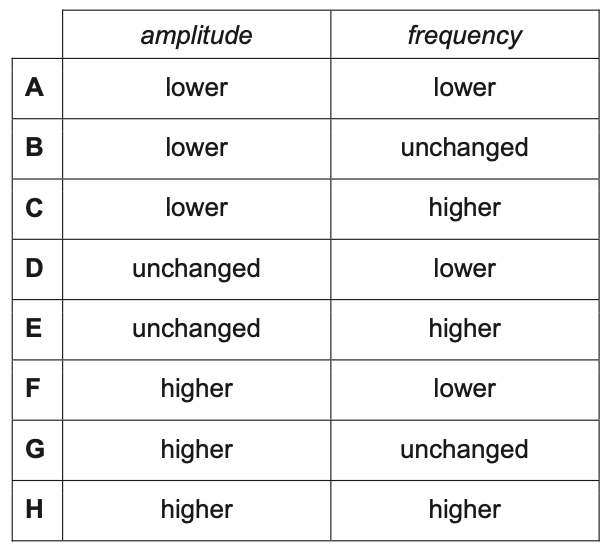
How do the amplitude and frequency of the echo heard by the rider compare to the amplitude and frequency of the original shout?
- A.lower, lower
- B.lower, unchanged
- C.lower, higher
- D.unchanged, lower
- E.unchanged, higher
- F.higher, lower
- G.higher, unchanged
- H.higher, higher
Answer: C
Question 23
1 markThe diagram shows a system consisting of two large copper tanks of water connected to each other by a solid cylindrical copper bar.
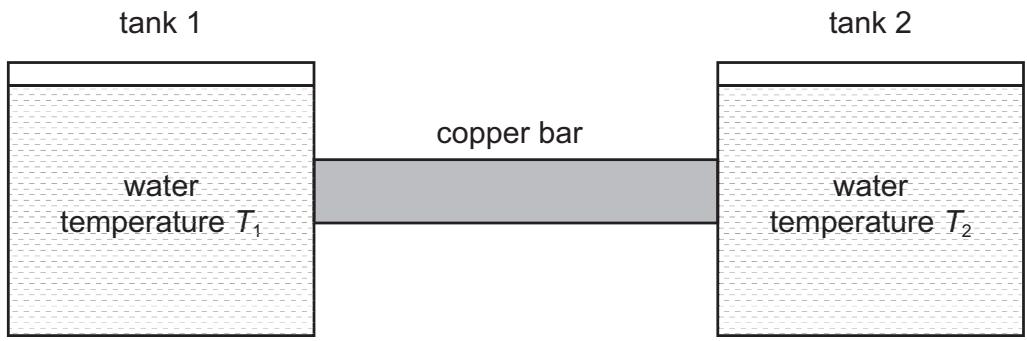
The temperature of the water in tank 1 is . The water in tank 2 is at a higher temperature . At all times .
The following four statements list changes that can be made, independently, to the system.
1 increase temperature
2 increase temperature
3 increase the length of the copper bar
4 increase the diameter of the copper bar
Which two changes each independently result in an increase in the rate of conduction of thermal energy along the copper bar?
The temperature of the water in tank 1 is . The water in tank 2 is at a higher temperature . At all times .
The following four statements list changes that can be made, independently, to the system.
1 increase temperature
2 increase temperature
3 increase the length of the copper bar
4 increase the diameter of the copper bar
Which two changes each independently result in an increase in the rate of conduction of thermal energy along the copper bar?
- A.1 and 2
- B.1 and 3
- C.1 and 4
- D.2 and 3
- E.2 and 4
- F.3 and 4
Answer: E
Question 24
1 markTwo identical resistors are connected in parallel to a 6.0 V battery. The two resistors dissipate a total power of 0.15 W.
One of these resistors is removed from the circuit and connected to a 12 V battery.
How much charge passes through this resistor in 6.0 minutes?
One of these resistors is removed from the circuit and connected to a 12 V battery.
How much charge passes through this resistor in 6.0 minutes?
- A.0.025 C
- B.0.050 C
- C.0.15 C
- D.0.30 C
- E.0.75 C
- F.1.5 C
- G.9.0 C
- H.18 C
Answer: G
Question 25
1 markA small piece of space debris of mass 0.10 g strikes the International Space Station at a relative speed of .
The piece of debris comes to rest relative to the space station in a time of 0.010 s.
What is the average force exerted on the space station by the piece of debris during this time?
The piece of debris comes to rest relative to the space station in a time of 0.010 s.
What is the average force exerted on the space station by the piece of debris during this time?
- A.0.0010 N
- B.1.0 N
- C.1.5 N
- D.100 N
- E.150 N
- F.1500 N
Answer: E
Question 26
1 markA block of mass 6.0 kg is pushed along a rough horizontal surface by a constant force of 8.0 N. The block accelerates uniformly from rest. After 4.0 s its velocity is .
How much work is done against resistive forces during this 4.0 s?
How much work is done against resistive forces during this 4.0 s?
- A.12 J
- B.20 J
- C.24 J
- D.32 J
- E.40 J
- F.64 J
Answer: B
Question 27
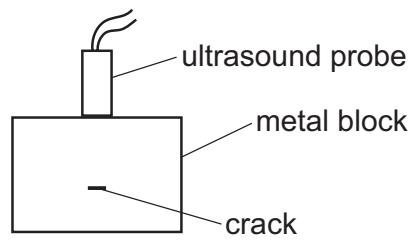
1 markUltrasound is used to find a crack inside a cuboid block of metal. An ultrasound probe is held in contact with the top surface of the metal block and perpendicular to the surface. A short pulse of ultrasound is sent into the metal block at time ms and reflects from both the crack and the bottom surface of the metal block.
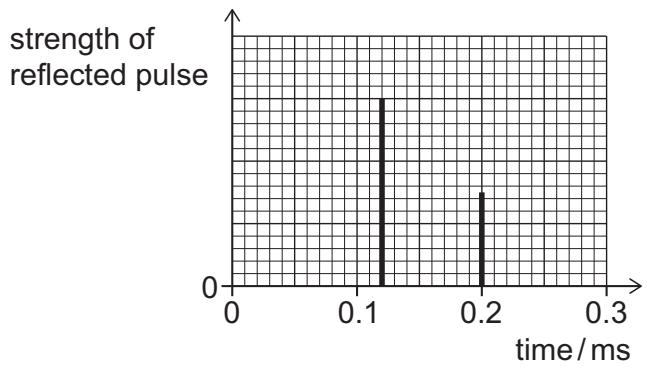
The times between the emission of the ultrasound pulse and the return of the reflections to the probe, and the strengths of the reflected pulses, are measured. The results are shown on the graph.
The speed of ultrasound in the metal is .
What is the distance between the bottom surface of the metal block and the crack?
The times between the emission of the ultrasound pulse and the return of the reflections to the probe, and the strengths of the reflected pulses, are measured. The results are shown on the graph.
The speed of ultrasound in the metal is .
What is the distance between the bottom surface of the metal block and the crack?
- A.0.2 m
- B.0.3 m
- C.0.4 m
- D.0.5 m
- E.0.6 m
- F.1.0 m
Answer: A
Question 28
1 markPower is supplied to an electric motor at 0.800 kW.
The motor has an efficiency of 60% and is switched on for half an hour.
How much energy is wasted during this time?
The motor has an efficiency of 60% and is switched on for half an hour.
How much energy is wasted during this time?
- A.0.160 J
- B.0.240 J
- C.160 J
- D.240 J
- E.576 J
- F.864 J
- G.576 000 J
- H.864 000 J
Answer: G
Question 29
1 markThe diagram shows a circuit that includes two ammeters and a resistor R.
The readings on the ammeters are shown.
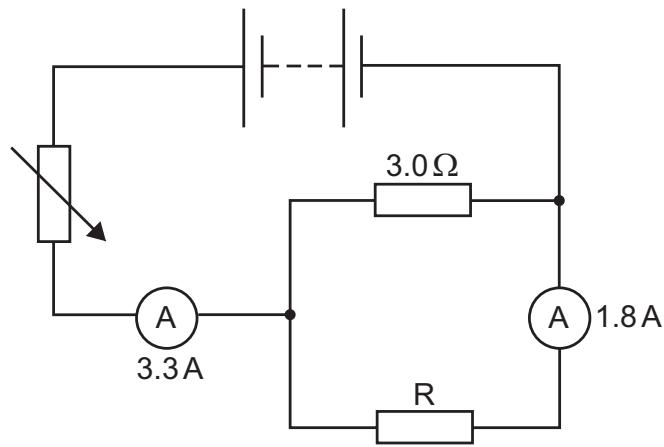
What is the resistance of resistor R?
The readings on the ammeters are shown.
What is the resistance of resistor R?
- A.0.40 Ω
- B.2.5 Ω
- C.3.0 Ω
- D.3.6 Ω
- E.5.5 Ω
- F.8.5 Ω
Answer: B
Question 30
1 markThe graph shows potential difference plotted against current for a filament lamp and a resistor.
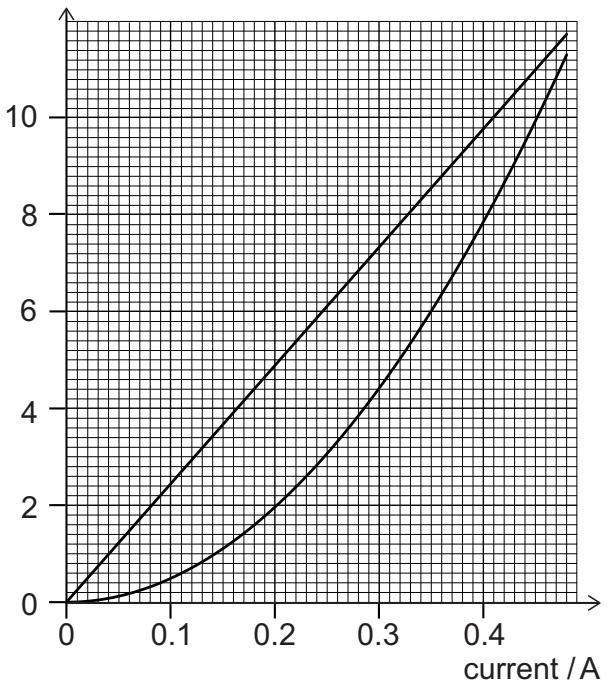
The lamp and the resistor are connected in parallel with each other to a 6.0 V power supply and the current in the lamp, , is recorded.
In a second circuit, the lamp and the resistor are now connected in series with each other to the same power supply, and the current in the resistor is 0.18 A. The potential difference across the lamp, , is recorded.
What are the values of in the first circuit and in the second circuit?
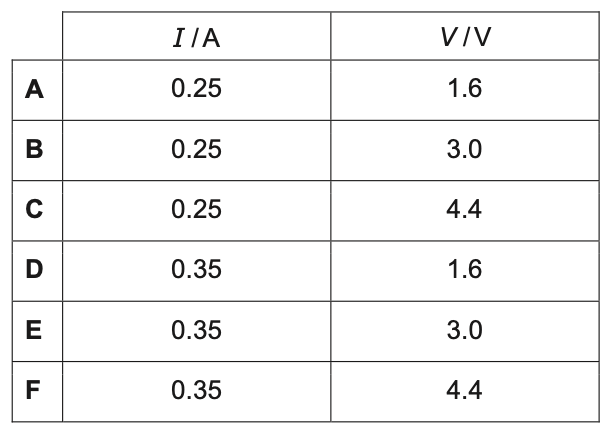
The lamp and the resistor are connected in parallel with each other to a 6.0 V power supply and the current in the lamp, , is recorded.
In a second circuit, the lamp and the resistor are now connected in series with each other to the same power supply, and the current in the resistor is 0.18 A. The potential difference across the lamp, , is recorded.
What are the values of in the first circuit and in the second circuit?
- A.,
- B.,
- C.,
- D.,
- E.,
- F.,
Answer: D
Question 31
1 markA child is bouncing a ball of mass 0.16 kg vertically up and down on a bat. Each time the ball hits the bat the duration of the contact is 0.20 s. The speed of the ball immediately before hitting the bat and immediately after it loses contact with the bat is .
What is the average contact force between the bat and the ball during each collision?
(gravitational field strength = )
What is the average contact force between the bat and the ball during each collision?
(gravitational field strength = )
- A.1.6 N
- B.3.2 N
- C.4.8 N
- D.6.4 N
- E.8.0 N
Answer: E
Question 32
1 markA transverse wave on a string has a speed of .
The horizontal distance between two points P and Q on the wave is 4.0 m, as shown in the diagram.
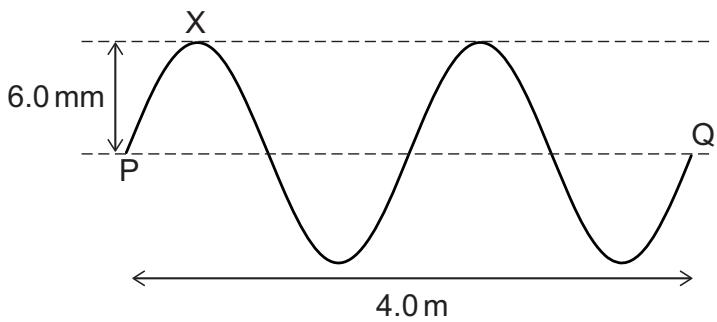
At time ms, point X on the string is at its maximum displacement of 6.0 mm above equilibrium.
What is the displacement of point X at time ms?
The horizontal distance between two points P and Q on the wave is 4.0 m, as shown in the diagram.
At time ms, point X on the string is at its maximum displacement of 6.0 mm above equilibrium.
What is the displacement of point X at time ms?
- A.6.0 mm above equilibrium
- B.between 0 mm and 6.0 mm above equilibrium
- C.0 mm
- D.between 0 mm and 6.0 mm below equilibrium
- E.6.0 mm below equilibrium
Answer: C
Question 33
1 markA neutral atom Q of a particular element contains a total of 20 particles (protons, neutrons and electrons).
The table shows information about the number of particles and relative charges of four atoms or ions W, X, Y and Z.
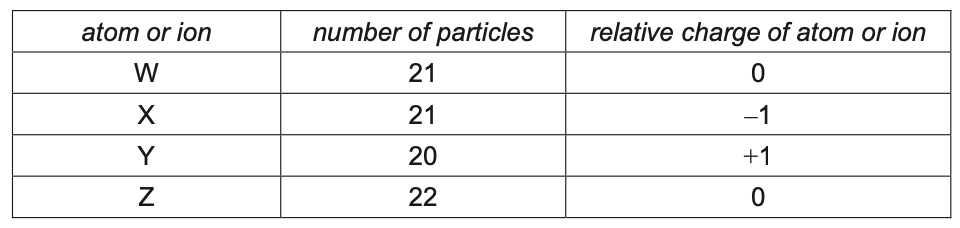
Which of these atoms or ions could be of a different isotope to Q but of the same element as Q?
The table shows information about the number of particles and relative charges of four atoms or ions W, X, Y and Z.
Which of these atoms or ions could be of a different isotope to Q but of the same element as Q?
- A.W only
- B.X only
- C.Z only
- D.X and Z only
- E.W and Y only
- F.W, X and Y only
- G.W, Y and Z only
- H.X, Y and Z only
Answer: G
Question 34
1 markRadioactive isotope X undergoes a single beta () decay to form the stable isotope Y.
A sample consists only of X and Y. The graph shows how the mass of Y present in the sample varies with time. After a long time, the mass of Y in the sample becomes a constant 50 g.
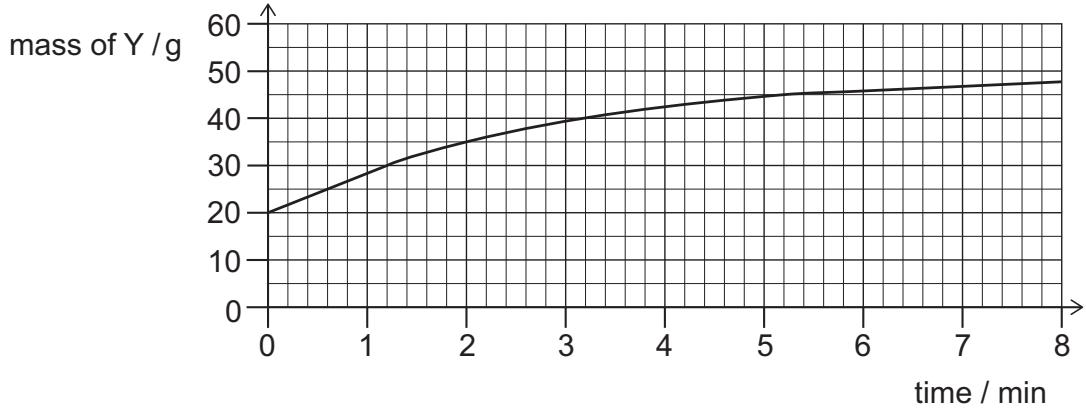
What is the half-life of X?
A sample consists only of X and Y. The graph shows how the mass of Y present in the sample varies with time. After a long time, the mass of Y in the sample becomes a constant 50 g.
What is the half-life of X?
- A.0.6 minutes
- B.1.2 minutes
- C.2.0 minutes
- D.3.2 minutes
- E.4.0 minutes
- F.5.2 minutes
Answer: C
Question 35
1 markA piece of metal of mass 50 g is at thermal equilibrium in a hot liquid at temperature .
The metal is removed from the liquid and immediately placed in 100 g of water that is at 20 °C.
The water is stirred and reaches a final temperature of 26 °C.
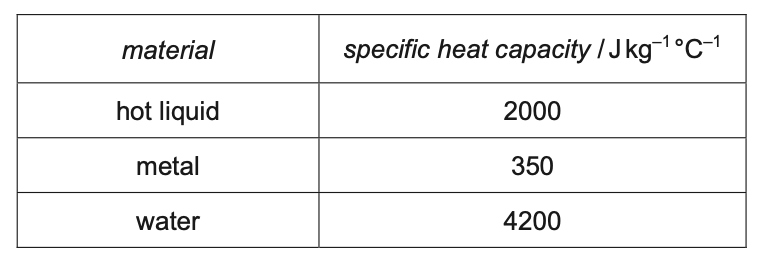
What is the temperature of the hot liquid?
(Assume that heat transfers to or from the surroundings are negligible.)
The metal is removed from the liquid and immediately placed in 100 g of water that is at 20 °C.
The water is stirred and reaches a final temperature of 26 °C.
What is the temperature of the hot liquid?
(Assume that heat transfers to or from the surroundings are negligible.)
- A.38 °C
- B.51 °C
- C.150 °C
- D.170 °C
- E.480 °C
Answer: D
Question 36
1 markA bar magnet is placed at position X close to one end of a coil and on the axis of the coil as shown.
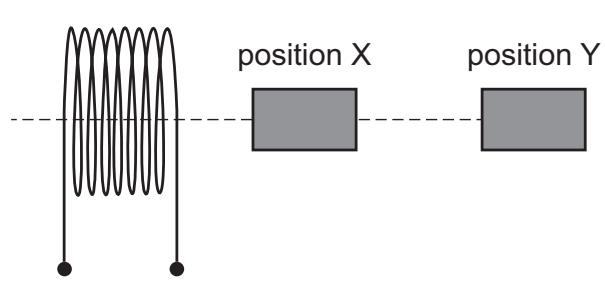
The graph shows how the velocity of the magnet varies as it is then moved rapidly to position Y and back to position X.
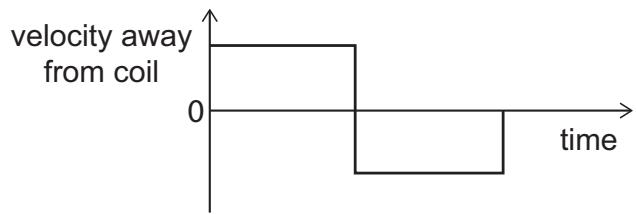
The magnetic field of the bar magnet still affects the coil when the magnet is at position Y.
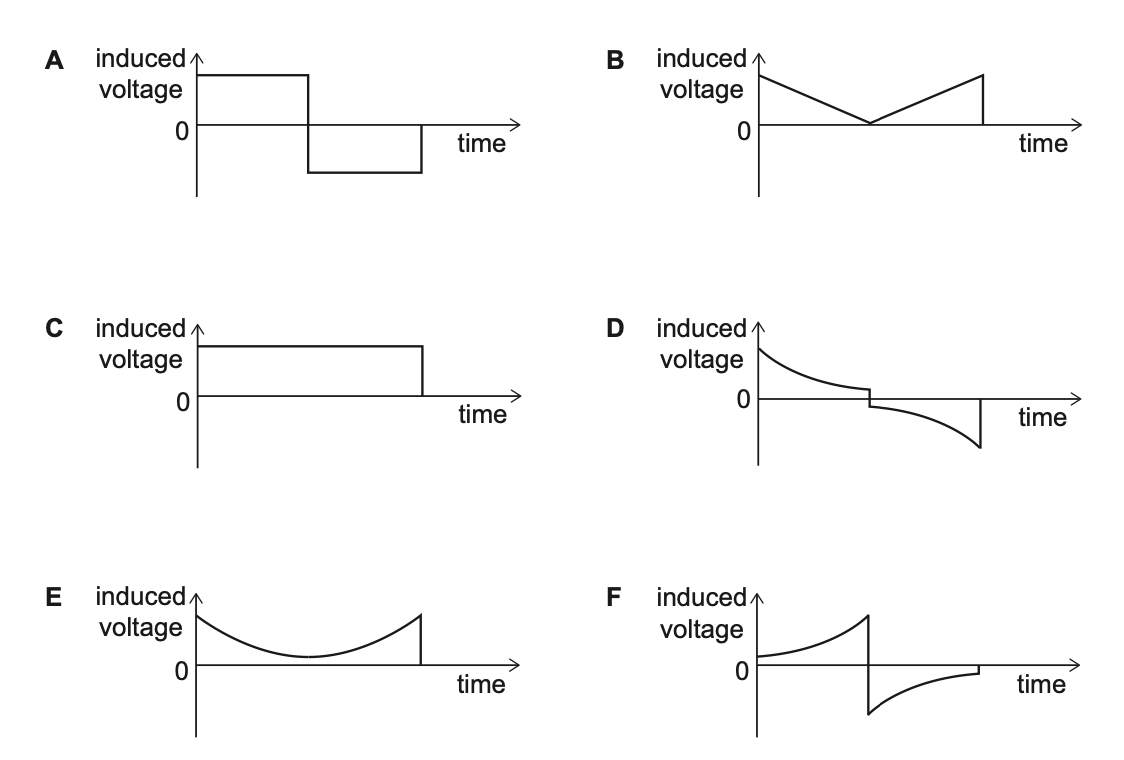
Which graph represents how the induced voltage in the coil changes as the magnet moves?
The graph shows how the velocity of the magnet varies as it is then moved rapidly to position Y and back to position X.
The magnetic field of the bar magnet still affects the coil when the magnet is at position Y.
Which graph represents how the induced voltage in the coil changes as the magnet moves?
- A.[Graph A shows a negative rectangular pulse, then a positive rectangular pulse of smaller height and longer duration.]
- B.[Graph B shows a negative voltage decreasing linearly to zero, then a positive voltage increasing linearly to a smaller peak.]
- C.[Graph C shows a negative rectangular pulse followed by zero voltage.]
- D.[Graph D shows a negative voltage that decreases in magnitude, then a positive voltage that decreases in magnitude.]
- E.[Graph E shows a curved negative pulse followed by a curved positive pulse.]
- F.[Graph F shows a sharp negative spike, then a sharp positive spike of smaller magnitude.]
Answer: D
Question 37
1 markA small slider of mass 30 g is at rest near the bottom of a frictionless slope and in contact with a light uncompressed spring as shown.
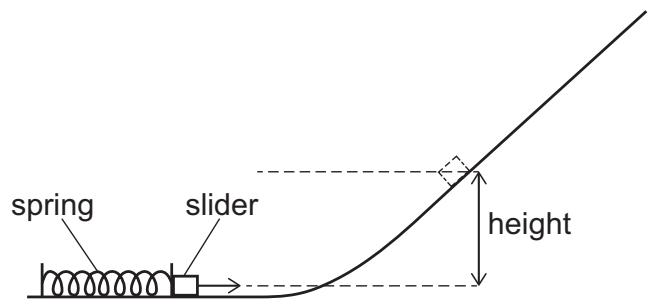
[diagram not to scale]
The spring is compressed by 5.0 cm and the slider remains in contact with it.
The spring is released and causes the slider to rise up the slope to a maximum vertical height of 20 cm.
The slider is replaced with one of mass 20 g.
The spring is now compressed by 15 cm, and the new slider remains in contact with it.
To what maximum vertical height does this new slider rise after it is released?
(the spring obeys Hooke's law; assume that air resistance is negligible)
[diagram not to scale]
The spring is compressed by 5.0 cm and the slider remains in contact with it.
The spring is released and causes the slider to rise up the slope to a maximum vertical height of 20 cm.
The slider is replaced with one of mass 20 g.
The spring is now compressed by 15 cm, and the new slider remains in contact with it.
To what maximum vertical height does this new slider rise after it is released?
(the spring obeys Hooke's law; assume that air resistance is negligible)
- A.40 cm
- B.60 cm
- C.90 cm
- D.120 cm
- E.180 cm
- F.270 cm
Answer: F
Question 38
1 markA tall, smooth cylinder contains air at atmospheric pressure of Pa. The density of the air in the cylinder is .
A heavy piston is now placed in the top of the cylinder and allowed to fall slowly downwards, compressing the air until the piston rests in equilibrium.
The mass of the piston is 50.0 kg and its cross-sectional area is .
What is the density of the air in the cylinder when the piston rests in equilibrium?
(gravitational field strength = ; assume that the air behaves as an ideal gas and that the temperature remains constant)
A heavy piston is now placed in the top of the cylinder and allowed to fall slowly downwards, compressing the air until the piston rests in equilibrium.
The mass of the piston is 50.0 kg and its cross-sectional area is .
What is the density of the air in the cylinder when the piston rests in equilibrium?
(gravitational field strength = ; assume that the air behaves as an ideal gas and that the temperature remains constant)
- A.
- B.
- C.
- D.
- E.
- F.
Answer: E
Question 39
1 markThere are two types of earthquake waves, called P-waves and S-waves.
When an earthquake occurs, both types of wave are produced at the same time and follow the same path.
The P-waves travel outwards from the source at and the S-waves travel out at .
A seismic monitoring station detects the P-waves 30 s before the S-waves.
How far have the waves travelled from the source of the earthquake to reach the seismic monitoring station?
When an earthquake occurs, both types of wave are produced at the same time and follow the same path.
The P-waves travel outwards from the source at and the S-waves travel out at .
A seismic monitoring station detects the P-waves 30 s before the S-waves.
How far have the waves travelled from the source of the earthquake to reach the seismic monitoring station?
- A.60 km
- B.90 km
- C.135 km
- D.150 km
- E.225 km
Answer: E
Question 40
1 markA solid cuboid has a mass of 32 kg and a density of .
Faces 1, 2 and 3 of the cuboid have different areas.
When the cuboid rests on one of these faces on a flat horizontal surface, the pressure on the surface due to the cuboid is .
When it rests on another of these faces, the pressure on the surface due to the cuboid is .
What is the pressure on the surface due to the cuboid when it rests on the third of these faces?
(gravitational field strength = )
Faces 1, 2 and 3 of the cuboid have different areas.
When the cuboid rests on one of these faces on a flat horizontal surface, the pressure on the surface due to the cuboid is .
When it rests on another of these faces, the pressure on the surface due to the cuboid is .
What is the pressure on the surface due to the cuboid when it rests on the third of these faces?
(gravitational field strength = )
- A.
- B.
- C.
- D.
- E.
Answer: A