Mapped to the ESAT specification
NSAA 2023 Chemistry Part Y
20 questions20 marksUpdated June 2026
Natural Sciences Admissions Assessment 2023 is one of the closest available past papers for the Engineering and Science Admissions Test. Below, all 20 questions are mapped to the ESAT topics they test, each with its answer. Sit it cold under exam timing, then work back through anything you missed using the solutions.
What this paper covers on the ESAT
Every question mapped to the Engineering and Science Admissions Test specification, so you know exactly which areas it tests.
Chemistry
- Quantitative chemistry (37)
- Atomic structure (2)
- Electrolysis (2)
- Energetics (2)
- Separation techniques (2)
- Acids, bases and salts (1)
- Chemical bonding, structure and properties (1)
- Chemical reactions, formulae and equations (1)
- Oxidation, reduction and redox (1)
Questions and answers are free. Full step-by-step worked solutions unlock with a free account. Start practising.
Question 21
1 markThe following organic reactions are carried out:
1. 1-Chloropropane is warmed with aqueous sodium hydroxide.
2. Propan-1-ol is heated under reflux with excess acidified potassium dichromate(VI).
3. Propan-2-ol is heated under reflux with excess acidified potassium dichromate(VI).
4. Propene is heated with hydrogen gas over a nickel catalyst.
What is the order of boiling points of the major organic product from each of these reactions, from lowest to highest boiling point?
1. 1-Chloropropane is warmed with aqueous sodium hydroxide.
2. Propan-1-ol is heated under reflux with excess acidified potassium dichromate(VI).
3. Propan-2-ol is heated under reflux with excess acidified potassium dichromate(VI).
4. Propene is heated with hydrogen gas over a nickel catalyst.
What is the order of boiling points of the major organic product from each of these reactions, from lowest to highest boiling point?
- A.1, 2, 3, 4
- B.1, 4, 3, 2
- C.2, 1, 3, 4
- D.2, 3, 4, 1
- E.3, 4, 2, 1
- F.3, 1, 2, 4
- G.4, 3, 1, 2
- H.4, 3, 2, 1
Answer: G
Question 22
1 markThe equations for the complete combustion of ethanol (Reaction 1) and the complete combustion of propan-1-ol (Reaction 2) are:
Reaction 1:
Reaction 2:
The standard energy change for Reaction 2 is 650 kJ mol⁻¹ more exothermic than the standard energy change for Reaction 1.
Assume the following bond energy data:
| bond | bond energy / kJ mol⁻¹ |
| :---- | :--------------------- |
| C-C | 350 |
| C-H | 400 |
| O-H | 450 |
| O=O | 500 |
Using this data, what is the value of the bond energy for the C=O bond?
Reaction 1:
Reaction 2:
The standard energy change for Reaction 2 is 650 kJ mol⁻¹ more exothermic than the standard energy change for Reaction 1.
Assume the following bond energy data:
| bond | bond energy / kJ mol⁻¹ |
| :---- | :--------------------- |
| C-C | 350 |
| C-H | 400 |
| O-H | 450 |
| O=O | 500 |
Using this data, what is the value of the bond energy for the C=O bond?
- A.175 kJ mol⁻¹
- B.425 kJ mol⁻¹
- C.450 kJ mol⁻¹
- D.650 kJ mol⁻¹
- E.825 kJ mol⁻¹
- F.900 kJ mol⁻¹
- G.1050 kJ mol⁻¹
- H.1650 kJ mol⁻¹
Answer: E
Question 23
1 markPart of an organic reaction mechanism is shown:
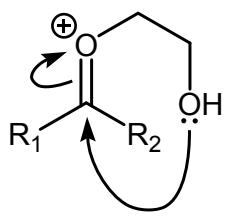
What is produced by this part of the mechanism?
What is produced by this part of the mechanism?
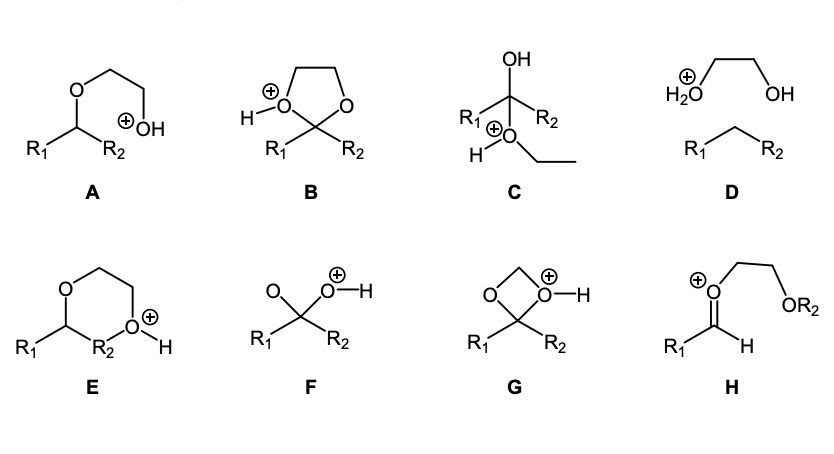
- A.[Image of structure A]
- B.[Image of structure B]
- C.[Image of structure C]
- D.[Image of structure D]
- E.[Image of structure E]
- F.[Image of structure F]
- G.[Image of structure G]
- H.[Image of structure H]
Answer: B
Question 24
1 markIbuprofen is a common pain relief and anti-inflammatory drug. It is often sold in tablet form, each tablet containing 200 mg of the drug.
Ibuprofen can be synthesised from isobutylbenzene in a 3-stage process with the percentage yields for each step shown on the arrows:
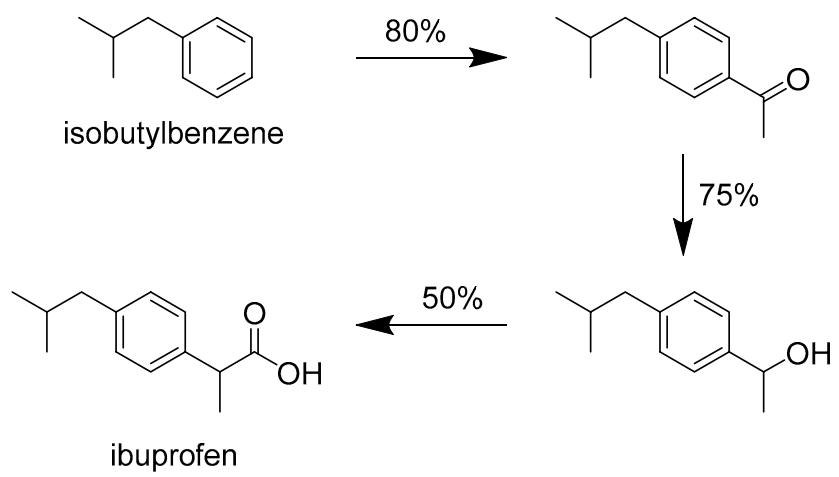
6.7 g of isobutylbenzene is converted to ibuprofen to trial this process.
What is the maximum number of 200 mg ibuprofen tablets that can be manufactured?
( values: H = 1; C = 12; O = 16)
Ibuprofen can be synthesised from isobutylbenzene in a 3-stage process with the percentage yields for each step shown on the arrows:
6.7 g of isobutylbenzene is converted to ibuprofen to trial this process.
What is the maximum number of 200 mg ibuprofen tablets that can be manufactured?
( values: H = 1; C = 12; O = 16)
- A.10
- B.15
- C.20
- D.33
- E.40
- F.50
Answer: B
Question 25
1 markThe enthalpy change for neutralisation of one mole of sulfuric acid was determined experimentally.
Solutions of sodium hydroxide (2.00 mol dm⁻³) and sulfuric acid (4.00 mol dm⁻³) were used in the experiment. The initial temperature of both solutions was 20.0°C.
40.0 cm³ of the sodium hydroxide solution was placed into a well-insulated container. The sulfuric acid was added to the alkali until the solution was neutral. The maximum temperature reached was 40.0°C.
Assume that the specific heat capacity of all aqueous solutions is x J g⁻¹ °C⁻¹, and that the density of all solutions is 1.0 g cm⁻³.
What is the value for the enthalpy change, in kJ mol⁻¹, for neutralisation of one mole of sulfuric acid?
(Assume that all heat is transferred to the solution and no heat is lost to the surroundings.)
Solutions of sodium hydroxide (2.00 mol dm⁻³) and sulfuric acid (4.00 mol dm⁻³) were used in the experiment. The initial temperature of both solutions was 20.0°C.
40.0 cm³ of the sodium hydroxide solution was placed into a well-insulated container. The sulfuric acid was added to the alkali until the solution was neutral. The maximum temperature reached was 40.0°C.
Assume that the specific heat capacity of all aqueous solutions is x J g⁻¹ °C⁻¹, and that the density of all solutions is 1.0 g cm⁻³.
What is the value for the enthalpy change, in kJ mol⁻¹, for neutralisation of one mole of sulfuric acid?
(Assume that all heat is transferred to the solution and no heat is lost to the surroundings.)
- A.-5.0x kJ mol⁻¹
- B.-10.0x kJ mol⁻¹
- C.-12.5x kJ mol⁻¹
- D.-15.0x kJ mol⁻¹
- E.-20.0x kJ mol⁻¹
- F.-25.0x kJ mol⁻¹
- G.-50.0x kJ mol⁻¹
- H.-100x kJ mol⁻¹
Answer: F
Question 26
1 markAn object is electroplated with a thin layer of chromium with a mass of 0.26 g, using a solution made up of CrO₃ dissolved in acid.
Assume that 1 mole of electrons carries a charge of 96 000 coulombs.
How long does it take, in minutes, to electroplate the object using a 12 A current?
(1 ampere (A) is a current of 1 coulomb per second. value: Cr = 52)
Assume that 1 mole of electrons carries a charge of 96 000 coulombs.
How long does it take, in minutes, to electroplate the object using a 12 A current?
(1 ampere (A) is a current of 1 coulomb per second. value: Cr = 52)
- A. minutes
- B.2 minutes
- C.4 minutes
- D. minutes
- E.20 minutes
- F.40 minutes
- G.120 minutes
- H.240 minutes
Answer: C
Question 27
1 markWater is classified as hard or soft depending on the concentration of calcium ions from dissolved salts. Water with a calcium ion concentration of less than 0.60 mmol dm⁻³ is soft.
Hard water, which has a calcium ion concentration greater than 0.60 mmol dm⁻³, can be softened by the addition of washing soda, sodium carbonate decahydrate (), to precipitate calcium carbonate.
A 10 dm³ sample of water contains a total of 15 mmol calcium ions from dissolved salts.
What is the minimum mass of washing soda required to change the classification of this sample from hard to soft?
( values: H = 1; C = 12; O = 16; Na = 23; Ca = 40. Assume that the only metal ions present in solution are calcium ions and there is no change of volume on the addition of the washing soda.)
Hard water, which has a calcium ion concentration greater than 0.60 mmol dm⁻³, can be softened by the addition of washing soda, sodium carbonate decahydrate (), to precipitate calcium carbonate.
A 10 dm³ sample of water contains a total of 15 mmol calcium ions from dissolved salts.
What is the minimum mass of washing soda required to change the classification of this sample from hard to soft?
( values: H = 1; C = 12; O = 16; Na = 23; Ca = 40. Assume that the only metal ions present in solution are calcium ions and there is no change of volume on the addition of the washing soda.)
- A.0.26 g
- B.0.41 g
- C.0.95 g
- D.1.1 g
- E.2.6 g
- F.4.1 g
Answer: E
Question 28
1 markTriiodomethane is a pale-yellow solid with the formula CHI₃. It is formed when some organic compounds react with alkaline aqueous iodine.
When an alcohol reacts, the series of steps that take place during the reaction to produce the triiodomethane are:
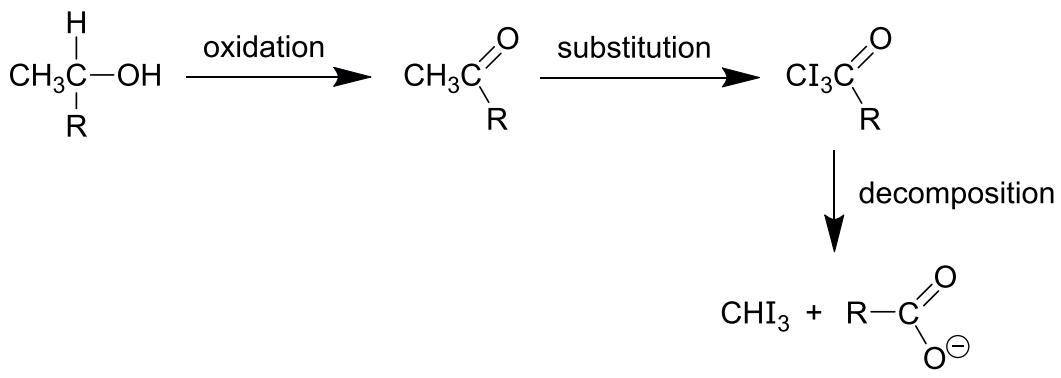
A compound with the following structural formula is completely reacted with excess alkaline aqueous iodine and the reaction mixture is then acidified with an excess of a dilute acid.
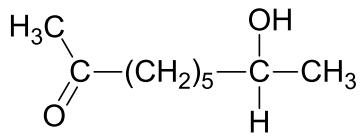
What is the final organic compound that is produced along with the triiodomethane?
When an alcohol reacts, the series of steps that take place during the reaction to produce the triiodomethane are:
A compound with the following structural formula is completely reacted with excess alkaline aqueous iodine and the reaction mixture is then acidified with an excess of a dilute acid.
What is the final organic compound that is produced along with the triiodomethane?
- A.[Image of chemical structure A]
- B.[Image of chemical structure B]
- C.[Image of chemical structure C]
- D.[Image of chemical structure D]
- E.[Image of chemical structure E]
- F.[Image of chemical structure F]
Answer: F
Question 29
1 markEthanethiol, , is a foul-smelling gas that is added to natural gas to enable humans to detect gas leaks, which would otherwise not be noticed.
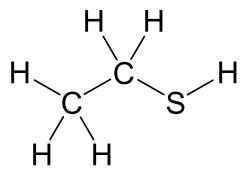
The minimum concentration of ethanethiol that a person can detect is mg per cm³ of air.
A gas leak happens in an empty room that has dimensions 20 m 20 m 3 m. Assume that the ethanethiol is spread evenly throughout the room.
If a person detected the gas leak, what is the minimum number of molecules of ethanethiol in the room to 1 significant figure?
( values: H = 1; C = 12; S = 32. Avogadro's number = )
The minimum concentration of ethanethiol that a person can detect is mg per cm³ of air.
A gas leak happens in an empty room that has dimensions 20 m 20 m 3 m. Assume that the ethanethiol is spread evenly throughout the room.
If a person detected the gas leak, what is the minimum number of molecules of ethanethiol in the room to 1 significant figure?
( values: H = 1; C = 12; S = 32. Avogadro's number = )
- A.
- B.
- C.
- D.
- E.
- F.
- G.
- H.
Answer: D
Question 30
1 markCompounds P and T are isomeric hydrocarbons containing six carbon atoms. Compound T decolourises bromine water in a 1:1 molar ratio, whereas compound P does not react at all.
Compounds P and T both undergo free radical substitution reactions with chlorine in the presence of ultraviolet light to produce a number of mono-chlorinated products. One of these products is compound Q, formed from hydrocarbon P, and another is compound V, formed from hydrocarbon T.
- Q undergoes a substitution reaction with aqueous sodium hydroxide to form compound R. Compound R is oxidised with acidified potassium dichromate to form compound S which does not react with either Tollens' reagent or sodium carbonate solution.
- V undergoes a substitution reaction with aqueous sodium hydroxide to form compound W. Compound W is oxidised with acidified potassium dichromate to form compound X which causes bubbling when added to sodium carbonate solution.
Compound R reacts with compound X, in the presence of an acid catalyst, to form compound Y.
What is the relative molar mass () of compound Y?
( values: H = 1; C = 12; O = 16)
Compounds P and T both undergo free radical substitution reactions with chlorine in the presence of ultraviolet light to produce a number of mono-chlorinated products. One of these products is compound Q, formed from hydrocarbon P, and another is compound V, formed from hydrocarbon T.
- Q undergoes a substitution reaction with aqueous sodium hydroxide to form compound R. Compound R is oxidised with acidified potassium dichromate to form compound S which does not react with either Tollens' reagent or sodium carbonate solution.
- V undergoes a substitution reaction with aqueous sodium hydroxide to form compound W. Compound W is oxidised with acidified potassium dichromate to form compound X which causes bubbling when added to sodium carbonate solution.
Compound R reacts with compound X, in the presence of an acid catalyst, to form compound Y.
What is the relative molar mass () of compound Y?
( values: H = 1; C = 12; O = 16)
- A.180
- B.184
- C.196
- D.200
- E.210
- F.214
Answer: C
Question 31
1 markCalcium and element X are two elements from Group 2 of the Periodic Table. Element X is one place above or one place below calcium in the group.
Some information about these two elements is:
| element | solubility of the element's anhydrous sulfate / mol per 100 g of water |
| :------ | :------------------------------------------------------------------- |
| calcium | |
| X | |
1.0 mol of XCO₃ is completely thermally decomposed. The solid residue is then completely reacted with dilute nitric acid, and the salt produced when in its anhydrous form has a mass of y.
Which row in the following table is correct?
( values: N = 14; O = 16; Mg = 24; Ca = 40; Sr = 88)
Some information about these two elements is:
| element | solubility of the element's anhydrous sulfate / mol per 100 g of water |
| :------ | :------------------------------------------------------------------- |
| calcium | |
| X | |
1.0 mol of XCO₃ is completely thermally decomposed. The solid residue is then completely reacted with dilute nitric acid, and the salt produced when in its anhydrous form has a mass of y.
Which row in the following table is correct?
( values: N = 14; O = 16; Mg = 24; Ca = 40; Sr = 88)
- A.thermal stability of XCO₃: more thermally stable than CaCO₃, value of y: y < 150 g
- B.thermal stability of XCO₃: less thermally stable than CaCO₃, value of y: y < 150 g
- C.thermal stability of XCO₃: more thermally stable than CaCO₃, value of y: y = 150 g
- D.thermal stability of XCO₃: less thermally stable than CaCO₃, value of y: y = 150 g
- E.thermal stability of XCO₃: more thermally stable than CaCO₃, value of y: y > 150 g
- F.thermal stability of XCO₃: less thermally stable than CaCO₃, value of y: y > 150 g
Answer: E
Question 32
1 mark0.125 mol of a hydrocarbon undergoes complete combustion to form 22 g of carbon dioxide and 9 g of water.
What is the total number of isomers that can be represented by the molecular formula of this hydrocarbon?
( values: H = 1; C = 12; O = 16)
What is the total number of isomers that can be represented by the molecular formula of this hydrocarbon?
( values: H = 1; C = 12; O = 16)
- A.2
- B.4
- C.5
- D.6
- E.7
- F.8
- G.13
Answer: D
Question 33
1 markUnsaturation of fatty acids and lipids is measured by the iodine number.
The iodine number is the mass, in g, of iodine required to saturate all the C=C bonds in 100 g of the substance.
The structures of lipid P and fatty acid Q are shown:
[Image showing the structure of lipid P, a triglyceride with . The top fatty acid chain has one C=C bond, the middle chain has two C=C bonds, and the bottom chain has three C=C bonds. The structure of fatty acid Q is also shown, with and three C=C bonds.]
Which of the following statements is/are correct?
1. One molecule of lipid P contains 112 hydrogen atoms.
2. The iodine number of lipid P is 203.2.
3. The iodine number of lipid P is greater than the iodine number of fatty acid Q.
( value: I = 127)
The iodine number is the mass, in g, of iodine required to saturate all the C=C bonds in 100 g of the substance.
The structures of lipid P and fatty acid Q are shown:
[Image showing the structure of lipid P, a triglyceride with . The top fatty acid chain has one C=C bond, the middle chain has two C=C bonds, and the bottom chain has three C=C bonds. The structure of fatty acid Q is also shown, with and three C=C bonds.]
Which of the following statements is/are correct?
1. One molecule of lipid P contains 112 hydrogen atoms.
2. The iodine number of lipid P is 203.2.
3. The iodine number of lipid P is greater than the iodine number of fatty acid Q.
( value: I = 127)
- A.none of them
- B.1 only
- C.2 only
- D.3 only
- E.1 and 2 only
- F.1 and 3 only
- G.2 and 3 only
- H.1, 2 and 3
Answer: E
Question 34
1 markA sample of copper(II) oxide is added to an excess of dilute sulfuric acid and warmed until no solid remains.
The solution is then electrolysed using inert electrodes.
During the first minutes, no bubbling is observed at the cathode, but the mass of the cathode increases by 0.635 g.
During the next minutes, bubbling is observed at the cathode. The volume of gas produced at the cathode is 120 cm³.
Bubbling is observed at the anode throughout the electrolysis. The gas is collected and measured.
Which row identifies the gas produced at the cathode, and the total volume of gas produced at the anode, measured at room temperature and pressure?
( value: Cu = 63.5. Assume that the volume of one mole of a gas is 24 dm³ at room temperature and pressure.)
The solution is then electrolysed using inert electrodes.
During the first minutes, no bubbling is observed at the cathode, but the mass of the cathode increases by 0.635 g.
During the next minutes, bubbling is observed at the cathode. The volume of gas produced at the cathode is 120 cm³.
Bubbling is observed at the anode throughout the electrolysis. The gas is collected and measured.
Which row identifies the gas produced at the cathode, and the total volume of gas produced at the anode, measured at room temperature and pressure?
( value: Cu = 63.5. Assume that the volume of one mole of a gas is 24 dm³ at room temperature and pressure.)
- A.gas formed at the cathode: hydrogen, total volume of gas produced at the anode / cm³: 360
- B.gas formed at the cathode: hydrogen, total volume of gas produced at the anode / cm³: 300
- C.gas formed at the cathode: hydrogen, total volume of gas produced at the anode / cm³: 240
- D.gas formed at the cathode: hydrogen, total volume of gas produced at the anode / cm³: 180
- E.gas formed at the cathode: oxygen, total volume of gas produced at the anode / cm³: 360
- F.gas formed at the cathode: oxygen, total volume of gas produced at the anode / cm³: 300
- G.gas formed at the cathode: oxygen, total volume of gas produced at the anode / cm³: 240
- H.gas formed at the cathode: oxygen, total volume of gas produced at the anode / cm³: 180
Answer: D
Question 35
1 markConcentrated sulfuric acid reacts with sodium iodide in three possible redox reactions, all of which produce iodine.
In these reactions, sulfuric acid is reduced to either , or or .
In an experiment, 0.3 g of sodium iodide reacts with excess concentrated sulfuric acid.
If exactly 0.1 g of this sodium iodide reacts in each of the three redox reactions, what is the total volume of sulfur-containing gases that are formed?
( values: Na = 23; I = 127. Assume that one mole of a gas occupies 24 dm³ at room temperature and pressure, and that none of the gases dissolve in the reaction mixture.)
In these reactions, sulfuric acid is reduced to either , or or .
In an experiment, 0.3 g of sodium iodide reacts with excess concentrated sulfuric acid.
If exactly 0.1 g of this sodium iodide reacts in each of the three redox reactions, what is the total volume of sulfur-containing gases that are formed?
( values: Na = 23; I = 127. Assume that one mole of a gas occupies 24 dm³ at room temperature and pressure, and that none of the gases dissolve in the reaction mixture.)
- A.10.0 cm³
- B.12.7 cm³
- C.16.0 cm³
- D.20.0 cm³
- E.24.0 cm³
- F.25.3 cm³
- G.32.0 cm³
- H.48.0 cm³
Answer: A
Question 36
1 markThe relative atomic mass of bromine is 80.0. Bromine has only two stable isotopes containing 44 and 46 neutrons.
The relative atomic mass of chlorine is 35.5. Chlorine has only two stable isotopes containing 18 and 20 neutrons.
Bromine and chlorine can form a compound BrCl₃. A sample of BrCl₃ was studied by mass spectrometry.
Which row in the table gives correct information about the low-resolution mass spectrum of BrCl₃?
(atomic numbers: Cl = 17; Br = 35)
The relative atomic mass of chlorine is 35.5. Chlorine has only two stable isotopes containing 18 and 20 neutrons.
Bromine and chlorine can form a compound BrCl₃. A sample of BrCl₃ was studied by mass spectrometry.
Which row in the table gives correct information about the low-resolution mass spectrum of BrCl₃?
(atomic numbers: Cl = 17; Br = 35)
- A.number of isotopic molecular ion peaks: 5, mass-to-charge ratio of the most intense peak(s): 184
- B.number of isotopic molecular ion peaks: 8, mass-to-charge ratio of the most intense peak(s): 184
- C.number of isotopic molecular ion peaks: 4, mass-to-charge ratio of the most intense peak(s): both 184 and 186
- D.number of isotopic molecular ion peaks: 5, mass-to-charge ratio of the most intense peak(s): both 184 and 186
- E.number of isotopic molecular ion peaks: 5, mass-to-charge ratio of the most intense peak(s): 186
- F.number of isotopic molecular ion peaks: 4, mass-to-charge ratio of the most intense peak(s): 186.5
- G.number of isotopic molecular ion peaks: 8, mass-to-charge ratio of the most intense peak(s): 186.5
- H.number of isotopic molecular ion peaks: 8, mass-to-charge ratio of the most intense peak(s): 192
Answer: E
Question 37
1 mark36 dm³ of oxygen gas reacts completely with excess water and arsenic to form an acid only. This acid contains a single arsenic in oxidation state +3.
What mass of arsenic would be required?
( values: As = 74.9; H = 1.0; O = 16. Assume that one mole of gas at room temperature and pressure occupies 24 dm³.)
What mass of arsenic would be required?
( values: As = 74.9; H = 1.0; O = 16. Assume that one mole of gas at room temperature and pressure occupies 24 dm³.)
- A.74.9 g
- B.84.3 g
- C.112.4 g
- D.149.8 g
- E.224.7 g
- F.449.4 g
Answer: D
Question 38
1 markThe general structure of an amino acid is:
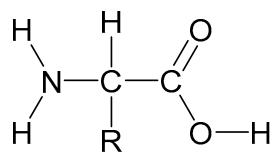
The R group determines the identity of the amino acid.
The equation for the reaction between three amino acids to make a tripeptide is shown.
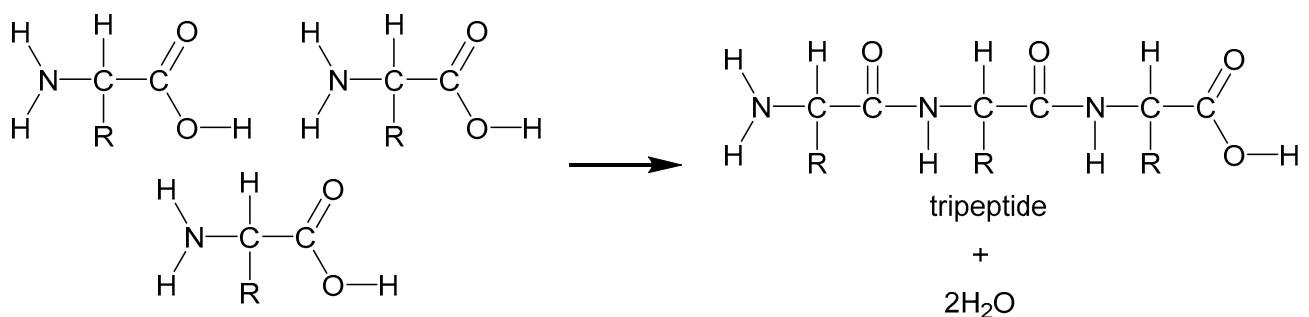
The three amino acids may be the same or different.
A tripeptide is broken down into its three component amino acids and analysed using chromatography.
The chromatogram is shown. Only two spots are present.
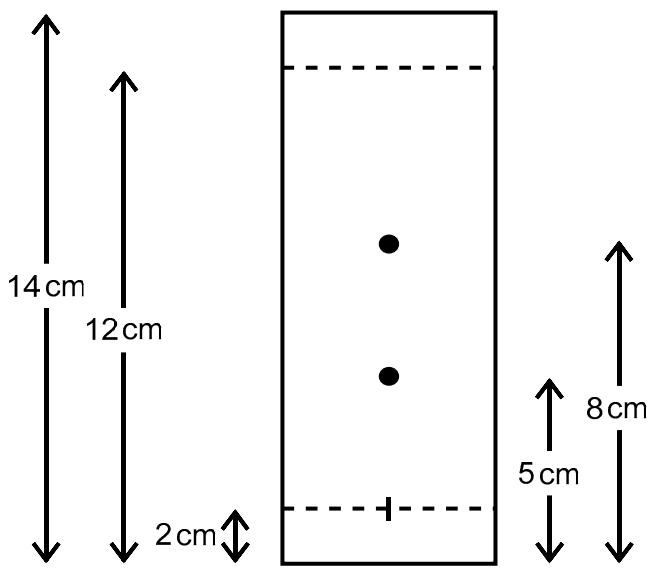
The values in this solvent and the values for some amino acids, including all those that make up the tripeptide, are given in the table.
| R group on the amino acid | | of amino acid |
| :------------------------ | :---- | :------------------ |
| -CH₃ | 0.30 | 89 |
| -CH(CH₃)₂ | 0.42 | 117 |
| -CH₂COOH | 0.60 | 133 |
| -CH₂CH₂COOH | 0.67 | 147 |
The constituent amino acids from 0.0100 mol of tripeptide are reacted separately with aqueous sodium hydroxide.
In total, 40.0 cm³ of 1.00 mol dm⁻³ of aqueous sodium hydroxide is required to exactly neutralise the acid groups on the amino acids.
Which row identifies of the tripeptide and the number of different tripeptides (as structural isomers) with this that can be made from the amino acids present?
( values: H = 1; C = 12; N = 14; O = 16)
The R group determines the identity of the amino acid.
The equation for the reaction between three amino acids to make a tripeptide is shown.
The three amino acids may be the same or different.
A tripeptide is broken down into its three component amino acids and analysed using chromatography.
The chromatogram is shown. Only two spots are present.
The values in this solvent and the values for some amino acids, including all those that make up the tripeptide, are given in the table.
| R group on the amino acid | | of amino acid |
| :------------------------ | :---- | :------------------ |
| -CH₃ | 0.30 | 89 |
| -CH(CH₃)₂ | 0.42 | 117 |
| -CH₂COOH | 0.60 | 133 |
| -CH₂CH₂COOH | 0.67 | 147 |
The constituent amino acids from 0.0100 mol of tripeptide are reacted separately with aqueous sodium hydroxide.
In total, 40.0 cm³ of 1.00 mol dm⁻³ of aqueous sodium hydroxide is required to exactly neutralise the acid groups on the amino acids.
Which row identifies of the tripeptide and the number of different tripeptides (as structural isomers) with this that can be made from the amino acids present?
( values: H = 1; C = 12; N = 14; O = 16)
- A. of tripeptide: 275, number of different tripeptides possible: 3
- B. of tripeptide: 311, number of different tripeptides possible: 3
- C. of tripeptide: 319, number of different tripeptides possible: 3
- D. of tripeptide: 345, number of different tripeptides possible: 3
- E. of tripeptide: 275, number of different tripeptides possible: 6
- F. of tripeptide: 311, number of different tripeptides possible: 6
- G. of tripeptide: 319, number of different tripeptides possible: 6
- H. of tripeptide: 345, number of different tripeptides possible: 6
Answer: A
Question 39
1 markAn organic compound X shows the following characteristics:
- X contains only carbon, hydrogen and oxygen. It has only one functional group.
- 0.148 g of X reacts with a small excess of sodium, producing 24.0 cm³ of hydrogen, measured at room temperature and pressure.
- 0.148 g of X is oxidised completely by 16.0 cm³ of acidified 0.100 mol dm⁻³ potassium manganate(VII) solution.
The half-equation for the reduction of manganate(VII) ions is:
Which statement about X is correct?
( values: H = 1; C = 12; O = 16. Assume that one mole of gas occupies 24.0 dm³ at room temperature and pressure.)
- X contains only carbon, hydrogen and oxygen. It has only one functional group.
- 0.148 g of X reacts with a small excess of sodium, producing 24.0 cm³ of hydrogen, measured at room temperature and pressure.
- 0.148 g of X is oxidised completely by 16.0 cm³ of acidified 0.100 mol dm⁻³ potassium manganate(VII) solution.
The half-equation for the reduction of manganate(VII) ions is:
Which statement about X is correct?
( values: H = 1; C = 12; O = 16. Assume that one mole of gas occupies 24.0 dm³ at room temperature and pressure.)
- A.X must be propanoic acid
- B.X must be methylpropan-1-ol
- C.X must be methylpropan-2-ol
- D.X must be butan-1-ol
- E.X must be butan-2-ol
- F.X could be either butan-1-ol or butan-2-ol
- G.X could be either butan-1-ol or methylpropan-1-ol
- H.X could be either butan-2-ol or methylpropan-2-ol
Answer: G
Question 40
1 markLawn sand is used to remove moss and enhance the green colour of grass.
Lawn sand is a mixture of three compounds:
- silicon dioxide.
- an ionic salt, X. One mole of this salt contains 7 moles of water of crystallisation.
- a second ionic salt that provides the grass with nitrogen and is not hydrated.
Both salts contain one cation and one anion and are soluble in water. The anion in both salts is the same.
Excess water is stirred with 10.00 g of lawn sand, and the mixture then filtered. 8.12 g of dry silicon dioxide is obtained.
Excess acidified aqueous barium chloride is added to all of the filtrate. A white precipitate is formed. This mixture is filtered and all of this second filtrate is used in the next step.
Excess sodium hydroxide is now added to the filtrate. A green precipitate is formed.
When this mixture is heated, 480 cm³ of ammonia, measured at room temperature and pressure, is produced.
Which of the following is an expression for the number of moles of X present in 10.00 g of lawn sand?
( values: H = 1; C = 12; N = 14; O = 16; Si = 28; S = 32; Cl = 35.5; Br = 80; I = 127; Mg = 24; Ca = 40; Fe = 56; Cu = 63.5; Ba = 137
(Assume that one mole of a gas occupies 24.0 dm³ at room temperature and pressure.)
Lawn sand is a mixture of three compounds:
- silicon dioxide.
- an ionic salt, X. One mole of this salt contains 7 moles of water of crystallisation.
- a second ionic salt that provides the grass with nitrogen and is not hydrated.
Both salts contain one cation and one anion and are soluble in water. The anion in both salts is the same.
Excess water is stirred with 10.00 g of lawn sand, and the mixture then filtered. 8.12 g of dry silicon dioxide is obtained.
Excess acidified aqueous barium chloride is added to all of the filtrate. A white precipitate is formed. This mixture is filtered and all of this second filtrate is used in the next step.
Excess sodium hydroxide is now added to the filtrate. A green precipitate is formed.
When this mixture is heated, 480 cm³ of ammonia, measured at room temperature and pressure, is produced.
Which of the following is an expression for the number of moles of X present in 10.00 g of lawn sand?
( values: H = 1; C = 12; N = 14; O = 16; Si = 28; S = 32; Cl = 35.5; Br = 80; I = 127; Mg = 24; Ca = 40; Fe = 56; Cu = 63.5; Ba = 137
(Assume that one mole of a gas occupies 24.0 dm³ at room temperature and pressure.)
- A. mol
- B. mol
- C. mol
- D. mol
- E. mol
- F. mol
- G. mol
- H. mol
Answer: B