NSAA 2023 Chemistry S1
20 questions20 marksUpdated June 2026
The NSAA 2023 Chemistry S1 paper in full: all 20 questions, each with its answer. NSAA is the Natural Sciences Admissions Assessment. Sit it cold under exam timing, mark it, then work back through anything you missed using the solutions below.
Download the original PDF →Questions and answers are free. Full step-by-step worked solutions unlock with a free account. Start practising.
Question 41
An experiment is carried out at two different pressures by changing the volume of the reaction vessel.
The experiment measures the rate of the reaction between molecules X and Y to form Z:
X(g) + Y(g) → Z(s)
Assume that the experiments are carried out under exactly the same conditions apart from the difference in pressure.
How will the rate of the reaction change with pressure, if at all, and what is the reason for this?
The options are described in the table below:
| | difference in rate of reaction | reason |
|---|---|---|
| A | the reaction is faster at lower pressure | average kinetic energy of molecules is greater at lower pressure |
| B | the reaction is faster at lower pressure | the rate of collisions is greater between molecules at lower pressure |
| C | the reaction is slower at lower pressure | average kinetic energy of molecules is less at lower pressure |
| D | the reaction is slower at lower pressure | the rate of collisions between molecules is lower at lower pressure |
| E | the reaction rate is the same at both pressures | the average kinetic energy of molecules is the same at both pressures |
The experiment measures the rate of the reaction between molecules X and Y to form Z:
X(g) + Y(g) → Z(s)
Assume that the experiments are carried out under exactly the same conditions apart from the difference in pressure.
How will the rate of the reaction change with pressure, if at all, and what is the reason for this?
The options are described in the table below:
| | difference in rate of reaction | reason |
|---|---|---|
| A | the reaction is faster at lower pressure | average kinetic energy of molecules is greater at lower pressure |
| B | the reaction is faster at lower pressure | the rate of collisions is greater between molecules at lower pressure |
| C | the reaction is slower at lower pressure | average kinetic energy of molecules is less at lower pressure |
| D | the reaction is slower at lower pressure | the rate of collisions between molecules is lower at lower pressure |
| E | the reaction rate is the same at both pressures | the average kinetic energy of molecules is the same at both pressures |
- A.The reaction is faster at lower pressure, and the reason is that the average kinetic energy of molecules is greater at lower pressure.
- B.The reaction is faster at lower pressure, and the reason is that the rate of collisions is greater between molecules at lower pressure.
- C.The reaction is slower at lower pressure, and the reason is that the average kinetic energy of molecules is less at lower pressure.
- D.The reaction is slower at lower pressure, and the reason is that the rate of collisions between molecules is lower at lower pressure.
- E.The reaction rate is the same at both pressures, and the reason is that the average kinetic energy of molecules is the same at both pressures.
Question 42
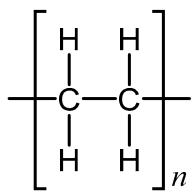
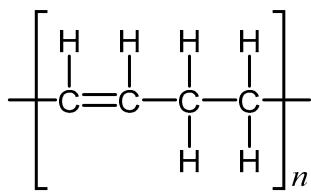
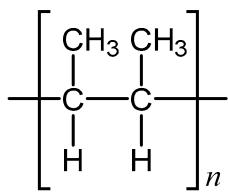
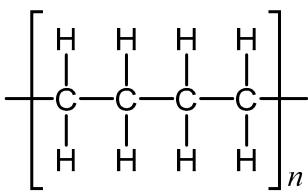
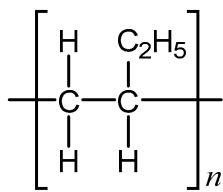
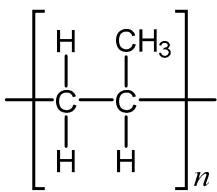
Which of the following represents the structure of the addition polymer formed from but-1-ene?
A
B
C
D
E
F
A
B
C
D
E
F
- A.The repeating unit is .
- B.The repeating unit is .
- C.The repeating unit is .
- D.The structure shown is a polymer chain of four repeating units of ethene.
- E.The repeating unit is .
- F.The repeating unit is .
Question 43
The chart shows the relative abundances of the isotopes of an element. The chart shows the following data points: (relative mass 64, relative abundance 4), (relative mass 66, relative abundance 3), (relative mass 68, relative abundance 2).
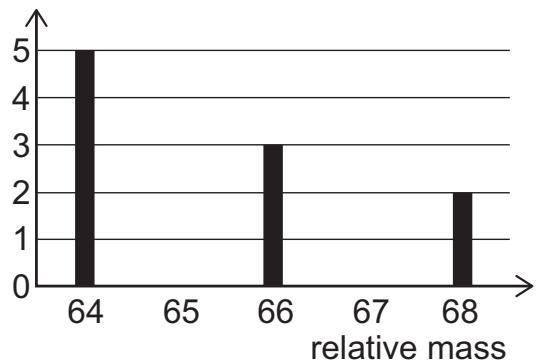
What is the relative atomic mass () of this element?
What is the relative atomic mass () of this element?
- A.64.0
- B.65.4
- C.65.8
- D.66.0
- E.66.6
Question 44
In this question, all solutions have the same concentration in .
Three separate experiments were set up using the same volume of each solution:
experiment 1: and
experiment 2: and
experiment 3: and
For each experiment, the solid formed was filtered, washed, dried, and weighed.
Which of the following statements is/are correct?
1 Experiment 3 forms the greatest mass of solid.
2 Experiment 3 has a noticeably greater rate of reaction than the others.
3 The reaction taking place in each experiment is a redox reaction.
Three separate experiments were set up using the same volume of each solution:
experiment 1: and
experiment 2: and
experiment 3: and
For each experiment, the solid formed was filtered, washed, dried, and weighed.
Which of the following statements is/are correct?
1 Experiment 3 forms the greatest mass of solid.
2 Experiment 3 has a noticeably greater rate of reaction than the others.
3 The reaction taking place in each experiment is a redox reaction.
- A.none of them
- B.1 only
- C.2 only
- D.3 only
- E.1 and 2 only
- F.1 and 3 only
- G.2 and 3 only
- H.1, 2 and 3
Question 45
How many moles of ions are present in of magnesium nitrate solution?
(Ignore ions produced by dissociation of water.)
(Ignore ions produced by dissociation of water.)
- A.0.003 mol
- B.0.006 mol
- C.0.009 mol
- D.0.018 mol
- E.0.133 mol
- F.0.400 mol
Question 46
Silicon is directly below carbon in the Periodic Table and has a melting point of 1414 °C.
Which of the following statements explains why silicon has a high melting point?
Which of the following statements explains why silicon has a high melting point?
- A.It forms ions with a charge of 4+.
- B.Its structure is a giant ionic lattice.
- C.It has a strong attraction between positive nuclei and delocalised electrons.
- D.It has strong intermolecular forces.
- E.Covalent bonds are broken on melting.
Question 47
Atoms of element Q have two full shells of electrons and the third shell requires one more electron to gain a noble gas configuration.
Which row of the table correctly describes the elements near to Q in the Periodic Table?
Which row of the table correctly describes the elements near to Q in the Periodic Table?
- A.Above Q: requires one more electron to fill a second shell of electrons. Below Q: gains an electron less favourably than Q. Left of Q: the atom contains one fewer proton than Q. Right of Q: is very unreactive compared to Q.
- B.Above Q: gains an electron more favourably than Q. Below Q: the atom contains more protons than Q. Left of Q: is found in Period 3. Right of Q: is a halogen.
- C.Above Q: requires one more electron to fill a second shell of electrons. Below Q: gains an electron less favourably than Q. Left of Q: is an alkaline earth metal. Right of Q: the atom contains one more proton than Q.
- D.Above Q: is found in Period 3. Below Q: contains an extra full shell of electrons compared to Q. Left of Q: the atom contains one fewer proton than Q. Right of Q: is very unreactive compared to Q.
- E.Above Q: gains an electron more favourably than Q. Below Q: the atom contains more protons than Q. Left of Q: the atom has an atomic number greater than Q. Right of Q: is found in Period 3.
Question 48
A simple ion of an element has a mass number , an atomic number and a charge of -1.
How many protons, neutrons and electrons are present in this ion?
How many protons, neutrons and electrons are present in this ion?
- A.protons: , neutrons: , electrons:
- B.protons: , neutrons: , electrons:
- C.protons: , neutrons: , electrons:
- D.protons: , neutrons: , electrons:
- E.protons: , neutrons: , electrons:
- F.protons: , neutrons: , electrons:
Question 49
Titanium metal can be extracted from titanium(IV) chloride, .
Titanium(IV) chloride is heated to 1000 °C with either sodium or magnesium metal in an atmosphere of argon.
Which one of the following statements is correct?
( values: Na = 23; Mg = 24; Cl = 35.5; Ti = 48)
Titanium(IV) chloride is heated to 1000 °C with either sodium or magnesium metal in an atmosphere of argon.
Which one of the following statements is correct?
( values: Na = 23; Mg = 24; Cl = 35.5; Ti = 48)
- A.A greater mass of magnesium chloride than sodium chloride is produced for each tonne of titanium made.
- B.The atmosphere of argon is used as a catalyst.
- C.In each reaction equation, the ratio of the reacting metal to titanium(IV) chloride is the same.
- D.Titanium is a weaker oxidising agent than either sodium or magnesium.
- E.A smaller mass of magnesium than sodium is required to produce 500 kg of titanium.
Question 50
Ethene gas and hydrogen gas react to form ethane gas.
The energy change for this reaction is -150 kJ .
Using the provided data, what is the mean C-H bond energy?
(Bond energy data: H-H = 430 kJ ; C-C = 350 kJ ; C=C = 600 kJ )
The energy change for this reaction is -150 kJ .
Using the provided data, what is the mean C-H bond energy?
(Bond energy data: H-H = 430 kJ ; C-C = 350 kJ ; C=C = 600 kJ )
- A.115 kJ
- B.200 kJ
- C.230 kJ
- D.265 kJ
- E.400 kJ
- F.415 kJ
- G.465 kJ
- H.830 kJ
Question 51
A water treatment unit processes of drinking water each day.
0.4 mg of chlorine gas is used to kill the bacteria in of the source water.
What volume of chlorine gas, if measured at room temperature and pressure, is used each day at the water treatment unit?
( value: Cl = 35.5. Assume that one mole of a gas occupies at room temperature and pressure.)
0.4 mg of chlorine gas is used to kill the bacteria in of the source water.
What volume of chlorine gas, if measured at room temperature and pressure, is used each day at the water treatment unit?
( value: Cl = 35.5. Assume that one mole of a gas occupies at room temperature and pressure.)
- A.
- B.
- C.
- D.
- E.
- F.
Question 52
Element X is in Group 13, Period 4. It consists of atoms of two isotopes with mass numbers 69 and 71. The relative atomic mass of element X is 69.7.
Which of the following statements is/are correct about element X?
1 75% of the atoms of element X have mass number 69.
2 An atom of element X has three electrons in its outer shell.
3 Element X forms an oxide with formula that reacts with acids.
Which of the following statements is/are correct about element X?
1 75% of the atoms of element X have mass number 69.
2 An atom of element X has three electrons in its outer shell.
3 Element X forms an oxide with formula that reacts with acids.
- A.none of them
- B.1 only
- C.2 only
- D.3 only
- E.1 and 2 only
- F.1 and 3 only
- G.2 and 3 only
- H.1, 2 and 3
Question 53
One mole of copper reacts completely with an excess of concentrated nitric acid.
A gaseous oxide of nitrogen is one of the products of the reaction. The volume of this gas is when measured at room temperature and pressure.
The oxidation state of the nitrogen in the gaseous oxide is one less than the oxidation state of the nitrogen in the nitric acid.
Which of the following could be the equation for this reaction?
(Assume that one mole of any gas occupies at room temperature and pressure.)
A gaseous oxide of nitrogen is one of the products of the reaction. The volume of this gas is when measured at room temperature and pressure.
The oxidation state of the nitrogen in the gaseous oxide is one less than the oxidation state of the nitrogen in the nitric acid.
Which of the following could be the equation for this reaction?
(Assume that one mole of any gas occupies at room temperature and pressure.)
- A.
- B.
- C.
- D.
- E.
- F.
- G.
Question 54
Two experiments were carried out using separate samples of a solution of an acid of concentration () and the following observations were made.
• of the acid solution exactly neutralised of sodium hydroxide solution.
• Bubbles of gas were given off when magnesium ribbon was added to the acid solution.
Which of the following statements can be deduced from this information?
1 It is a monoprotic acid.
2 It is a strong acid.
3 The acid has a relative molar mass () of 90.
• of the acid solution exactly neutralised of sodium hydroxide solution.
• Bubbles of gas were given off when magnesium ribbon was added to the acid solution.
Which of the following statements can be deduced from this information?
1 It is a monoprotic acid.
2 It is a strong acid.
3 The acid has a relative molar mass () of 90.
- A.none of them
- B.1 only
- C.2 only
- D.3 only
- E.1 and 2 only
- F.1 and 3 only
- G.2 and 3 only
- H.1, 2 and 3
Question 55
When methanol is burned in the apparatus shown it gives out . However, only 80% of the energy released is transferred into the water.
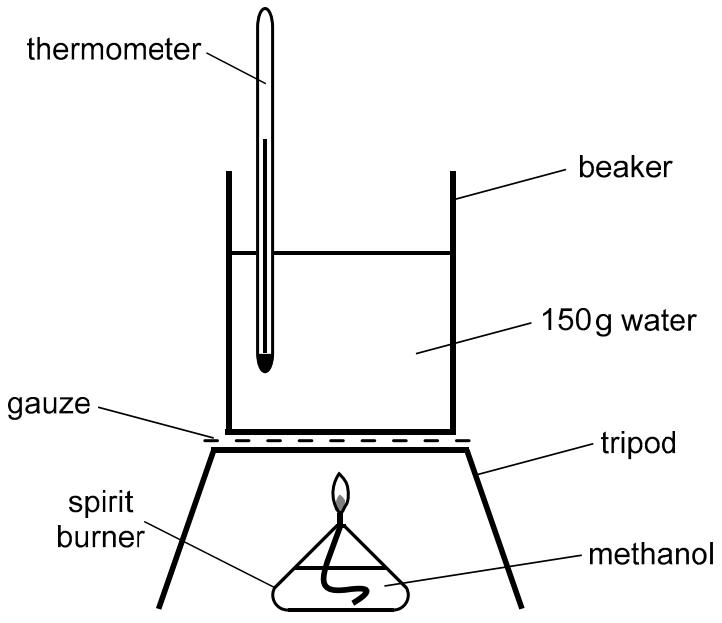
The starting temperature of the water is 12°C.
What mass of methanol would need to be burned to give a 60°C temperature rise in the water?
( value: methanol = 32. Assume that the specific heat capacity of water = )
The starting temperature of the water is 12°C.
What mass of methanol would need to be burned to give a 60°C temperature rise in the water?
( value: methanol = 32. Assume that the specific heat capacity of water = )
- A.1.28 g
- B.1.60 g
- C.1.92 g
- D.2.00 g
- E.2.40 g
Question 56
A student electroplates a solid metal ball with copper.
The student dissolves 80.0 g of anhydrous copper(II) sulfate in water and makes up the solution to exactly to use as the electrolyte.
Two electrodes are placed in this solution. One electrode is the ball to be electroplated and the other electrode is an inert graphite electrode. The electrodes are connected to a battery.
After some time, the ball is removed and is found to be coated with 8.00 g of copper. Water is added to the remaining solution to give a final volume of exactly .
What is the final concentration of the copper(II) ions in solution?
( values: O = 16; S = 32; Cu = 64)
The student dissolves 80.0 g of anhydrous copper(II) sulfate in water and makes up the solution to exactly to use as the electrolyte.
Two electrodes are placed in this solution. One electrode is the ball to be electroplated and the other electrode is an inert graphite electrode. The electrodes are connected to a battery.
After some time, the ball is removed and is found to be coated with 8.00 g of copper. Water is added to the remaining solution to give a final volume of exactly .
What is the final concentration of the copper(II) ions in solution?
( values: O = 16; S = 32; Cu = 64)
- A.
- B.
- C.
- D.
- E.
- F.
- G.
Question 57
The structure of cyclohexa-1,4-diene is:
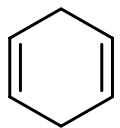
Bromine is dissolved in inert organic solvent to form of bromine solution.
What is the minimum volume of this bromine solution required to react completely with of cyclohexa-1,4-diene?
( value: cyclohexa-1,4-diene = 80. Density of cyclohexa-1,4-diene = )
Bromine is dissolved in inert organic solvent to form of bromine solution.
What is the minimum volume of this bromine solution required to react completely with of cyclohexa-1,4-diene?
( value: cyclohexa-1,4-diene = 80. Density of cyclohexa-1,4-diene = )
- A.
- B.
- C.
- D.
- E.
- F.
- G.
- H.
Question 58
The relative tendency for metals to form positive ions in solution can be measured using the following apparatus:
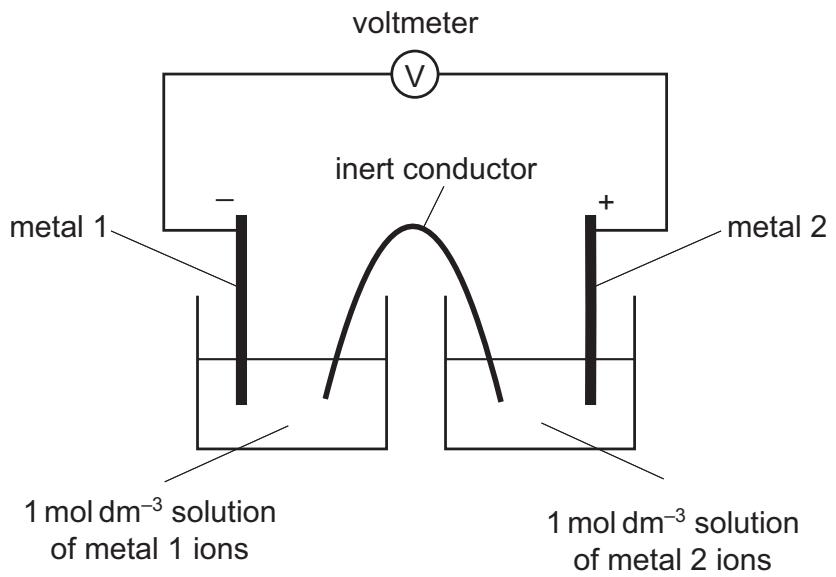
Electrons can pass from metal 1 to metal 2 via the external circuit. The difference in the tendency of the metals to form positive ions is given by the reading on the voltmeter. The higher the reading on the voltmeter the greater the difference in the tendency of the pair of metals to form positive ions.
Results from three experiments are given in the following table.
| experiment | metal 1 | metal 2 | reading on voltmeter / V |
|---|---|---|---|
| 1 | P | Q | +0.62 |
| 2 | S | Q | +0.30 |
| 3 | S | R | +1.24 |
Using the information in the table, what is the order of reactivity of the four metals P, Q, R and S, from most reactive to least reactive?
Electrons can pass from metal 1 to metal 2 via the external circuit. The difference in the tendency of the metals to form positive ions is given by the reading on the voltmeter. The higher the reading on the voltmeter the greater the difference in the tendency of the pair of metals to form positive ions.
Results from three experiments are given in the following table.
| experiment | metal 1 | metal 2 | reading on voltmeter / V |
|---|---|---|---|
| 1 | P | Q | +0.62 |
| 2 | S | Q | +0.30 |
| 3 | S | R | +1.24 |
Using the information in the table, what is the order of reactivity of the four metals P, Q, R and S, from most reactive to least reactive?
- A.P, Q, R, S
- B.P, Q, S, R
- C.P, S, Q, R
- D.P, S, R, Q
- E.S, P, Q, R
- F.S, P, R, Q
- G.S, R, Q, P
- H.S, R, P, Q
Question 59
A sample of aluminium ore (bauxite) contains 75.0% by mass of hydrated aluminium oxide.
Hydrated aluminium oxide is one mole of aluminium oxide combined with two moles of water.
What is the minimum mass of this sample of bauxite that is required to produce 108 tonnes of aluminium?
(1 tonne = . values: H = 1; O = 16; Al = 27)
Hydrated aluminium oxide is one mole of aluminium oxide combined with two moles of water.
What is the minimum mass of this sample of bauxite that is required to produce 108 tonnes of aluminium?
(1 tonne = . values: H = 1; O = 16; Al = 27)
- A.184 tonnes
- B.207 tonnes
- C.272 tonnes
- D.276 tonnes
- E.368 tonnes
- F.421 tonnes
- G.592 tonnes
- H.736 tonnes
Question 60
Equal amounts of carbon dioxide and carbon monoxide are produced when 2.0 mol of propanol, , are reacted with a limited supply of oxygen. Water is the only other product in this reaction.
How many moles of oxygen molecules are used in this reaction?
How many moles of oxygen molecules are used in this reaction?
- A.3.5 mol
- B.7.0 mol
- C.7.5 mol
- D.8.5 mol
- E.15 mol
- F.17 mol