Mapped to the ESAT specification
NSAA 2023 Physics Part B
20 questions20 marksUpdated June 2026
Natural Sciences Admissions Assessment 2023 is one of the closest available past papers for the Engineering and Science Admissions Test. Below, all 20 questions are mapped to the ESAT topics they test, each with its answer. Sit it cold under exam timing, then work back through anything you missed using the solutions.
What this paper covers on the ESAT
Every question mapped to the Engineering and Science Admissions Test specification, so you know exactly which areas it tests.
Mathematics 1
- Algebra (7)
Physics
- Waves (5)
- Electricity (4)
Questions and answers are free. Full step-by-step worked solutions unlock with a free account. Start practising.
Question 21
1 markAn object has mass and weight on the Moon. The Moon has no atmosphere.
The object is released from rest at height above the surface of the Moon.
Which expression gives the speed of the object as it reaches the surface?
The object is released from rest at height above the surface of the Moon.
Which expression gives the speed of the object as it reaches the surface?
- A.
- B.
- C.
- D.
- E.
- F.
- G.
- H.
Answer: G
Question 22
1 markA spaceship of mass 10000 kg is moving at 2.0 ms⁻¹ relative to a space station.
The spaceship is captured by a robotic arm attached to the space station and brought to rest by a force of 1000 N.
How far will the spaceship move in its initial direction relative to the space station while the force is being applied?
(Assume that the acceleration of the space station is negligible.)
The spaceship is captured by a robotic arm attached to the space station and brought to rest by a force of 1000 N.
How far will the spaceship move in its initial direction relative to the space station while the force is being applied?
(Assume that the acceleration of the space station is negligible.)
- A.0.050 m
- B.0.10 m
- C.0.20 m
- D.5.0 m
- E.10 m
- F.20 m
Answer: F
Question 23
1 markA heater is connected in series with a dc power supply, a variable resistor and an ammeter in the circuit shown.
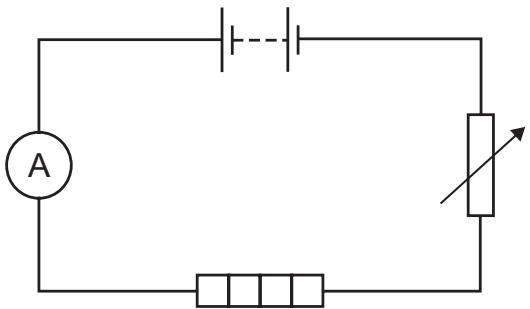
The variable resistor is adjusted until the reading on the ammeter is 0.50 A and the resistance of the heater is 8.0.
How much energy is converted to thermal energy in 5.0 minutes?
The variable resistor is adjusted until the reading on the ammeter is 0.50 A and the resistance of the heater is 8.0.
How much energy is converted to thermal energy in 5.0 minutes?
- A.10 J
- B.40 J
- C.160 J
- D.600 J
- E.2400 J
- F.9600 J
Answer: D
Question 24
1 markA circuit is set up as shown. All three resistors are identical.
When the switch is open, the reading on the ammeter is 1.0 A and the power transferred from the battery is 1.0 W.
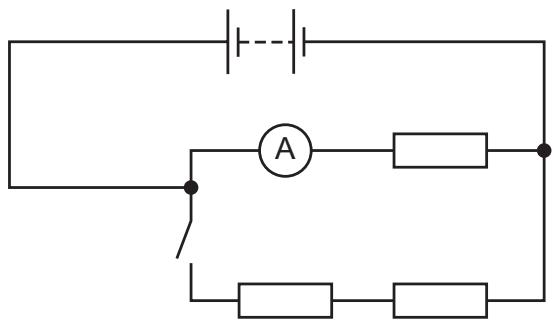
The switch is now closed.
What is the new reading on the ammeter and what is the new power transferred from the battery?
When the switch is open, the reading on the ammeter is 1.0 A and the power transferred from the battery is 1.0 W.
The switch is now closed.
What is the new reading on the ammeter and what is the new power transferred from the battery?
- A.ammeter reading: 0.67 A, power transferred: 0.67 W
- B.ammeter reading: 0.67 A, power transferred: 1.3 W
- C.ammeter reading: 0.67 A, power transferred: 1.5 W
- D.ammeter reading: 0.67 A, power transferred: 2.0 W
- E.ammeter reading: 1.0 A, power transferred: 1.0 W
- F.ammeter reading: 1.0 A, power transferred: 1.5 W
- G.ammeter reading: 1.0 A, power transferred: 2.0 W
- H.ammeter reading: 1.0 A, power transferred: 3.0 W
Answer: F
Question 25
1 markA car travels for a total time of 20 s. For the first seconds its speed is 5.0 ms⁻¹ and for the remainder of the journey its speed is 10 ms⁻¹.
The average speed for the whole journey is 8.5 ms⁻¹.
What is the value of ?
The average speed for the whole journey is 8.5 ms⁻¹.
What is the value of ?
- A.3.0
- B.6.0
- C.10
- D.17
- E.
- F.
Answer: B
Question 26
1 markA spring is initially unstretched. A force is used to stretch the spring. The extension and the energy stored in the stretched spring are measured for different values of .
The graph shows how the energy , in J, varies with the extension squared, , in cm².
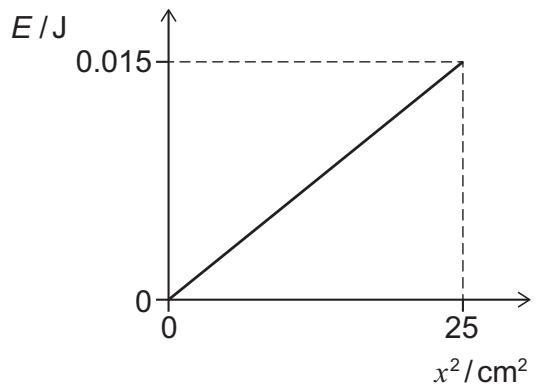
What is the magnitude of when the spring stores 0.015 J of energy?
The graph shows how the energy , in J, varies with the extension squared, , in cm².
What is the magnitude of when the spring stores 0.015 J of energy?
- A.0.30 N
- B.0.60 N
- C.1.2 N
- D.1.5 N
- E.2.4 N
- F.3.0 N
- G.30 N
- H.60 N
Answer: B
Question 27
1 markThe nuclide symbol for helium-3 is He.
A nuclide of element X has double the nuclear charge and four times the mass of helium-3.
This nuclide of X decays by a single beta () emission to form a nuclide of element Z.
What is the nuclide symbol for this nuclide of Z?
A nuclide of element X has double the nuclear charge and four times the mass of helium-3.
This nuclide of X decays by a single beta () emission to form a nuclide of element Z.
What is the nuclide symbol for this nuclide of Z?
- A.Z
- B.Z
- C.Z
- D.Z
- E.Z
- F.Z
- G.Z
- H.Z
Answer: E
Question 28
1 markA solid, cylindrical metal bar has a uniform cross-sectional area of 12 cm² and a volume of 180 cm³.
The bar rests on a horizontal surface on one of its circular faces.
The pressure on the surface due to the bar is 0.45 N cm⁻².
What is the density of the metal, in g cm⁻³?
(gravitational field strength = 10 N kg⁻¹)
The bar rests on a horizontal surface on one of its circular faces.
The pressure on the surface due to the bar is 0.45 N cm⁻².
What is the density of the metal, in g cm⁻³?
(gravitational field strength = 10 N kg⁻¹)
- A.2.5 g cm⁻³
- B.3.0 g cm⁻³
- C.3.75 g cm⁻³
- D.7.5 g cm⁻³
- E.15 g cm⁻³
- F.33 g cm⁻³
Answer: B
Question 29
1 markA ray of light is directed horizontally towards two long, plane mirrors X and Y which are both at 45° to the horizontal. After two reflections the ray is travelling horizontally again.
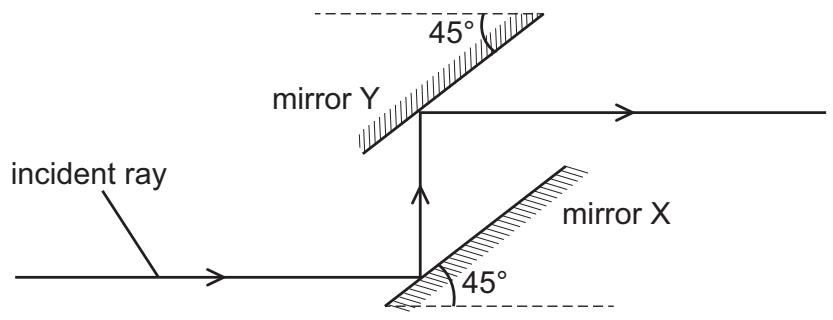
Mirror X is now rotated clockwise through less than 45°. After this rotation, mirror X makes an angle with the horizontal, where . The direction of the incident ray is unchanged.
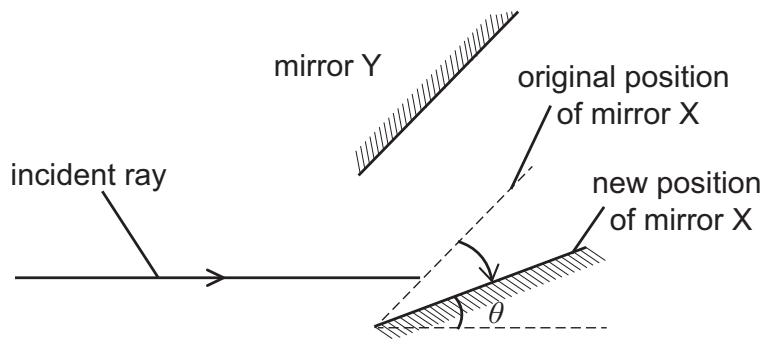
In what direction and through what angle should mirror Y be rotated in order for the ray to be still horizontal and travelling to the right after reflecting from mirror Y?
Mirror X is now rotated clockwise through less than 45°. After this rotation, mirror X makes an angle with the horizontal, where . The direction of the incident ray is unchanged.
In what direction and through what angle should mirror Y be rotated in order for the ray to be still horizontal and travelling to the right after reflecting from mirror Y?
- A.clockwise through an angle
- B.anticlockwise through an angle
- C.clockwise through an angle
- D.anticlockwise through an angle
- E.clockwise through an angle
- F.anticlockwise through an angle
Answer: E
Question 30
1 markTwo samples of pure radioactive isotopes X and Y decay with half-lives of 2 days and 3 days, respectively.
Both X and Y decay in a single step into different stable isotopes.
Initially the number of atoms of X is twice the number of atoms of Y.
After how many days are the expected numbers of atoms of X and Y equal to each other?
Both X and Y decay in a single step into different stable isotopes.
Initially the number of atoms of X is twice the number of atoms of Y.
After how many days are the expected numbers of atoms of X and Y equal to each other?
- A.The expected numbers of atoms of X and Y are never equal.
- B.2 days
- C.3 days
- D.4 days
- E.6 days
- F.12 days
Answer: E
Question 31
1 markTwo stones are held at rest at the same height at the top of a cliff.
One stone is released and falls freely under gravity.
A time later, the other stone is released and falls freely under gravity.
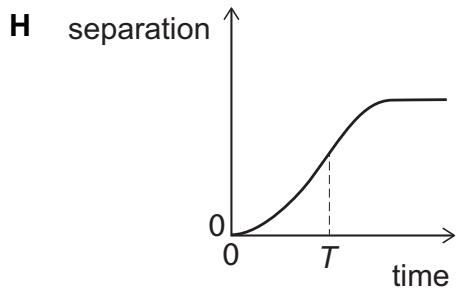
Which graph shows how the vertical distance separating the stones varies with time, from the moment the first stone is released and before the first stone lands?
(Assume that air resistance is negligible.)
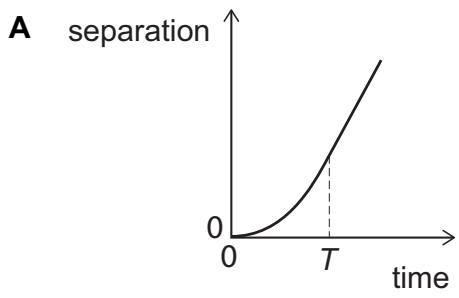
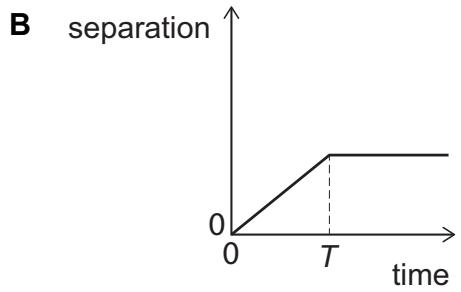
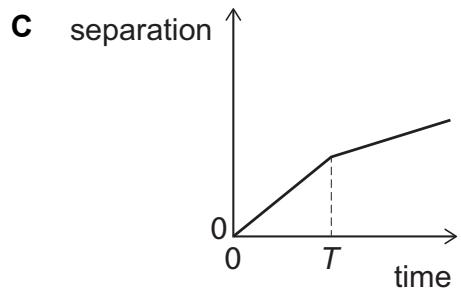
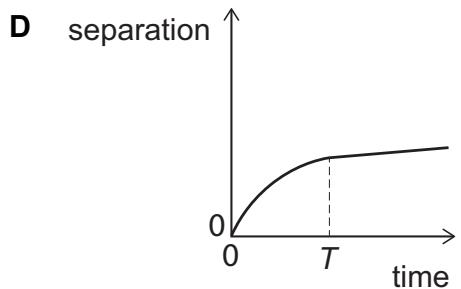
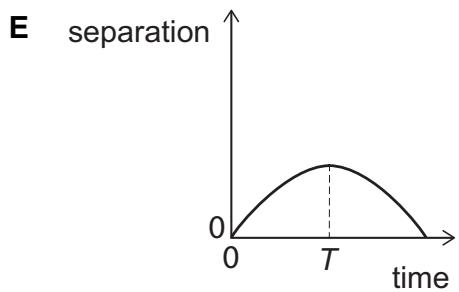
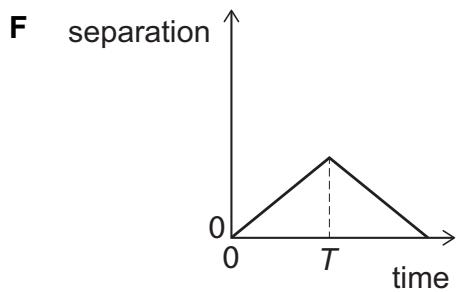
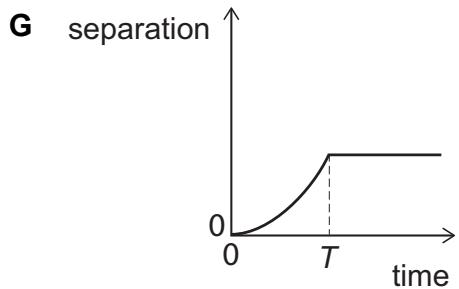
One stone is released and falls freely under gravity.
A time later, the other stone is released and falls freely under gravity.
Which graph shows how the vertical distance separating the stones varies with time, from the moment the first stone is released and before the first stone lands?
(Assume that air resistance is negligible.)
- A.[Graph of separation vs time: linearly increasing from t=0 to t=T, then curving upwards with increasing gradient.]
- B.[Graph of separation vs time: zero from t=0 to t=T, then increasing linearly.]
- C.[Graph of separation vs time: zero from t=0 to t=T, then curving upwards with increasing gradient.]
- D.[Graph of separation vs time: zero from t=0 to t=T, then curving upwards but with decreasing gradient.]
- E.[Graph of separation vs time: parabolic curve from the origin, peaking at t=T, then decreasing.]
- F.[Graph of separation vs time: linearly increasing from origin to a peak at t=T, then linearly decreasing.]
- G.[Graph of separation vs time: zero from t=0 to t=T, then increasing linearly, then becoming horizontal (constant).]
- H.[Graph of separation vs time: zero from t=0 to t=T, then increasing with an S-shaped curve.]
Answer: A
Question 32
1 markA large, flat, metal plate is coated on one side with a layer of thermally insulating material of the same thickness as the metal plate.
The uninsulated top surface of the metal plate is maintained at a constant temperature .
The bottom surface of the insulating material is maintained at a constant, lower temperature .
The system is in equilibrium.
The diagram shows this arrangement.
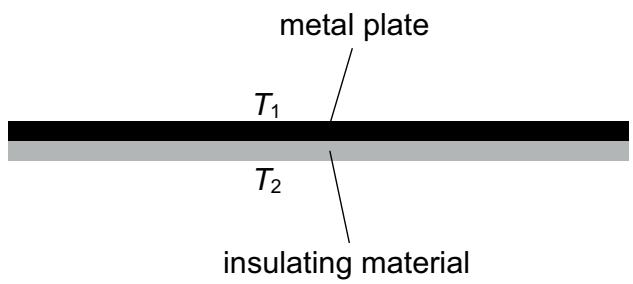
Which graph could show how the temperature varies with distance from the top surface of the metal plate to the bottom surface of the insulating material?
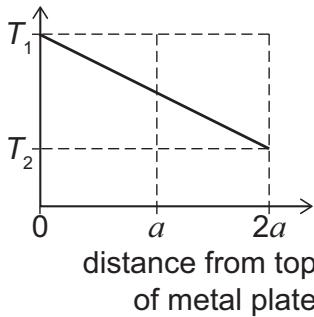
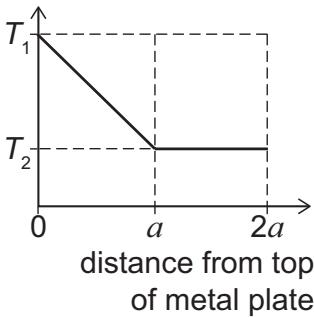
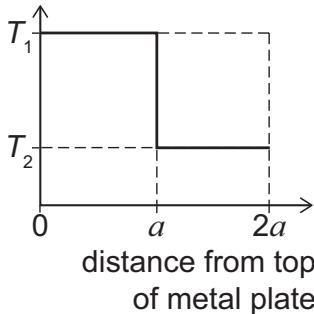
The uninsulated top surface of the metal plate is maintained at a constant temperature .
The bottom surface of the insulating material is maintained at a constant, lower temperature .
The system is in equilibrium.
The diagram shows this arrangement.
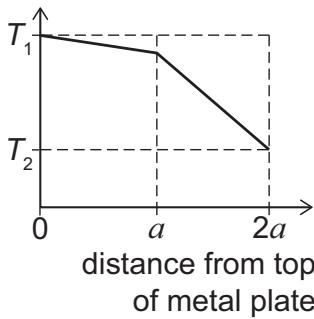
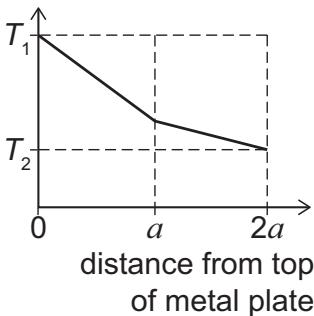
Which graph could show how the temperature varies with distance from the top surface of the metal plate to the bottom surface of the insulating material?
- A.[Graph of temperature vs distance: a small linear drop in temperature from T1 over the distance 0 to a, followed by a large linear drop to T2 over the distance a to 2a.]
- B.[Graph of temperature vs distance: a large linear drop in temperature from T1 over the distance 0 to a, followed by a small linear drop to T2 over the distance a to 2a.]
- C.[Graph of temperature vs distance: a single straight line showing a linear drop from T1 at distance 0 to T2 at distance 2a.]
- D.[Graph of temperature vs distance: temperature is constant at T1 from distance 0 to a, then a linear drop to T2 over the distance a to 2a.]
- E.[Graph of temperature vs distance: temperature is constant at T1 from distance 0 to a, then a vertical drop to T2 at distance a, and then constant at T2 until 2a.]
Answer: A
Question 33
1 mark10g of ice at 0°C is added to 20g of liquid water at 30 °C.
The mixture reaches thermal equilibrium.
What is its equilibrium temperature, ?
(specific latent heat of fusion of ice = 330 Jg⁻¹
specific heat capacity of liquid water = 4.2 Jg⁻¹°C⁻¹
assume that there is no heat transfer between the mixture and its surroundings)
The mixture reaches thermal equilibrium.
What is its equilibrium temperature, ?
(specific latent heat of fusion of ice = 330 Jg⁻¹
specific heat capacity of liquid water = 4.2 Jg⁻¹°C⁻¹
assume that there is no heat transfer between the mixture and its surroundings)
- A.
- B.
- C.
- D.
- E.
- F.
- G.
Answer: B
Question 34
1 markThe voltage output of a power station is stepped up using a transformer before the power is transmitted to a distant town. The primary coil of this transformer has 300 turns and the secondary coil has 1500 turns.
In the town, a step-down transformer reduces the voltage supplied by the transmission cables to 33 000 V for distribution within the town. The step-down transformer supplies a current of 1500 A.
The current in the transmission cables is 450 A and both transformers are ideal and 100% efficient.
What is the voltage output of the power station?
(Assume that the resistance of the transmission cables is negligible.)
In the town, a step-down transformer reduces the voltage supplied by the transmission cables to 33 000 V for distribution within the town. The step-down transformer supplies a current of 1500 A.
The current in the transmission cables is 450 A and both transformers are ideal and 100% efficient.
What is the voltage output of the power station?
(Assume that the resistance of the transmission cables is negligible.)
- A.1980 V
- B.6600 V
- C.22 000 V
- D.110 000 V
- E.550 000 V
Answer: C
Question 35
1 markA physicist introduces a thin piece of glass into the path of a laser beam in order to delay the beam. The light of the laser beam has a single wavelength in air.
While the beam is inside the glass it completes 10 more complete oscillations compared to the same beam passing through the same thickness of air.
The speed of light in air is and the speed of light in glass is .
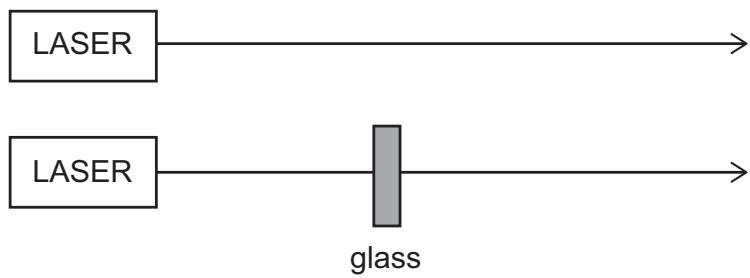
What is the thickness of the glass?
While the beam is inside the glass it completes 10 more complete oscillations compared to the same beam passing through the same thickness of air.
The speed of light in air is and the speed of light in glass is .
What is the thickness of the glass?
- A.6.7
- B.10
- C.13
- D.15
- E.20
- F.30
Answer: E
Question 36
1 markA transverse wave with an amplitude of 3.0 cm travels along a stretched string. The wave has a frequency of 12 Hz and a wavelength of 0.25 m.
What is the average speed of a particle in the string as the string oscillates during a time of 2.0 s?
What is the average speed of a particle in the string as the string oscillates during a time of 2.0 s?
- A.36 cm s⁻¹
- B.72 cm s⁻¹
- C.125 cm s⁻¹
- D.144 cm s⁻¹
- E.300 cm s⁻¹
Answer: D
Question 37
1 markA copper ring, with a small gap XY, rests in a uniform horizontal magnetic field. The ring lies in the plane of the page and the direction of the magnetic field is horizontal from left to right, as shown in the diagram.
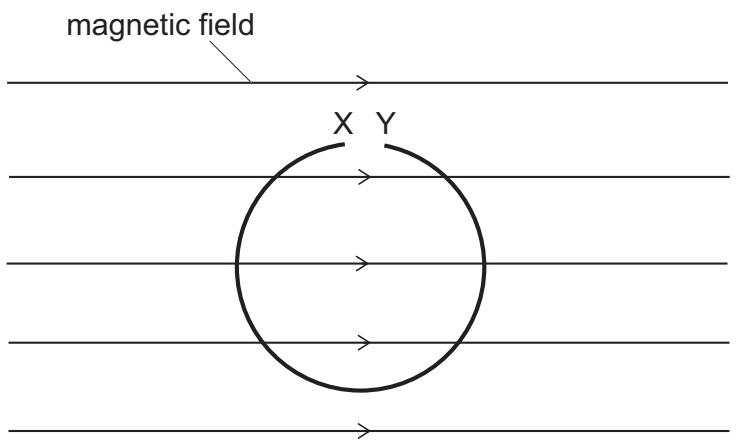
A voltage is now applied across XY, such that X is connected to the positive terminal of the power supply and Y is connected to the negative terminal.
Which statement describes the motion of the ring immediately after the voltage is applied?
(Assume that the mechanism supporting the ring allows the ring to move freely and allows the voltage to be applied continuously.)
A voltage is now applied across XY, such that X is connected to the positive terminal of the power supply and Y is connected to the negative terminal.
Which statement describes the motion of the ring immediately after the voltage is applied?
(Assume that the mechanism supporting the ring allows the ring to move freely and allows the voltage to be applied continuously.)
- A.The ring moves towards the bottom of the page.
- B.The ring moves towards the top of the page.
- C.The ring moves towards the left of the page.
- D.The ring moves towards the right of the page.
- E.The ring rotates about an axis perpendicular to the plane of the page in a clockwise direction.
- F.The ring rotates about an axis perpendicular to the plane of the page in an anti-clockwise direction.
- G.The ring rotates about an axis that is in the plane of the page and parallel to the field.
- H.The ring rotates about an axis that is in the plane of the page and perpendicular to the field.
Answer: H
Question 38
1 markA battery and two resistors X and Y are connected in series.
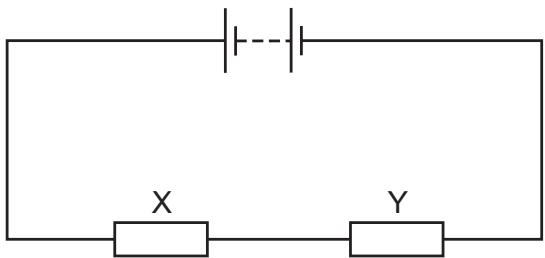
The power transferred by the battery is 6 W.
The resistance of X is 10 .
The voltage across Y is 4 V.
What is the current in the circuit?
The power transferred by the battery is 6 W.
The resistance of X is 10 .
The voltage across Y is 4 V.
What is the current in the circuit?
- A. A
- B. A
- C. A
- D.1 A
- E. A
- F. A
Answer: B
Question 39
1 markA cubic block of wood of side length floats in water with the top face of the block horizontal and above the surface.
The block is displaced downwards by a small distance without becoming fully submerged, and then released.
The density of the wood is 0.80 g cm⁻³ and the density of water is 1.0 g cm⁻³.
What is the initial acceleration of the block after it is released?
(gravitational field strength = 10 N kg⁻¹)
The block is displaced downwards by a small distance without becoming fully submerged, and then released.
The density of the wood is 0.80 g cm⁻³ and the density of water is 1.0 g cm⁻³.
What is the initial acceleration of the block after it is released?
(gravitational field strength = 10 N kg⁻¹)
- A.0.80 ms⁻²
- B.1.0 ms⁻²
- C.1.25 ms⁻²
- D.1.80 ms⁻²
- E.8.0 ms⁻²
- F.11.0 ms⁻²
Answer: C
Question 40
1 markA diver at the bottom of a lake of depth fills a syringe with an ideal gas and seals the nozzle. The piston remains free to move. The volume of the gas in the syringe at the bottom of the lake is 90 cm³.
As the diver returns to the surface, the temperature of the gas does not change. At the surface of the lake the gas in the syringe is at atmospheric pressure and the volume of the gas is 720 cm³.
What is the volume of the gas in the syringe at a depth ?
As the diver returns to the surface, the temperature of the gas does not change. At the surface of the lake the gas in the syringe is at atmospheric pressure and the volume of the gas is 720 cm³.
What is the volume of the gas in the syringe at a depth ?
- A.160 cm³
- B.180 cm³
- C.206 cm³
- D.225 cm³
- E.288 cm³
- F.315 cm³
- G.360 cm³
- H.405 cm³
Answer: A