Coordinates in Four Quadrants for the ESAT
Updated July 2026
Working with coordinates in all four quadrants is a fundamental skill for ESAT Mathematics 1, enabling the precise location of points and shapes on a plane. This topic covers the definition of axes, the origin, and the use of ordered pairs to solve geometric problems involving polygons in both positive and negative regions.
The Cartesian coordinate system uses two perpendicular axes, the horizontal -axis and the vertical -axis, to define the position of points using the notation relative to their intersection at the origin .
Understanding the Coordinate Axes
The coordinate axes, and , provide a standardized method for locating any point within a two dimensional plane. These two lines are perpendicular to one another and intersect at a central point known as the origin. The coordinates of the origin are .
The axes divide the plane into four distinct regions called quadrants. The orientation of these axes is as follows:
- The -axis is typically the horizontal axis. Numbers to the right of the origin are positive, while numbers to the left of the origin are negative.
- The -axis is typically the vertical axis. Numbers above the origin are positive, while numbers below the origin are negative.
To identify a specific point, we use an ordered pair of numbers contained within brackets and separated by a comma. The coordinate always appears first, followed by the coordinate. This is written as .
Consider the diagram below, which illustrates how points are positioned across the four quadrants:
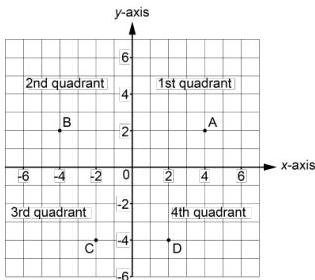
In this diagram, we can identify the coordinates of four specific points:
Point A is located at . It is 4 units to the right and 2 units up. Point B is located at . It is 4 units to the left and 2 units up. Point C is located at . It is 2 units to the left and 4 units down. Point D is located at . It is 2 units to the right and 4 units down.
Solving Geometric Problems with Coordinates
Coordinate geometry allows us to determine the properties of shapes based on the positions of their vertices. By calculating distances between and values, we can find side lengths and the coordinates of missing points.
Worked Example: Identifying Vertices of a Square
A square ABCD is drawn on a coordinate plane. We are given the following information: Point A is . Point B is . Point C lies in the 4th quadrant. Point D lies in the 3rd quadrant.
What are the coordinates of C and D?
Step 1: Determine the length of the side of the square. To find the length of side AB, we look at the difference between their coordinates, since their coordinates are the same (both are 4). Point A is 6 units to the left of the origin and point B is 3 units to the right of the origin. Therefore, the distance between them is units. Since ABCD is a square, every side must have a length of 9 units.
Step 2: Locate point C. Point C must be 9 units away from point B. Since B is at and C must lie in the 4th quadrant (where values are negative), we move 9 units downwards from B. The coordinate remains 3, and the coordinate becomes . Thus, C is at .
Step 3: Locate point D. Point D must be 9 units away from point A. Since A is at and D must lie in the 3rd quadrant (where both and values are negative), we move 9 units downwards from A. The coordinate remains -6, and the coordinate becomes . Thus, D is at .
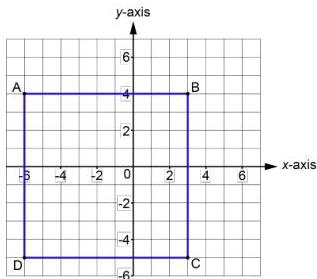
By following this logic, we have successfully identified the coordinates for all vertices while ensuring they satisfy the quadrant requirements specified in the problem.
Key takeaways
- Always state the coordinate before the coordinate in the format .
- The -axis is horizontal (positive right, negative left) and the -axis is vertical (positive up, negative down).
- The origin is the intersection of the two axes and has the coordinates .
- Horizontal distance is the difference between values: vertical distance is the difference between values.
When solving problems involving shapes, always draw a quick sketch of the four quadrants. This helps you verify if your calculated coordinates actually land in the required quadrant.
A frequent error is reversing the order of the coordinates. Remember the alphabetical order: comes before , just as horizontal movement is considered before vertical movement.
The coordinate system is the bridge between algebra and geometry. It allows geometric properties, such as the side length of a square, to be calculated using simple arithmetic on the vertex coordinates.
Frequently asked questions
What are the signs of the coordinates in each quadrant?
In the first quadrant, both and are positive. In the second quadrant, is negative and is positive. In the third quadrant, both and are negative. In the fourth quadrant, is positive and is negative.
How do I calculate the distance between two points on the same horizontal line?
If two points have the same coordinate, the distance between them is the absolute difference of their coordinates, calculated as .
What does it mean if a coordinate is zero?
If the coordinate is 0, the point lies on the -axis. If the coordinate is 0, the point lies on the -axis.
Can coordinates be non-integers?
Yes, coordinates can be any real number, including decimals and fractions, to represent any location on the continuous plane.