Operations with Integers Decimals and Fractions
Updated July 2026
Mastering the four operations across integers, decimals, and fractions is vital for ESAT Mathematics 1. This guide covers place value, column arithmetic, and fraction manipulation. Understanding these fundamentals ensures accuracy in complex multi-step problems, particularly when handling positive and negative values or mixed numbers in a non-calculator environment.
Mathematical fluency requires applying addition, subtraction, multiplication, and division to varied number formats by aligning place values for decimals and finding common denominators or reciprocals for fractions.
Place value
To perform arithmetic accurately, you must understand and use place value for both integers and decimals. Each place value is a factor of different from its immediate neighbour. For instance, hundreds multiplied by are thousands. The following table illustrates standard place values:
| millions | hundred thousands | ten thousands | thousands | hundreds | tens | units | decimal point | tenths | hundredths | thousandths |
Example: Identifying place value
By placing numbers in the table, we can identify the value of specific digits:
- The in represents hundreds.
- The in represents hundredths.
- The in represents thousandths.
Addition and subtraction of integers and decimals
To add or subtract, numbers must be aligned according to their place value. Line up the decimal points vertically to ensure digits of the same value are in the same column.
Example: Addition of decimals
Calculate
Fill any blanks with zeros. In addition, start from the rightmost column. For , the is moved (carried) to the next column as hundredths, which equals tenth.
| tens () | units () | tenths () | hundredths () | thousandths () | |
|---|---|---|---|---|---|
Example: Subtraction of decimals
Calculate
Filling blanks with zeros is critical here. Start from the right. Since cannot be taken from , convert one hundredth into thousandths. . Then, subtract from and from . For the units, since cannot be taken from , convert one ten into units, giving . Finally, .
| tens () | units () | tenths () | hundredths () | thousandths () | |
|---|---|---|---|---|---|
| (from ) | (from ) | ||||
Addition and subtraction of fractions
To add or subtract fractions, they must have a common denominator. For mixed numbers, you can process the integer and fractional parts separately.
Example: Addition of fractions
Find . The lowest common multiple (LCM) of and is .
and
Sum:
Example: Subtraction of fractions
Find . Convert the mixed number: . Using the LCM of and , we get .
Multiplication of integers and decimals
Place value is key in multiplication. There are three primary methods.
Method 1: Formal column multiplication
To calculate , write the numbers in columns. First, multiply by units (carrying hundreds and tens). Then, multiply by by placing a in the units column and multiplying by . Finally, add the results: .
Method 2: Boxes (partitioning)
Split into and into . Multiply every part and sum the results:
| Total | |||
|---|---|---|---|
| Total |
Method 3: Bones
This method uses diagonal lines to sum products of individual digits. Multiply the digits relating to each box, writing the answer as two digits (e.g., ). Sum the diagonals starting from the bottom right.
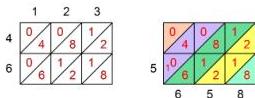
Example: Multiplication of decimals
To calculate , first calculate . Since and , the final answer must be divided by . Thus, . Always estimate to check: , confirming our answer is reasonable.
Division of integers and decimals
In a division, the dividend is the number being divided, the divisor is the number you divide by, and the quotient is the result. For example, in , is the dividend, is the divisor, and is the quotient.
Example: Division of integers (Bus stop method)
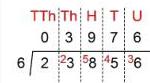
Calculate . Place the dividend under the 'bus stop' and the divisor to the left.
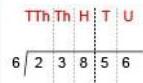
- remainder . Carry the to the next column ().
- remainder . Carry the ().
- remainder . Carry the ().
- remainder . Carry the ().
- .
The quotient is .
Example: Division of decimals
Calculate . To divide by a decimal, multiply both the dividend and divisor by the same power of until the divisor is an integer. .
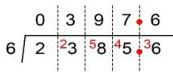
Performing the division gives . Check with an approximation: .
Multiplication of fractions
To multiply fractions, convert mixed numbers to improper fractions, then multiply numerators and denominators independently.
Example: . Multiplying directly gives . Alternatively, simplify before multiplying by dividing the top and bottom by , and the top and bottom by , yielding .
Example: . Simplifying before multiplying ( and ) results in .
Division of fractions
To divide fractions, invert the divisor (the second fraction) and multiply. Convert mixed numbers to improper fractions first.
Example 1: .
Example 2: .
Key takeaways
- Align numbers by place value for addition and subtraction, using zeros as placeholders in decimals.
- Always convert mixed numbers to improper fractions before attempting multiplication or division.
- To divide by a decimal, scale both the dividend and divisor by the same power of 10 to make the divisor an integer.
- Simplify fractions before multiplying to make mental calculations easier and reduce errors.
Use estimation to verify your answers. For example, if multiplying by , rounding to helps you immediately spot if your decimal point is misplaced in the final answer.
In subtraction, failing to fill blank decimal places with zeros often leads to errors. For , you must treat the thousandths place in as and borrow accordingly.
The four operations on fractions and decimals are essentially the same underlying place value logic. Common denominators in fractions perform a similar function to aligning decimal points; both ensure you are adding or subtracting quantities of the same magnitude.
Frequently asked questions
Why must the divisor be an integer when performing long division with decimals?
It is much easier to divide by a whole number. Since is equivalent to the fraction , multiplying both by the same power of (like ) preserves the value of the result while simplifying the operation.
Can I add mixed numbers without converting them to improper fractions?
Yes, you can add the whole numbers and the fractions separately. However, if the fractional part sums to more than , you must carry the extra whole number over to the integer sum.
How do I handle negative fractions in these operations?
Apply the standard rules for signs: adding a negative is subtraction, and multiplying or dividing two negatives results in a positive. Perform the fraction arithmetic using absolute values first, then apply the correct sign.