Factors and Prime Factorisation for ESAT Mathematics 1
Updated July 2026
This topic explores the fundamental properties of integers, including factors, multiples, and prime numbers. It covers the systematic methods for finding highest common factors and lowest common multiples using prime factorisation. Understanding the Unique Factorisation Theorem is essential for solving complex arithmetic problems without a calculator.
Every integer greater than 1 can be expressed as a unique product of prime numbers, a principle known as the Unique Factorisation Theorem. This prime factorisation serves as a mathematical signature used to calculate factors, multiples, and roots efficiently.
Multiples and Common Multiples
A multiple of a number is any value that appears in that number's times table. When two or more numbers share a multiple, it is called a common multiple. The lowest common multiple, or LCM, is the smallest positive integer that is divisible by all the numbers in a given set.
Example: Finding common multiples
Find the first three common multiples of 6 and 8.
Multiples of 6 are 6, 12, 18, 24, 30, 36, 42, 48, 54, 60, 66, 72...
Multiples of 8 are 8, 16, 24, 32, 40, 48, 56, 64, 72, 80, 88, 96...
By comparing these lists, we find that the common multiples of 6 and 8 are 24, 48, 72...
Factors and Common Factors
A factor, also referred to as a divisor, is a number that divides into another number exactly, leaving no remainder. A common factor is a number that divides exactly into two or more specified numbers. The highest common factor, or HCF, is the largest integer that is a factor of every number in the set.
Example: Finding common factors of two or more numbers
Find all the common factors of 12 and 18.
Factors of 12 are 1, 2, 3, 4, 6 and 12.
Factors of 18 are 1, 2, 3, 6, 9 and 18.
The common factors, which appear in both lists, are 1, 2, 3 and 6.
Prime Numbers and Prime Factorisation
Prime numbers are integers that possess exactly two distinct factors: 1 and the number itself. Prime factorisation is the process of writing an integer as a product of prime numbers. The Unique Factorisation Theorem states that every integer greater than 1 has a unique prime factorisation, regardless of the order in which the factors are written.
Divisibility Tests
These tests are helpful for identifying factors quickly:
- A number is divisible by 2 if its last digit is even.
- A number is divisible by 3 if the sum of its digits is divisible by 3.
- A number is divisible by 4 if the last two digits form a number divisible by 4.
- A number is divisible by 5 if the last digit is 0 or 5.
- A number is divisible by 6 if it is divisible by both 2 and 3.
- For divisibility by 7, subtract twice the last digit from the remaining digits and check if the result is divisible by 7. For example, for 546, calculate . Since 42 is a multiple of 7, 546 is divisible by 7.
- A number is divisible by 8 if the last three digits form a number divisible by 8.
- A number is divisible by 9 if the sum of its digits is divisible by 9.
Example: Deciding if a number is prime
Is 153 a prime number?
Using the divisibility test for 3, we add the digits: . Since 9 is divisible by 3, 153 is divisible by 3. This means 153 has factors other than 1 and itself (specifically 1, 3, and 153). Therefore, 153 is not prime. When checking for primality, always test prime divisors in increasing order.
Characteristics of Prime Numbers
There are ten prime numbers less than 30: 2, 3, 5, 7, 11, 13, 17, 19, 23, and 29. Note that 1 is not a prime number because it only has one factor. The number 2 is the only even prime number. Excluding 2 and 5, all other prime numbers must end in 1, 3, 7, or 9.
Methods for Prime Factorisation
Example: Writing the prime factorisation in index form
Write 180 as a product of its prime factors using index notation.
Method 1: Division Table
Start by dividing by the smallest possible prime and continue until the result is a prime number.
So, .
Method 2: Factor Tree
Break the number into branches where the two numbers multiply to the value above. Circle prime numbers to terminate a branch.
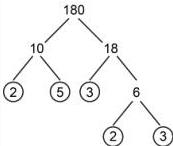
Both methods yield the same result: .
Finding HCF and LCM using Prime Factorisation
Example: Finding HCF and LCM for two numbers
Find the HCF and LCM of 180 and 420.
First, find the prime factorisations:
Place these factors into a Venn diagram:
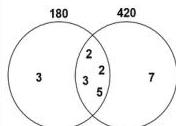
The HCF is the product of the primes in the intersection: .
The LCM is the product of all primes shown in the diagram: .
Verification: and . The product of the two numbers equals the product of their HCF and LCM.
Example: Finding HCF and LCM for three numbers
Find the HCF and LCM of 180, 168 and 72.
Prime factorisations:
To find the HCF, identify factors common to all three lists: .
To find the LCM, identify the maximum number of times each prime factor appears in any single factorisation. The LCM must contain three 2s, two 3s, one 5, and one 7.
.
Further Applications
Proving a number is a factor
Show that 210 is a factor of 3780.
Because all the prime factors of 210 are contained within the prime factorisation of 3780, 210 is a factor.
Solving problems with prime numbers
Sarah writes a 2-digit number, reverses the digits, and subtracts the new number from the original. Can her answer be prime?
Let the tens digit be and the units digit be . The original number is and the reversed number is . The difference is:
If , the result is a multiple of 9, which cannot be prime. If , the result is negative, which is also not prime. Therefore, the answer can never be prime.
Finding square roots of large numbers
Given , find without a calculator.
We can split the prime factors into two identical groups:
.
Key takeaways
- A prime number has exactly two factors, 1 and itself, meaning 1 is not a prime number.
- The Unique Factorisation Theorem ensures every integer greater than 1 has a single unique set of prime factors.
- The HCF is found by taking the lowest power of each common prime factor, while the LCM is found by taking the highest power of every prime factor present.
- The relationship can be used to verify calculations for two numbers.
In the ESAT, you will not have a calculator. Memorising the divisibility rules for 3, 7, and 9 is vital for quickly simplifying large fractions or identifying prime numbers in multiple-choice questions.
Be careful when finding the LCM. Students often mistakenly multiply all the factors together without accounting for commonality, which results in a multiple that is much larger than the lowest common multiple.
The relationship between HCF and LCM is linked to the way prime factors 'overlap'. The HCF represents the intersection of the sets of prime factors, while the LCM represents the union. This is why their product equals the product of the original numbers.
Frequently asked questions
Why is 1 not considered a prime number?
By definition, a prime number must have exactly two distinct factors: 1 and itself. Since 1 has only one factor (1), it does not meet this criterion.
Can there be more than one even prime number?
No, 2 is the only even prime number. Any other even number is divisible by 2, meaning it would have at least three factors: 1, 2, and the number itself.
How do you find the LCM of three numbers using prime factorisation?
List the prime factorisations of all three numbers. For each distinct prime factor that appears, take the highest power found in any of the individual factorisations. Multiply these highest powers together to get the LCM.
What is the fastest way to check if a number is divisible by 6?
Check two conditions: the number must be even (divisible by 2) and the sum of its digits must be divisible by 3.