Decimals Percentages and Fractions for the ESAT
Updated July 2026
This guide covers the essential techniques for converting between fractions, decimals, and percentages for ESAT Mathematics 1. You will learn to identify terminating and recurring decimals and transform them into precise fractional representations. Mastering these conversions is vital for comparing numerical values and performing efficient calculations during the exam.
Fractions, decimals, and percentages are interchangeable forms used to describe proportions. A decimal terminates if its simplified denominator has only 2 and 5 as prime factors: otherwise, it becomes a recurring decimal with an infinite, repeating pattern of digits.
Definitions and Principles
Fractions, decimals, and percentages are all mathematical tools used to describe a proportion of a whole, a number, or a group. Understanding the relationship between them is fundamental for numerical reasoning.
A terminating decimal is a decimal that contains a finite number of digits.
A recurring decimal contains digits or patterns of digits that repeat infinitely. To identify which type a fraction will produce, simplify the fraction to its lowest terms and examine the prime factors of the denominator. If the only prime factors are and/or , the decimal will be terminating. If there are any other prime factors, the decimal will be recurring.
Converting Between Mixed Numbers and Improper Fractions
To convert a mixed number to an improper fraction, you must transform the integer part into a fraction with the same denominator as the fractional part, then sum them.
Example: Write as an improper fraction.
To convert an improper fraction into a mixed number, divide the numerator by the denominator. The quotient is the whole number, and the remainder is placed over the original denominator.
Example: Write as a mixed number.
Divide the numerator by the denominator: remainder .
This gives the mixed number .
Cancelling and Equivalent Fractions
To cancel a fraction to its lowest terms, divide both the numerator and the denominator by their highest common factor (HCF). Alternatively, use prime factorisation.
Example: Cancel to its lowest terms.
Method 1: Prime Factorisation
Method 2: Repeated Division
You can also cancel by dividing by smaller common factors such as or until no further simplification is possible.
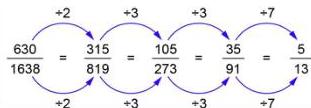
Equivalent fractions are found by multiplying or dividing the numerator and denominator by the same non-zero value. This allows you to find unknown values within equivalent ratios.
Example: Find the value of where
You can determine the scale factor required to convert to :
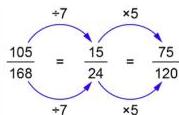
This gives . Alternatively, use cross-multiplication: , which leads to .
Converting Fractions to Decimals
There are two main methods to convert a fraction into a decimal: using powers of or using division.
- Denominator as a power of 10: If possible, use equivalent fractions to make the denominator etc.
Example: Convert to a decimal.
- Short Division: Divide the numerator by the denominator.
Example: Convert to a decimal.
Using short division: into gives .
Converting Between Decimals and Percentages
To convert a decimal to a percentage, multiply by and add the percentage symbol. To convert a percentage to a decimal, divide by .
Example: Convert to a decimal.
Example: Convert to a percentage.
Converting Terminating Decimals to Fractions
Identify the place value of the final digit to determine the denominator. Use the digits as the numerator and then simplify.
Example: Convert to a fraction in its lowest terms.
The digit is in the thousandths column, so the denominator is .
Converting Fractions to Recurring Decimals
Fractions with denominators like or are easily converted. For others, use division.
Example: Convert to a recurring decimal.
Example: Convert to a recurring decimal.
Divide numerator and denominator by : .
Using division: into gives . Note that after the first , the remainder is always , leading to an infinite string of s.
Converting Recurring Decimals to Fractions
Use an algebraic method to eliminate the recurring part.
Example: Convert to a fraction in its lowest terms.
Let . Since two digits recur, multiply by (which is ):
Subtracting the two equations: .
Example: Convert to a fraction in its lowest terms.
Let . Multiply by to shift the decimal:
Subtract from :
Ordering Fractions, Decimals, and Percentages
To order different forms, convert them all into a single consistent form, usually decimals.
Example: Write in ascending order:
Comparing these values: .
Thus, the ascending order is: .
Key takeaways
- A fraction simplifies to a terminating decimal if and only if the prime factors of its denominator are only 2 and 5.
- To convert a recurring decimal to a fraction, multiply by where is the number of recurring digits, then subtract the original value.
- When comparing or ordering values, converting all numbers to decimals is generally the most reliable and efficient method.
- Mixed numbers must be converted to improper fractions before most multiplication or division operations.
- Place value columns (tenths, hundredths, thousandths) determine the denominator when converting terminating decimals to fractions.
In the ESAT, time is limited. Memorise common fraction to decimal conversions such as eighths () and elevenths () to speed up comparison questions.
When subtracting decimals algebraically to find a fraction, ensure the recurring parts align perfectly. If they do not, you will not eliminate the infinite tail, and the subtraction will fail.
The denominator of a fully simplified recurring decimal always involves prime factors other than 2 or 5. This is because our base 10 number system is built on : any fraction whose denominator does not ‘fit’ into a power of 10 will never terminate.
Frequently asked questions
How do I know whether to multiply by 10, 100, or 1000 when converting a recurring decimal?
You multiply by where is the length of the repeating pattern. For , multiply by . For , multiply by . This ensures the digits after the decimal point align perfectly for subtraction.
What happens if a fraction is not in its lowest terms when I check the denominator's prime factors?
You must simplify the fraction to its lowest terms first. For example, might look like it would recur because has a factor of , but it simplifies to , which is , a terminating decimal.
Can every recurring decimal be written as a fraction?
Yes, any decimal that eventually repeats a pattern can be expressed as a rational number (a fraction). Only non-terminating, non-repeating decimals (irrational numbers like or ) cannot be written as fractions.
Is it faster to use division or equivalent fractions for conversion?
If the denominator is a factor of a power of 10 (like 2, 4, 5, 8, 20, 25, 40, 50), using equivalent fractions is usually faster. For more complex denominators like 7, 13, or 17, short division is necessary.