Scale Factors Diagrams and Maps for ESAT
Updated July 2026
This lesson covers the application of scale factors to similar shapes, scale drawings, and maps for ESAT Mathematics 1. You will learn to identify linear multipliers between similar figures and perform precise unit conversions for real-world map scales. Understanding these proportional relationships is vital for solving geometric and spatial problems in the exam.
A scale factor is a constant multiplier used to calculate the lengths of corresponding sides in mathematically similar shapes. If shape is a scale version of shape , every side length in is found by multiplying the equivalent side length in by the scale factor .
Similar Shapes and Scale Factor
When two shapes are mathematically similar, the lengths of the sides of one shape are directly proportional to the lengths of the corresponding sides of the other. We can determine the side lengths of one shape from another by multiplying each original length by a constant known as the scale factor.
Consider the diagram below showing three similar triangles. The first triangle serves as the base with side lengths , , and . The other two triangles are related to it by constants and , which are the scale factors.
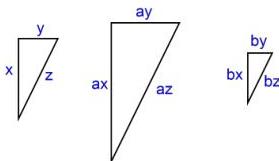
A scale factor can be greater than 1 or less than 1. In this specific diagram, , indicating an enlargement, while , indicating a reduction.
Enlargements and Scale Factor Calculations
In an enlargement, every dimension is increased by the same multiplier. We can see this in the relationship between Trapezium A and Trapezium B, where Trapezium B is an enlargement of Trapezium A with a scale factor of 3.
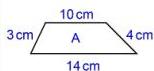
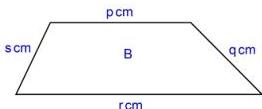
To find the missing values , , , and on Trapezium B, we multiply each corresponding length on Trapezium A by the scale factor 3:
Scale Diagrams
A scale diagram is a representation of an object or drawing that is mathematically similar to the original, though usually smaller. In the triangle examples discussed previously, each triangle is effectively a scale drawing of the others.
When working with scale diagrams, we often need to determine the scale factor by comparing known corresponding sides. Consider the following figures where Figure B is a scale drawing of Figure A.
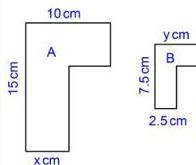
We can see that the base of Figure B is , while the corresponding base of Figure A is . Since is half of , the scale factor from A to B is .
To find the missing values and :
- The length corresponds to the length on Figure A. Therefore, .
- The length on Figure B corresponds to the length on Figure A. Since , we find by multiplying by 2, giving .
Maps and Ratio Scales
A map is a specific type of scale diagram. Its scale is frequently expressed as a ratio. For instance, if on a map represents in reality, we can write the scale as represents or as a unitless ratio . This is because .
Worked Example: Map to Real Life
A map of a village uses a scale of . If the distance from a bank to a post office on the map is , what is the actual distance in metres?
- First, calculate the distance in centimetres: .
- Next, convert centimetres to metres. Since there are in a metre: .
Worked Example: Real Life to Map
Using the same map scale of , if the actual distance between a supermarket and a bank is , what is this distance in millimetres on the map?
- First, convert the real distance to centimetres: .
- Divide the real distance by the scale factor to find the map distance: .
- Finally, convert centimetres to millimetres. Since there are in : .
Key takeaways
- Mathematically similar shapes have corresponding side lengths related by a constant multiplier called the scale factor.
- A scale factor results in an enlargement, while results in a reduction of the shape.
- Map scales are often written as ratios , where one unit on the map represents units in the real world.
- Always convert units carefully, noting that and .
When working with map ratios, convert everything into the smallest unit mentioned in the question (like millimetres) before doing your final division or multiplication to avoid decimal errors.
A common mistake is forgetting to use the same units on both sides of a ratio. A scale of does not mean is , it means is .
Scale factors are linear. While this topic focuses on lengths, it is the foundation for understanding how area changes by and volume changes by in similar solids.
Frequently asked questions
How do you find the scale factor if you have the lengths of two corresponding sides?
Divide the length of the side on the new shape by the length of the corresponding side on the original shape. Scale factor .
What is the unitless ratio for a map scale where 1 cm represents 2 km?
Since , the ratio is .
Does the scale factor apply to the angles of similar shapes?
No, the angles in similar shapes remain identical. Only the side lengths are multiplied by the scale factor.
If I am moving from a real distance to a map distance, do I multiply or divide?
You divide the real distance by the scale ratio . For a scale of , you divide the real distance by to find the map distance.