Algebraic Manipulation for the ESAT
Updated July 2026
This lesson covers the fundamental algebraic techniques required for ESAT Mathematics 1, including collecting like terms, expansion, and factorisation. Mastering these operations is essential for simplifying complex expressions and solving equations. You will learn how to handle single brackets, multiple binomials, and identify highest common factors efficiently.
Algebraic expressions are manipulated by combining terms with identical variable components and powers, or by using the distributive law to expand and factorise expressions.
Understanding Like Terms
In algebra, like terms are terms that are identical in their variable parts and powers, though their numerical constant multipliers may differ. For example, and are like terms because the variable components match perfectly. Similarly, and are like terms.
However, and are not like terms because the powers of are different. Likewise, and are not like terms. Only like terms can be collected and combined through addition and subtraction.
Collecting Like Terms
To simplify an expression, we group the like terms together. Consider the following expression:
To simplify this, identify and group the terms based on their variables and powers:
- terms:
- terms:
- terms:
- terms:
- terms:
Combining these results, the expression becomes:
While this is mathematically correct, it is standard practice to rearrange the result either in alphabetical order with the highest index first:
Or by listing terms with the highest indices first regardless of the variable:
Multiplying a Single Term Over a Bracket
You can multiply a single term over a bracket by multiplying every term inside the bracket by the term outside. This follows the rule .
Example: Multiply out
Method 1: Direct Multiplication
Multiply each term inside the bracket by :
Result:
Method 2: Grid Method
A grid can help ensure no terms are missed:
| × | +2p | -5q | +6r |
|---|---|---|---|
| -3p | -6p^2 | +15pq | -18pr |
Taking Out Common Factors
Factorising is the reverse of expanding. Common factors are factors that appear in every term of an expression.
Example: Factorise
Method 1: Systematic Division
- Numbers: The highest common factor (HCF) of 6, 15, and 21 is 3.
- Variables: Identify variables present in all terms. Here, and appear in all three, but does not appear in the final term.
- Powers: Take the lowest power of each shared variable that appears across all terms. For , this is . For , this is (or ).
- Common Factor: The overall common factor is .
Now, divide every original term by :
Final factorised form:
Method 2: Full Expansion
Write out terms in full to see shared components:
Combining these gives:
Expanding Products of Two Binomials
To expand , every term in the first bracket must be multiplied by every term in the second.
Method 1: FOIL or Arrow Diagrams
You can visualise the multiplication using arrows:
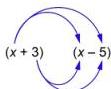
This gives , which simplifies to .
Another way to visualise this is:
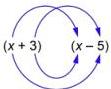
This gives .
Method 2: Splitting the Multiplication
Method 3: Grid Method
This is often the safest method for longer expressions:
| × | +3 | |
|---|---|---|
| +3x | ||
| -5 | -5x | -15 |
Expanding Products of More Than Two Binomials
Example: Multiply
First, multiply the first two brackets (as solved in the previous section):
Then, multiply this result by the remaining bracket:
Method 1: Splitting
Recall that :
Method 2: Grid
| × | |||
|---|---|---|---|
Key takeaways
- Like terms must have the exact same variables raised to the exact same powers to be combined.
- The distributive law requires multiplying the external term by every individual term inside a bracket.
- Factorisation requires identifying the highest common factor for numerical coefficients and the lowest power of shared variables.
- When expanding three or more binomials, calculate the product of two brackets first, then multiply that result by the next bracket.
For long algebraic expansions in the ESAT, always use the grid method. It creates a visual checklist that ensures you have multiplied every combination of terms and makes it much easier to spot errors in negative signs.
Be careful when factorising expressions where one term is the common factor itself. For example, in , the factorised form is . Students often forget the , which is essential to preserve the original expression's value.
Expanding and factorising are inverse operations. You can always verify your factorisation by expanding your answer; if you do not return to the original expression, a mistake was made during the division of coefficients or subtraction of indices.
Frequently asked questions
Can I combine and if they have the same coefficient?
No. Even if coefficients are identical, terms are only like terms if the powers are the same. and represent different dimensions or growth rates and cannot be added together into a single term.
Does the order of brackets matter when expanding multiple binomials?
No. Multiplication is commutative, so you can multiply the brackets in any order. However, it is usually easiest to multiply two brackets together first and then multiply the resulting quadratic by the remaining linear bracket.
What is the most common mistake when expanding a negative term over a bracket?
The most frequent error is failing to change the sign of the second or third terms inside the bracket. For example, is , not .