Factorising Quadratic Expressions for the ESAT
Updated July 2026
Factorising quadratic expressions is a fundamental requirement for ESAT Mathematics 1. This topic involves rewriting trinomials and binomials as products of linear factors. Proficiency in this area is necessary for solving quadratic equations, simplifying complex algebraic fractions, and identifying key features of quadratic graphs such as intercepts.
To factorise a quadratic expression is to write it as a product of two linear factors. For an expression , this involves finding coefficients , and such that .
Factorising expressions of the form
Many quadratic expressions of the form can be written as the product of two linear expressions with integer coefficients, formatted as . In this structure, the relationships between the coefficients are defined by and . This means that and are two numbers whose product equals the constant term and whose sum equals the linear coefficient .
For example, to factorise , we identify two numbers that multiply to 6 and add to 5. These numbers are 3 and 2, which gives us the factorisation .
Worked Example:
To factorise , we seek two numbers and such that and . By checking factor pairs of 72, we find that 8 and 9 satisfy both conditions because and . Therefore, .
Worked Example:
In the expression , the linear coefficient is -1 and the constant term is -72. We need two numbers whose product is -72 and whose sum is -1. The numbers are -9 and +8. Thus, .
The Difference of Two Squares:
Quadratic expressions consisting of one squared term subtracted from another are known as the difference of two squares. These always factorise according to the pattern .
Worked Example:
There are two ways to approach this factorisation:
- Treat it as a standard quadratic: . We need two numbers with a product of -16 and a sum of 0. These are +4 and -4, leading to .
- Use the difference of two squares identity: Since , we immediately write .
Worked Example:
Even if the constant is not a perfect square, we can still use this method by using square roots. Because , we can factorise the expression as .
Factorising expressions of the form
When the coefficient of is not 1, the expression can be expressed as . Here, the coefficients must satisfy , , and .
Worked Example:
Method 1: Systematic Trial
If , we expand the right side to get . We must find such that and such that , while ensuring . Because all terms are positive, we only need to consider positive factors.
Pairs for include (6,1), (1,6), (2,3), and (3,2). Pairs for include (1,20), (20,1), (2,10), (10,2), (4,5), and (5,4). By testing combinations, we find that when , and , the middle term is . The correct factorisation is .
Method 2: Splitting the Middle Term
First, multiply the coefficient of by the constant term: . Now find two numbers that multiply to 120 and add to the linear coefficient, 23.
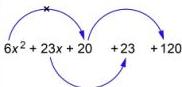
The numbers are +15 and +8. We split into and factorise by grouping:
Since is a common factor, we get .
Worked Example:
Using the splitting method, we multiply . We need two numbers that multiply to -42 and add to -1.
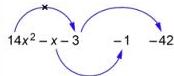
These numbers are -7 and +6. Split the middle term and factorise:
Note that when factorising the second pair, the negative sign outside the bracket is treated as -1. This results in .
The Difference of Two Squares:
This pattern extends to cases where the term has a coefficient. The general rule is .
Worked Example:
We identify the square roots of both terms: and . Using the identity, we get .
Key takeaways
- To factorise , find two integers that add to and multiply to .
- The difference of two squares identity is vital for simplifying expressions and occurs frequently in ESAT questions.
- For , the method of splitting the middle term requires finding factors of that sum to .
- Always check factorisations by expanding the brackets to verify the original expression is recovered.
When using the splitting the middle term method, it does not matter which order you place the two new terms. For example, and will both lead to the same final factorised result.
Be careful when factorising by grouping if the second pair of terms starts with a minus sign. For example, in , you must factor out -1 to get . A common error is failing to change the sign inside the bracket.
Factorising a quadratic expression is equivalent to finding the roots of the equation . If an expression factorises as , then and are the intercepts of the graph .
Frequently asked questions
What should I do if the constant term in a quadratic is negative?
If the constant term is negative, one of your factors ( or ) must be positive and the other must be negative. The factor with the larger absolute value will take the sign of the linear coefficient .
Does every quadratic expression factorise into integers?
No, not all quadratics factorise with integer coefficients. For the ESAT, if an expression does not factorise easily, you may need to use the quadratic formula or complete the square instead.
How do I factorise a difference of squares involving a non-perfect square like ?
You can still use the difference of two squares identity by treating the constant as the square of its square root. Thus, .