Roots Intercepts and Turning Points of Quadratic Functions
Updated July 2026
Quadratic functions are fundamental to ESAT Mathematics 1. This topic covers identifying roots, intercepts, and turning points from graphs and algebraic methods like completing the square. Understanding the parabolic shape and how to manipulate the quadratic equation allows for precise analysis of function behaviour and critical points.
A quadratic function forms a parabola where the roots are the x-intercepts, the y-intercept occurs at , and the turning point is found by completing the square to find the maximum or minimum value.
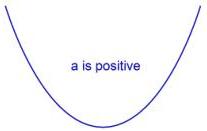
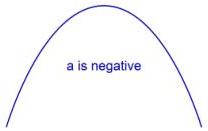
A quadratic function of a variable is defined by the expression , where and represent constants. When plotted on a coordinate plane, the resulting graph is a curve known as a parabola. The orientation of this parabola is determined entirely by the coefficient . If , the parabola opens upwards (a U-shape). If , it opens downwards (an upside-down U-shape).
Roots of quadratic functions graphically
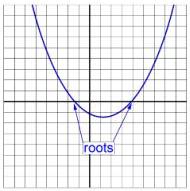
When you plot the graph of , the roots of the function are found at the points where the curve intercepts the x-axis. These roots represent the solutions to the quadratic equation . Depending on the specific function, the graph might cross the x-axis twice, touch it once, or not cross it at all.
Intercepts of quadratic functions
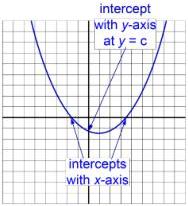
The y-axis intercept of the graph occurs when the value of is zero. Substituting into the equation gives , which simplifies to . On a graph, this is the specific point where the curve crosses the vertical axis.
The x-axis intercepts occur when the value of is zero, meaning we must solve . There can be 0, 1, or 2 intercepts with the x-axis, which can be identified by looking at the points where the curve meets the horizontal axis.
The turning point of quadratic functions
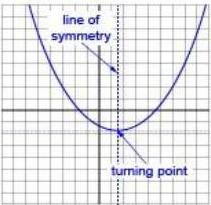
The turning point is the extreme point of the parabola. It is the minimum (lowest point) if the parabola is U-shaped () and the maximum (highest point) if the parabola is an upside-down U-shape (). Every quadratic graph is perfectly symmetric, and the vertical line of symmetry always passes directly through the turning point.
Finding the roots of a quadratic function algebraically
To find the roots of algebraically, you must solve the equation . This involves finding the values of that satisfy , typically through factorisation, the quadratic formula, or completing the square.
Completing the square
Completing the square is a method used to rewrite a quadratic expression. Since , we can rearrange this to show that:
where is a constant. This process expresses the quadratic as a difference of two squares.
Finding the turning point by completing the square
The turning point corresponds to the minimum value of the function if or the maximum value if . By completing the square, we can determine this point precisely. For the general form , we can factor out and complete the square:
To find the turning point, we look for the value of that makes the squared term equal to zero. Because is always greater than or equal to zero, the turning point occurs when , leading to . The corresponding y-coordinate is then .
Worked Example: Roots from a graph
Consider the graph of shown below. We want to find the roots correct to 1 decimal place.
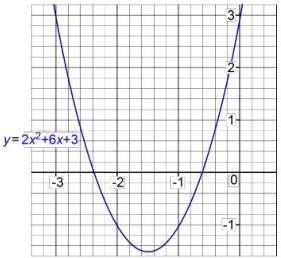
On this scale, 5 small squares represent 1 unit, meaning each small square is units. By observing where the curve crosses the x-axis, we find the roots are at approximately and .
Worked Example: Intercepts
For the function , what is the intercept with the y-axis?
The curve intercepts the y-axis when . Substituting this gives: . Thus, the y-intercept is .
Worked Example: Turning point from a graph
Look at the graph of again to find its turning point.
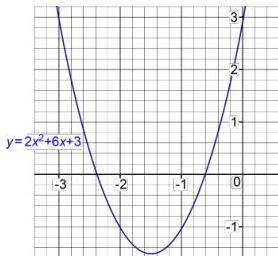
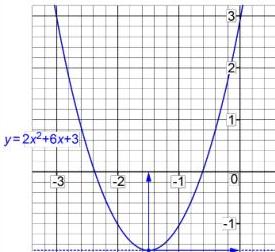
The turning point is the location where the curve is parallel to the x-axis. Reading from the graph, the coordinates are .
Worked Example: Finding roots algebraically
Find the roots of .
Set :
Factorising the quadratic gives:
Setting each factor to zero: or or
Worked Example: Completing the square practice
-
Complete the square for : First, halve the coefficient of to get 2. Since , we have:
-
Complete the square for : Halve to get . Thus:
-
Complete the square for : First, factor out the 2 so the coefficient is 1: Now complete the square for the expression inside the bracket:
Worked Example: Turning points via completing the square
-
Find the turning point for : Complete the square: The turning point occurs when the squared bracket is zero: , so . Substituting this back gives . The turning point is .
-
Find the turning point for : Complete the square: This function reaches its minimum when , which means and .
Key takeaways
- The roots of a quadratic function are the x-coordinates where the graph crosses the x-axis, found by solving .
- The y-intercept of is always the constant term .
- Turning points of a quadratic represent the maximum or minimum and can be identified as if the function is in the form .
- A quadratic graph is always symmetrical about a vertical line passing through its turning point.
When identifying roots or turning points from a graph in the ESAT, always check the scale of the axes carefully. Note how many units each small grid square represents to avoid precision errors.
A common error when completing the square for where is forgetting to multiply the subtracted term by the factor when expanding the brackets.
The turning point coordinate is exactly halfway between the two roots (if they exist). This highlights the perfect symmetry of the quadratic parabola.
Frequently asked questions
Can a quadratic function have no roots?
Yes. If the parabola is entirely above the x-axis (with ) or entirely below the x-axis (with ), it will never cross the axis and therefore has no real roots.
How do you know if a turning point is a maximum or a minimum?
Look at the coefficient of the term. If is positive, the graph is U-shaped and the turning point is a minimum. If is negative, the graph is an upside-down U-shape and the turning point is a maximum.
What is the relationship between factorisation and finding roots?
Factorising a quadratic into the form allows you to identify the roots and directly, as these are the values that make the function equal to zero.