Solving Linear Inequalities for the ESAT
Updated July 2026
This section covers the techniques required to solve linear inequalities in one and two variables. You will learn to manipulate inequality signs correctly, represent solution sets on number lines, and identify feasible regions on coordinate graphs, all of which are essential skills for the ESAT Mathematics 1 paper.
A linear inequality describes a range of possible values rather than a single fixed point, using symbols like or , and its solution set is represented as an interval on a number line or a shaded region on a graph.
Symbols and Labelling Conventions
Inequalities use specific symbols to define ranges of values. When representing these on a number line, the style of circle used indicates whether the boundary value is included in the solution set.
- Less than (): defines points such that can take any value less than 4, but not including 4. On a number line, this is shown with an open circle at 4.
- Greater than (): defines points such that can take any value greater than 4, but not including 4. This is also shown with an open circle at 4.
- Less than or equal to (): includes every value less than 4 and the value 4 itself. This is shown with a solid circle at 4.
- Greater than or equal to (): includes every value greater than 4 and the value 4 itself. This is shown with a solid circle at 4.
Inequalities in Two Variables
When working with two variables, inequalities are represented as shaded regions on a coordinate graph. The boundary is defined by the equivalent linear equation. A dotted line indicates that the boundary is not included (for or ), while a solid line indicates the boundary is included (for or ).
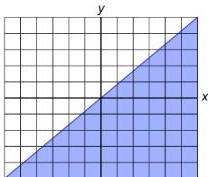
In the graph above, the shaded region represents . Because it is a strict inequality, the boundary line is dotted.
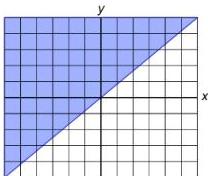
In this second graph, the shaded region shows . The boundary line is solid because the values on the line satisfy the inequality.
Rules for Simplifying Inequalities
To solve or simplify an inequality, follow these algebraic rules to ensure the inequality sign remains correct:
- Addition and Subtraction: Adding or subtracting any real number from both sides leaves the sign unchanged. If , then .
- Positive Multiplication and Division: Multiplying or dividing by a positive real number leaves the sign unchanged. If , then .
- Inversion: If and are both positive or both negative, inverting both sides changes the direction of the sign. If , then .
- Negative Multiplication and Division: Multiplying or dividing by a negative real number changes the direction of the inequality sign. If , then .
Combining Inequalities
Combined inequalities take the form or . Both signs must point in the same direction. For instance, is mathematically incorrect as a combined statement.
- and can be written as .
- and simplify to the single range .
- and do not define a single continuous range and cannot be combined into one statement.
- The statement is invalid because it implies , which is false.
Worked Examples: One Variable
Simple Linear Inequality
Solve and show the result on a number line.
- Add 4 to both sides:
- Divide by 3:
The number line would feature an unfilled circle at 4 with an arrow pointing to the right.
Two Sided Linear Inequality
Solve and show the result on a number line.
- Add 4 to all three sections:
- Divide all three sections by 3:
This is represented by an unfilled circle at 4 and a filled circle at 8, with a line connecting them.
Finding a Range from Two Inequalities
Find the range for which both and are valid.
- Solve the first:
- Solve the second:
- Combine the results:

Complicated Inequalities
Solve . (Note: Following the guide's step-by-step logic for the similar expression ):
- Multiply out the bracket:
- Subtract from both sides:
- Add 5 to both sides:
- Multiply by -1 and reverse the sign:
- Divide by 3:
Worked Examples: Two Variables
Graphing a Single Inequality
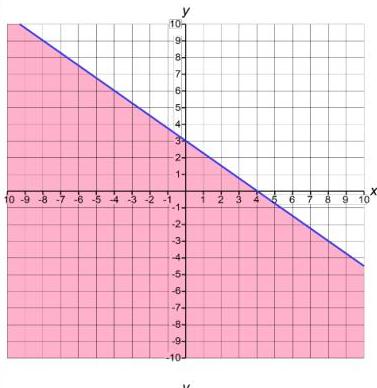
Shade the region for .
- Draw the boundary line as a solid line.
- Test a point. At , , which is less than 12. Therefore, the region containing the origin is the correct one.
Simultaneous Inequalities Graphically
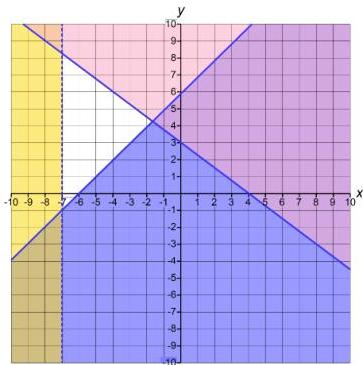
Draw the region where , , and are all satisfied.
To find the solution, it is often easier to shade out the unwanted regions:
- For , shade the region above the solid line.
- For , shade the region below the solid line.
- For , shade the region to the left of the broken line.
The unshaded area remaining is the required solution.
Key takeaways
- Multiplying or dividing an inequality by a negative number requires reversing the direction of the inequality sign.
- A solid line or circle indicates the boundary value is included (), while a dotted line or open circle indicates it is excluded ().
- To identify the correct side of an inequality on a graph, test a simple coordinate such as in the original inequality.
- When combining two separate inequalities into one statement, ensure the resulting range is continuous and logically consistent.
In the ESAT, time is limited. If you are asked to identify a region from a list of inequalities, quickly check the intercepts of the boundary lines and test the origin to eliminate incorrect regions immediately.
The most common error is forgetting to flip the inequality sign when dividing by a negative coefficient. Always double check this step specifically during your calculation.
Solving systems of linear inequalities is the foundational step for Linear Programming, a field of mathematics used to find the maximum or minimum values of functions subject to constraints, such as maximising profit in a business context.
Frequently asked questions
What happens to the inequality sign if I square both sides?
Squaring both sides is only safe if both sides are known to be non-negative. For example, if , then . However, if (e.g., ), squaring would change the relationship (16 is not less than 9). Avoid squaring unless you are certain of the signs.
Why do we use a dotted line for strict inequalities?
A dotted line represents a boundary that the values can approach but never actually reach. This mirrors the use of the open circle on a number line for and symbols.
How do I solve if appears in all three parts?
You can treat it as two separate inequalities: solve and independently. The final solution is the set of values that satisfies both results simultaneously.