Geometric Notation and Symmetries for ESAT Mathematics 1
Updated July 2026
Mastering geometry for the ESAT requires a precise understanding of fundamental terms, notation, and symmetry. This guide covers everything from basic points and lines to the specific properties of regular polygons and their rotational and reflectional symmetries, providing the terminology essential for interpreting and solving complex exam problems.
Geometry involves the study of positions, lines, and shapes in planes or space, defined by precise properties such as parallelism, perpendicularity, and symmetry. A thorough grasp of these conventional terms ensures accuracy when describing geometric relationships and transformations.
Fundamental Geometric Terms
Geometry begins with the most basic building blocks of space: points, lines, and line segments. A point represents a singular position in space. This position can be described by its coordinates on a grid or identified as the intersection point where two lines meet. A line is a one-dimensional figure that extends infinitely in both directions. In contrast, a line segment is only a finite portion of a line, bounded by two distinct endpoints.
Vertices, Edges, and Planes
When these basic elements form shapes, we use specific terms to describe their features. An edge is the side of a polygon or a polyhedron. A vertex (plural: vertices) is essentially a corner. For flat shapes, a vertex is the point where two edges meet. However, the term also applies to three-dimensional figures: for objects like cones or pyramids, all corners, including the point at the very top, are called vertices.
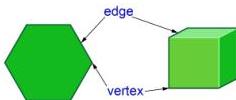
A plane is defined as a flat surface that extends infinitely in two dimensions. In many geometric problems, we operate within a single flat plane.
Relationships Between Lines
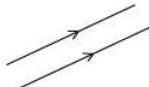
Lines can relate to one another in specific ways. Parallel lines are lines that remain the same perpendicular distance apart at all times and never intersect. On diagrams, parallel lines are typically indicated by arrowheads.
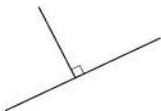
Perpendicular lines are lines that intersect at right angles to one another. A right angle is exactly . When two lines are perpendicular, the angle at their intersection is generally marked with a small square.
Subtended Angles and Polygons
An angle subtended by an arc or a line segment is formed when two rays originate from the endpoints of that arc or segment and meet at a single point.
A polygon is a closed shape on a plane with three or more straight sides. A regular polygon is a specific type of polygon where every side is of equal length and every internal angle is equal.
Symmetries of Polygons
Polygons are often characterised by their symmetry, which includes reflection and rotational components.
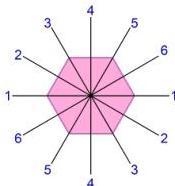
Reflection Symmetry: If you fold a two-dimensional shape along a line of reflection symmetry, one side of the shape will fold exactly onto the other side. Similarly, if a mirror were placed along this line, one side would be an exact reflection of the other. For instance, a regular hexagon possesses 6 distinct lines of symmetry.
Rotational Symmetry: If you draw around the outline of a shape and rotate it about its centre, the order of rotational symmetry is the number of times the shape fits exactly into its outline during a full rotation.
Consider a hexagon rotated about its centre . It will fit back onto its outline 6 times: specifically when a reference mark (such as a red dot) is at vertices and .
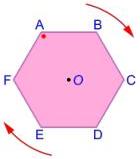
This hexagon has 6 lines of symmetry and an order of rotational symmetry of 6. While regular polygons generally have the same number of lines of symmetry as their order of rotational symmetry, this is not a universal rule for all shapes.
Worked Example: Symmetries of a Regular Octagon
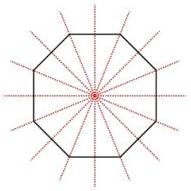
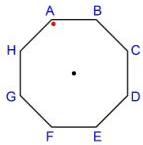
Question: Describe the symmetries of a regular octagon.
Solution: A regular octagon has eight equal sides and eight equal angles. By applying the principles of symmetry:
- There are 8 lines of reflection symmetry. These lines pass through opposite vertices or the midpoints of opposite sides.
- The order of rotational symmetry is 8. If the octagon is rotated about its centre, it will fit its outline 8 times (once every turn).
Key takeaways
- A vertex is any corner of a shape, including the apex of a cone or pyramid.
- Parallel lines maintain a constant perpendicular distance, while perpendicular lines meet at a angle.
- Regular polygons have equal side lengths and equal internal angles.
- The order of rotational symmetry is the number of times a shape fits its original outline during a full rotation.
- A regular polygon with sides typically has lines of symmetry and an order of rotational symmetry of .
When identifying the number of lines of symmetry in a regular polygon, remember that for an -sided polygon, the lines pass through opposite vertices (if is even) or through a vertex and the midpoint of the opposite side (if is odd).
Do not assume that all shapes have the same number of lines of symmetry as their order of rotational symmetry. While this is true for regular polygons, a parallelogram has an order of rotational symmetry of 2 but has zero lines of reflection symmetry.
Symmetry properties can be used to simplify complex geometry problems. For example, if a shape has reflection symmetry, the area or perimeter calculations for one half can often be doubled to find the total, or coordinates of vertices can be found by reflecting known points across the line of symmetry.
Frequently asked questions
What is the difference between a line and a line segment?
A line is an infinitely long one-dimensional figure, whereas a line segment is a finite portion of a line bounded by two endpoints.
Do all polygons with equal sides count as regular polygons?
No. A regular polygon must have both all sides equal and all angles equal. For example, a rhombus has all sides equal but is not regular unless its angles are also all (making it a square).
Does a point have dimensions?
No, a point is defined as a singular position with zero dimensions. A line is one-dimensional, and a plane is two-dimensional.
How is an angle subtended by a line segment defined?
It is the angle whose two rays pass through the two endpoints of the line segment and meet at a specific vertex or point.