Geometry and Angle Properties for the ESAT
Updated July 2026
This guide covers the fundamental geometric principles required for ESAT Mathematics 1, including angle relationships on lines, at vertices, and within parallel systems. You will learn to calculate interior and exterior angles of various polygons, ranging from triangles to dodecagons, using established formulas and deductive reasoning.
Geometric proofs and calculations rely on the fact that angles at a point sum to , angles on a straight line sum to , and the interior angles of an -sided polygon sum to .
Properties of angles around a point, lines and vertices
To solve complex geometry problems, you must first master the basic properties of angles at intersections and on lines. These foundational rules allow you to determine unknown values by creating equations based on known sums.
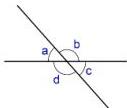
- The sum of all angles around a single point is ().
- The sum of angles that lie on one side of a straight line is (, , etc.).
- Perpendicular lines intersect at a right angle, which is exactly .
- Vertically opposite angles, formed at the vertex where two straight lines cross, are equal ( and ).
Angle properties of parallel lines
When a transversal line crosses a pair of parallel lines, specific angle relationships are established that are constant regardless of the angle of the transversal.
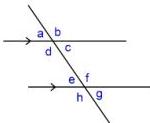
If a line crosses parallel lines:
- Alternate angles are equal ( and ). These are often found in Z shaped configurations.
- Corresponding angles are equal (, , , and ). These are found in F shaped configurations.
- Allied or co-interior angles are supplementary, meaning they add up to ( and ). These are found in C shaped configurations.
Angle properties of triangles and quadrilaterals
Triangles and quadrilaterals follow strict internal sum rules that form the basis for polygon geometry.
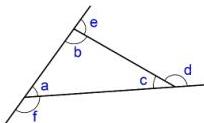
The sum of the interior angles of any triangle is (). Furthermore, the exterior angle of a triangle is equal to the sum of the two interior opposite angles (, , and ).
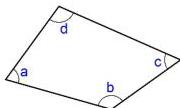
The sum of the interior angles of any quadrilateral is ().
Interior and exterior angle sum of polygons
For any polygon with sides, the total sum of the interior angles in degrees is calculated using the formula . This is because any -sided polygon can be split into triangles.
The sum of the exterior angles of any polygon, regardless of the number of sides, is always .
Worked Examples: Basic Properties
Finding unknown angles at a point
Find the value of in the following diagram.
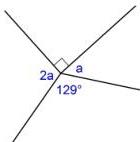
Since the sum of angles at a point is , we set up the equation:
Finding unknown angles on a straight line
Find the value of in the diagram below.
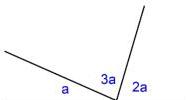
The sum of angles on a straight line is :
Finding vertically opposite angles
Find the value of using the diagram of three straight lines.
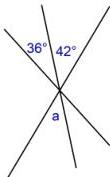
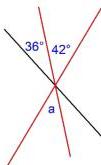
As shown by the red highlighted lines, and are vertically opposite angles. Therefore, .
Worked Examples: Parallel Lines
Alternate angles
Find the value of .
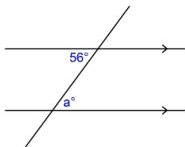
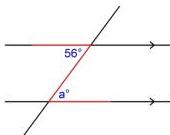
Angle is alternate to the angle, as they are contained within the Z shape formed by the transversal crossing parallel lines. Thus, .
Co-interior or allied angles
Find the size of angle .
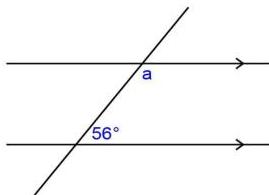
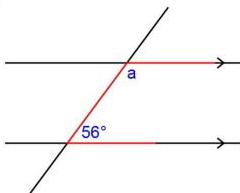
Angle and are co-interior (allied) angles, forming a C shape. They must sum to :
Finding multiple angles in parallel lines
Find , , , and .
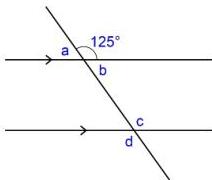
- (angles on a straight line). So .
- and are vertically opposite, so .
- is a corresponding angle to the given , so .
- is vertically opposite to , so .
Combining angle facts
Find angle .
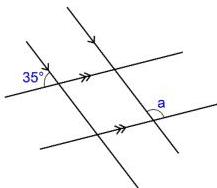
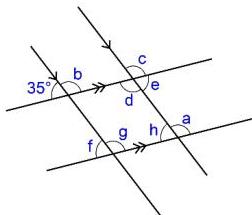
Method 1: Let be the angle on the straight line with (). Let be the corresponding angle to on the middle parallel line (). Finally, is corresponding to , so .
Method 2: Identify corresponding angles relative to the angle. Let and . Angle sits on a straight line with , so .
Worked Examples: Polygons
Triangle and Quadrilateral calculations
Find angles and in the triangle diagram.
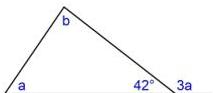
First, (straight line), so and . To find , we can use the exterior angle property: , which means . Alternatively, using the sum of triangle angles: , so .
What is the size of angle in the quadrilateral?
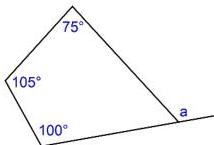
The interior sum is . The missing interior angle is . Since and are on a straight line, .
Complex Polygon sums
Example 1: Three angles of a pentagon are , , and . The other two are equal. Find the size of the two equal angles.
A pentagon has 5 sides. Sum . Subtracting known angles: . Dividing by 2 gives per angle.
Example 2: Find the interior angle of a regular dodecagon (12 sides).
Method 1: Exterior angle sum is . Each exterior angle . The interior angle is . Method 2: Interior sum . Each interior angle .
Example 3: Exterior angles of a pentagon are , , , , and . Find .
The sum of exterior angles is : . Thus .
Key takeaways
- Angles on a straight line always sum to and angles at a point sum to .
- Alternate angles (Z shape) and corresponding angles (F shape) are equal in parallel line systems.
- The sum of interior angles for any -sided polygon is given by the formula .
- The sum of the exterior angles of any polygon is always , regardless of the number of sides.
When dealing with parallel lines, always look for the Z, F, and C shapes to quickly identify angle relationships. If you are stuck on a polygon problem, try dividing the shape into triangles from a single vertex to verify the interior angle sum.
A common mistake is confusing the exterior angle with the reflex interior angle. An exterior angle is formed by extending one of the sides of the polygon, not by measuring the angle outside the shape from one side to the next.
The sum of exterior angles being is a powerful tool because it does not depend on the number of sides . This often provides a faster route to finding interior angles in regular polygons than the interior sum formula.
Frequently asked questions
What is the difference between alternate and corresponding angles?
Alternate angles are found on opposite sides of a transversal between two parallel lines (forming a Z shape) and are equal. Corresponding angles are in the same relative position at each intersection where a straight line crosses parallel lines (forming an F shape) and are also equal.
How do you calculate the interior angle of a regular polygon?
You can find the total sum using and divide by the number of sides . Alternatively, calculate the exterior angle first () and subtract this from .
Are co-interior angles equal?
No, co-interior (or allied) angles are generally not equal unless they are both . Instead, they are supplementary, meaning they add up to .
What is the exterior angle theorem for triangles?
The exterior angle theorem states that the measure of an exterior angle of a triangle is equal to the sum of the measures of its two remote (opposite) interior angles.