Ratio and Proportion for ESAT Mathematics 1
Updated July 2026
Master the principles of direct and inverse proportion, including algebraic models and graphical interpretations. This topic is essential for ESAT candidates as it forms the basis for modelling physical relationships and solving problems involving square or fractional powers. You will learn to calculate constants of proportionality to solve multi-step problems.
Two variables are in direct proportion if their ratio remains constant (), while they are in inverse proportion if their product remains constant (), where is the constant of proportionality.
Understanding proportion is fundamental to modelling how one quantity changes in relation to another. The symbol used to denote proportionality is .
Direct Proportion
Direct proportion occurs when two variables increase or decrease at the same rate. For example, if one chocolate bar costs £6, then 6 bars cost £36 and bars cost £6. In this scenario, there is no bulk-buy discount, so the price per bar remains constant. The number of chocolate bars and the total price are in direct proportion: as one increases, the other increases by a proportional amount.
If we let represent the total cost and the number of bars, we write this relationship as . This can be expressed as the equation . In general, if is directly proportional to , we write or , where is a constant. You can use any letter to represent this constant, provided it is not already used for a variable in the problem.
Graphs Illustrating Direct Proportion
When you plot a graph of against for variables in direct proportion, the resulting graph is always a straight line that passes through the origin . If a line is straight but does not pass through the origin, the variables are not in direct proportion.
Inverse Proportion
In an inverse proportion relationship, as one variable increases, the other decreases. For instance, consider the thickness of ice, , on a pond relative to the air temperature, . As the temperature decreases, the ice gets thicker. We say is inversely proportional to , which is written as .
Algebraically, this is expressed as , where is a constant. It is important to understand that saying is inversely proportional to is mathematically equivalent to saying is proportional to .
Graphs Showing Inverse Proportion
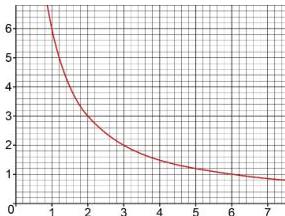
If you plot on the vertical axis against on the horizontal axis where and are inversely proportional, the graph takes the form of a reciprocal curve, as shown below:
Proportion Involving Integer and Fractional Indices
Proportionality is not limited to linear relationships. If , then the equation is . The index can be any integer or fractional value. For example, might be proportional to the square of () or the square root of ().
Worked Example: Direct Proportion
On days when the outside temperature is above , the number of ice creams sold in a shop, , is proportional to , where is the temperature. When the temperature is , the shop sells 30 ice creams. How many will be sold when the temperature is ?
- Set up the equation: , so .
- Find : Substitute and into the equation. , which simplifies to , so .
- Solve for the new value: Substitute and into the equation. . The shop will sell 78 ice creams.
Verifying Direct Proportion from a Graph
Consider the following graph of and :
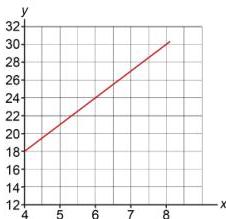
To determine if is directly proportional to , we can use two methods:
Method 1: Check the origin. A direct proportion graph must be a straight line through the origin. While this graph is a straight line, it does not pass through , so is not directly proportional to .
Method 2: Check the constant . If , then , meaning must be constant for all points. From the graph, when , , giving . However, when , , giving . Since the values of differ, it is not direct proportion.
Worked Example: Inverse Proportion
The number of pairs of gloves sold in a store, , is inversely proportional to the outside temperature for temperatures between 1 and 10. When , . How many are sold when ?
- Set up the equation: .
- Find : Substitute and . , so .
- Solve for the new value: When , . Therefore, 25 pairs of gloves are sold.
Verifying Inverse Proportion from a Graph
Look at the following graph and determine if could be inversely proportional to :
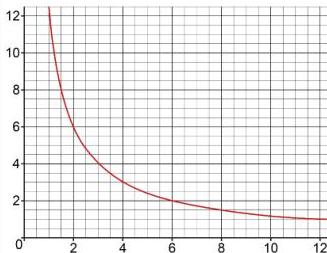
If is inversely proportional to , then , or . We test multiple points from the line to see if remains constant:
- When , , so .
- When , , so .
- When , , so .
- When , , so .
- When , , so .
- When , , so .
Since is consistently 12 for these points, it is reasonable to assume is inversely proportional to .
Worked Example: Proportion with Indices
The number of water bottles sold, , is proportional to the square of the average daily temperature, , for temperatures between 10 and 30. When , . Find when .
- Set up the equation: , so .
- Find : Substitute and . . This gives .
- Solve for the new value: When , . The shop sells 288 bottles.
Key takeaways
- Direct proportion is represented by and always produces a straight line through the origin.
- Inverse proportion is represented by , which is equivalent to saying is proportional to .
- To solve any proportion problem, always find the constant of proportionality using given coordinates first.
- Proportionality can involve powers or roots, such as or , depending on the problem description.
- In a graph of inverse proportion, the product of the coordinates will be constant for every point on the curve.
In the ESAT, always write down the general formula or before doing any calculations. This ensures you do not forget to apply powers or roots to the variables when substituting numbers.
A common error is assuming a downward-sloping straight line represents inverse proportion. Inverse proportion always forms a curve (a hyperbola) that never touches the or axes.
Proportionality is a subset of power laws. Direct proportion is a power law where the exponent is 1 (), while inverse proportion is a power law where the exponent is -1 ().
Frequently asked questions
What is the difference between a linear relationship and direct proportion?
All direct proportion relationships are linear (), but not all linear relationships are direct proportion. A linear relationship only represents direct proportion if the y-intercept is zero.
Can the constant of proportionality be a fraction or a decimal?
Yes, can be any constant value. In the water bottle example, was . It is determined entirely by the initial data points provided in the question.
How do I know if a question requires a power, like or ?
The question will specifically state the relationship, for example, 'proportional to the square of ' (), 'proportional to the cube of ' (), or 'inversely proportional to the square root of ' ().
If is inversely proportional to , what happens to if doubles?
Since , if is replaced by , the new value of becomes , which is half of the original value.